“Fulfillment was already there”: Debord & ’68 | Situationist International

Andy Merrifield discusses the influence of Guy Debord and the Situationist International on the events of May ’68.

On the brink of working class and student insurgency came Guy Debord’s The Society of the Spectacle (1967), the radical book of the 1960s, perhaps the most radical radical book ever written. Its 221 strange theses give us stirring crescendos of literary power, compelling evocations of an epoch in which unity spelt division, essence appearance, truth falsity. A topsy-turvy world where everything and everybody partook in a perverse paradox. Debord mocked the reality of this non-reality, an absurd world in which ugliness signified beauty, stupidity intelligence, subjecting it to his own dialectical inversion, his own spirit of negation. This was theory that identified enemy minefields and plotted a Northwest Passage, getting daubed on the walls of Paris and other cities during May 1968: “POWER TO THE WORKERS’ COUNCILS,” “DOWN WITH THE SPECTACULAR COMMODITY ECONOMY,” “THE END OF THE UNIVERSITY.”

Its refrains were all over the modern high-rise environment at the University of Paris-Nanterre, a classic scene of urban isolation and separation, a “suburban Vietnam,” where a peripheral new town university coexisted with working-class slums and Arab and Portuguese shantytowns. The place was sterile, sexually and socially repressive, and totalitarian. This was the spirit of a society without any spirit. The same centralisation, hierarchy, and bureaucratic obsession persisting in the educational sector persisted in other aspects of the French state. Tough rules governed student dorms and freedom of movement; classes were overcrowded, resources stretched; professors were distant, student alienation rife. The right-wing Gaullist regime attempted to modernise the economy, in line with Common Market membership, and unemployment was growing.

At the University of Strasbourg, two years prior, a handful of Situationists had intervened; angry students of Henri Lefebvre and friends of Debord. They’d riled and denounce, tried to revolutionise students with an influential pamphlet called “On the Poverty of Student Life—Considered in its Economic, Political, Psychological, Sexual and especially Intellectual Aspects, with a Modest Proposal for its Remedy.” They’d infiltrated the National Union of French Students (UNEF), accused students at Strasbourg of pandering to a society dominated by the commodity and the spectacle. Student poverty was a poverty of ideas, a poverty of guts. Students were really “submissive children,” labour-power in the making, without class consciousness. They accepted the business and institutional roles for which the “university-factory” prepared them, never questioning the system of production that alienated all activity, products, people, and ideas. The Situationist’s text struck a chord; translated reprints extended its audience, notably to the U.S., Britain and Italy. In Strasbourg, the document caused a scandal; a coterie of students refused to be integrated. Critical awareness gathered steam over the next year and a bit, until, in late March of 1968, it blew a gasket at Nanterre.

On Friday, March 22nd, assorted Situationists, young communists, Trotskyists, anarchists, and Maoists invaded the university’s administration building, and began occupying it. The week before, the “Committee of the Enragés and the Situationist International” had been established. Its members put up posters and scribbled slogans on the walls of Nanterre and the Sorbonne in the Latin Quarter: “TAKE YOUR DESIRES FOR REALITY,” “NEVER WORK,” “BOREDOM IS COUNTER-REVOLUTIONARY,” “TRADE UNIONS ARE BROTHELS,” “PROFESSORS, YOU MAKE US GROW OLD,” “IF YOU RUN INTO A COP, SMASH HIS FACE IN.” In early May, “the March 22 Movement” met with UNEF at the Sorbonne. The authorities tried to break up the meeting; instead they only unleashed its latent power. The gendarmerie mobile poured into the Sorbonne’s courtyard and encircled its buildings. Several thousand students fought back, inside and outside, ripping up paving stones on the street. Skirmishes broke out elsewhere, spreading both sides of the Seine, flaring up at Châtelet and Les Halles. On May 6 and 7 a huge student demonstration took over the Boulevard Saint Michel and thoroughfares near rue Gay-Lussac; protesters overturned cars, set them ablaze, dispatched Molotov cocktails, and manned the barricades.

On May 13 there was a one-day general strike. With the French Communist Party (PCF) and general worker’s union (CGT) joining the action, “student-worker” solidarity suddenly looked possible. Situationists and students took over the Sorbonne. On one revered fresco they emblazoned the caption: “HUMANITY WILL ONLY BE HAPPY THE DAY THE LAST BUREAUCRAT IS HUNG BY THE GUTS OF THE LAST CAPITALIST.” Exams had been cancelled at the barricades; sociologists and psychologists became the new cops. Next day, in Nantes, workers at the Sud-Aviation plant occupied their factory and locked out the bosses. Meanwhile, Renault workers at Cléon in Seine-Maritime followed suit. Then the Nouvelles Messageries de la Presse Parisienne launched a wildcat action, halting newspaper distribution. Workers’ councils linked up with students’ councils, becoming comrades in arms. The working class, at last, declared its unequivocal support for the student movement when rank and filers at Renault-Billancourt took over France’s largest factory.

By May 20 strikes and occupations became contagious. Nationwide, around 10 million workers downed tools and froze assembly lines. France seemed on the precipice of revolution; a festival of people was glimpsed. Alienation was cast off, momentarily; freedom was real; capitalised time abandoned. Without trains, cars, Metro and work, leisure time was reclaimed, time lived. Students and workers seized the contingent situation, acted spontaneously, created new situations, realising something what no trade union or party could ever do, or wanted to do. And yet, as quickly as things erupted, they were almost as speedily repressed, by state and bourgeoisie, soon backed by the Communists and the CGT. The optimistic promise, the beach beneath the paving stones, had dissipated, for now. The music was over. There was no other side to break on through to.

The occupation of Paris was, and still is, seen throughout the world as an event of historical significance. Solidarity between workers and students had for a moment expressed itself; so too direct action militancy and student internationalism. From the LSE to Berkeley, from Columbia to Nantes, from the Sorbonne to Barcelona, dissatisfaction had spread like wildfire. At the same time, The Society of the Spectacle’s demands, as Debord would write (with Gianfranco Sanguinetti) in The Veritable Split in the Situationist International (1972), “were plastered in the factories of Milan as in the University of Coimra. Its principal theses, from California to Calabria, from Scotland to Spain, from Belfast to Leningrad, infiltrate clandestinely or are proclaimed in open struggles…The Situationist International imposed itself in a moment of universal history as the thought of the collapse of a world; a collapse which has now begun before our eyes.”

In old photos of the student occupations of the Sorbonne, Debord is visible in the thick of the action, lurking with intent. He was no student himself, nor was he particularly “youthful”: in May 1968, Debord, the freelance revolutionary, was thirty-six, older than a lot of junior professors, and almost twice the age of many student leaders (like Daniel Cohn-Bendit). He must have seemed like an old guy to many kids, somebody’s dad drinking in the student bar. Already his appearance had started to deteriorate. Surrounded by a large crowd of student activists, we can see him standing side on, without glasses, wearing a white jacket. His face is a lot puffier than a decade earlier; a boozer’s physiognomy was rapidly becoming apparent. By comparison with other ’68ers, who were mere political toddlers, he was a veteran provocateur.

Debord and other Situationists were genius agitators and organisers, and their presence was felt, practically and theoretically. The spirit of The Society of the Spectacle was there, even if some kids had never read nor fully understood it. On the other hand, Debord was frequently the most sectarian, invariably falling out with allies—especially falling out with allies, being most ruthless with old friends and former comrades. “Guy was a very tenacious person,” Jean-Michel Mension, a past oustee, remembered in his Situationist memoir The Tribe. “He was already very hard—very strict in the way he conceived of existence with this person or that.” There “were certainly jokers who became part of Guy’s group merely because they were friends of so and so, people who had no business there and who lasted only six months or a year before Guy found them really idiotic and kicked them out.”

Debord likewise dissed former pal Henri Lefebvre, the Nanterre Marxist professor, denouncing him as an “agent of recuperation.” He said the sexagenarian philosopher had stolen certain Situationist ideas. Debord reckoned Lefebvre’s take on the 1871 Paris Commune was almost entirely lifted from SI’s pamphlet, “Theses on the Commune” (1962). “This was a delicate subject,” Lefebvre recalled in a 1987 interview. “I was close to the Situationists…And then we had a quarrel that got worse and worse in conditions I don’t understand too well myself…I had this idea about the Commune as a festival, and I threw it into debate, after consulting an unpublished document about the Commune that is at the Feltrinelli Institute in Milan.”

Both Lefebvre and Debord believed the Commune some sort of historical antecedent of 1968. For seventy-three days, between March and May of 1871, when Prussian forces at war with France surrounded Paris, the city had become a liberated zone of people power. The barricades went up, even across Haussmann’s mighty boulevards, amid the carnivals and pranks. Freely elected workers, artists, and small business owners were suddenly at the helm. Their rally cries were territorial and urban; their practice was festive and spontaneous. The Communards, until the National Guard massacred 20,000 of them, launched a revolt in culture and everyday life, demanded freedom and self-determination, crushed Louis Napoleon’s authority as he’d once crushed their freedom, occupied the streets, shouted and sang for their “right to the city.”

For the first time, it looked like a working-class revolution wasn’t merely possible, but imminent. In “Theses on the Commune,” Debord said the Situationists believed that the “Commune was the biggest festival of the nineteenth-century” (Thesis #2). “Underlying the events of that spring of 1871,” he went on, “one can see the insurgents’ feeling that they had become the masters of their own history, not so much on the level of ‘governmental’ politics as on the level of their everyday life.” “The Commune,” Thesis #7 said, “represents the only realisation of a revolutionary urbanism to date.” It “succumbed less to the force of arms,” the next thesis explained, “than to the force of habit.” “Theoreticians who examine the history of this movement,” continued #11, importantly, “can easily prove that the Commune was objectively doomed to failure and could not have been fulfilled. They forget that for those who really lived it, the fulfillment was already there” (emphasis in original). “The audacity and inventiveness of the Commune,” #12 stated, “must obviously be measured not in relation to our time, but in terms of the prevailing political, intellectual and moral attitudes of its own time, in terms of the interdependence of all the prevailing banalities that it blasted to pieces.” “The social war of which the Commune was one moment,” declared the penultimate #13, “is still being fought today. In the task of ‘making conscious the unconscious tendencies of the Commune’ (Frederick Engels), the last word is still to be said.”

In the wake of May ’68, Debord released a film version of The Society of the Spectacle, dedicating it to wife Alice Becker-Ho, whose beautiful image, clad in flat cap, leaning on a wall with a cigarette drooping nonchalantly from her mouth, fills one frame. It evokes an Alice-cum-Brando’s Wild One pose: “Alice, whattya rebelling against?” “Whaddya got?” The film’s dialogue closely follows Debord’s original text, but the rapid-fire captions, disarming classical music, and exaggerated footage make it visually stunning. There are battle scenes and moody vistas of Paris, spliced between images of Lenin, Stalin, Mao and Castro, all giving speeches; Debord plainly disapproves. There are news clips from the ’68 Renault strike, with workers locked inside the factory by the unions; scenes from the Bourse alive with frenzied traders, participating in money mayhem; there’s a vision of the Tower of Babel amid pitched battles from Vietnam and Watts (Los Angeles), circa 1965; Paris’s streets are ablaze, and students can be seen fighting cops; there are burning barricades at night, the storming of the Winter Palace in 1917, street altercations in Italy in the 1960s, Italian police leaping from jeeps, truncheoning a crowd of young people; West German security forces patrol another street, while Soviet tanks push back German workers in Berlin in June 1953.

The Society of the Spectacle, the movie, sealed a magical era for Debord. “Whoever considers the life of the Situationists,” he contended a few years later, “finds there the history of the revolution. Nothing has been able to sour it.” It was how it’d been for the Communards, who really lived it, whose fulfillment was already there. Fulfillment was already there for Debord, too: he really did live it in ’68, and now the music was over. Nothing could sour it. Yet as the dust settled from 1968, emptiness prevailed in the ruins. Many soixante-huitards suddenly found themselves stuck between the rock and the hard place, between a degenerative past and an impossible future. For a moment, the dream of spontaneous freedom became real, in wide-awake time. An instant later, it disappeared in a puff of smoke.

Source: Verso

The Hippies // By Hunter S. Thompson 

The Hippies – By Hunter S. Thompson

The best year to be a hippie was 1965, but then there was not much to write about, because not much was happening in public and most of what was happening in private was illegal. The real year of the hippie was 1966, despite the lack of publicity, which in 1967 gave way to a nationwide avalanche in Look, Life, Time, Newsweek, the Atlantic, the New York Times, the Saturday Evening Post, and even the Aspen Illustrated News, which did a special issue on hippies in August of 1967 and made a record sale of all but 6 copies of a 3,500-copy press run. But 1967 was not really a good year to be a hippie. It was a good year for salesmen and exhibitionists who called themselves hippies and gave colorful interviews for the benefit of the mass media, but serious hippies, with nothing to sell, found that they had little to gain and a lot to lose by becoming public figures. Many were harassed and arrested for no other reason than their sudden identification with a so-called cult of sex and drugs. The publicity rumble, which seemed like a joke at first, turned into a menacing landslide. So quite a few people who might have been called the original hippies in 1965 had dropped out of sight by the time hippies became a national fad in 1967.

Ten years earlier the Beat Generation went the same confusing route. From 1955 to about 1959 there were thousands of young people involved in a thriving bohemian subculture that was only an echo by the time the mass media picked it up in 1960. Jack Kerouac was the novelist of the Beat Generation in the same way that Ernest Hemingway was the novelist of the Lost Generation, and Kerouac’s classic “beat” novel, On the Road, was published in 1957. Yet by the time Kerouac began appearing on television shows to explain the “thrust” of his book, the characters it was based on had already drifted off into limbo, to await their reincarnation as hippies some five years later. (The purest example of this was Neal Cassidy [Cassady], who served as a model for Dean Moriarity in On the Road and also for McMurphy in Ken Kesey’s One Flew Over the Cuckoo’s Nest.) Publicity follows reality, but only up to the point where a new kind of reality, created by publicity, begins to emerge. So the hippie in 1967 was put in the strange position of being an anti-culture hero at the same time as he was also becoming a hot commercial property. His banner of alienation appeared to be planted in quicksand. The very society he was trying to drop out of began idealizing him. He was famous in a hazy kind of way that was not quite infamy but still colorfully ambivalent and vaguely disturbing.

Despite the mass media publicity, hippies still suffer or perhaps not from a lack of definition. The Random House Dictionary of the English Language was a best seller in 1966, the year of its publication, but it had no definition for “hippie.” The closest it came was a definition of “hippy”: “having big hips; a hippy girl.” Its definition of “hip” was closer to contemporary usage. “Hip” is a slang word, said Random House, meaning “familiar with the latest ideas, styles, developments, etc.; informed, sophisticated, knowledgeable [?].” That question mark is a sneaky but meaningful piece of editorial comment.

Everyone seems to agree that hippies have some kind of widespread appeal, but nobody can say exactly what they stand for. Not even the hippies seem to know, although some can be very articulate when it comes to details.

“I love the whole world,” said a 23-year-old girl in San Francisco’s Haight-Ashbury district, the hippies’ world capital. “I am the divine mother, part of Buddha, part of God, part of everything.

“I live from meal to meal. I have no money, no possessions. Money is beautiful only when it’s flowing; when it piles up, it’s a hang-up. We take care of each other. There’s always something to buy beans and rice for the group, and someone always sees that I get ‘grass’ [marijuana] or ‘acid’ [LSD]. I was in a mental hospital once because I tried to conform and play the game. But now I’m free and happy.” She was then asked whether she used drugs often. “Fairly,” she replied. “When I find myself becoming confused I drop out and take a dose of acid. It’s a short cut to reality; it throws you right into it. Everyone should take it, even children. Why shouldn’t they be enlightened early, instead of waiting till they’re old? Human beings need total freedom. That’s where God is at. We need to shed hypocrisy, dishonesty, and phoniness and go back to the purity of our childhood values.”

The next question was “Do you ever pray?” “Oh yes,” she said. “I pray in the morning sun. It nourishes me with its energy so I can spread my love and beauty and nourish others. I never pray for anything; I don’t need anything. Whatever turns me on is a sacrament: LSD, sex, my bells, my colors…. That’s the holy communion, you dig?” That’s about the most definitive comment anybody’s ever going to get from a practicing hippie. Unlike beatniks, many of whom were writing poems and novels with the idea of becoming second-wave Kerouacs or Allen Ginsbergs, the hippie opinion makers have cultivated among their followers a strong distrust of the written word. Journalists are mocked, and writers are called “type freaks.” Because of this stylized ignorance, few hippies are really articulate. They prefer to communicate by dancing, or touching, or extrasensory perception (ESP). They talk, among themselves, about “love waves” and “vibrations” (“vibes”) that come from other people. That leaves a lot of room for subjective interpretation, and therein lies the key to the hippies’ widespread appeal.

This is not to say that hippies are universally loved. From coast to coast, the forces of law and order have confronted the hippies with extreme distaste. Here are some representative comments from a Denver, Colo., police lieutenant. Denver, he said, was becoming a refuge for “long-haired, vagrant, antisocial, psychopathic, dangerous drug users, who refer to themselves as a ‘hippie subculture a group which rebels against society and is bound together by the use and abuse of dangerous drugs and narcotics.” They range in age, he continued, from 13 to the early 20’s, and they pay for their minimal needs by “mooching, begging, and borrowing from each other, their friends, parents, and complete strangers…. It is not uncommon to find as many as 20 hippies living together in one small apartment, in communal fashion, with their garbage and trash piled halfway to the ceiling in some cases.”

One of his co-workers, a Denver detective, explained that hippies are easy prey for arrests, since “it is easy to search and locate their drugs and marijuana because they don’t have any furniture to speak of, except for mattresses lying on the floor. They don’t believe in any form of productivity,” he said, “and in addition to a distaste for work, money, and material wealth, hippies believe in free love, legalized use of marijuana, burning draft cards, mutual love and help, a peaceful planet, and love for love’s sake. They object to war and believe that everything and everybody except the police are beautiful.”

Many so-called hippies shout “love” as a cynical password and use it as a smokescreen to obscure their own greed, hypocrisy, or mental deformities. Many hippies sell drugs, and although the vast majority of such dealers sell only enough to cover their own living expenses, a few net upward of $20,000 a year. A kilogram (2.2 pounds) of marijuana, for instance, costs about $35 in Mexico. Once across the border it sells (as a kilo) for anywhere from $150 to $200. Broken down into 34 ounces, it sells for $15 to $25 an ounce, or $510 to $850 a kilo. The price varies from city to city, campus to campus, and coast to coast. “Grass” is generally cheaper in California than it is in the East. The profit margin becomes mind-boggling regardless of the geography when a $35 Mexican kilogram is broken down into individual “joints,” or marijuana cigarettes, which sell on urban street corners for about a dollar each. The risk naturally increases with the profit potential. It’s one thing to pay for a trip to Mexico by bringing back three kilos and selling two in a circle of friends: The only risk there is the possibility of being searched and seized at the border. But a man who gets arrested for selling hundreds of “joints” to high school students on a St. Louis street corner can expect the worst when his case comes to court.

The British historian Arnold Toynbee, at the age of 78, toured San Francisco’s Haight-Ashbury district and wrote his impressions for the London Observer. “The leaders of the Establishment,” he said, “will be making the mistake of their lives if they discount and ignore the revolt of the hippies and many of the hippies’ non hippie contemporaries on the grounds that these are either disgraceful wastrels or traitors, or else just silly kids who are sowing their wild oats.”

Toynbee never really endorsed the hippies; he explained his affinity in the longer focus of history. If the human race is to survive, he said, the ethical, moral, and social habits of the world must change: The emphasis must switch from nationalism to mankind. And Toynbee saw in the hippies a hopeful resurgence of the basic humanitarian values that were beginning to seem to him and other long-range thinkers like a tragically lost cause in the war-poisoned atmosphere of the 1960’s. He was not quite sure what the hippies really stood for, but since they were against the same things he was against (war, violence, and dehumanized profiteering), he was naturally on their side, and vice versa.

There is a definite continuity between the beatniks of the 1950’s and the hippies of the 1960’s. Many hippies deny this, but as an active participant in both scenes, I’m sure it’s true. I was living in Greenwich Village in New York City when the beatniks came to fame during 1957 and 1958. I moved to San Francisco in 1959 and then to the Big Sur coast for 1960 and 1961. Then after two years in South America and one in Colorado, I was back in San Francisco, living in the Haight-Ashbury district, during 1964, 1965, and 1966. None of these moves was intentional in terms of time or place; they just seemed to happen. When I moved into the Haight-Ashbury, for instance, I’d never even heard that name. But I’d just been evicted from another place on three days’ notice, and the first cheap apartment I found was on Parnassus Street, a few blocks above Haight.

At that time the bars on what is now called “the street” were predominantly Negro. Nobody had ever heard the word “hippie,” and all the live music was Charlie Parker-type jazz. Several miles away, down by the bay in the relatively posh and expensive Marina district, a new and completely unpublicized nightclub called the Matrix was featuring an equally unpublicized band called the Jefferson Airplane. At about the same time, hippie author Ken Kesey (One Flew Over the Cuckoo’s Nest, 1962, and Sometimes a Great Notion, 1964) was conducting experiments in light, sound, and drugs at his home at La Honda, in the wooded hills about 50 miles south of San Francisco. As the result of a network of circumstance, casual friendships, and connections in the drug underworld, Kesey’s band of Merry Pranksters was soon playing host to the Jefferson Airplane and then to the Grateful Dead, another wildly electric band that would later become known on both coasts along with the Airplane as the original heroes of the San Francisco acid-rock sound. During 1965, Kesey’s group staged several much-publicized Acid Tests, which featured music by the Grateful Dead and free Kool-Aid spiked with LSD. The same people showed up at the Matrix, the Acid Tests, and Kesey’s home in La Honda. They wore strange, colorful clothes and lived in a world of wild lights and loud music. These were the original hippies.

It was also in 1965 that I began writing a book on the Hell’s Angels, a notorious gang of motorcycle outlaws who had plagued California for years, and the same kind of weird coincidence that jelled the whole hippie phenomenon also made the Hell’s Angels part of the scene. I was having a beer with Kesey one afternoon in a San Francisco tavern when I mentioned that I was on my way out to the headquarters of the Frisco Angels to drop off a Brazilian drum record that one of them wanted to borrow. Kesey said he might as well go along, and when he met the Angels he invited them down to a weekend party in La Honda. The Angels went and thereby met a lot of people who were living in the Haight-Ashbury for the same reason I was (cheap rent for good apartments). People who lived two or three blocks from each other would never realize it until they met at some pre-hippie party. But suddenly everybody was living in the Haight-Ashbury, and this accidental unity took on a style of its own. All that it lacked was a label, and the San Francisco Chronicle quickly came up with one. These people were “hippies,” said the Chronicle, and, lo, the phenomenon was launched. The Airplane and the Grateful Dead began advertising their sparsely attended dances with psychedelic posters, which were given away at first and then sold for $1 each, until finally the poster advertisements became so popular that some of the originals were selling in the best San Francisco art galleries for more than $2,000. By this time both the Jefferson Airplane and the Grateful Dead had gold-plated record contracts, and one of the Airplane’s best numbers, “White Rabbit,” was among the best-selling singles in the nation.

By that time, too, the Haight-Ashbury had become such a noisy mecca for freaks, drug peddlers, and curiosity seekers that it was no longer a good place to live. Haight Street was so crowded that municipal buses had to be rerouted because of the traffic jams.

At the same time, the “Hashbury” was becoming a magnet for a whole generation of young dropouts, all those who had canceled their reservations on the great assembly line: the high-rolling, soul-bending competition for status and security in the ever-fattening yet ever-narrowing American economy of the late 1960’s. As the rewards of status grew richer, the competition grew stiffer. A failing grade in math on a high school report card carried far more serious implications than simply a reduced allowance: It could alter a boy’s chances of getting into college and, on the next level, of getting the “right job.” As the economy demanded higher and higher skills, it produced more and more technological dropouts. The main difference between hippies and other dropouts was that most hippies were white and voluntarily poor. Their backgrounds were largely middle class; many had gone to college for a while before opting out for the “natural life”à an easy, unpressured existence on the fringe of the money economy. Their parents, they said, were walking proof of the fallacy of the American notion that says “work and suffer now; live and relax later.”

The hippies reversed that ethic. “Enjoy life now,” they said, “and worry about the future tomorrow.” Most take the question of survival for granted, but in 1967, as their enclaves in New York and San Francisco filled up with penniless pilgrims, it became obvious that there was simply not enough food and lodging.

A partial solution emerged in the form of a group called the Diggers, sometimes referred to as the “worker-priests” of the hippie movement. The Diggers are young and aggressively pragmatic; they set up free lodging centers, free soup kitchens, and free clothing distribution centers. They comb hippie neighborhoods, soliciting donations of everything from money to stale bread and camping equipment. In the Hashbury, Diggers’ signs are posted in local stores, asking for donations of hammers, saws, shovels, shoes, and anything else that vagrant hippies might use to make themselves at least partially self-supporting. The Hashbury Diggers were able, for a while, to serve free meals, however meager, each afternoon in Golden Gate Park, but the demand soon swamped the supply. More and more hungry hippies showed up to eat, and the Diggers were forced to roam far afield to get food.

The concept of mass sharing goes along with the American Indian tribal motif that is basic to the whole hippie movement. The cult of tribalism is regarded by many as the key to survival. Poet Gary Snyder, one of the hippie gurus, or spiritual guides, sees a “back to the land” movement as the answer to the food and lodging problem. He urges hippies to move out of the cities, form tribes, purchase land, and live communally in remote areas. By early 1967 there were already a half dozen functioning hippie settlements in California, Nevada, Colorado, and upstate New York. They were primitive shack-towns, with communal kitchens, half-alive fruit and vegetable gardens, and spectacularly uncertain futures. Back in the cities the vast majority of hippies were still living from day to day. On Haight Street those without gainful employment could easily pick up a few dollars a day by panhandling. The influx of nervous voyeurs and curiosity seekers was a handy money-tree for the legion of psychedelic beggars. Regular visitors to the Hashbury found it convenient to keep a supply of quarters in their pockets so that they wouldn’t have to haggle about change. The panhandlers were usually barefoot, always young, and never apologetic. They would share what they collected anyway, so it seemed entirely reasonable that strangers should share with them. Unlike the beatniks, few hippies are given to strong drink. Booze is superfluous in the drug culture, and food is regarded as a necessity to be acquired at the least possible expense. A “family” of hippies will work for hours over an exotic stew or curry, but the idea of paying three dollars for a meal in a restaurant is out of the question.

Some hippies work, others live on money from home, and many get by with part-time jobs, loans from old friends, or occasional transactions on the drug market. In San Francisco the post office is a major source of hippie income. Jobs like sorting mail don’t require much thought or effort. The sole support of one “clan” (or “family,” or “tribe”) was a middle-aged hippie known as Admiral Love, of the Psychedelic Rangers, who had a regular job delivering special delivery letters at night. There was also a hippie-run employment agency on Haight Street; anyone needing temporary labor or some kind of specialized work could call up and order whatever suitable talents were available at the moment. Significantly, the hippies have attracted more serious criticism from their former compatriots of the New Left than they have from what would seem to be their natural antagonists on the political right. Conservative William Buckley’s National Review, for instance, says, “The hippies are trying to forget about original sin and it may go hard with them hereafter.” The National Review editors completely miss the point that serious hippies have already dismissed the concept of original sin and that the idea of a hereafter strikes them as a foolish, anachronistic joke. The concept of some vengeful God sitting in judgment on sinners is foreign to the whole hippie ethic. Its God is a gentle abstract deity not concerned with sin or forgiveness but manifesting himself in the purest instincts of “his children.”

The New Left brand of criticism has nothing to do with theology. Until 1964, in fact, the hippies were so much a part of the New Left that nobody knew the difference. “New Left,” like “hippie” and “beatnik,” was a term coined by journalists and headline writers, who need quick definitions of any subject they deal with. The term came out of the student rebellion at the University of California’s Berkeley campus in 1964 and 1965. What began as a Free Speech Movement in Berkeley soon spread to other campuses in the East and Midwest and was seen in the national press as an outburst of student activism in politics, a healthy confrontation with the status quo.

On the strength of the free speech publicity, Berkeley became the axis of the New Left. Its leaders were radical, but they were also deeply committed to the society they wanted to change. A prestigious University of California faculty committee said the activists were the vanguard of a “moral revolution among the young,” and many professors approved. Those who were worried about the radicalism of the young rebels at least agreed with the direction they were taking: civil rights, economic justice, and a new morality in politics. The anger and optimism of the New Left seemed without limits. The time had come, they said, to throw off the yoke of a politico-economic establishment that was obviously incapable of dealing with new realities.

The year of the New Left publicity was 1965. About the same time there was mention of something called the pot (marijuana) left. Its members were generally younger than the serious political types, and the press dismissed them as a frivolous gang of “druggies” and sex “kooks” who were only along for the ride.

Yet as early as the spring of 1966, political rallies in Berkeley were beginning to have overtones of music, madness, and absurdity. Dr. Timothy Leary the ex-Harvard professor whose early experiments with LSD made him, by 1966, a sort of high priest, martyr, and public relations man for the drug was replacing Mario Savio, leader of the Free Speech Movement, as the number-one underground hero. Students who were once angry activists began to lie back in their pads and smile at the world through a fog of marijuana smoke or to dress like clowns and Indians and stay “zonked” on LSD for days at a time. The hippies were more interested in dropping out of society than they were in changing it. The break came in late 1966, when Ronald Reagan was elected governor of California by almost a million-vote plurality. In that same November the GOP gained 50 seats in Congress and served a clear warning on the Johnson administration that despite all the headlines about the New Left, most of the electorate was a lot more conservative than the White House antennae had indicated. The lesson was not lost on the hippies, many of whom considered themselves at least part-time political activists. One of the most obvious casualties of the 1966 elections was the New Left’s illusion of its own leverage. The radical-hippie alliance had been counting on the voters to repudiate the “right-wing, warmonger” elements in Congress, but instead it was the “liberal” Democrats who got stomped. The hippies saw the election returns as brutal confirmation of the futility of fighting the Establishment on its own terms. There had to be a whole new scene, they said, and the only way to do it was to make the big move either figuratively or literally from Berkeley to the Haight-Ashbury, from pragmatism to mysticism, from politics to dope, from the involvement of protest to the peaceful disengagement of love, nature, and spontaneity. The mushrooming popularity of the hippie scene was a matter of desperate concern to the young political activists. They saw a whole generation of rebels drifting off to a drugged limbo, ready to accept almost anything as long as it came with enough “soma” (as Aldous Huxley named the psychic escape drug of the future in his science-fiction novel Brave New World, 1932). New Left writers and critics at first commended the hippies for their frankness and originality. But it soon became obvious that few hippies cared at all for the difference between political left and right, much less between the New Left and the Old Left. “Flower Power” (their term for the power of love), they said, was nonpolitical. And the New Left quickly responded with charges that hippies were “intellectually flabby,” that they lacked “energy” and “stability,” that they were actually “nihilists” whose concept of love was “so generalized and impersonal as to be meaningless.”

And it was all true. Most hippies are too drug oriented to feel any sense of urgency beyond the moment. Their slogan is “Now,” and that means instantly. Unlike political activists of any stripe, hippies have no coherent vision of the future which might or might not exist. The hippies are afflicted by an enervating sort of fatalism that is, in fact, deplorable. And the New Left critics are heroic, in their fashion, for railing at it. But the awful possibility exists that the hippies may be right, that the future itself is deplorable and so why not live for Now? Why not reject the whole fabric of American society, with all its obligations, and make a separate peace? The hippies believe they are asking this question for a whole generation and echoing the doubts of an older generation.

Source: The Hippies // By Hunter S. Thompson | +diStRito47+

Kenny Wilson Talks about Bob Dylan at Secular Hall Leicester 5th October 7 p.m.

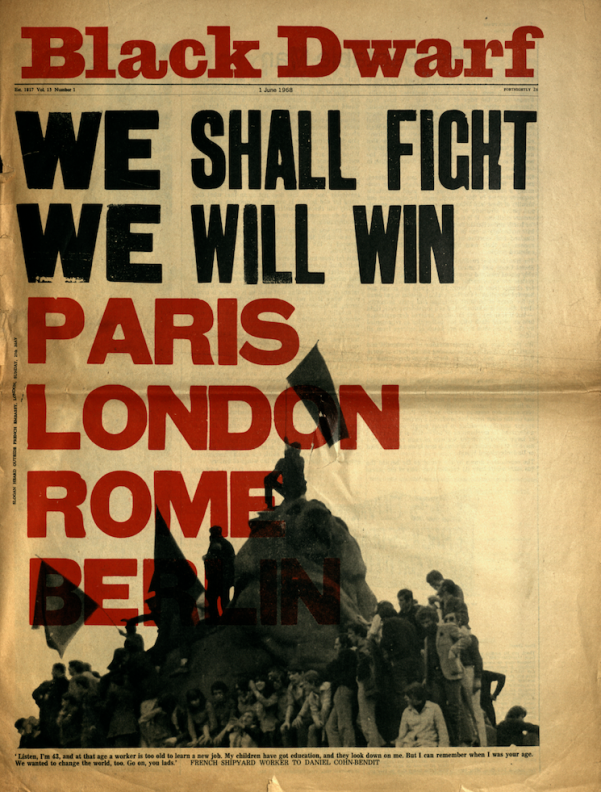
We Shall Fight, We Will Win: On The Black Dwarf and 1968 (Verso)

We Shall Fight, We Will Win: On The Black Dwarf and 1968

Screen_shot_2018-05-16_at_14.44.37-

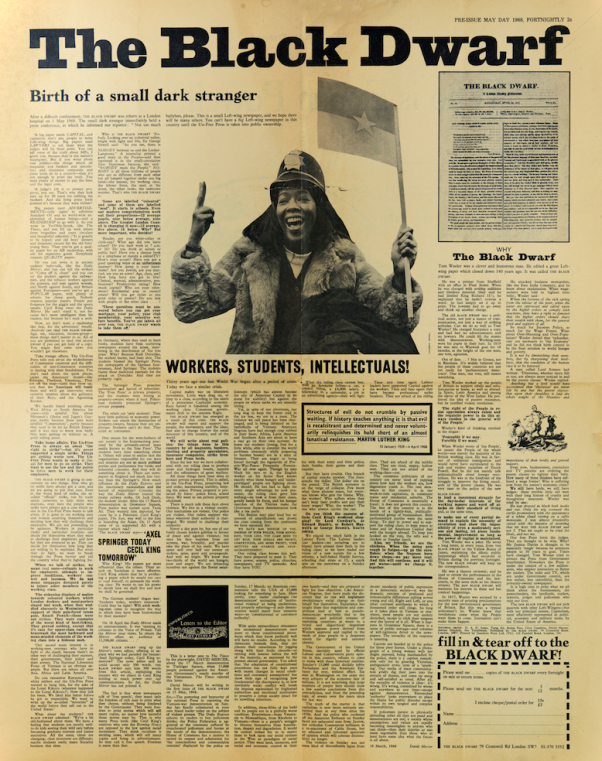
The Black Dwarf  was announced with a free broadsheet on 1 May 1968 and published four weeks later. The inspiration was the struggle of the Vietnamese liberation movement against American imperialism that had taken over territories from the European colonial powers. The Tet offensive by the Vietnamese NLF (National Liberation Front) that year had witnessed an assault on most of the provincial capitals in occupied South Vietnam which culminated with a surprise assault on the US Embassy in Saigon (now Ho Chi Minh city), where the stars and stripes were lowered and the NLF flag hoisted. This symbolism, as well as real gains on the ground, marked the beginning of the end of the US war. The game was up. The tortures, use of chemical weapons, destruction of the ecology by defoliants carried on for another seven years. Imperial narcissism knows no boundaries. It was the Tet offensive that boosted the anti-war movements in the United States and across the world.

First issue of <i>The Black Dwarf</i> released as a free-sheet on May Day 1968

In Britain the Vietnam Solidarity Campaign grew rapidly. In October 1967, 10,000 marchers came close to entering the US embassy. In March 1968 contingents from the German SDS and the French JCR joined us as 30,000 people mobilised by the Vietnam Solidarity Campaign surrounded the US Embassy in London.  We had been baton-charged by mounted police (‘The Cossacks, the Cossacks’ was our cry as we edged forward thinking of Vietnam and Petrograd 1917). Mick Jagger, marching with us, angered by police brutalities, thought we should have answered force with force. Britain was hopeless. A few months later he wrote Streetfighting Man. Culture was intervening in politics.

‘Hey! think the time is right for a palace revolution, but where I live the game to play is compromise solution
Hey, said my name is called Disturbance; I’ll shout and scream, I’ll kill the King, I’ll rail at all his servants’

The BBC refused to play it. He scribbled a note ‘For you!’ and sent it to me with the song. We published the lyrics in The Black Dwarf, aligned with a text by Engels on street fighting. A debate on the new music and the new mood erupted briefly in the New Left Review with Richard Merton (Perry Anderson’s nom-de-plume) arguing that:

“… it is incorrect to say that the Stones are ‘not major innovators’. Perhaps a polarization Stones-Beatles such as Adorno constructed between Schoenberg and Stravinsky (evoked by Beckett) might actually be a fruitful exercise. Suffice it to say here that, for all their intelligence and refinement, the Beatles have never strayed much beyond the strict limits of romantic convention: central moments of their oeuvre are nostalgia and whimsy, both eminently consecrated traditions of middle-class England…By contrast, the Stones have refused the given orthodoxy of pop music; their work is a dark and veridical negation of it. It is an astonishing fact that there is virtually not one Jagger-Richards composition which is conventionally about a ‘happy’ or ‘unhappy’ personal relationship. Love, jealousy and lament—the substance of 85 per cent of traditional pop music—are missing. Sexual exploitation, mental disintegration and physical immersion are their substitutes.”

In Britain music, in France cinema, were the auguries of what was about to come.

VSC broke with the more traditional opposition to the war. It declared its solidarity with NLF and supported its victory. Whereas the old New Left had launched CND and developed a ‘third camp’ position, the VSC responded to the conjuncture. The NLF was created, led by the Vietnamese Communist Party. It was armed by the Soviet Union and China. At one point, Bertrand Russell, distinguished VSC sponsor, wrote an open letter to Leonid Brezhnev, then leader of the Soviet Union, demanding that the Soviet Air Force be dispatched to defend the Vietnamese.

This was the political context in which The Black Dwarf was launched. It was conceived as a political-cultural weekly. The idea came from Clive Goodwin, a radical literary agent who became the publisher. The first meeting to discuss the paper took place at his house on 79 Cromwell Road. The room was lit by Pauline Boty’s paintings. She had been married to Clive and died of leukaemia in 1963. Present were Clive, the poets Christopher Logue and Adrian Mitchell, the playwright David Mercer, Margaret Mattheson, BBC script editor Roger Smith, D.A.N. Jones (who we wanted to be editor) and myself. Behind the scenes were Kenneth Tynan (who offered to review the House of Commons, but didn’t), Ken Trodd and Tony Garnett. We all agreed it was a great idea. Christopher Logue was sent off to look at old radical journals in the British Museum. The following week he returned with the name: The Black Dwarf. It was a polemical paper edited by Thomas Wooler in 1817 and agitating viciously and satirically for electoral and parliamentary reform. The title was inspired by the stunted bodies and soot-stained faces of coal miners.

Communication was slow in those days and it wasn’t till late afternoon on 9 May 1968 that we got news that something serious might erupt in Paris. The Sorbonne had been occupied! Five thousand people were packing the amphitheatre. Action Committees of various sorts were sprouting like magic mushrooms. The isolation of the Nanterre March 22 Committee had been broken. Of its two principal inspirers, Daniel Bensaid died some years ago, steadfast as ever, while the other Daniel (I think his last name was Cohn-Bendit) died politically. His corpse, I’m reliably informed, is currently on guard duty at the Elysee cemetery. He now regards Macron as the true representative of ’68. We published Sartre’s remarks to the Sorbonne students in the amphitheatre:

“Something has emerged from you which surprised, which astonishes and which denies everything which has made our society what it is today. That is what I would call the extension of the field of possibility. Do not give up.”

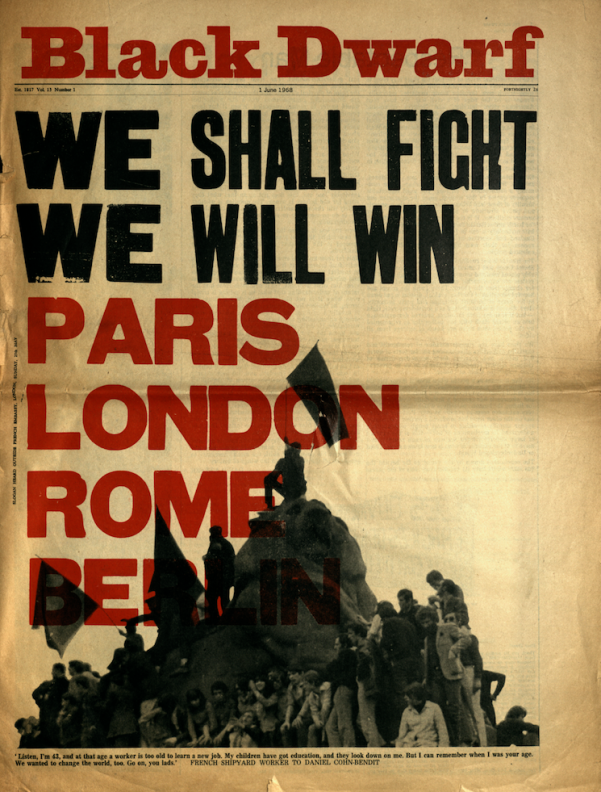
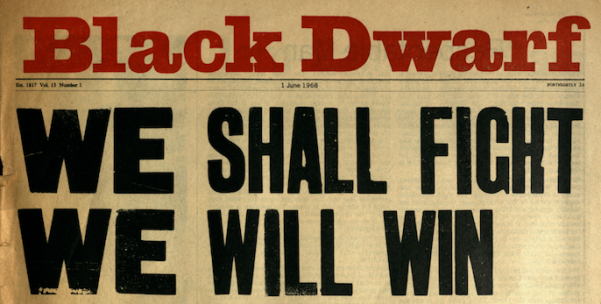
The night of the barricades on 10 May set France on fire. Soon the whole country was involved and 10 million workers went on strike, occupying factories in Rouen, Nantes, Paris, Lyon, etc. It seemed as if the Paris Commune had been reborn. As the first issue was brought to us, I thought the cover chosen by D.A.N. Jones was too weak and watery. We needed to identify with the movement. On a scrappy piece of paper, I wrote: ‘We Shall Fight, We Will Win, Paris, London, Rome, Berlin’ and handed it to our designer, Robin Fior. Everyone except Jones agreed. We decided to pulp 20,000 copies of the first issue. Jones walked out and I was appointed editor.

In our May Day broadsheet in 1968 we had described the first Editor of the old paper thus:

“Tom Wooler was a clever and humorous man. He edited a great left-wing paper which closed down 140 years ago…He was a printer from Sheffield with an office in Fleet Street. When he was charged with writing seditious and libellous material (they said he had libelled King Richard II) he explained that he hadn’t written a word. He had simply set it up in print!”

He was acquitted but forced a change in the law. Henceforth printers became liable as well. Ironically our Black Dwarf was rejected by almost a hundred printers and we finally ended up taking the train to a printer in Bala, North Wales the only printshop prepared to do the job. It was the same with distributors. They rejected us en masse. Only the great Collets’ bookshop on Charing Cross Road in London and a few radical bookstores elsewhere in the country (all gone now) stocked the magazine. We were dependent on street sellers and Mick Shrapnell a VSC/hippy militant used to sell 500 copies on his own. The musical Hair , a huge West End hit, helped with the lead actress displaying the latest issue on stage in every performance. Our supporters in the painting fraternity: David Hockney, Ron Kitaj, Jim Dine, Felix Topolski didn’t have much dosh but donated paintings that we auctioned. Other donors would drop in with much needed cash. We managed to print 45 issues of the paper and were amongst the first to declare 1969 as the ‘Year of the Militant Woman?’ with Sheila Rowbotham’s stunning manifesto. I had told the designer David Wills that it should be designed like an old-fashioned manifesto. The unreconstructed pig tried to subvert the message by placing the manifesto on two gigantic breasts. Sheila rang in a state as she saw the proofs. I rushed over, had it changed and sacked Wills on the spot afterwards. These things happened.

Politics was getting polarised and a number of the staff and EB members split on my decision to publish three pages from dissident ANC guerrillas who had been tortured and denounced by their leaders simply for asking critical questions of overall strategy and tactics. I was convinced they were genuine. Supporters of the ANC leadership were horrified when the magazine appeared. Thabo Mbeki led a squad of supporters to buy up all our copies in Collets. We reprinted. But the vote had revealed a division between Trotskyists and the others and a split took place. Was it avoidable? Probably, but left politics was becoming more and more polarised after the French May and the Prague Spring. A group of us left and established The Red Mole, much more linked to the IMG [International Marxist Group]. Another problem was lack of funds. We were in trouble anyway but the split was regrettable. The non-Trotskyists set up Seven Days , a paper I liked very much which should have survived.

The Black Dwarf and Seven Days are now digitalised in full and made available by the Amiel-Melburn Trust archive, an extremely valuable resource.

Tariq Ali

17 May 2018

Q&A: A.J. Weberman on Dylan, Lennon, Garbage, New York, and the JDL – Tablet Magazine

Good interview and article about A.J. Weberman by David Samuels of the Tablet.

Source: Q&A: A.J. Weberman on Dylan, Lennon, Garbage, New York, and the JDL – Tablet Magazine

Alan Weberman is a stone cold meshugganeh. He is by no means a reliable news source. Yet, by the same token, the legalese that these days must precede any printed record of the former Yippie, drug dealer, JDO activist, and pioneering garbologist’s nonstop provocations should not be taken as evidence that Weberman is somehow innately any less truthful than the celebrities, political figures, and power structures that he delighted in tweaking, torturing, and maligning for the past half-century. Weberman is no more or less corrosive than he always was, and politicians and rock stars are no more honest.

What’s changed, in the meanwhile, is us. We don’t see the point of Webermans anymore. They’re too abrasive. Or maybe, we are all Webermans now, thanks to the Internet, which flushed away the grittiness of a true oppositional culture down the social media toilet bowl. Thanks to Google, Facebook, and Twitter, there is no longer anything thrilling or shocking about calling celebrities bad names and going through their garbage. Or maybe it’s because famous people have more money, and better lawyers. Or because what’s left of the press is run by Ivy League conformist-types who are eager to maintain the pure ivory of their permanent records and are very anxious about keeping up institutional appearances, which are the only real form of capital they have, because the press is broke, which is a fool-proof recipe for boring.

If it helps, you can think of Weberman as a bullet-headed human keyhole into the oppositional culture that New York City nurtured in the bad old days, before Giuliani and Bloomberg cleaned the place up and turned it into one big dormitory for knowledge workers who were good with numbers and would die before eating at the wrong restaurant or sending their kids to the wrong preschool. Everything that was wrong about the old New York is right about Weberman, and everything that is right about the new New York is wrong about Weberman. So, like most things in life, it depends on your angle. Without Weberman, the world will become an even colder and less hospitable place for weirdos, which is something that I oppose.

I met Alan Weberman in his high-rise apartment, which is located in the upper part of the Upper East Side and offers a spectacular view of Queens. Through a haze of smoke, he offered me some of his memories, while being interrupted by the incessant demands of an ill-mannered bulldog, who is clearly the main focus of his affections. An edited transcript of our conversation was then redacted by a lawyer. I put the lawyer’s version aside, as I wrestled with the question of whether a lawyered version of Weberman was even worth publishing.

After an appropriate period of prayerful reflection, which lasted over a year, I have decided that it is important to hear Weberman speak about Bob Dylan, John Lennon, Meir Kahane, being a drug dealer, and some of his other pet subjects. It’s good to remember that being Jewish once meant being half-crazy, in addition to being neurotic and annoying. Anyone who wants to hear a recording of Weberman talking to Bob Dylan on the telephone can click here.

Where did your obsessive focus come from? Were you that way as a kid?

It started when I was in Washington, D.C. on Nov. 22, 1973, as part of an organized demonstration to find out who stole John F. Kennedy’s brain from the National Archives. You know, because the brain was missing. A New York Times reporter came across that. There was an article recently that some people say RFK took it.

So, we had this demonstration, and this guy Bernard Fensterwald was having a conference on the same day. I’d gotten vibes from working with Fensterwald that there was more to him than really met the eye. So, I’d been working all week, not smoking pot, putting up posters, handing out leaflets all over D.C. Then I came back and gave a little speech at Fensterwald’s conference.

Then I met this girl who was working for Fensterwald, and I says, “Let’s get high,” you know. So we started, I had a little hash, but it was Georgetown University, and these nuns were coming in and out. And so I said let’s go back to your dorm room so we went back to her dorm room, getting high and listening to rock and roll. And then somebody starts yelling from downstairs. It’s Steven Soter, you know Carl Sagan’s sidekick. And he shows me these pictures of the tramps who were picked up an hour after the assassination in a freight car you know behind the Texas schoolbook depository. So, you know so one of them looks like, says oh I thought this one was Frank Sturges, but Bernard Fensterwald said he went down to D.C. to Dallas and did a fucking study and it wasn’t the guy.

And I says, “You believe Fensterwald man? Fensterwald’s probably working for the CIA.” I looked at the tramp shots and I says, “Hmm, one of them looks like Howard Hunt, one of them looks like Frank Sturgis, and the other one looks like this guy who I rented a room to when I was going to Michigan State before I got expelled for dealing pot.” So I says, “Wait a minute, how can one guy, one tramp, can look like Sturgis, the other looked like Hunt, they’re both Nixon’s plumbers in Watergate?” Howard Hunt was involved in Bay of Pigs, and Frank Sturgis was involved with every goddamn thing imaginable.

So, I went to the National Archives, and that’s when I started speed-reading documents, and I read every document in the National Archives about the Kennedy assassination. Then I hooked up with this guy Mike Canfield, and Canfield convinced Congressman Gonzalez to introduce a bill to investigate the Kennedy assassination. And that’s how the House Select Committee on Assassinations was formed.

Did you ever read Norman Mailer’s novel Harlot’s Ghost?

No. I went through his garbage, though.

What did you find?

Betting slips.

Haha.

He’s a chicken shit, though. I was there going through his garbage and he came out of his house in Brooklyn Heights and I expected a big confrontation. But I was wearing a trench coat, so he must have thought I was a Fed or something. He just moved along.

I lived on that block, just up the hill from that big Jehovah’s Witness “Watchtower” building. Do you think Dylan was inspired to write “All Along the Watchtower” because of his view of that sign from downtown Manhattan?
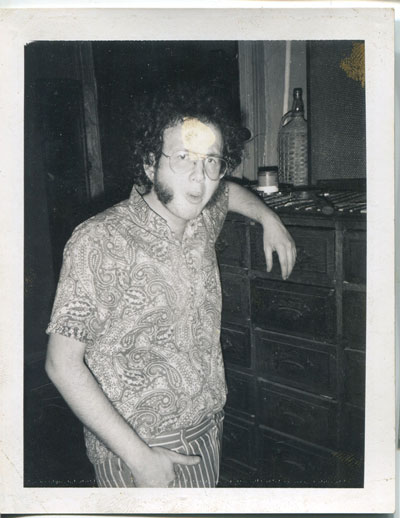
(Photo courtesy of A.J. Weberman)

No, no. All along the watchtower, princes kept the view, while all the women came and went, it’s about his career. Before, when I was at a very primitive stage of Dylanology, I thought the wind began to howl meant Dylan, the wind, like blowing in the windbegan to howl, like Ginsberg’s poem “Howl.” So, I went and asked Ginsberg about it. He comes to the door naked. He says, “No, Weberman no, no.”

But he would ask me for advice. He got mugged a lot, and he wanted to know what to do.

He is a human being.

You know, he fucked around with needles and he got fucking hepatitis. And then he finally got some money.

Why did everybody love the needle so much back then?

Don’t ask me. I didn’t mess with needles. But it’s just a very pleasurable thing, apparently. And when I knew Lennon, he was an addict. See the way he looks at the end of his life: He’s skinny, he’s emaciated. Him and Yoko, time and time again, they didn’t have clothes on. I would follow him into the fucking bathroom and watch him take a piss. You know, what difference did it make, he was nude anyway.

I feel like gestures that seemed perverse and counter-cultural when you made them first back in the day, like digging through Bob Dylan’s garbage, have become widely shared social instincts. In a way, garbage-ology is the soul of the Internet.

You know, the term garbologist existed—in Australian, it meant a garbage collector—but there was no garbology, which is the study of garbage. So, I invented the word “garbology.” It’s come to mean studying garbage to see what you can know, to increase recycling and understand socioeconomic divides and this and that. I did it just to spy on Dylan, essentially.

I’ve read some of the stuff you’ve written about your purported—and in some cases, recorded—phone conversations with Bob Dylan, which are hilarious. Why do you think he kept talking to you?

Well, I brought my Dylan class over to his house on a field trip. And he came out and he says, “Al, whatchu bringing all these people around for?” So I says, “Oh, it’s a field trip for my Dylanology class. But actually it’s a demonstration against all you’ve come to represent.” You know, and so it went. He rolled up his sleeves and he says, “Look, I’m not a junkie.”

Then Dylan called me later on, when I got back to Sixth and Bleecker, and he says “Hey, how’d you like a job as my bodyguard or a chauffeur?” So I says, “You’re trying to buy me off, man. You’re trying to co-opt me and it’s not going to work.” And I started hanging around the studio with him and we had a great time. He writes about it in Chronicles, you know—allegorically.

You know, we always moved in the same circles, druggie-type circles in the West Village. The guy who lived next door to me in the West Village was the guy who Dylan originally crashed with, Ray Gooch. So, there was a connection right there. There were generally fewer people around back then.

Then Dylan wrote “Dear Landlord,” which was the first song about the Dylan- Weberman relationship, and it’s full of threats.

He was right to see you as threatening, no?

No. He was threatening my life and stuff. He could get into a really creepy fucking head, where we’ll be sitting around and he wouldn’t turn the lights on in Houston Street, and he’d be looking at that church on Houston and Sullivan—St. Anthony’s—and it would all get real gray and everything. And then he’d say, “Al, if you get into my life, I might gain a soul.”

I says, “Gain a soul? What do you mean, man? Are you threatening to kill me, are you gonna kill me?” He says, “No, but I know some mafia people who might.”

But guess what. He didn’t want to be blackmailed by the mob for the rest of his life. You know so he went around, he did a number on me himself. He caught me on Bleecker Street and beat the shit out of me.
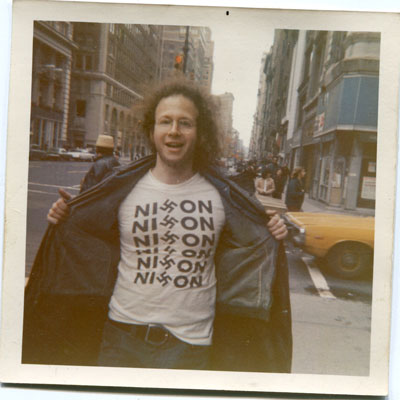
(Photo courtesy of A.J. Weberman)

You were like something he couldn’t get off his shoe.

I was threatening his whole thing. He couldn’t shoot junk in peace. And then I chased him out of Greenwich Village by having a birthday party in front of his house and it was in the centerfold of the Daily News. After that, he couldn’t live in that neighborhood anymore. There were too many hippies camping out in front of his house and stuff.

You could have just left the man in peace. Why did you bother him?

I thought he was a sellout. You know, he sold out the left. But guess what, Dylan was never a leftist. He just fell into the easiest thing that would make him famous.

It was a big fuckin’ laugh what Dylan did. He had people singing how many years can the cannonballs fly before they’re forever banned? And if you look at Dylan in other contexts, he says “catch a cannonball bring me down the line, my bag is sinking low and I do believe it’s time.” So he’s saying, “Let’s find a black heroin connection, my bag is sinking low”—i.e., I’m running out of dope. “How many times must the cannonballs fly”—cannonballs are out of control, namely black people, “before they’re forever banned.” And what he means by banned is, people were banned in South Africa who were part of the ANC, because they opposed Apartheid.

That’s nuts.

Dylan sings racist sub-content, pro-apartheid sub-content, in his lyrics.

You understand that this is your own, very personal interpretation of Dylan’s lyrics, right?

Time after time these things come up. You used to ride on the chrome horse with your diplomat, you used to have diplomatic relations with the biggest exporter of chrome, South Africa. Who carried on his shoulder—Who shouldered the white man’s burden—a siamese cat, slang for a black man, a nigger. Ain’t it hard when you discovered that he really wasn’t where it’s at—wasn’t it hard for you to rationalize what you’d done when you decided to break diplomatic relations with South Africa.

So, that’s where Dylan’s head is at, man. He’s a fucking racist, he’s a fucking Holocaust revisionist, and he’s a Nazi fucking sympathizer. But when I knew him he was a proud Jew, OK? And I was a self-hating fucking Jew, pro-Palestinian, digging my own grave. And not just because I was Jewish. I was a hippie, too.

But then in the eighties, when Dylan wrote “Neighborhood Bully” about the scapegoating of Israel, did you feel some sense that maybe the two of you were on the same trajectory, after all?

Oh, it was a great song, you know. But then Dylan became a Christian. So, he sang, your father was an outlaw and a wanderer by trade, he taught me how to pick and choose and how to throw a blade. OK, so your father is an outlaw—your antecedents killed Christ—and a wanderer by trade, and they were forced to wander the world because of that. He taught you how to pick and choose—the chosen people—and how to throw the blade, circumcision. He oversees his kingdom so no stranger does intrude—he watches very carefully who he takes in and allows to convert to Judaism.

I also discovered backwards masking. You know, when I played “If Dogs Weren’t Free” backwards, it said “If Mars Invades Us” or something. I was friends with Jann Wenner, and so Jann ran it on Random Notes in Rolling Stone. Then people began to play records backwards and they got “Paul Is Dead.”

When you look at Jann Wenner now, he’s buff, right?

I don’t know how he did it, he must be taking steroids or something. When I knew him he was a little wimp I could push around. You know, I got him in the Eastside Bookstore once and threw him up against the wall. But now, I don’t know.

Do you believe that decoding Dylan lyrics for the past 50 years has really been the best use of your highly original mind?

It was like, you know, when you’d buy Ovaltine and if you get enough wrappers they would give you the Ovaltine secret decoder ring, where each number on the ring represented a letter. So, you’d tune into the Ovaltine hour and then you’d copy a letter and then another letter and then what was the message? Drink Ovaltine.

This is another case of that. I wasted my fucking life trying to fucking understand this stuff.

So, you went from Dylanology to Meir Kahane and his followers or proteges in the JDO, the Jewish Defense Organization.

It was Mordechai Levy who came by to spy on the Yippies for the secret service, essentially. Levy came across to spy on me and he didn’t find much anti-Israel stuff among the Yippies. It was all basically, you know, pro-pot single-issue politics. And then he started doing data mining on Nazis. You know, he would find a Nazi’s phone number, call up the business office and say “Could you read me back the numbers that were called from this number.” And then from those records he’d do another search on everyone that the Nazis called. And in that sense he sort of unraveled the neo-Nazi network in the United States at the time.

I was very impressed by his methodology. And essentially he rolled me over. He let me hear calls with Palestinians where he would get them to admit they were working with the Klan. Then he started the Jewish Defense Organization, and then any alleged acts of, shall we say, vandalism, ceased after we formed the JDO, because you can’t do both things at once.

What is the point of what you do now?

The purpose is to fight the Nazis essentially. I’m not like an armchair anarchist or revolutionary. You know, when we were fighting against the war in Vietnam, we were instigating riots.

Well, it would hard to get the Jews of America to riot about anything these days. You could give Iran, say, a nuclear bomb in broad daylight, and you would barely hear a peep from these folks. You could round up all the Gypsies, or the Guatemalans, and put them into concentration camps. Regardless of their political orientation, Jews in America are some pretty wealthy, self-satisfied white people these days, and they are largely ignorant of their own history. That’s why I like hearing stories from people like you.

You’re just mad at Bob Dylan, because you wanted to have a relationship with him that he clearly didn’t want to have, because he thought you were a nut.
No, I’m not. I’m telling you the truth, so you know.

Back in the days of the JDO, a lot of Jews were being put into schools that were integrated for the first time. And then you had the whole Bed-Stuy-Brownsville, community control of the school of school boards, where they threw out the Jewish teachers. So, a lot of Jewish kids were radicalized.

What turned me off to the JDL was the “nigger, nigger, nigger” all the time, you know. The Yippies were opposed to the JDL. We published their credit card numbers in the Yipster Times, and then they came around with baseball bats to beat my head in. I said, “Hey, you’re getting all these charges on your bill, you know what you can do you can get the legitimate charges taken off too you know while you’re at it.”

Kahane was an interesting guy, got kosher food in the prisons. Common fare. That benefited the Muslims, too.

What do you think of Kahane now?

He was a theocrat. He wanted religious police. He was a racist. Israelis decided he was a racist. Ultimately it’s their call.

The Soviet Jewry issue was one place that he had a positive impact. His violence was appropriate there. It threw a scare into people, especially the brain-dead Jews who ran the national Jewish organizations in America, both then and now. It also scared the Russians.

Yeah, absolutely. He put a lot of heat on the Russians. There’s no doubt about it. He went to prison for it, too.

And what do you think about the fact that Kahane worked for the FBI all those years?

He hated the left essentially. But I would have to file an FOIA request and see if I can get his reports to the Feds or his contact sheets or whatever.

Kahane gets out of school and becomes an undercover informant for the FBI infiltrating Klan activity, so he almost looks like a civil rights guy. Then he moves to the Russians and the Soviet Jewry thing, and then he is revealed as an extreme theocrat and a racist. What I’ve always wondered is, did he continue working for the FBI the whole time?

No. Once he started with the so-called terrorists, they don’t want to touch him. You know he’s committing, he’s inciting the commission of illegal acts, he’s participating to some degree. You know they dropped him after that.

Then, of course, in an irony of history, Kahane is the one that al-Qaida ends up targeting first, because they recognized him. They’re like, “That guy’s is really dangerous, because he’s the Jewish version of us.” And the failure to really follow up on the investigative leads in the Kahane assassination—because everyone thought that Kahane was simply a crazy Jewish racist who embarrassed everyone and probably did deserve to get shot—opened the door to the first World Trade Center attack, and then to the success of the Sept. 11 plot.

It was stupid. They had Emad Salem in there for the first World Trade Center bombing, this guy Carson Dunbar took him out, he was head of the New York FBI office. Then the bombing occurred, they put him back in the cell, and then they arrested everyone including Sheikh Rahman, and they made tapes of Sheikh Rahman talking to Emad Salem. And Emad Salem is saying, “Let’s bomb the FBI building.” And Rahman says, “Slow down slow down. It took us three years to train the one who killed Kennedy.” You know, and when this came up on trial, everybody the U.S. attorney, Lynn Stewart, the whole fucking crew, they weren’t going to say, “Hey, that could have been Robert Kennedy.” They all just laughed and said, “Oh, how could it be John Kennedy?”

And guess what: Rahman was close to Mohammad [M.T.] Mehdi, and Mehdi was close to Sirhan Sirhan, who did kill Robert Kennedy.

When you read accounts of the assassination of Robert Kennedy, it’s always presented as some inexplicable Oswald-like lone gunman event—except the man who did it, Sirhan Sirhan, had a very clear political purpose, which was to mark the anniversary of the Six Day War and to protest American support for Israel. He killed Robert Kennedy because he understood him to be a powerful American Zionist who was running for President.

Robert Kennedy was going to send U.S. fighter jets to Israel. Sirhan Sirhan was a Palestinian, and he was trained by a Muslim Brotherhood cell. The FBI still won’t give me documents about this one suspicious guy who ran a little study group in which Sirhan Sirhan participated, an Egyptian. They won’t give me his name.

Let’s talk about your relationship with John Lennon.

How that started was that we invaded Allen Klein’s office, he did the fucking Concert for Bangladesh album, and he kept all the money instead of giving it to the Muzzies in Bangladesh. So, New York magazine does a whole story on it, and we figure, “Hey, if this guy has to rip off the starving people of Bangladesh, he must be one hungry motherfucker.” So, we had our free lunch for starving music executives program where we went to the dumpsters on 1st Avenue near the fruit stands, got all this rotten fruit, came into Klein’s office, and tossed it around. Fucking Phil Spector was there man, he attacked my old lady, Anne. So, then he had the bodyguards throw us out.

So then, John and Yoko call me. And Yoko says, “Come on over for tea with you and Anne.” You know, so we went over to Bank Street. And then the friendship started.

What do you think they wanted? Did they want protection, because they were new to New York?

No, no. They were pissed off at Allen Klein, they liked what we did, you know. We spoke for them, too. They liked activism.

That guy John Lennon was a revolutionary. You know, “working-class hero.” He was into that fucking IRA. I met IRA guys over there who were selling hash and smurfing arms and sending it back to the IRA in Ireland. He was crazy, you know. He gave me money to start riots in Miami, at the Republican Convention.

So, Lennon believed in his politics, unlike Dylan?

You know, Lennon, he was using smack a lot of the time. You’d go there and they’d say, “Oh he’s depressed, you can’t go in the room.” They’d just load me up with records and Yoko’s art and everything, you know. And, in retrospect, you know, I would say he was going through cold turkey. He had no track marks, he was snorting at the time.

Back when Lennon convinced me he was up to revolutionary shit, we went and we put a phone line, we went to the back of the house, to John Cage’s phone line, and put an extension into Lennon’s house so when Cage went to sleep at night, Lennon could make his calls on Cage’s line without the FBI tapping them.

Did John Cage ever know that?

I don’t think so. I know Andy Warhol knew that we stole his furniture. What happened was, we’d just moved, we got back from Miami and we had the Yippie headquarters on 3rd Street and 2nd Avenue in a basement on the Angels block. So, we were looking for like a space heater or something. So, I was walking by Cooper Square and I saw this door was busted open. So, I walked upstairs and then holy shit, there was all this art deco stuff was there. You know bureaus and lamps and clocks made out of marble. I said, “Wow, somebody abandoned this.”

So, I had this guy come with a truck and loaded it all into a truck and brought it back to my loft and to the Yippie house. A week later, I read in New York magazine that somebody looted Andy Warhol’s art deco stash. So, later at a party, Dana Beal went over and told him, “Andy, we were the ones that took it, we thought it was abandoned property.” Andy says, “I don’t care, as long as you didn’t sell it, it’s OK with me.”

What did Lennon want from America?

What did he want? He loved New York, you know. He liked Jerry Rubin and Abbie Hoffman. You know, they’re entertaining people. And David Peel, of course. He was a revolutionary, so he just fit right into the crew basically. He came to demonstrations.

I had one, you know, “Paul Is Dead,” we were demonstrating outside Linda Eastman’s parents’ house. You know we had a hearse and we had a big mock funeral for Paul McCartney because his album was so apolitical. So, he and Yoko, they showed up in bags and read a whole statement.

When did you stop seeing him?

After he moved to the Dakota. Then they got real heavy into heroin. Really heavy, you know. They became addicts.

Did you ever see John Lennon use heroin?

No, he knew I was opposed to it. Because I was saying that Dylan was an addict, and he had sold out his left-wing thinking to use heroin—when of course there was no left-wing thinking. He just became the Marxist minstrel, because that’s what was happening at the time.

You’re just mad at Bob Dylan, because you wanted to have a relationship with him that he clearly didn’t want to have, because he thought you were a nut.

No, I’m not. I’m telling you the truth, so you know.

But you admire Dylan. You think he is very smart.

Oh yeah, he’s smart. He’s a freak. He played at Hubert’s Flea Circus. You know, you could ask him to sing any song and he’d sing it, like some kind of machine on 42nd Street. I’m waiting for him to write about that, because I used to go to Hubert’s all the time. He loved it in New York at the time, the gaslight. The Café Wha? I worked at the Wha? I paid Jimmy Hendrix $30 a night for three sets.

Jimi Hendrix is the one person in music history that I would trade everything I own for the chance to spend three hours in a small room where he was playing live.

(Photo courtesy of A.J. Weberman)

Oh, I heard him all the time. We would drop the actual glassware on the floor when he started to play, and then sweep it up later on, you know, so we wouldn’t miss a second. We’d go out and listen to him. Man, he’d go crazy, he’d play with his tongue, he’d play behind his back, he had all kinds of stuff—a lot of Dylan covers, “All Along the Watchtower,” “Like a Rolling Stone,” “Wild Thing.”

I remember Jimi saying to me when Eric Burdon was in the audience one night—“He’s going to sign me to go to England, I’m going to have plenty of money man, and I’m going to take every drug there is.” And I says, “You sure you want to take every one?” He says, “Yeah, I’m sure.”

He was a nice guy. Friendly, not condescending. He saw himself as basically a black Yippie. He gave the money to Abbie Hoffman to send joints to Congress. Every congressman got a joint. And, according to Abbie, a big percentage of them didn’t turn their joints over to the FBI.

Did you believe that pot was going to change people’s heads and change American society for the better?

And acid. We were going to squirt the cops with DMSO and LSD in water guns. DMSO would make their skin a permeable membrane. And of course the LSD would be psychotomimetic, it would make them crazy. But people don’t take acid anymore.

I don’t even know where I’d get acid in New York City these days. And if I did drop acid in my present condition, I would probably flip out and become a real-estate broker at Corcoran or something. So that part of my life is clearly over with.

It became an ordeal. But it could end regressive behaviors it can end alcoholism, it has good therapeutic value if taken under the right circumstances.

What do you make of the speed at which pot is being legalized in America?

I’m happy about it. You know, I got radicalized when I sold five joints to a fuckin’ undercover cop at Michigan State. I was facing 20 years on the sail, minimum mandatory, 10 years, when they vacuumed my pockets and found little minute amounts of cannabis. I had to come to New York City, get a job from the Lawrence employment agency, go see a shrink, you know, and then pay the district attorney 5,000 to let me off the fucking hook.

I turned Dana Beal on to pot, and then Dana came to New York City, escaped from a mental hospital where his mother put him for attacking someone in his class, he got a job at Klein’s on Union Square, in the record department, and then he moved on to the Record Hunter on 5th Avenue and 42nd, enrolled at NYU, was an A student. And then I turned him on to LSD. And he said, I want to be a revolutionary. So we had the first smoke-in in Tompkins Square Park, in 1967 in the Summer of Love. The East Village Other gave us an office on Avenue A and 10th Street, and we put a big sign in the window, Psychedelic Revolution. And anyone, we had marches. Anyone, anytime there was a pot bust we’d march through the East Village, and people were very happy to have us doing that. They’d throw flowers at us. Including the fucking flower pot.

So, then we opened three stores, Dana got busted, he had to go underground, and he hooked up with the Weather Underground in Wisconsin, and we continued to push for legalized marijuana. Myself, publisher Rex Weiner, and some other people, we had the first Marijuana Day Parade. May Day is J Day. John and Yoko sponsored it one year. We had a giant joint on stage. Yossarian, the underground cartoonist, would do the posters. We had had somebody smoking pot in an iron lung, had a hippie tied a little kid in a wheelchair or a high chair and a hippie forcing him to smoke pot, you know all kinds of weird, bizarre stuff. And then NORML came along, and so it became more widespread.

The current President of the United States writes in his memoirs about smoking pot.

Yeah, he lived next door here, in the adjoining building. You can see from the terrace downstairs, that fire escape where Obama said he went out to smoke dope. I think it’s a progressive thing. But then you know you’ve got Nazis like Ron Paul who want to make all drugs legal for people who are looking for a shortcut to happiness, who are never going to be able to find that happiness via traditional economic means. That’s part of his hidden agenda to fuck up the African American community, because he is basically a Nazi at heart.

I was staying at Grover Norquist’s town house, right—

Grover Norquist, the Republican direct-mail guru?

He was like a libertarian, he loved rock and roll, he had the greatest collection of rock records, man.

You were friends with Grover Norquist because of his record collection?

We had a friend in common, and I needed a place to stay in D.C. So, my friend takes me over to Spotlight, which was a real right-wing John Birch-type magazine, right, because I’ve done research for [late Congressman Henry] Gonzalez and [Sen. Richard] Schweiker, who created a Congressional Commission to investigate the conclusions of the Warren Commission about the circumstances around Kennedy’s death. And so I show them the tramp shots.

And so they say, “Oh this is very interesting. What’s your name?” And I say, “Allen Jules Weberman.” And then the guy says “Allen Jew Weberman?” And so I say, “Who are these fucking guys?” So, then I went back and listened to their stinking broadcast and I says, “Holy shit, it’s fucking Father Coughlin has come to life again.” And then I started to subscribe to the Spotlight. And in every issue, it was Ron Paul this, and Ron Paul that. Ron Paul was at this meeting. Ron Paul was their hero. That was his fan club, his base.

To have somebody like Ron Paul alive is like having a cancer. His big catch-phrase is “the New World Order.” Do you know what the new world order is? The new world order is where the Jews control everything. It’s another way of saying ZOG, the Zionist Occupation Government. It’s dog-whistle politics.

Do you feel the same way about Ron’s kid, Rand Paul?

Yeah. He wants to cut off aid to Israel. And he goes to Israel and says how much he likes the place and then ultimately he wants to destroy it. You know what he was named after? The Rand, the South African currency.

That’s hilarious. But is that true?

That’s what I believe. Ask Ron Paul.

What do you think of this city now? I was born here, I grew up here, but I stay out of Manhattan these days, because it generally depresses me.

Well, it’s lost a lot of its interesting places, really, like 4th Avenue and the bookstores, the electronic places on Courtland Street. You know it’s become pretty homogenous—Payless Shoes, Starbucks, ATMs, Duane Reade. And basically you have de facto segregation now, in that you need to have an income that’s like 40 times the amount of the rent per year or something.

Right. No one is a racist anymore, because even that would mean that they had an allegiance to something other than money. But then I remember the shooting galleries and the junkies, the people living in abandoned buildings, and that time wasn’t so good, either. I hate that fake nostalgia for the New York I grew up in from people who came here in 2011 to be stockbrokers or work for some crappy Internet company. The old New York City had its virtues, but it was pretty dangerous and shitty.

Everybody was getting ripped off. You know you work at a job, make $50 a week and you buy something and then next thing you know the junkies have come and stolen it from you. My customers at low numbers in the East 60s were getting home and people were trying to break down their doors in home invasions.

The city was fucking chaos, you know. But for me, it was wonderful. Because they were taking riff-raff. Everybody wanted to rent to me, even on MacDougal Alley, a little town house they were going to rent opposite Washington Square. I finally settled on 240 Central Park South, overlooking the park there. Antoine Saint Exupery’s old apartment. It was a love nest for somebody who owned 6th Avenue Electronics. So I had a terrace, wood-burning fireplace, in a tower of 240 Central Park South. And it was rent stabilized. I had to pay money to get the guy out and pay a fee to the broker, but they didn’t really scrutinize your records so much, because it was a buyer’s market.

But the city was deteriorating. There were pornography places on every block. There were all kinds of roving gangs around 8th Avenue and 42nd Street and 9th Avenue.

Was it fun being a drug dealer in the city?

Yeah, except for the rips.

Did you have guys with guns take stuff from you?

No, just once. What happened was this idiot guy from High Times was doing some story on coke dealers. So he calls me up and he says, “Oh do you want me to bring my friend around, he’s a big coke smuggler.” I says, “No, don’t bring him around.” So, he brought him around anyway. Then the guy sent his crew back to rip me off. You know so when somebody left, they came up, they cuffed me up, you know hit me a couple of times with a gun, kicked the dog, and stole a bunch of reefer from Gainesville, but they missed the mushrooms, you know. So, I says, “Aw fuck.”

So, what I did was I put double doors on there so you got buzzed in one door, and you’re in a little hallway and then you get buzzed in the other door with a TV camera to see who it was and then tear gas that could be remotely controlled. I hired somebody to put the doors in.

And sure enough the rips came back. And what they did was there was next door we had Studio 10 at 10 Bleecker Street, Quiet Riot played there and other bands of note. So I look out the window and all of the sudden, the black guards are white. The rips had kidnapped the guards, they’d kidnapped the black guards and tied ’em up and put ’em inside 10 Bleecker, and got their uniforms and were outside the door. So then this woman comes who was not a criminal herself, but comes from a crime family whose name would be easily recognizable, and she refused to open the door.

So they let her go, and then I buzzed the guy in. You know, so he comes in and then all of a sudden, the lights go out, the tear gas goes off, and then me and this guy who later actually ended up working in Times Square as a bouncer in one of the peep shows, cleaning up the semen with a fucking mop, and this other guy Smitty, who was also happened to have organized crime connections, but was forced into it by his father. And they come down and we have two fuckin shotguns, Ithacas—we cocked the fuckin Ithacas and said “We’re gonna fuckin blow you away.” And then boom, we hear a fuckin shot goes off. I release the front door and he goes limping away. He shot himself in the leg!

So that was the Wild West back then, man. The cops saw everybody going in and out in and out, all these people like Jim Jarmusch, I ran into him the other day, he was a customer. Ginsburg brought a whole bunch of people around. The President’s brother [name has been excised at lawyer’s request]. Other people I don’t want to mention. That photographer dude who did the pictures of the young kids, Robert Mapplethorpe, brought his crew around. The people from Saturday Night Live, the writers, it was a salon. You know, everybody you could get jobs, you could meet, advance your career, meet other people. And then the cops chased us out and I had to start a delivery service.

And now you comment on stories on the Internet. What’s the pleasure in that?

Well, a lot of my comments are pretty absurd. Like this woman today, she ran, she came in number 75 in the marathon. So she said, “Oh I finished in 5 and 40.” So I says, “How can you finish in 5 minutes and 40 seconds?”

What are your favorite sites to comment on?

Well, I’m barred from Huffington Post, and I’m barred from the Gothamist. Wenner got me barred. You know because when they came out with the Rolling Stone thing, with the Chechen bomber’s picture on the cover of Rolling Stone, you know, then I said “Aw, man, Wenner is doing intellectual limbo. He’s reached a new fuckin low.” You know, I knew the guy was a fucking low-life from years back. But I didn’t realize it went this deep. Even his own writer Matt Taibbi wouldn’t defend him, put his heart in the defense, because he was almost killed by Chechnyan separatists in Moscow. And the Daily News, somehow I got banned from there.

The Forward, I was banned for a little while because I said that a lot of gay Jews don’t like Israel, because they were maltreated when they were younger by other Jews.

Do you think the open information culture that the Internet has created has been a good thing for American democracy?

It spread a lot of ignorance. It gives a lot of ignorant people a chance to express themselves. When you see some kind of a factoid, a lot of times it’s repeated time after time, so you just put it in quote marks and put it in the Google search, and then you can see that it comes up in certain groups over and over again. So you know that somebody’s started it and the rest of the idiots just promulgated it. But the big thing is that Facebook has changed a lot of people’s lives.

You like Facebook?

Facebook is good. It gives people a chance to express themselves.

There was something in your spirit, in good ways and bad, that is now widely diffused throughout the culture because of the Internet. It’s become part of our cultural DNA. You had so much passion and aggression and interest and you had tools and you were an obsessive. I think that energy is part of what makes the Internet run. That, and porn.

Right, right. Well, you know we were tied in with Cap’n Crunch, you know he lived at 9 Bleecker, and he was making the—

Yeah, the long-distance phone hacks. Ron Rosenbaum wrote a great magazine article about that, in the days when there were great magazine articles.

In Esquire.

[Stops to take a phone call]

They’re putting up like a garbage transfer point here, so all the wealthy people at Asphalt Green are pissed off. But guess what? Asphalt Green used to be an asphalt plant that the mob used to make inferior cement and stuff. So what are they so afraid of? It’s not going to be toxic, it’s just going to be people’s garbage. Rich people’s garbage!

The Neglected History of the May ’68 Uprising in France

Source: The Neglected History of the May ’68 Uprising in France

On the morning of June 10, 1968—a couple of weeks after French labor unions signed an agreement with Prime Minister Georges Pompidou to put an end to a crippling general strike—workers at the Wonder battery factory in the northern Parisian suburb of St. Ouen voted to return to the job.

Later that afternoon, as union representatives conferred outside the factory gates with the rank and file, an amateur camera crew captured the scene. The group’s 10-minute film, Wonder, May ’68, focuses on a young woman who has drawn a crowd around her.

“No!” she barks at her union rep, fighting back tears and shaking her head as he tries to console her by listing management’s modest concessions. “I’m not going back inside. I’m not putting my feet back in that prison.”

The woman has the unmistakable glow of raised expectations, that special energy that comes from successful collective action. When you convince yourself you’re capable of changing the world by banding together with your co-workers, the feeling of power that results doesn’t fade easily. In France, during the months of May and June 1968, millions of other workers caught the bug: Between 7 and 9 million went on strike. Hundreds of thousands of them did so while occupying their factories, as at Wonder in St. Ouen.

The fact is all too often neglected, if not outright forgotten, today. The unprecedented wave of protests and strikes that swept across France for a few weeks in 1968—known today simply as “May ’68”—was, at its core, a workers’ movement. This was the largest wildcat general strike in the history of capitalism: a mass revolt against low pay, poor working conditions, and the hierarchical, dehumanizing organization of the capitalist workplace itself.

Events in the Left Bank of Paris simply provided the spark. Ironically, they’ve since become better known than the actual strike movement. On May 3, hundreds of college students gathered for a general assembly in the courtyard of the Sorbonne University. Administrators responded by calling the riot police—the infamous CRS—who subsequently marched onto campus and arrested hundreds of protesters, including student leaders. This, in turn, enraged the burgeoning student movement, culminating in nighttime skirmishes with the CRS known as the “Night of the Barricades.” On the morning of May 11, French people woke up to images of smoldering barricades in the heart of Paris, of overturned cobblestones, of riot cops beating students.

Then, the most important phase of the revolt kicked off.

On May 13, France’s two largest unions—the General Confederation of Labor (CGT) and the French Democratic Confederation of Labor (CFDT)—joined students in solidarity marches across the country, decrying police repression. While unions themselves didn’t call for further action, workers took initiative on their own, launching strikes and occupying factories across France. First, the Sud-Aviation factory outside of Nantes; eventually, plants belonging to Renault, Citroën, and the state-run energy company; soon, the postal service, the public rail company, and the entirety of the country ground to a halt.

The strike wave lasted for weeks. As it peaked by the end of May, union and government leaders gathered for negotiations. This proved a turning point. It is not unreasonable to posit that the revolt might have continued to grow under different circumstances. Had the CGT and the closely linked Communist Party thrown their full weight behind the workers’ movement, France might have drawn closer to full-scale political change. Instead, the country’s two largest left-wing organizations encouraged an end to the crisis. Enticed by a national agreement that ensured enhanced union rights, a 35 percent hike in the minimum wage, and a 7 percent pay raise for everyone else, millions of employees gradually began to return to their jobs. In a May 30 radio address, Charles de Gaulle announced the dissolution of the National Assembly and the organization of new legislative elections. A few weeks later, the Gaullists emerged with an even larger majority.

May ’68 is simply too large of a historical fact to ignore in France today. As such, this year’s 50th anniversary saw a host of museum exhibitions, TV specials, radio programs, and new books to commemorate the uprising. Rather than focus on the strike movement, though, most highlighted the familiar pillars of what has since become the dominant narrative of 1968, in France and abroad. According to this version of events, May was, alternatively, the product of a cultural rebellion and intergenerational clash; the outburst of privileged students feeling trapped by a centralized education system; the result of Parisian kids reliving their favorite Victor Hugo novels by playing revolution; or, at its best, a protest against the social conservatism of postwar French society. All of these things may be true, but they miss the bigger picture.

Even Tony Judt, the masterful historian of Europe, fell victim to these tropes. His magnum opus Postwar devotes just a few pages to May ’68. It contains no mention of the millions of workers who went on strike. In their place, Judt makes note of the “tight red corduroy pants and fitted black shirts” apparently worn by some Parisian protesters.

Ironically, the chronological proximity of May ’68 may be partly to blame. Since the events are still part of the recent past, a relatively small bunch of well-connected politicians, artists, and writers who participated in the events have been able to disproportionately shape collective memory. Since these unofficial experts of ’68 tend to speak from both personal experience and positions of authority, they receive an unusually generous benefit of the doubt. Other critics have observed as much. Rather than history, the general public is treated to a series of their interpretations treated as fact.

Of course, many of these former radicals have, by now, spent the bulk of their careers as either centrists or right-wingers: people like Alain Finkielkraut, the ex-Maoist who became an anti-communist “New Philosopher” alongside Bernard-Henri Lévy (commonly called BHL) in the mid-to-late 1970s; Romain Goupil, a filmmaker and ex-Trotskyist who supported the American war and occupation in Iraq; or Daniel Cohn-Bendit, the emblematic anarchist-leaning student leader who was later elected to the European Parliament and now backs Emmanuel Macron. Not only does their version of May ’68 nicely reflect today’s dominant ideologies—recasting May as a cultural rebellion avoids uncomfortable questions like the exploitation of labor and the distribution of wealth—but the life stories of BHL and company have the added benefit of fitting a media-friendly trope: the fiery young idealist who grows up and turns rightward.

While prominent ex-radicals have spilled much ink on ’68, they tend to avoid much talk of the workers’ rebellion. This makes sense from their perspective. For true believers in the liberal capitalist order, May ’68 is much easier to understand this way. After all, it is a profoundly unsettling thought that millions of people could be so unhappy with the supposedly democratic society in which they live—so enraged at what they put up with on a daily basis at work—that they’re willing to put their jobs on the line to change things. May ’68 retains its subversive aura because of what it suggests about the stability of our advanced Western societies: Possibilities for revolt are much greater than they appear on the surface.

As any trade unionist worth his or her salt knows, there is no such thing as a “spontaneous” job action. An unexpected development can sometimes trigger a movement, but workers act together only under certain conditions. They have to share grievances, for one. But just as importantly, they must trust one another and have confidence they can win the struggle they embark upon. France in the late 1960s encouraged this sort of thinking: Left-wing parties and labor unions were deeply present in the lives of the working class, supplying wage-earners with a culture of solidarity and a well-known history of resistance, from the Paris Commune to the Popular Front to the Maquis to mass strikes following the Liberation. At the same time, French employers were especially antagonistic, seeking to hit government-imposed production targets by maintaining tightly organized workplaces and downward pressure on wages.

Pay wasn’t so good. While the trend pales in comparison to the United States since the 1970s, Thomas Piketty’s research has shown that income inequality in France reached a postwar peak around the years 1967 and 1968, hitting its highest levels since the 1930s. Although unions and employers engaged in nationwide collective bargaining at the time, they often failed to lift up those at the bottom of the ladder.

In addition to subpar compensation, workers often had little say on the job, with few chances of career advancement and effectively zero input over the production process. Employers maintained strict classification schemes that left the lowest-paid categories of the work force, the ironically termed specialized workers, feeling disrespected and ready to lash out. Understandably, the strikes of May-June gave life to far-reaching critiques about the soul-crushing nature of work itself. And to more than a few moments of vengeance in the form of “boss-nappings.” At the occupied Sud Aviation factory, workers locked their boss in his office and forced him to listen to the “Internationale” on loop.

Immigrants and women advanced their own workplace grievances alongside those of their white male French counterparts. At Renault’s flagship auto plant in Boulogne-Billancourt, North African, Spanish, and Portuguese workers came up with their own list of demands, calling for an end to discrimination and for equal union rights. French law barred most foreigners from serving as union representatives until 1972—a change brought about thanks to worker activism in 1968 and subsequent years.

The strike movement in May swelled thanks to the mass, working-class base of the labor movement and the left. About a fifth of the French work force belonged to a union at the time. This was a sign of significant influence. Unlike in the United States, union membership in France doesn’t confer additional job benefits. To hold a union card in France is to be a workplace activist, to adhere to a certain set of values. In 1968, most unionized employees belonged to the Communist-tied CGT, whose program plainly endorsed the class struggle and the nationalization of key economic sectors. In certain workplaces—especially in the auto industry and in heavy industry—union density was higher than 20 percent, and non-members were often sympathizers. While labor leaders didn’t call for May’s strike wave and CGT officials sought to bring it to an end, it is inconceivable to imagine the movement’s taking root without a base of union activists.

By the same token, the dominant force on the left was the French Communist Party (PCF). Party leaders were famously critical of the student movement in 1968, and justifiably mocked for their outmoded political vision. Still, the PCF’s presence fueled a working-class political consciousness matched in Europe only by Italy, where the Communist Party carried similar weight. French Communists had received the second-highest vote total in the previous year’s legislative elections, just behind the Gaullists. While many critics emerged to the party’s left in the 1960s, nearly all remained attached to the Marxist tradition. Thousands of these Maoists, Trotskyists, and anarchists fanned the flames of rebellion in 1968.

Once the fire started, then, it was hard to put out.

In March 1968, Le Monde ran a now-legendary column titled “When France Is Bored.” The writer lamented the apparent calm reigning over France, just as the United States rioted, Vietnam burned, and China was swept by the Cultural Revolution. It’s a reminder of how the vast majority of the French intellectual establishment didn’t see May ’68 coming. Of course, an Algerian autoworker or a public-sector union activist would have written a very different piece.

Fifty years later, in a world that has increasingly little to do with de Gaulle’s France, this seems the most striking lesson of May ’68: Working-class discontent often runs far deeper than elites perceive—or, frankly, care to understand. When teachers went on strike this spring in West Virginia, Oklahoma, Arizona, and Kentucky, subsequent headlines often betrayed the ignorance of the political and media establishment. Journalists called the protests “spontaneous.” Republican legislators who had spent years slashing state education budgets were similarly caught by surprise. To the West Virginia teachers working side gigs to make ends meet and regularly lamenting the state of public education at union meetings, the movement was anything but spur-of-the-moment.

In the aftermath of ’68, left-wing activists endlessly debated the revolutionary character of the movement: Were striking autoworkers who raised the red flag over their plant truly intent on overthrowing capitalism? When workers booed union leaders encouraging them to go back to work, were they ready for political change? These debates won’t be settled soon. What’s clear, in any case, is that the discontent ran deep. And for a few weeks, millions of people let it be known, almost bringing down the government in the process.

Nearly 30 years after May 1968, director Hervé Le Roux set out to discover the identity of the young woman at the center of the Wonder factory film, capturing the quest in a documentary of his own, Reprise. Le Roux does manage to track down some of her colleagues, but the end of the film is disheartening. Not only does nobody seem to know what came of her, nobody even knows her name.

International Times

1960s: Days of Rage's avatar1960s: Days of Rage


International Times (it or IT) is the name of various underground newspapers, with the original title founded in London in 1966. Editors included Hoppy, David Mairowitz, Roger Hutchinson, Peter Stansill, Barry Miles, Jim Haynes and playwright Tom McGrath. Jack Moore, avant-garde writer William Levy and Mick Farren, singer of The Deviants, also edited at various periods. … The paper’s logo is a black-and-white image of Theda Bara, vampish star of silent films. The founders’ intention had been to use an image of actress Clara Bow, 1920s It girl, but a picture of Theda Bara was used by accident and, once deployed, not changed. Paul McCartney donated to the paper as did Allen Ginsberg through his Committee on Poetry foundation. International Times was launched on 15 October 1966 at The Roundhouse at an ‘All Night Rave’…

View original post 223 more words

The Gutenberg Galaxy: The Making of Typographic Man – Marshall McLuhan (1962)

1960s: Days of Rage's avatar1960s: Days of Rage


The Gutenberg Galaxy: The Making of Typographic Man is a 1962 book by Marshall McLuhan, in which the author analyzes the effects of mass media, especially the printing press, on European culture and human consciousness. It popularized the term global village, which refers to the idea that mass communication allows a village-like mindset to apply to the entire world; and Gutenberg Galaxy, which we may regard today to refer to the accumulated body of recorded works of human art and knowledge, especially books. McLuhan studies the emergence of what he calls Gutenberg Man, the subject produced by the change of consciousness wrought by the advent of the printed book. Apropos of his axiom, ‘The medium is the message,’ McLuhan argues that technologies are not simply inventions which people employ but are the means by which people are re-invented. The invention of

View original post 215 more words