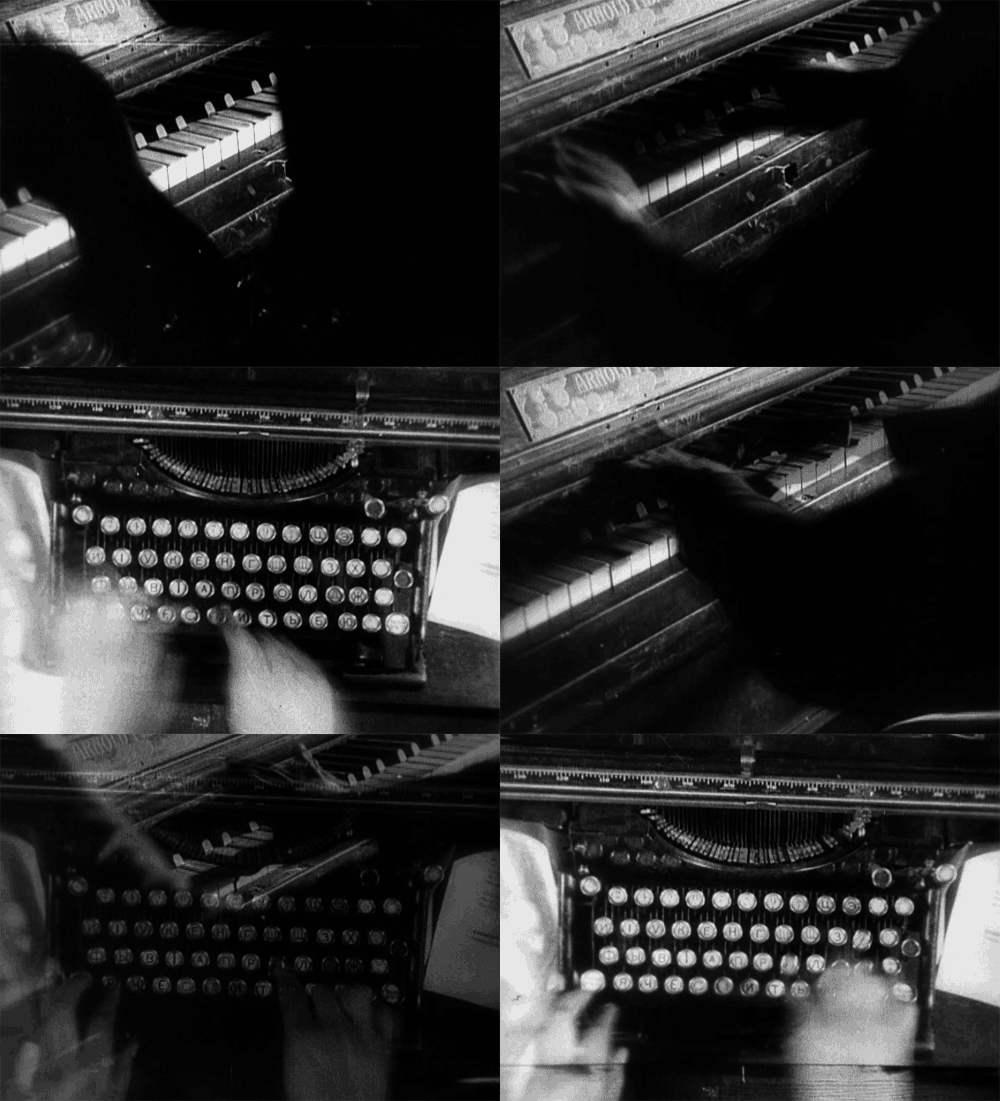
Vertov’s feature film, produced by the film studio VUFKU, presents urban life in the Soviet cities of Kiev, Kharkov, Moscow and Odessa.[2] It has no actors.[3] From dawn to dusk Soviet citizens are shown at work and at play, and interacting with the machinery of modern life. To the extent that it can be said to have “characters”, they are the cameramen of the title, the film editor, and the modern Soviet Union they discover and present in the film.
Man with a Movie Camera was largely dismissed upon its initial release; the work’s quick-cut editing, self-reflexivity, and emphasis on form over content were all subjects of criticism. In the British Film Institute’s 2012 Sight & Sound poll, however, film critics voted it the eighth greatest film ever made,[4] and the work was later named the best documentary of all time in the same magazine.[5]
Dimitri Kirsanoff, born in Estonia but operating mostly in Paris, was heavily influenced by the theories of Soviet Montage. In his most famous short film, Ménilmontant (1926) – still frightfully obscure in most circles – he adheres to this style strictly, almost obsessively. His preference towards a brisk editing pace carries a unique vitality that is also seen in the work of Soviet masters Eisenstein and Vertov, who pioneered and perfected the technique of montage in the mid-to-late 1920s. But, nevertheless, I don’t think it works quite as well here. The Battleship Potemkin (1925) and The Man with the Movie Camera (1929) – perhaps the two most recognised works of Soviet montage – utilise their chosen editing style to full effect precisely because they place greater emphasis on the collective over the individual, in accordance with traditional Communist ideology. There is deliberately no emotional connection attempted nor made between the viewer and any individual movie character, for that would be contrary to the filmmaker’s intentions (interestingly, however, the montage fell out of preference from the 1930s in favour of Soviet realism).
Ménilmontant falters because it strives to create an emotional connection with the characters (particularly the younger sister, played by Nadia Sibirskaïa), but Kirsanoff’s chosen editing style continually keeps the audience at an arm’s length. The closest he comes to true pathos is with the park-bench sequence, when an old man offers some bread and meat to the famished woman, delicately avoiding eye contact to preserve her dignity. Even in this scene, the montage style intrudes. A director like Chaplin (and I’m a romantic at heart, so he’s naturally one of favourite filmmakers) would have placed the camera at a distance, framing the profiles of both the woman and the old man within the same shot, thus capturing the subtle emotions and inflections of both parties simultaneously. Kirsanoff somewhat confuses the scene, cutting sequentially between the woman, the man and the food in a manner that reduces a simple, poignant act of kindness into a technical exercise in film editing. It works adequately, of course, a precise demonstration of the Kuleshov Effect, but there’s relatively little heart in it. But we’ll cease with my complaints hereafter. I know my own film tastes well enough to recognise that what I disliked about the film – its emotional distance, for example – represents precisely what others love about it. There’s no doubting that the photography (when it’s kept on screen long enough) is breathtakingly spectacular, making accomplished use of lighting, shadows and in-camera optical effects such as dissolves, irises and superimpositions. There are touches of the surreal. Kirsanoff cuts non-discriminately forwards in time, backwards and into his characters’ dreams, fragmenting time and reality into a series of shattered images, their individual meanings obscure until considered sequentially as in the pieces of a puzzle. Most impressive, I thought, was how several shots captured the linear perspective of roads and alleys, watching his characters gradually depart into the distance as though merely following the predetermined pathways of their future. The film ends exactly as it begins – with a bloody and unexplained murder – suggesting the inevitable cycle of human suffering, its causes unknown and forever incomprehensible.
Here is a video I have made using Adobe Premiere of photos I took in Tarifa October 2015 with original music composed using an R3 Loop Station and Zoom GFX5 effects unit.
This is a video of my talk at BRLSI in July. It’s not great quality but you get the whole thing! I originally put it on YouTube but it got blocked because of my use of two Bob Dylan songs. This was a bit disappointing but I have decided to upload it here instead. I hope Bob won’t mind too much, he always seemed to understand the true value of copyright theft and plagiarism!
Friday 3rd and Saturday 4th of March 2017 I attended a conference at DMU, Leicester about film maker Peter Whitehead, and celebrating the donation of his archive to the University.
I found out about it late but am really glad I went. There were some excellent talks that brought new light to the meaning and relevance of the 1960s Counterculture, and other aspects of the Swinging 60s, and also a sublime showing of Whitehead’s Tonite Let’s All Make Love in London on the big screen at Phoenix Square Cinema, Leicester. It was almost like watching a different film to the one I have only previously seen on YouTube.
This is a fascinating view of what was happening at the height of what is now seen as the first great flowering of the Counterculture. It is not uncritical though and the seeds of it’s decline can be seen in the interviews of contemporary stars like Julie Christie, Michael Caine and David Hockney. There is almost a sense of impending loss, and also a critique of it’s superficiality and materialism.
The film is really a response to Time Magazine’s famous article about Swinging London that shifted American’s ‘must visit’ tourist location from Paris to London. After a brilliant start with footage from the UFO Club accompanied by a great version of Interstellar Overdrive by Pink Floyd, Michael Caine bizarrely announces that “…it all started with the loss of the British Empire….”
There is no narrative as such but a series of Chapters that are linked by the time and place, and a general sense of bewilderment by the participants. Following some amazing footage of the Rolling Stones live in Ireland Mick Jagger comes across as a slightly lost , petulant school boy trying to make sense of it all “… they don’t like violence but they themselves are violent which doesn’t seem to make sense…”. Yes okay Mick, thanks for that, you sound just like my mother. Julie Christie, who looks absolutely stunning, bemoans the fact that she is totally superficial and has nothing to say “… everything’s happening to me and I’m not happening to anything…am I allowed to talk?…”. David Hockney is not impressed by ‘Swinging London’ at all and prefers New York and California. The bars stay open til 2 a.m. and the drinks are cheaper and he can meet ordinary people in the clubs, unlike London which is overpriced and exclusive. To be fair though, David Hockney has been moaning about something for most of his life, quite often about not being allowed to smoke cigarettes wherever he wants! He is very amusing though. When Julie Christie smokes a cigarette in the film she doesn’t look like she quite knows what to do with it. Vanessa Redgrave, on the other hand, exudes confidence and political commitment and sings a capella and lectures the audience, a bit like an over-confident trainee teacher.
Andrew Loog Oldham is the stereotype of a cynical, Svengali-like pop manager who talks about how he ‘invented’ the Rolling Stones image as the ‘bad boys’ of pop, which, in fact, they quite obviously are not. He revels in his lack of knowledge but obviously believes he can do anything he wants “… I might get into politics someday..or films” he says. In some ways, this is quite a refreshing and confident attitude. Nevertheless, he never did get into either politics or films which is probably just as well as I am sure he would have joined the ranks of the Thatcherites and done something really terrible like close down the NHS or sell the whole of England to Disneyworld. The film ends where it began with some amazing footage of dancers at the UFO Club and the music of Pink Floyd. A truly remarkable film! There is a real sense of dynamism and change. The way the music accompanies the live performances of the Stones is inspired especially with the song Lady Jane. Whitehead doesn’t bother about synchronicity and blends unrelated recordings with live footage. Have You Seen Your Mother Baby (Standing in the Shadows), a surprisingly dark and seemingly uncommercial recording (even though it was a top ten hit), it’s not unlike the Velvet Underground, plays while the band and audience go wild and Lady Jane introduces a strange and eerie sense of calm.
The rest of the conference passed quickly. It took place over two days but the papers delivered were so fascinating that I never lost interest the whole time I was there. This has got to be a first for me, my attention can easily wander! I usually have alternative activities at hand in case I get bored! Didn’t need them this time! There were a wide range of themes that dealt with the 60s with some, but not all, relating to the work of Peter Whitehead
Adrian Smith discussed the interesting sub genre The Love Business: European Prostitution Drama as British Popular Entertainment. This dealt with the film distributors who were showing European films, many of which had a serious sub-text, as soft porn films to a British audience. There are some echoes of this theme in a recent Channel 4 series Magnifica 70 that deals with film and censorship in Brazil in 1970. Worryingly, this is about a right wing dictatorship in Brazil but could just as easily be about censorship and social control in Britain in the 1960s. Definitely worth a look.
The Love Business: European Prostitution Drama as British Popular Entertainment
Richard Farmar looked at the bizarre film The Touchables and Melanie Williams gave an interesting account of the film maker David Hart. She talked about the “Right-wing Counterculture” which to some would be a contradiction in terms. The majority of countercultural participants were either “left wing” or perhaps “apolitical” but she made a very good argument about how many issues, like women’s lib or gay rights, could belong to either the left or right. She pointed out how politician and journalist Jonathon Aitken started as a countercultural figure in the 1960s but ended up as a cabinet minister in the Conservative Government of the 1980s (before he ended up in jail, that is!). I have investigated elements of right wing attitudes in my essay The Decline of the 1960s Counterculture and the Rise of Thatcherism in which I look at libertarianism and other aspects of the counterculture in the 1980s such as sexual freedom, drug taking and “alternative” businesses such as Virgin and Gap.
David Hart and Right-wing Counterculture
Caroline Langhorst gave an interesting talk on three lesser known films of the 1960s all of which are critical of the optimism and the joie de vivre of the period. These are Tonite Let’s All Make Love in London,Privilege (starring Manfred Mann singer Paul Jones) and Herostratus (featuring a young Helen Mirren).
1960s Dystopian Tendecies
Both Privilege and, especially, Herostratus are relatively unknown films. Privilege had a cinema release in the 1960s (I actually saw it) but I believe Herostratus was virtually lost, although there is a copy now on Blu-ray (which I have yet to see). There are some clips of it on YouTube which are quite intriguing. Personally, I feel that the films that really define and critique the era, especially in terms of pop music and the counterculture, are Easy Rider,Performance (featuring Mick Jagger) and, of course, Tonite Let’s All Make Love in London. What becomes generally apparent is the mainstream media’s inability to really understand what is going on during this period. Their attempt to commercialise the movement in films of the time often produced a cliched view of pop culture and society that, for some, defines what the 1960s are about but is actually a ridiculous fiction.
Niki de Sainte Phalle with her trademark targets. An influence on Mod fashion?
There were some interesting talks about feminism in the 1960s. Alissa Clark investigated Peter Whitehead and Niki de Saint-Phalle’s collaberation Daddy. In 1972, Saint Phalle shot footage for this surreal horror film about a deeply troubled father-daughter, love-hate relationship. She was an artist, sculptor and film maker who made quite an impact on the avant garde scene from the 1940s onwards.
Jane Arden “The Other Side of Underneath”
There was also a passionate and forceful account of radical filmmaker and theatremaker Jane Arden who I had actually not heard of before. In 1970, Arden formed the radical feminist theatre group Holocaust and then wrote the play A New Communion for Freaks, Prophets and Witches. The play would later be adapted for the screen as The Other Side of the Underneath (1972). Arden directed the film and appeared in it uncredited; screenings at film festivals, including the 1972 London Film Festival, caused a considerable stir. The film depicts a woman’s mental breakdown and rebirth in scenes at times violent and highly shocking; the writer and critic George Melly described it as “a most illuminating season in Hell”, while the BBC Radio journalist David Will declared the film to be “a major breakthrough for the British cinema”. Interesting stuff!
Stephen Glynn gave an entertaining look at Whitehead’s films of the Rolling Stones including the iconic promotional film for the song We Love You and Steve Chibnall showed us what the 1960s Counterculture was like in a provincial city, namely Leicester! Well, I should know because I was there, but he managed to come out with facts that I knew nothing about. For example, how the local paper The Leicester Mercury led a campaign to close down the late night clubs and coffee bars that proliferated at the time. Do You Know What Your Children Are Up To While You Sleep? screamed the headlines. My favourite band Legay complained that they had hardly anywhere left to play and were moving to London! I am shocked and stunned by these revelations!
Jimi Hendrix at the Leicester Art College Hawthorn Building. Local rock and roll band Warlock ended up doing the support spot.
Richard Dacre gave an entertaining account of the Counterculture and Peter Whitehead at the Royal Albert Hall. Apparently, after Wholly Communion, poetry performances were banned at the hall for more than 20 years! Hilarious. I am looking forward to the Whitehead inspired festival at the RAH later on this year!
Leonard Cohen’s “Hallelujah” was a complex, nearly indecipherable musical riddle that flummoxed even its composer. Originally released as a funereal synth-laden dirge on 1984’s Various Positions, he spent years tinkering with the track during live performances in a relentless pursuit to unlock its full melodic potential. Ultimately, it was John Cale who provided the key.
The iconoclastic Velvet Underground co-founder, producer and innovative writer/arranger crafted an elegiac version of “Hallelujah” that vaulted the song into a rarefied strata of modern standards. Now he speaks to PEOPLE about the song’s long journey.
First included on an obscure Leonard Cohen tribute album, I’m Your Fan, commissioned by the French music magazine Les Inrockuptibles in 1991, it’s perhaps best known for the stark version that appeared the following year on Cale’s live collection, Fragments of a Rainy Season. Something of a precursor to the “unplugged” performance concept that exploded in the first half of the 1990s, the album was a stripped down career retrospective reaching back to Cale’s early collaborations with his Velvet Underground bandmate Lou Reed.
Last fall, the album was recently given a deluxe reissue, complete with bonus tracks and outtakes from throughout the extensive European tour. “Hallelujah” received a bewitching video directed by Abby Portner, invoking elements from Shakespeare’s MacBeth to portray the song’s crumbling grandeur.
Cale first heard the track while attending one of Cohen’s concerts at New York City’s Beacon Theater in 1990. “I was really an admirer of his poetry,” he tells PEOPLE. “It never let you down. There’s a timelessness to it.” The song stayed in his mind, he didn’t decide to record it until Les Inrockuptiblesasked him to contribute to I’m Your Fan several months later. In the pre-digital days, there was really only one way to learn the tune at short notice: “I called Leonard and asked him to send me the lyrics.”
Famously, there were a lot. “Fifteen verses,” Cale confirms. “It was a long roll of fax paper. And then I choose whichever ones were really me. Some of them were religious, and coming out of my mouth would have been a little difficult to believe. I choose the cheeky ones.”
After recording the song for I’m Your Fan, he toyed with a variety of arrangements on his 1992 tour documented on Fragments of a Rainy Season. “There were a lot of different venues and a lot of different kinds of performances. And as it turned out the ones that were best were the ones that were done on a real piano, not an electric piano. Every time we got a real Steinway things went up a couple notches.”
Cale’s version of “Hallelujah” immediately struck a chord, inspiring a host of artists to offer their own take. A young Jeff Buckley added a hauntingly intimate version to Grace, his sole release before drowning in the Mississippi at age 30. His death added an extra dose of pathos to the intensely gripping song, and within a decade the number of cover versions had swelled to 300. According to Cale, Cohen grew weary of his creation’s popularity. “He said, ‘I don’t want to hear any more new versions of “Hallelujah”! Let’s put an embargo on that!’”
Here’s me at the microphone at an event at Hansom Hall, Leicester organised by David Soden. It is a battle between performers and images taken of them and projected on to screens around the hall. Here’s a short video of one of the performances:
It was a brilliant event that reminded me a bit of the happenings and events of my youth. Mind you, the technology has changed a lot since then with banks of computers rapidly processing images as they are taken but the effect on the senses was surprisingly similar! It was not that far from the projections and light shows of the past!!
I particularly like this song because it references places I know in Berlin and has such an atmosphere of longing and even dread. An example is that Pottsdammer Platz was a bleak ‘no mans land’ in the 70s. This is a very touching song about something more than nostalgia.