Until recently I knew about Marcel Duchamp but not very much. I knew he was an iconoclast who presented a porcelain urinal as a work of art but I had no idea of his profound influence on others like John Cage and Merce Cunningham. Visiting this exhibition at the Barbican changed all that. It is apparent how important Duchamp’s ideas were. In fact, it has filled in quite a few gaps for me.
It is perhaps not suprising to have not seen many of his works in the past. It seems that most of them are in Philadelphia and there aren’t really that many of them. Also, many of his art works were conceptual and the original pieces were lost. It was the idea that was important. This was especially true of his readymades. The famous urinal piece Fountain was presented for exhibition to the Society of Independent Artists exhibit in 1917. “Artworks in the Independent Artists shows were not selected by jury, and all pieces submitted were displayed. However, the show committee insisted that Fountain was not art, and rejected it from the show. This caused an uproar amongst the Dadaists, and led Duchamp to resign from the board of the Independent Artists.”(Wikipedia)
Duchamp Fountain. This is the only known photograph of the original urinal that was lost. Signed by R.Mutt! It was turning it on it’s side and signing it that made it art!
This was the point at which Duchamp rejected retinal (roughly, things you can see) art and developed ideas of “art at the service of the mind.” In fact, he is probably the first conceptual artist. He liked the idea of being an artist but was not so convinced by art.He was a big influence on the Dadaists of the early 20s who rejected mainstream art.
Dada was born out of negative reaction to the horrors of World War I. This international movement was begun by a group of artists and poets associated with the Cabaret Voltaire in Zurich. Dada rejected reason and logic, prizing nonsense, irrationality and intuition. The origin of the name Dada is unclear; some believe that it is a nonsensical word. Others maintain that it originates from the Romanian artistsTristan Tzara and Marcel Janco‘s frequent use of the words da, da, meaning yes, yes in the Romanian language. Another theory says that the name “Dada” came during a meeting of the group when a paper knife stuck into a French-German dictionary happened to point to ‘dada’, a French word for ‘hobbyhorse’.(Dona Budd “The Language of Art Knowledge”)
This exhibition deals with Duchamp’s ideas but also looks at his influence on other artists particularly John Cage, Merce Cunningham, Robert Rauschenberg and Jasper Johns. As I found earlier on this year he was also a big influence on Richard Hamilton who created his own picture of Nude Descending a Staircase which you can see in a previous post. The Nude by Duchamp was painted at a time when he was influenced by both Cubism and Futurism and he tries to convey movement in the picture which I think he succeeds in. The Hamilton picture on the other hand seems very static. Was that intentional?
Hamilton’s version of Duchamp
John Cage is someone I know a lot more about. Like Duchamp and other members of the American avant garde in the 1940s and 50s he was often seen as a dilettante, a kind of fool but after the publication of his book Silence in the early 1960s opinion of him radically changed and he is now seen as one of the most important composers of the 20th Century. Yes, he is the composer of the infamous 4’33” that so many have heard of but so few have actually heard. It consists of silence in three parts. Of course, he used it to prove there was no such thing as silence. He was influenced by Duchamp but his readymades were found sounds. He put forward the theory that all sound is and can be music. He also introduced chance into his compositions by using the I Ching (a Chinese divination book of wisdom) and other methods. Artist Robert Rauschenberg created paintings that were pure white to show that visual events still happened with shadows, blemishes etc. Choreographer Merce Cunningham created dances in collaboration with Cage and Rauschenberg that used similar chance methods. All of this happened because of the ideas and influence of Duchamp. His position in history is assured.
John Cage score for Strings 20 created by dropping ink stained pieces of string on to a page.
White Painting by Robert Rauschenberg
The exhibition was fascinating and definitely worth visiting. There is music playing and the recorded sounds of dancers (and sometimes real dancers). There is a strange kind of peacefulness in the air, probably helped by the fact the gallery wasn’t that full when I was there! It raises and in some ways answers the question “what is art for?”. On the other hand the pieces are still displayed in a pristine white gallery and they are still worth millions of dollars to collectors. It’s ironic that 50 years after Duchamp questioned Art and announced the readymade that Andy Warhol could take a Brillo box or a soup can and call it art and it now sells for tens of thousands of dollars. Either someone didn’t get the joke or they never really understood what was being said in the first place. And in the post modern world of Damian Hirst and Tracey Emin there is no longer even any irony in it.
Duchamp with his bicycle wheel mounted on a stool. Apparently this was never exhibited. He liked having it in his studio and spin the wheel round!
Jasper Johns Figure 8. Creating art from the mundane!
I found this blog when looking for images of Duchamp and decided to copy and post it here. It links to my ‘Vandalising Rothko’ piece and at the time I had no idea what Yellowism was! I found it very interesting so I reposted it in full. It is clear that Vladimir Umanets was very influenced by Duchamp. I want to make it clear that I do not necessarily agree with what’s written here, I’m not sure I can even understand it! However, I believe that Umanets was motivated by a strong force and the question “What Is Art For?” is still a valid pursuit. He showed courage and commitment to do what he did but I’m not convinced by his philosophy at this stage.
Here’s an interesting post from Interdome about the treatment of Umanets i.e. giving him a two year prison sentence for defacing the Rothko:
As a case study, let’s look at Ai’s Dropping a Han Dynasty Urn.
On the surface level, the photo set appears to mock artistic fetishism: Ai looks like he could not possibly give a fuck as he lets the valuable artifact shatter on the ground. There’s a sublime disregard in the pictures; it’s art against art like Kruger’s sentences are ads against ads. But as an artist, Ai can’t destroy art, he can only make more. From one urn, he gets three pictures. If I went into the Hirshhorn, grabbed one of the photos off the wall, and let it fall to ground like I didn’t give a fuck, I would be arrested and taken to jail. It’s only freedom of expression if you break something you own, otherwise it’s vandalism.
One true vandal learned this lesson (or taught it) very publicly when Vladimir Umanets was sentenced to two years in prison for writing “a potential work of yellowism” on a Mark Rothko painting in London’s Tate Modern. Yellowism is the idea that if anything can become art regardless of its use value, then we could imagine a third category of stuff past art, in light of which the art/non-art distinction dissolves. Both are equally potential works of yellowism, just like a soup can and a urinal are equally art objects. Umanets writing “a potential work of yellowism” on a Rothko is the same as Duchamp Sharpie-ing “a potential work of art” on a toilet while he takes a piss. Except Umanets isn’t an artist. We know he’s not an artist because he’s in jail in England, and England, Ai would remind us, has freedom of expression.
Umanets wasn’t looking for freedom of expression, but freedom from expression, out from under the artistic injunction to replace what you destroy. He wanted to break without buying, but that’s not in liberalism’s deal. And no one cries for a vandal.
Because Umanets is a vandal and not an artist, there won’t be any complaints from the U.S. State Department. Because this is England and not Russia, there won’t be a Human Rights Watch report, as there was for the band Pussy Riot when they were arrested for trespassing. Even anti-capitalist arts writers called for his head on a platter.
When looking from art perspective, one can say that yellowism is a dead territory where the richness of meanings and interpretations is reduced to one – to yellow. But one needs to remember that yellowists don’t announce the death of art. Art is and will be alive forever. They rather say that yellowism is dead, inert, homogeneous mass without creativity. Authors of the manifesto and definition of yellowism are the authors of the death – yellowists are the authors of a single interpretation. This death is positioned outside of art, like mirror.
Roland Barthes in “The Death of the Author” says: “To give a text an Author” and assign a single, corresponding interpretation to it “is to impose a limit on that text.” Barthes argues against the method of reading that relies on aspects of the author’s identity — their political views, historical context, religion, ethnicity, psychology, or other biographical or personal attributes — to distill meaning from the author’s work. Yellowists want to impose a limit on the text, on art, and on ordinary reality too, but not by giving a “text” an author. Paraphrasing Barthes I say: To give a “text” a YELLOW and assign a single, corresponding interpretation to it is to impose a limit on the text. Barthes demands the death of the author (author disappears) because the author’s identity limits the text, the reading. In yellowism case author also disappears and yellow – the necessary “limitation” appears instead of the author.
Inside yellowism the artistic kingdom of meanings and interpretations is erased together with the author. It doesn’t matter WHO made a piece of yellowism because all pieces were, are and will be about yellow only. Yellowism is permanent, boring, inert, homogeneous flat, ‘dead’ mass. Always was and always will be. Like in the forest where all the trees (meanings) ‘look’ the same – wherever you go you are in the same place anyway. A thousand kilometers left, two meters right or backwards – you are always in the same place. In yellowism the nature of the authors has “the identity of the indistinguishable forest”.
Barthes conclusion: “the birth of the reader must be ransomed by the death of the Author.” Yellowism conclusion: the death of meanings and the death of the author must be ransomed by the birth of single meaning – yellow.
Marcin Lodyga
“Sounds from the chamber”
piece of yellowism
for public audition in yellowistic chambers only
CD / audio recording of a walk through Miroslaw Balka exhibition Gravity made in the gallery space
executed in 2013
Anonymous asked: please can you explain the relevance of all the tits and bums on this site to yellowism. Is yellowism tits and bums? is that the context everything is reduced to?
►► Luncheon on the grass
(on the grass: Arthur Danto, Roy Turner, Joseph Kosuth, Marcin Lodyga)
What makes the difference between a Brillo box and a work of art consisting of a Brillo box is a certain theory of art. It is the theory that takes it up into the world of art, and keeps it from collapsing into the real object which it is. – Arthur Danto. But to expose the irrelevance of this idea when attributed to the tradition, we have only to ask what “real object”, “Le déjeuner sur l’herbe” by Manet collapses into when the implicit theory which supported it is refuted. – ask another thinker Roy Turner (Philosophy Now magazine)
Marcin Lodyga starts: If “Le déjeuner sur l’herbe” by Manet was placed in the context of yellowism, inside a yellowistic chamber, then it would stop to be a work of art and it would become a piece of yellowism – a pure expression of yellow color in the form of Manet painting. Inside yellowism the painting by Manet is not a work of art. We have only to ask what piece of yellowism “Le déjeuner sur l’herbe” by Manet collapses into when the implicit context of yellowism which supported it is refuted. The answer: it collapses into a work of art, it becomes a work of art again, it gains its previous status.
Painting is a kind of art. If you make paintings you are already accepting (not questioning ) the nature of art. One is then accepting the nature of art to be the European tradition of a painting-sculpture dichotomy. – nervously said Joseph Kosuth (“Art After Philosophy”). Dear Joseph – Marcin replies – in the context of yellowism – which is NOT a kind of total, huge conceptual art work, as you would consider it probably, painting is not a work of art. You said: “Art is the definition of art”, I say: yellowism is the definition of yellowism.
As a case study, let’s look at Ai’s Dropping a Han Dynasty Urn.
On the surface level, the photo set appears to mock artistic fetishism: Ai looks like he could not possibly give a fuck as he lets the valuable artifact shatter on the ground. There’s a sublime disregard in the pictures;…
justiceismine asked: Yellowism is neither art, nor anti-art but a cause. Some might ask if Yellowism is needed or say it’s pathetic/stupid but I say it deserves it’s place as did Jackson Pollock for example, which he did not get at his time.
spacecowboysparklefingers asked: No one is going to drink your yellow kool-aid. Your totalitarian snake oil ideology has been ineffectual and irrelevant since De Stijl/Neoplasticism tried it. There is no dialogue here, you won’t even respond to this with anything more than an “X”. Please don’t write on anymore Rothko’s (or any other pieces of art for that matter), they are not yours to write on, and some people really enjoy them. No one wants you here yellowism, go home.
Marcin Lodyga
“You can start painting again, in yellowism”
yellowistic draft
signed and dated on the front
poster printed for the occasion of Duchamp season in Barbican, London
150 x 100 cm
executed in 2013
Yellowism is not dadaism or neo-dadaism. If you think that yellowism is dadaism then actually you are a dadaist, because you try to devalue yellowism and make it meaningless. Dadaists were nihilists and they “promoted” nonsense. The fact that in yellowism everything means yellow leads to the wrong conclusion that everything means nothing and therefore yellowism is perceived as nihilism /dadaism. This is the big misunderstanding. The real consequence of yellowism existence is the philosophy of ONE and the vision of many different isms (existing outside of art) which can be reduced to (one) yellow-ism anyway. Although yellowism clones exist under different names – they are yellowism. In the future: many one-perspective “worlds”. Not only one “world” full of perspectives (meanings), many various subjective interpretations – like in postmodernism, especially postmodern art, but also many separate “worlds” (greenism, blueism, chairism) with one perspective each, concentrated on one meaning only. Yellowism, divided into many isms, will be positioned away from the forever developing, “organic” realm of art.
The total flattening announced by yellowists is more humanitarian than dadaism because it doesn’t leave people with nothing – inside the desert of meanings where you can watch only the wrecks and corpses of culture. Yellowists save one meaning (yellow) for everything and also they let you live in the “yellowistic totalitarian illusion of many”- you can exist in autonomous groups called greenism, blueism, chairism or skyism etc. but you will be a yellowist anyway. All roads lead to Rome. The universal Rome – the absolute truth will be always outside of art.
Dadaists are nihilists, they do not offer anything, they don’t show a new perspective, new possibilities, they replace everything with nothing. » Dada (…) wants nothing, absolutely nothing, and what it does is to make the public say ” We understand nothing, nothing, nothing “. “The Dadaists are nothing, nothing, nothing and they will surely succeed in nothing, nothing, nothing.” « 391, No. 12, Paris, March 1920 Francis Picabia who knows nothing, nothing, nothing.
Nihilists say that without absolute, universal, and transcendent values, there can be no real values at all. Friedrich Nietzsche, however, argues that the lack of such absolute values does not imply the absence of any values at all. Nietzsche “permits” the values of many different and even mutually exclusive perspectives. This is called “perspectivism” – all ideations take place from particular perspectives. This means that there are many possible conceptual schemes, or perspectives in which judgment of truth or value can be made. This leads (me) to postmodernism. Postmodernism is the consequence of Nietzsche’s perspectivism but is nihilistic. The proliferation of alternative perspectives, beliefs and values makes that postmodern society is foundationless.
This what we see in the galleries is the result of postmodernism or post-post modernism, or postpostpostmodernism, whatever. Many perspectives, many points of view, not one grand and universal but many interpretations closed inside the circle called “art”. In the future artists will resign from art, will abandon this circle. Art full of many perspectives will still exist but will be surrounded by – isms. Some artists will never leave the territory of art but there will be yellowists, greenists, chairists looking at them from outside – located in one perspective circles.
All the other isms are actually yellow-ism because, they have the same architecture, logic. Finally they can be reduced to yellowism, flattened to yellow-ism. However, people will need this totalitarian illusion of many isms, they will construct their own contexts, for example greenism,redism, chairism or godism, and they will be happy inside the isms but all the new one-meaning worlds can be always considered as yellowism.
Yellowism doesn’t replace (like dadaism) all the values with nothing, yellowism gives one sense instead of nonsense. Yellowism presents the vision of many autonomous territories around multiperspective art. Yellowism saves the ONE – whatever it is: blue, green, chair and offers the new grand philosophy of ONE.
Marcin Lodyga, Khadija Davies
Portrait of Members of Art & Language with Caps, in the Style of Jackson Pollock
yellowistic draft
signed and dated 18/01/13 on the front
magazine cover, pink ink
22.4 x 28.6 cm
Executed in 2013
►► Discipline and punish.The birth of the black hole
Yellowists see the whole domain of reality and the whole domain of art as gigantic readymades which can be transported into the context of yellowism. Yellowism is a specific prison, a ghetto in which you are free from freedom, in which the freedom of interpretation doesn’t exist. Every content placed in this territory defines yellow color. It requires a noetic discipline. You have to respect the internal yellowism law. Yellowism is a bit like a black hole – most of the information about the matter that went into forming the black hole is lost. In the end yellowism only remembers the total mass, charge, and angular momentum. The physical form of objects and beings transported from art and reality is preserved, but all the forms carry only one, always and forever the same, identical message. You can observe that something is moving inside, you can watch pieces of yellowism free from the past and future; there is a movement but there is actually no time.
Yellowists don’t punish art, they don’t take a revenge on art or reality. Manifesto of yellowism is not a death sentence for art. Yellowists don’t destroy and don’t create. Yellowism is not vandalism and it’s not a form of creation. There is no postmodern, Derrida’s deconstruction, any destruction or creative construction inside yellowism. There is something else: flatstruction. Everything is flattened to yellow, all interpretations are ironed to one flat surface, to one meaning. The total flattening (flatstruction) is a state of permanent homogeneity. Yellowists don’t create and they don’t destroy, they make everything flat therefore, inside yellowism, deconstruction, creativity, vandalism, surrealism or fascism or anything else is flattened to one, to the expression of yellow.
Artists push the boundaries of art and are imprisoned in their seeming freedom. Yellowists are free outside of art. They resigned from art, they overstepped the boundary and the fact that everything can be about yellow gives them the almost cosmic freedom.
Today you can overstep the border, you can be a bit like Alice through the looking glass, you don’t have to, together with other artists, push the boundaries of art further anymore, now it’s time to cross it and discover the another, still unknown for many, space called yellowism. Of course, you can stay where you are and run your artistic life in harmony with the motion of postmodernism. Yellowists don’t announce the end of art; they say in manifesto: art is a forever developing whole. They don’t promote a slogan: “art is dead”, they rather say that yellowism is dead and always was dead and always will be dead. Therefore they don’t want to replace art with yellowism. They just introduce a new autonomous territory, specific environment which is parallel to the context of art. They give you a vision of time in culture when the resignation from art will be a trend. Yellowists show you the possibility of alternative existence in which the fact that you abandon art is considered as the most creative decision. It doesn’t matter what the condition of art will be after twenty or hundred years – yellowism will be still the same. Any changes and any progress around yellowism are and will be, metaphorically speaking, like a tank of formaldehyde for a dead animal.
You have tried to control me
and you have succeeded
You have tried to take what I am
and put it in a pocket
and control me
and take what I am and
say what I should be
in a grim world
of dark shadows.
No you can’t!!
I will not be controlled
by your desire for power
and lost energy.
I am free!!
Please leave me alone so I can grow
in the garden of my own making
and my own design.
I don’t belong to you or anyone
I am ME!
You have no control over me.
Let me breathe!
Let me be!!
Otto Gross: minor character in David Cronenberg’s New Film, A Dangerous Method – major character in Eric Koch’s 2008 novel, Premonitions.
If you have seen the film, you will remember Otto Gross, a handsome character, played by Vincent Cassel, who gave the advice never to repress any sexual urges.
In Eric Koch’s novel – written without any reference to Jung’s love affair with Sabina Spielrein – he gives the same advice. Freud first welcomed him as an unusually gifted disciple, then rejected him because Gross turned out to be too radical for him, and too unethical.
Here are some extracts from the introduction:
“He was the nearest approach to the romantic idea of genius I have ever met, and he also illustrated the supposed resemblance of genius to madness.” Ernest Jones, Free Association, Memoirs of a Psychoanalyst, page 173.
Front cover of the German “Die Aktion” from 1914. Illustration of Charles Péguy’s on the occasion of his death made by Egon Schiele (Photo credit: Wikipedia)
The psychology of the unconscious is the philosophy of revolution: i.e., this is what it is destined to become because it ferments insurrection within the psyche, and liberates individuality from the bonds of its own unconscious. It is destined to make us inwardly capable of freedom, destined to prepare the ground for the revolution.
The incomparable revaluation of all values, with which the imminent future will be filled, begins in this present time with Nietzsche‘s thinking about the depths of the soul and with Freud’s discovery of the so-called psychoanalytic technique. This latter is a practical method which for the first time makes it possible to liberate the unconscious for empirical knowledge: i.e., for us it has now become possible to know ourselves. With this a new ethic is born, which will rest upon the moral imperative to seek real knowledge about oneself and one’s fellow men.
What is so overpowering in this new obligation to appreciate the truth is that until today we have known nothing of the question that matters incomparably above all others – the question of what is intrinsic, essential in our own being, our inner life, our self and that of our fellow human beings; we have never even been in position to inquire about these things. What we are learning to know is that, as we are today, each one of us possesses and recognises as his own only a fraction of the totality embraced by his psychic personality.
In every psyche without exception the unity of the functioning whole, the unity of consciousness, is torn in two, an unconscious has split itself off and maintains its existence by keeping itself apart from the guidance and control of consciousness, apart from any kind of self-observation, especially that directed at itself.
I must assume that knowledge of the Freudian method and its important results is already widespread. Since Freud we understand all that is inappropriate and inadequate in our mental life to be the results of inner experiences whose emotional content excited intense conflict in us. At the time of those experiences – especially in early childhood – the conflict seemed insoluble, and they were excluded from the continuity of the inner life as it is known to the conscious ego. Since then they have continued to motivate us from the unconscious in an uncontrollably destructive and oppositional way. I believe that what is really decisive for the occurrence of repression is to be found in the inner conflict … rather than in relation to the sexual impulse. Sexuality is the universal motive for the infinite number of internal conflicts, though not in itself but as the object of a sexual morality which stands in insoluble conflict with everything that is of value and belongs to willing and reality.
It appears that at the deepest level the real nature of these conflicts may always be traced back to one comprehensive principle, to the conflict between that which belongs to oneself and that which belongs to the other, between that which is innately individual and that which has been suggested to us, i.e., that which is educated or otherwise forced into us.
This conflict of individuality with an authority that has penetrated into our own innermost self belongs more to the period of childhood than to any other time.
The tragedy is correspondingly greater as a person’s individuality is more richly endowed, is stronger in its own particular nature. The earlier and the more intensely that the capacity to withstand suggestion and interference begins its protective function, the earlier and the more intensely will the self-divisive conflict be deepened and exacerbated. The only natures to be spared are those in whom the predisposition towards individuality is so weakly developed and is so little capable of resistance that under the pressure of suggestion from social surroundings, and the influence of education, it succumbs, in a manner of speaking, to atrophy and disappears altogether – natures whose guiding motives are at last composed entirely of alien, handed-down standards of evaluation and habits of reaction. In such second-rate characters a certain apparent health can sustain itself, i.e., a peaceful and harmonious functioning of the whole of the soul or, more accurately, of what remains of the soul. On the other hand, each individual who stands in any way higher than this normal contemporary state of things is not, in existing, conditions, in a position to escape pathogenic conflict and to attain his individual healthi.e., the full harmonious development of the highest possibilities of his innate individual character.
It is understood from all this that such characters hitherto, no matter in what outward form they manifest themselves – whether they are opposed to laws and morality, or lead us positively beyond the average, or collapse internally and become ill – have been perceived with either disgust, veneration or pity as disturbing exceptions whom people try to eliminate. It will come to be understood that, already today, there exists the demand to approve these people as the healthy, the warriors, the progressives, and to learn from and through them.
Not one of the revolutions in recorded history has succeeded in establishing freedom for individuality. They all fell flat, each time as precursors of a new bourgeoisie, they ended in a hurried desire to conform to general norms. They have collapsed because the revolutionary of yesterday carried authority within himself. Only now can it be recognized that the root of all authority lies in the family, that the combination of sexuality and authority, as it shows itself in the patriarchal family still prevailing today, claps every individuality in chains.
The times of crisis in advanced cultures have so far always been attended by complaints about the loosening of the ties of marriage and family life … but people could never hear in this “immoral tendency” the life affirming ethical crying out of humanity for redemption. Everything went to wrack and ruin, and the problem of emancipation from original sin, from the enslavement of women for the sake of their children, remained unsolved.
The revolutionary of today, who, armed with the psychology of the unconscious has a vision of a free, happy future for the relationship between the sexes, fights against the most primal form of rape, against the father and against father right. The coming revolution is the revolution for mother right.* It does not matter under what outward form and by what means it comes about.
(From Die Aktion, April 1913, reprinted in Anarchism…, vol.1 p281, Robert Graham.)
In the past few weeks I have been reading widely about the 1960s Counterculture both here and in America. This interest was inspired by two things. Writing an account of My Life in Music, which included my experience of the Counterculture in Leicester, and visiting an exhibition of sculptures by Francis Upritchard at Nottingham Contemporary and seeing James Riley’s talk about the perceived end of the Counterculture into “bad craziness” in the early 1970s.
My original piece was just based on memory with no reference to any other sources but I was struck by how close my experience was to the sequence of events described by James Riley. I was also intrigued by Francis Upritchard’s description of hippies in New Zealand when she says that “all the things that hippies hoped would happen, or felt might happen, didn’t.” In one sense her exhibition is about the failure of the 1960s and 70s counter-culture that is still celebrated at festivals – and its gaudy, individualistic “alternative” aftermath.
At this point it might be worthwhile to describe what I think the Counterculture is (or was). The Counterculture appeared in the 1960s both in the UK and America and became influential throughout the Western World and also in Eastern Europe. It’s protaganists were mainly young but there were significant influences from older artists and intellectuals. It’s not really clear why or how it came about but it epitomised what became known as the Generation Gap. This could be described as the difference between people who became adults before World War 2 and those who were adults after it.
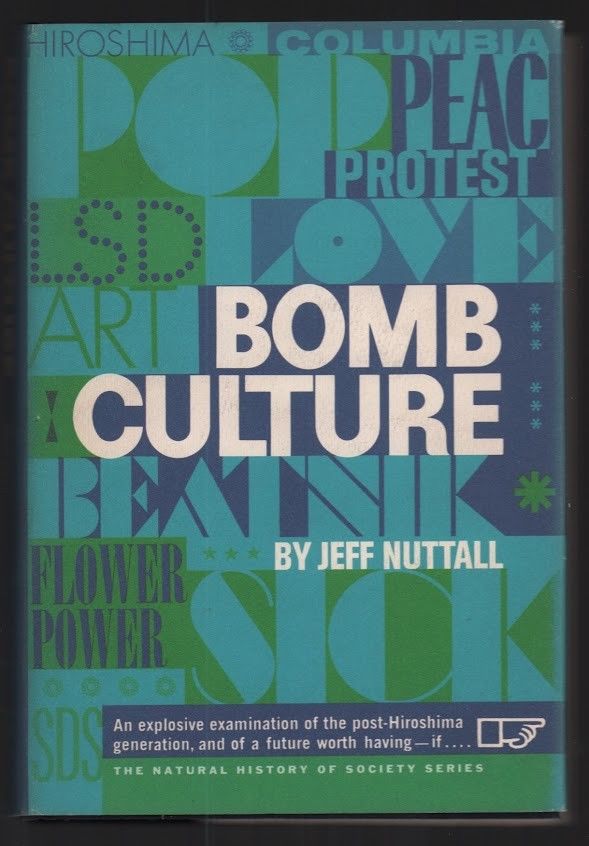
Jeff Nuttall in his seminal book Bomb Culture(1968) thinks that alternative attitudes in the UK grew out of the shadow and fear of the H Bomb. As the Cold War developed there was a constant reminder with the proliferation of nuclear weapons that the World could end any minute. This lead to massive demonstrations in the UK organised by CND (The Aldermaston Marches). Although these were attended by many thousands of people it became clear by the early sixties that the government had no intention of disarming or stopping the arms race. This lead to disillusionment and a feeling of alienation. Many young people began to reject the growing Affluent Societyand started creating their own culture much to the bewilderment of the older generation who, as Prime Minister Harold Macmillan said at the time, had “never had it so good”. A youth subculture emerged called The Beatniks by the press. They grew their hair, played trad jazz and folk music, frequented coffee bars and hitchhiked around the country, influenced by American beat writers like Jack Kerouac. In the UK this is where the Counterculture had it’s roots. Here is an unintentionally hilarious TV report about Beatniks in Cornwall in 1960:
Of note in this film is the playing and singing of Whiz Jones. You may think he is influenced by Bob Dylan but you’d be wrong. It was two years before Dylan’s first album was released, he hadn’t even arrived in New York by then. The guitar and singing style was undoubtedly learnt from American folk singer Ramblin’ Jack Elliot who was in England at the time and influenced a whole generation of British guitarists including Donovan (he was also a big influence on Bob Dylan!).
The roots of the American Counterculture are slightly different. Although there was the same fear of nuclear annihilation especially with the Cuban Missile Crisisof 1962 when the Soviet Union based nuclear missiles in Cuba within easy reach of the USA. Another factor was the Civil Rights Movement that was working to end racial segregation in the South and also the Vietnam War especially when conscription was accelerated from 1964. Out of this milieu a counterculture was created that eventually became what are known asHippies. This movement had a profound effect both in America and the rest of the World during the 1960s and it’s legacy has continued until now as I hope to demonstrate.
The UK and American countercultures influenced each other. Initially, the British counterculture imitated the Americans especially in the areas of poetry and the creation of Underground newspapers and magazines. As time progressed the British started influencing the Americans especially in the areas of art, fashion and music. The Beatles became the most popular and influential group in the World and embraced many countercultural ideas like drugs, mysticism and experimentalism. Paul McCartney was closely linked to the English Underground and was a main financier of the International Times, an important countercultural paper that had a wide distribution. Pink Floydemerged out of the British Underground with their take on psychedelic rock and, again, eventually became one of the most popular groups in the World.
The name Underground started to be increasingly used for the Counterculture although, really, this was a misnomer. The main players and self styled leaders were media savvy and natural experts in self promotion. (This was especially true of American Yippies Abbie Hoffman and Jerry Rubin. They achieved international fame at the Chicago Conspiracy Trial where the American justice system managed to appear both brutal and ridiculous. In a rare display of humour a member of the conventional left described their antics as Groucho Marxism!) It never really became underground until the 1970s when the mainstream media and press began to lose interest in it.
The Underground did not have a coherent political agenda. Although there was much talk of Revolution it was not clear what this really meant. This was true both in Britain and America. It definitely did not mean the same thing as what the old left referred to . The Communist states were seen as no better than the Capitalist ones and probably worse. Even Cuba, apart from the love for Che Guevara (who in the spirit of rock n roll died young and left a good looking corpse. He became the poster boy of the Revolution with his long hair and revolutionary beret!) was treated with suspicion. There was no strict ideology but general beliefs in the use of drugs (particularly marijuana and LSD), rejection of alcohol, free love, anti-war, anti-materialism, anti-consumerism, individualism, creativity, opposition to alienating work, rejection of television and advertising, caring for and living with the natural environment etc. The list could get very long and forms a general philosophy which is hard to formally categorise. The Revolution consisted of all these things. Slogans appeared that would have done justice to the best copywriters of Madison Avenue like “make love not war”, “turn on, tune in, drop out” and “do your own thing”.
So, why did the Revolution fail and where did it go wrong? Conventional wisdom would say that three events in 1969 caused a massive shift in attitudes. The infamous Charles Manson murders, The Woodstock Festival and the killing of a member of the audience by Hell’s Angels at Altamont Free Festival. The death of 60s idealism and the lost innocence of rock n roll is the theme of Don McLean’s song American Pie.
Charles Manson and his Family inverted the ideas of a hippy commune and went on a killing spree based on a psychotic interpretation of the Beatles White Album.
Woodstock is widely seen as the epitome and apotheosis of the Love Generation but can also be seen as the start of a megalithic, bloated and commercial music industry involving large scale festivals and stadium gigs. In order to attract popular acts large amounts of money were paid. Jimi Hendrix is reputed to have received $50,000, an incredible amount at the time equivalent to more than half a million now. Joan Baez virtually destroyed her credibility by accepting $10,000 even though she was using much of her own money to support radical causes. The festival made a colossal loss although that was recouped by subsequent sales of the film rights and DVD. A very interesting book about the making of this festival is Barefoot in Babylon by Robert Stephen Fitz. Rather than the music being an expression of the Counterculture a new commercial aristocracy was formed. The divorce between the music and the Counterculture was perhaps most symbolically shown when Pete Townshend of the Who knocked Abbie Hoffman off thestage with his guitar when Hoffman invaded the stage and tried to make an impromptu speech. It affected both people for years afterwards and effectively ended Hoffman’s political career. The clown prince of politics had been made to appear ridiculous and ineffective! Pete Townshend showed he wasn’t too enamoured with peace and love as this audio clip shows.
To deflect criticism of the cost of tickets on their 1969 tour of America the Rolling Stones gave a free concert at Altamont Speedway in California. This remarkably badly organised festival has become immortalised in the film Gimme Shelter (No, the Revolution wasn’t televised but it was often caught on film, which provided a good source of income from “Free” Festivals. The Stones had already done this with the Hyde Park Free Festival). The general air of chaos and violence is palpable with at least three deaths and a murder.
However, I don’t subscribe to conventional wisdom. Nor do I think that the Counterculture ended in 1969. As James Riley has said these events could just be coincidence and don’t signify anything. Personally, I think that after 1972 the Counterculture actually did go Underground. It was no longer really visible and it also became separated from the Music Industry which had become a large and profitable globalised industry. The press and media also lost interest until it gained notoriety again in the 1980s as the Peace Convoyand the New Age Travellers. This culminated in the savagery and brutality of mainstream culture under Thatcherism at the Battle of the Beanfield. This is an Observer article about this event twenty years later:
“* Tony Thompson, crime correspondent * The Observer, Sunday 12 June 2005
It looked just like a carnival – at first. The weather was sunny and music played as the 140 vehicles set off towards Stonehenge. The 600 or so Travellers were on their way to attend the annual free festival on squatted land beside the ancient stones.
A few hours later the convoy had been ambushed by more than 1,300 police officers; dozens of Travellers were injured, all but a handful were arrested, and every one of their vehicles was destroyed.
This month marks the 20th anniversary of what has become known as the Battle of the Beanfield. Despite four months’ planning, the police operation to stop the convoy was a shambles. Faulty police intelligence suggested the Travellers were armed with chainsaws, hammers, petrol bombs and even firearms. All this information was false.
Plans to stop the convoy near the A303 collapsed when a convoy outrider spotted the roadblock and directed the travellers down a side road, where they encountered a second roadblock. After a first wave of violent assaults by the police, in which windscreens were smashed and the occupants dragged out screaming, most of the vehicles broke into a neighbouring field, derailing the police plan further.
For the next four hours there was a standoff, while Assistant Chief Constable Lionel Grundy, the officer in charge, insisted all Travellers had to be arrested.
The final assault began at 7pm, by which time all the officers had changed into riot gear. Pregnant women were clubbed with truncheons, as were those holding babies. The journalist Nick Davies, then working for The Observer, saw the violence. ‘They were like flies around rotten meat,’ he wrote, ‘and there was no question of trying to make a lawful arrest. They crawled all over, truncheons flailing, hitting anybody they could reach. It was extremely violent and very sickening.’
When some of those remaining tried to get away, driving their vehicles through the beanfield, the police threw anything they could lay their hands on – fire extinguishers, stones, shields and truncheons – at them in order to bring them to a halt. The empty vehicles were then systematically smashed to pieces and several were set on fire. Seven healthy dogs belonging to the Travellers were put down by officers from the RSPCA. In total, 537 people were arrested – the most arrests to take place on any single day since the Second World War.
All those arrested were charged with obstruction of the police and the highway, but most of the charges were dismissed in the courts. The Travellers’ unexpected saviour was the Earl of Cardigan, whose family owned the forest where the convoy had stayed the night before. Cardigan had tagged along out of interest, and his descriptions of the violence prevented what might otherwise have become a major miscarriage of justice.
Cardigan recalled that in many cases ‘the smashing up of the vehicles and the instructions to ‘Get Out! Get Out! Get Out!’ and hand over your keys were given simultaneously and therefore there was no chance to understand what was being shouted at you, and to comply before your vehicle started disintegrating around you with your windscreen broken in and your side panels beaten by truncheons and so on.’
It remains a mystery why the police felt compelled to use such violence. With evidence that radio logs of conversations between officers on the day have been altered, the full story may never be known.
‘The Battle of the Beanfield remains a black day for British justice and civil liberties,’ says Andy Worthington, whose book on the event is published this week. ‘From the anti-Traveller legislation of the 1986 Public Order Act and the 1994 Criminal Justice Act to the current hysteria surrounding Gypsy and traveller settlements, the repercussions are still being felt.‘”
The 1986 Public Order Act caused many New Age Travellers to leave England to more tolerant places like Spain and New Zealand. Interestingly, the hippies that Francis Upritchard came across may have been refugees from this time.
Margaret Thatcher was an enigma. Behind the authoritarian Iron Lady facade she wasn’t even really a Tory. She is considered to be the first of what are called conviction politicians. She appeared motivated by a mission and set of beliefs. Tony Blair and David Cameron have also used this approach and in some ways are seen as her successors. Thatcher’s beliefs had more to do with 19th Century Economic Liberalism than traditional Tory concerns. Her mission was to restore the British nation to it’s former glory and roll back the tide of National Debt, Trade Unions holding the country to ransom and encourage Free Trade and Private Enterprise. She famously hated the sixties and virtually saw that period as the main cause of the country’s woes with it’s strong Trade Unions, Nationalised industries and Social Liberal values.
Margaret Thatcher was ruthlessly effective and she chose her battles well. By defeating the Miner’s Strike and legislating against the Closed Shopshe seriously reduced the power of the Trade Unions. At the same time she closed down most of the old heavy industries like steel, ship building and coal mines. By deregulating the banks, Privatising Nationalised businesses like energy and telecommunications and giving council house tenants the Right to Buy she effectively created a new capitalist society which boomed on the back of investments, services and rising house prices. It seemed to work so well that with the fall of the Berlin Wall in 1989and the end of the Cold War political economist Francis Fukuyama declared “What we may be witnessing is not just the end of the Cold War, or the passing of a particular period of postwar history, but the end of history as such…. That is, the end point of mankind’s ideological evolution and the universalization of Western liberal democracy as the final form of human government.” Mind you, considering events that happened in 2008, this was probably a bit premature!
But, I would still contend that the ideas of the 60s Counterculture permeated this period. As I have already said, Hippie ideals were resurrected with the Peace Convoy which was attracting many people to it, especially the legion of unemployed created by Thatcher’s early policies. But the ideas had also influenced the mainstream. The new bankers and brokers of the “Greed is Good” years were not the conservative bowler hatted bores of yesteryear but cocaine sniffing, champagne swilling hedonists who roared round London in new Porsches. They were into conspicuous consumption and, dare I say, a rock n roll life style. Also, the type of entrepreneurs that Thatcher was trying to encourage already existed in businesses started in the 60s. Although not British, clothing store chain The Gap, started as a “head shop” in San Francisco. Global business Time Out started when Tony Elliot took over the listings page from International Times because no one else could be bothered to do it! It became an immensely profitable business. Perhaps the most well known business with counterculture roots was Richard Branson with his Virgin brand. This started off as a mail order record company in the late 60s. All of these businesses brought a more relaxed, casual style and in the case of Branson a kind of celebrity status that would never have happened in the past. Basically, countercultural ideas had been assimilated by the mainstream.
However, the real Underground continued both in the Peace Convoy, the Greenham Common Women’s Peace Camp and more recently with the Occupy Movement which has become a global phenomenon. I will say more about this later!