A Week in Florence

image

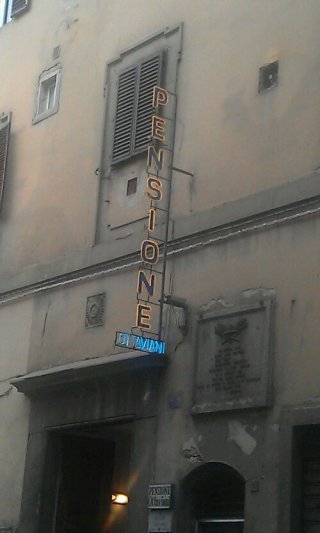
Pensione Ottaviani where we were staying. Excellent and friendly small hotel in the heart of the city.

Here we are. First day on a trip to Florence staying at a delightful little hotel called Pensione Ottaviani right in the heart of the city. The beautiful church of Santa Maria Novella is just across the road and the Duomo is a short walk away. The weather is good but not too hot. Perfect weather for sightseeing. The only problem is deciding where to go first. It’s Sunday so there may be problems visiting churches unless we attend mass. No, I think maybe the best thing is to visit the Piazza del Duomo and then to the Ponte Vecchio and across the river to the Boboli gardens and the Palazzo Pitti. Yes, that’s a good idea.

image

Palazzo Pitti. Grim palace that looks a bit like a prison. Home of the Medicis at one time. The Boboli Gardens behind are very nice.

The Palazzo Pitti is a pretty grim looking place that was the residence of one of the wealthy dukes that dominated Florence. It looks a bit like a prison from the outside and there are no benches or chairs to sit on in the square in front. They obviously still want the peasants to suffer! The Boboli Gardens in the rear are very pleasant and afford a very good walk if you can afford it. The reason for going inside is to view one of the best exhibitions of Renaissance art there is with works by Raphael and Titian and many others. They are hung in the way they would have been presented originally and so give a different perspective to the paintings than in a normal gallery. There are some excellent pictures in there but also quite a few that I would consider mediocre. In some ways I found it quite a depressing litany of images of the rich and powerful who don’t really deserve to be remembered. They stare blankly from the walls and you feel they are trapped forever in their own conceit. The whole experience is like a homage to a vacant and meaningless materialism. The religious pictures sit uneasily with the portraits. Why did they want pictures of the dieing Christ on their walls? The sheer scale of the opulence of the palace scream out against any kind of humility or charity. This is a truly bizarre experience and one that is quite tiring because there are so few chairs and benches inside as well. Time for a nice cappuccino I think.

image

Florence, place of great cappuccinos!! Or should that be cappuccini!

OK, time to move on. The Duomo is a truly astonishing place. It’s size is immense. Apparently, it took over a hundred years and the genius of Bruneleschi to work out how to put a roof on it without it falling down. It represents an amazing ambition to create something that had never been done before. This cathedral dominates the city of Florence and is clearly visible from all the vantage points in the surrounding hills.
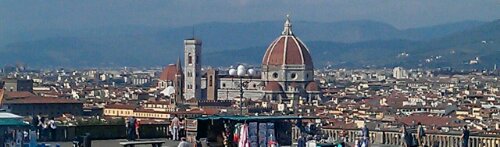
Another view of the Cathedral and the Campanile. Astonishing buildings and so big!

Florence is a lovely city and is very self contained. The people are also very friendly even though it is packed with tourists, even in October. It is easy to walk to all the main attractions and the restaurants are also good. It’s a bit on the expensive side but I suppose that’s to be expected. Next stop is Ponte Vecchio which is truly remarkable lined mainly with jewelry shops.

Ponte Vecchio

The first big exhibition we went to was at the Palazzo Strozzi called “The Thirties. The Arts in Italy Beyond Fascism”. This was a fascinating exhibition that demonstrated the variety of artistic expression that was taking place even under the cultural,totalitarian restrictions of Fascism. There were some disturbing examples of Fascist and Nazi art alongside experimentalism and expressionistic work. Things got really bad in 1938 though when Italy enacted it’s own racial law under pressure from the Nazis. The holocaust had reached Italy! This is what the curator says about the exhibition:

“The Thirties. The Arts in Italy Beyond Fascism comprises 96 paintings, 17 sculptures and 20 objects of design and tells the story of a crucial era characterised by an extremely vigorous arts scene in the years of the Fascist regime, against a backdrop that included the embryonic development of mass communication in Italy – radio, cinema and illustrated magazines – which stole numerous ideas from the “fine” arts and transmitted them to a broader audience. This retrospective illustrates an era that profoundly changed the history of Italy. The 1930s also witnessed the increasing mass production of household objects, which led to dramatic changes in people’s lifestyle, allowing ordinary families to live out a dream of modernity surrounded by designer objects, a practice that continues to this day”.

I would recommend this exhibition if it comes your way.

Programme for the exhibition

Palazzo Strozzi
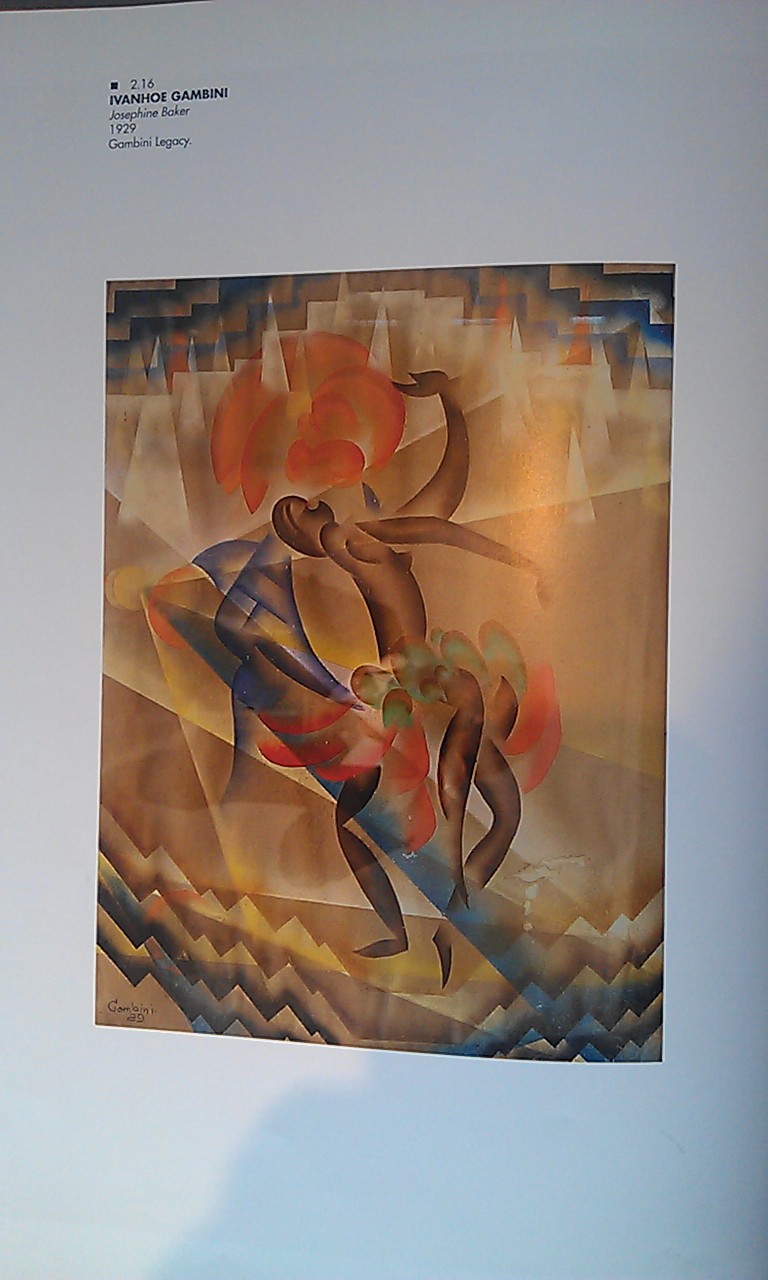
Josephine Baker.

Crude propaganda using Futurist techniques with a touch of Art Deco!

Dream Complex No.1

It’s a hard slog walking around exhibitions (but in this case worth it). Time for a nice sit down and a rest outside the Santa Maria Novella church.
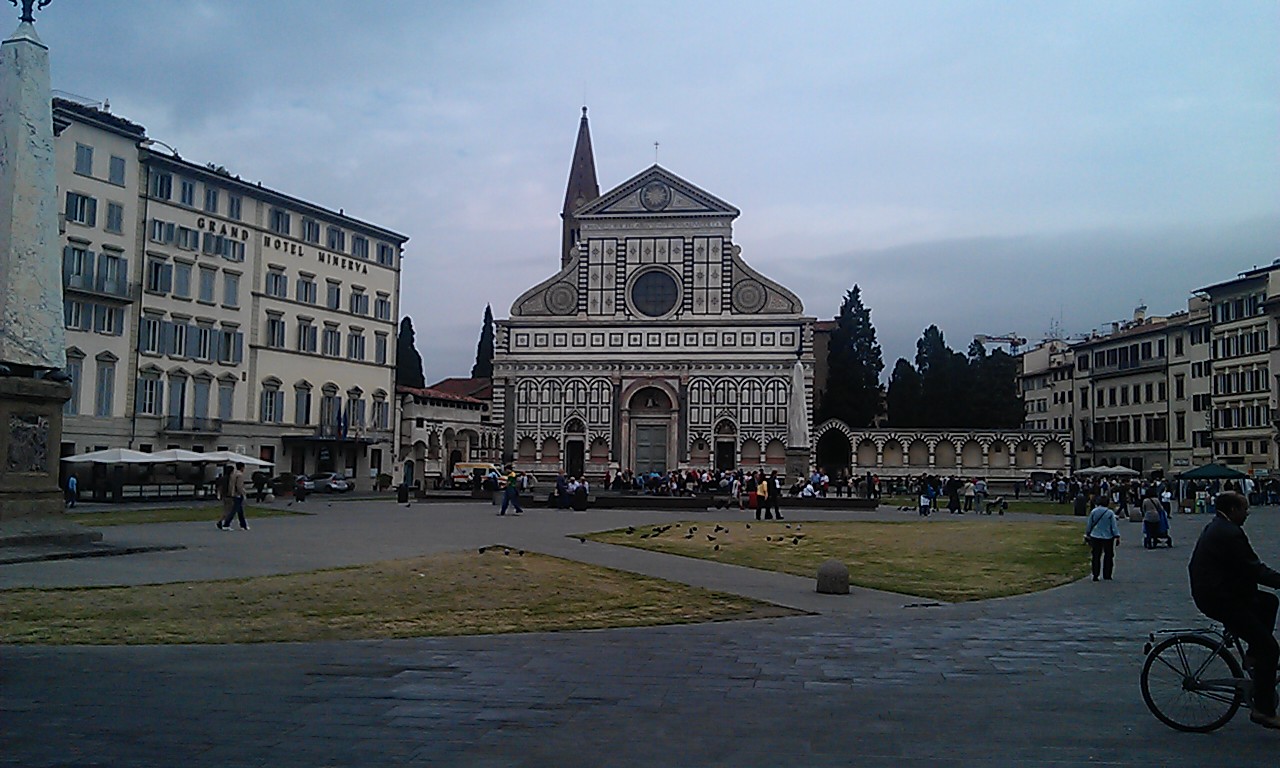
Santa Maria Novella

Sue outside Santa Maria Novella
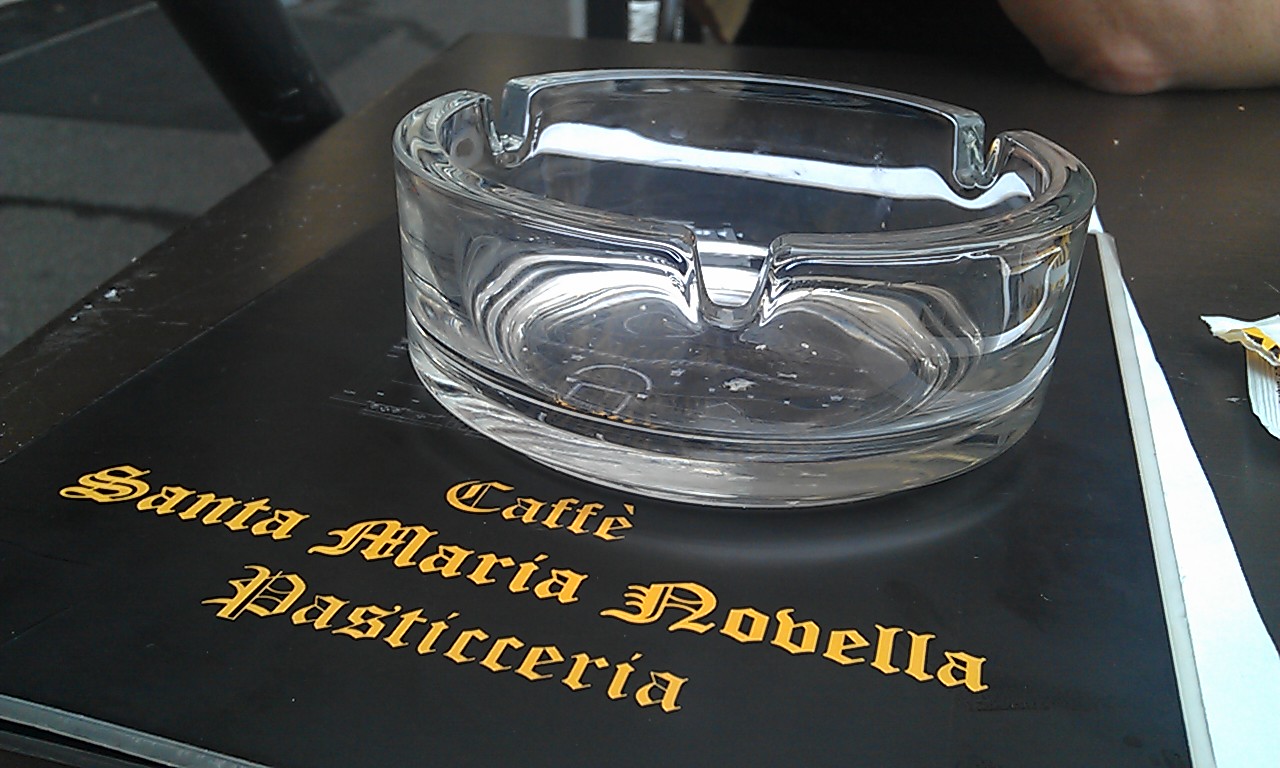
Nice caffe!!

Beautiful cloisters at Santa Maria Novella.
Mmm, Special Effects! That’s what that button does!!

The church of Santa Maria Novella is beautiful and contains many astounding frescoes. Unfortunately they don’t allow you to take photos ( a common thing in most museums and art galleries which I think is a bit mean really). The stand out feature though is the crucifix painted by Giotto. It is a sublime and beautiful piece of work.
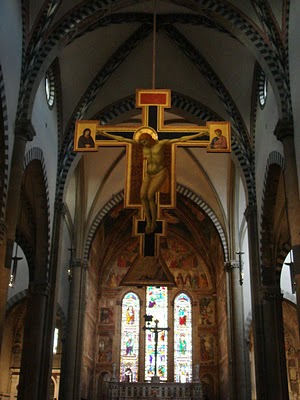
Crucifix painted by Giotto.

We spent two days travelling round Florence on an open top bus. Fortunately, the weather remained good for most of the time although there were a few heavy showers at times. The view from Piazzale Michelangelo is breathtaking and it contains one of the many copies of David, the sculpture of which Vasali said that once you’ve seen it you’ll never need to see another sculpture. The original is in the Accademia which we visited and it really is breathtaking. The hands and feet look like they might start moving any minute! It is enormous and seems to be alive!

Michelangelo’s David

Thursday night we went to the open mic at the Irish pub “The Fiddler’s Elbow” on Piazza Santa Maria Novello. Not many people there but had a really good time. Was asked to play at a Bob Festival to be held next May. That’ll be fun!

On the last day we went to Pisa where we were flying from. Spent the afternoon having a meal with the leaning tower in the background. Very nice!

The leaning tower. Nice hat!

The cathedral at Pisa.

Vandalising Rothko

The news item that interested me most in the past week is about the vandalising of a Mark Rothko canvas in the Tate gallery. The kind of outcry that this caused was quite interesting. An article by Jonathon Jones in The Guardian described it as virtually a sacrilegious act even though it’s not a religious painting. He displays a sense of awe and wonder that puts all Great Artists on a pinnacle and compares their work to some kind of deep spiritual experience. Other articles in the same paper either give a history of the grand tradition of vandalising art or described works of art that might be improved by vandalism!

image

The vandalised Rothko. He writes “a potential piece of Yellowism”. But how will it become an actual piece of Yellowism? Will this improve the value of the painting as Umanets has suggested?

Included in his article Jonathon Jones expresses outrage concerning the vandalism of Michelangelo’s Pieta with a hammer. I dare say many people share this outrage and agree with the many comments on Twitter that would condemn these perpetrators to torture, death or worse. However, there as been a long history of vandalising Great works of art. I am writing this in Florence, Italy and found out before this recent act that Michelangelo’s iconic sculpture David was vandalised with a hammer shortly after it was erected. It seems that hammers, knives and machetes are the most favoured weapons of destruction for vandalising art but shotguns and sulphuric acid have also been used. The statue symbolised Florence’s republican resistance to the autocracy of the Medicis (David versus Goliath) and was seen as a legitimate target by the supporters of the aristocracy! But perhaps the biggest collective act of vandalism occured during the English Civil War when a massive amount of art work and buildings were destroyed by the Puritans. Henry VIII was quite a major perpetrator as well when he dissolved the monasteries in search of loot!

image

Showing the damage done to Michelangelo’s Pieta with a hammer.

Vladimir Umanets was an unknown Pole until last week. Now he has achieved celebrity by tagging Rothko’s “Black on Maroon” at the Tate Modern. He compares himself to Marcel Duchamp who signed a urinal and presented it for exhibition in 1917 thus creating perhaps the first piece of conceptual art. He also likens himself to Damian Hurst who has signed his name to work he has not done. Umanets has said he is part of a new art movement (consisting of him and one other) called Yellowism. He expresses an appreciation of Rothko’s work who he sees as a seminal Yellowist. Now, is this guy crazy or is he making a valid point?

Duchamp famously produced a post card featuring the Mona Lisa on which he drew a moustache and goatee beard. No doubt, he would have preferred to have defaced the real picture but was either unable to or too scared of the consequences. Either way it was a controversial act that blew a giant raspberry at the art establishment and became iconic in it’s own right and later, in a parody of the conventions of classical art, was copied by Salvador Dali albeit with a different moustache. Dali had his own style in vandalism. When presented with a picture by Andy Warhol, apparently he threw it on the floor and pissed on it. Warhol remained calm and detached throughout. Perhaps he couldn’t decide whether it was a compliment or an insult!

image

Duchamp’s great masterpiece!!

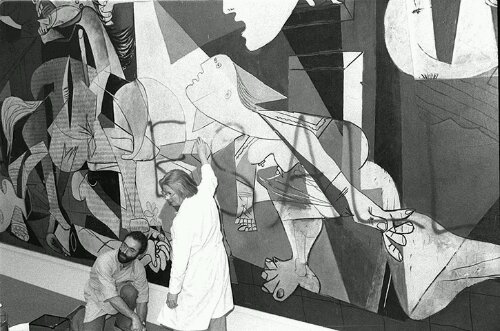
I think Umanets was quite brave in what he did. Witnesses say he sat quietly for a long time and then wrote on the painting with a black pen. He knew he would be caught and was ready with his explanation. Unfortunately, he either hasn’t said (or it hasn’t been reported) what Yellowism actually is. This would make it more meaningful like the anti-war protest perpetrated on Picasso’s Guernica. Defacing Great works of art will always get you attention and will guarantee you a place in history (although maybe for all the wrong reasons)!

image

“Lies all Lies” written on Picasso’s Guernica. This is a strange protest considering the painting is already anti -war. Why didn’t he pick a painting that glorified war of which there are many?

Another remarkable case of vandalism was when suffragette Mary Richardson attacked Rokeby’s Venus with a meat cleaver. This actually became a picture in itself. She was drawing attention to the hunger strike of Mrs. Pankhurst that was happening at the time. Considering the subject matter of the painting it could also been seen as an act of proto-feminism.

image

Mary Richardson being apprehended at the National Gallery, London after attacking Rokesby’s Venus with a meat cleaver.

Personally, my favourite piece of art vandalism is when two Chinese students stripped to the waist and had a pillow fight on Tracy Emin’s Bed. Although, in this case, a more effective piece of vandalism would be if someone sneaked in and tidied it up and washed the sheets. Now that would be hilarious!

image

Bouncing on Tracy Emin’s bed!

Day Trip to Sheffield

Decided to go to Sheffield today and give a running commentary of while I am here. Just got off the train and am now in the town centre sitting in a Caffe Nero. You probably realise by now that my life centres around Caffe Neros and Wetherspoons. One sells expensive coffee and the other sells cheap beer. They both use the same free WiFi provider though and I can use the same login details. God, this is even beginning to bore me! Sorry!

image

Caffe Nero. Town Hall in the background. It looks a bit like a fairy tale castle. Incredibly grandiose!

Sheffield is amazing. This is the first time I’ve looked around the city although I’ve been here times in the past doing gigs. Same thing happened in Derby. I felt like I knew the places but I don’t at all. Well, at least I’m making up for it now.

image

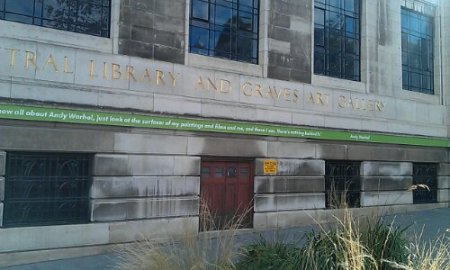
Graves Gallery

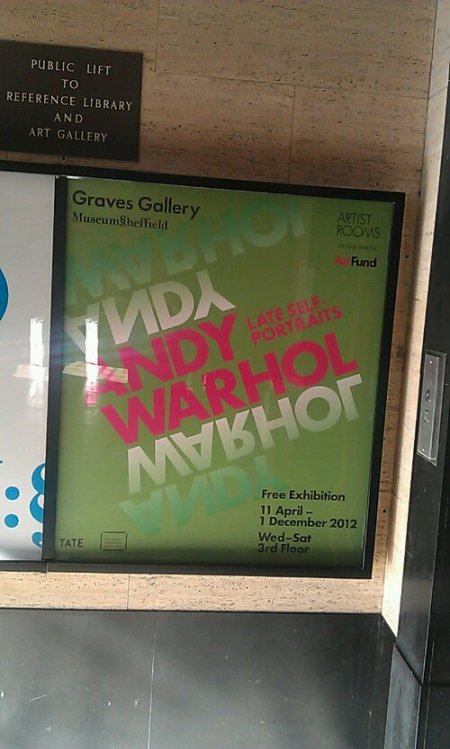
One of the reasons for coming here was to visit Graves Art Gallery where there is an exhibition of Andy Warhol self portraits. I’ve been interested in Warhol since the heady days of the 60s. Initially it was because of his association with the Velvet Underground and the hedonistic partying of the Factory. This became the stuff of legends and was attractive to an impressionable teenager like me. We tried to create our own version of The Factory in Leicester. At that time Warhol was the pre-eminent underground film maker and many of his films were shown in Leicester at our self created Arts Lab. I was impressed by their extreme nature and humour. I then became interested in his art but saw it mainly as iconoclastic and nihilistic which suited my state of mind at the time. I’ve since seen many of his paintings in galleries and realise he was a great stylist who had much to say. Even his car crash pictures have a strange kind of beauty about them and I never realised how big they were! It is clear he loved baiting the art establishment and he also loved critics and intellectuals who found a meaning in his work he never thought was there. His real achievement was to create profundity out of the ordinary, something I respect and have always tried to emulate. The mundane can be interesting with the right mental attitude. In fact, I believe everything is interesting! By making a Brillo box and Campbell’s soup cans ART he exposed the shallow commercialism of all art. They are ordinary objects in a supermarket but display them in a gallery and they become ART. There is no difference between a Warhol on the art market and a Van Gogh or a Da Vinci. Van Gogh may have been a tortured genius attempting to communicate with the world but his work is now seen as a high value commodity. Da Vinci was a product of the patronage of the Medicis of Florence. Their works are  just expensive and rare products that the rich invest in, more valuable than gold! Essentially, they are all the same. Even the Abstract Expressionists played the same game. They may not have liked it but they were just part of the system. Warhol knew exactly what it was about: MONEY. When he moved from advertising to being an ARTIST he really saw no difference in the two areas apart from the fact that ART could be far more lucrative to the artist and give him fame and celebrity. That’s why the art establishment hated him so much. He exposed it’s commercial core. Some of his comments like “everyone in the future will be famous for 15 minutes” ,”art is what you can get away with” and “I’m a deeply superficial person” show a real insight into the workings of the art and culture industries. Notice the emphasis on “deeply“. He wasn’t totally superficial he was deeply superficial. The ultimate post-modernist statement!

image

Andy Warhol poster

Well, true to form I came on the day when the Graves Gallery was closed. I seem to make a habit of this. So, I didn’t see the self portraits of Andy Warhol but I did see the public library that it is part of. Very impressive as is the square that it belongs to. I went to the Millenium Gallery nearby that has several exhibitions in it. The John Ruskin gallery is nice but didn’t really rock my boat.

image

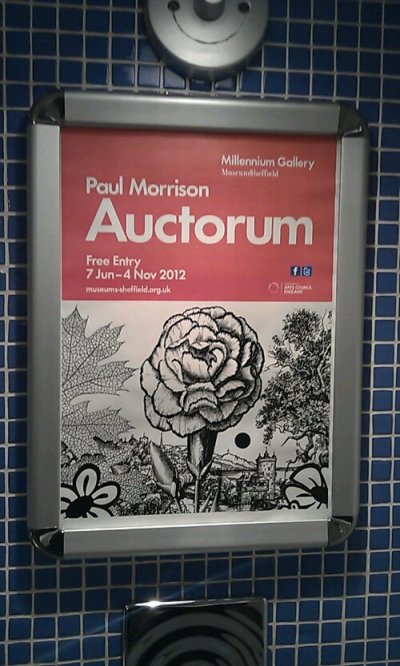
Paul Morrison poster

The exhibition of Paul Morrison was far more impressive. He is a local Sheffield artist who has achieved some fame and renown around the world. I really liked his work. He creates weird landscapes that seem strangely normal until you look closer and realise the anomalies. His video art is also interesting with changing views of water and aquarian growth. He is truly post-modern borrowing from nearly everything. I particularly liked his Bridget Riley inspired op-art piece which unfortunately did not translate into my photograph. Sheffield, I WILL be back!

image

Paul Morrison op-art flower

Day out in Derby

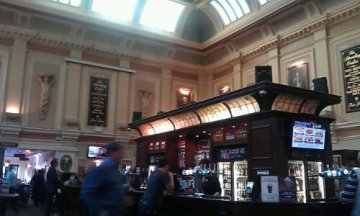
Well, here I am in Derby in the grandest looking Wetherspoons I’ve ever been to.  I think it used to be a bank. Very impressive. Can’t decide whether to have one of their curries though. The decisions I have to make!

image

Derby Wetherspoons

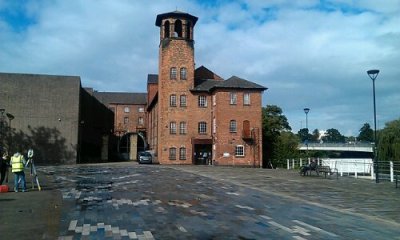
Derby is interesting. Never really looked around it before. The cathedral is quite boring, very Protestant, but there are some interesting plaques of eminent figures of the city’s industrial past. In fact, I didn’t realise that Derby had the first self-contained factory and is therefore at the beginning of the Industrial Revolution. Around the Silk Mill is a World Heritage Site. Quite picturesque with the River Derwent flowing past it.

image

The Silk Mill

Went to the Museum & Art Gallery. There is quite a disturbing exhibition of the town’s army regiments. I didn’t realise the extent of British agression overseas. Not just the obvious ones but South America and other places I didn’t realise the British ever went to. For all the talk you hear about Free Trade, it was actually Forced Trade! It also contains information about how the military controlled riots and civil disobedience at the time of the Industrial Revolution. Frightening stuff! There is also an interesting historical connection with Bonny Prince Charlie and the Jacobite rebellion where local troups were used to repel them. Thought that was just going on in Scotland. Me? I’m on the side of Charlie!! And the workers!!

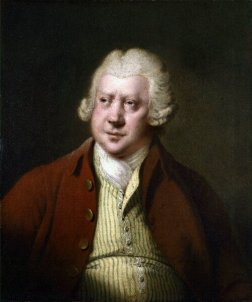
The art gallery is quite limited but there is a good exhibition of Joseph Wright. His paintings exhibit great technique but really just pander to the status quo. Some interesting portraits of the Arkwright family who were the arch capitalists of the 18th/19th Centuries. It’s interesting, like the de Medici’s of Florence, people from humble backgrounds who achieve great wealth need to immortalise themselves in works of art. Joseph Wright is no Leonardo Da Vinci though!

image

Sir Richard Arkwright by Joseph Wright

I like Derby. Next time I’ll bring my guitar and do a bit of busking.

Woody Guthrie Night at The Musician Leicester

Had a busy weekend just gone preparing for a Woody Guthrie memorial concert at the Musician Venue, Leicester. On Saturday morning I decided I needed to practice and learn some new songs so that I had enough for the night. I didn’t think I needed too many though because a film was being played and there were going to be other participants, I thought.

I was practicing and enjoying what I was doing then I decided to record some of them so I could hear what they sounded like. Well, I was quite pleased with the results so I decided to make a CD of my versions of Woody songs that I would give away to the audience on the night. From that moment my whole weekend was involved with recording, mixing and manufacturing CDs with covers. I made 20 and then gave up. It’s so time consuming!

Sunday night and the concert came around. I got there early and set up and sound checked. Then I found the film was not being shown and there were no other participants! It was entirely my own show! This was when I panicked. Fortunately, my friend Jenny Carter turned up and joined me on violin. I did two sets and did a lot of talking between numbers explaining the background of the songs and also about Woody’s guitar style which was a big influence on me. The whole night went really well and I found I had enough songs. It was quite inspirational for me and reignited my love of Woody’s music and his superb lyrics. He manages to combine simplicity with profundity. A remarkable writer.

The gigs are coming in rapidly at the moment. Am playing tonight at the Leicester O2 Academy for University overseas students and have just got a gig for the Hind pub, Leicester on Saturday. Am looking forward to this. I used to play there regularly but the pub changed hands. It’s a great place to play and, hopefully, I will get more gigs  out of it.

Check out one of my Woody recordings below.

http://soundcloud.com/kenny-wilson/slipknot

James Riley’s talk

Here is a link to James Riley’s superb talk:

James Riley’s talk

Nottingham Contemporary

A strange thing happened to me on Thursday. On a complete whim I decided to take a train to Nottingham. I had a bit of a walk round and then went to Caffe Nero for a cappuccino. So far so boring. Then I decided to visit a gallery. I’ve never been to Nottingham Contemporary before so I decided to give it a try.

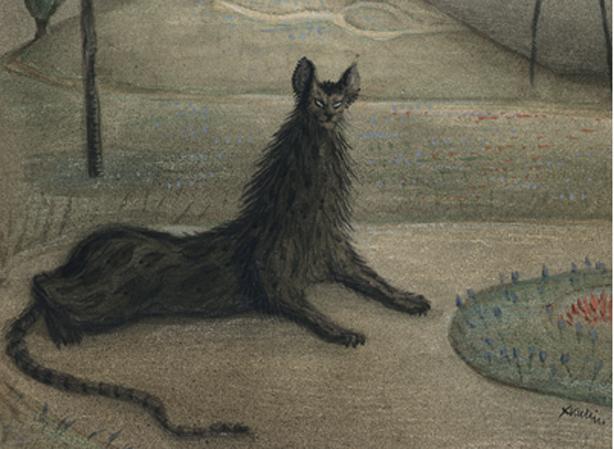
There were two exhibitions on. One was an exhibition of drawings by Alfred Kubin, an Austrian artist and writer who I have never heard of before. He is described as a late Symbolist and all the drawings were made as a young man in the late 19th/early 20th centuries. They are incredibly powerful and predate but are similar to later Surrealist works. This is what the programme notes say:

“Haunting drawings of death, trauma and fantastical creatures inhabiting imaginary worlds sprung from Alfred Kubin’s pen at the beginning of the 20th century. His work, executed in a delicate, atmospheric ink wash technique, anticipated some of the horrors of the First World War, and the following decades, at a time when Europe’s empires were toppling. His exquisite, yet nightmarish black and white drawings came from his own imagination, or from illustrating works by writers like Fyodor Dostoyevsky and Edgar Allan Poe.” I would definitely recommend visiting this exhibition.

The other exhibition was of Francis Upritchard who is a New Zealand artist. At first I couldn’t quite see what her sculptures were aiming at. The more I looked at them though the more it became apparent, helped by the exhibition notes! Again, they are very impressive and quite haunting. I was most impressed by the “Hippies and Holy Fools” section. There seems to be a weariness and almost hopeless feel to them as though it is the last clinging to  a lost ideal. This is what the notes say about it:

“Francis Upritchard’s psychedelically coloured human figures “live” on islands of ornate furniture. There is a festival feeling to their gatherings, emphasised by Upritchard’s acid-bright colours, hand-woven blankets and tie-dyed silks. Upritchard has said “all the things that hippies hoped would happen, or felt might happen, didn’t.” In one sense her exhibition is about the failure of the 1960s and 70s counter-culture that is still celebrated at festivals – and its gaudy, individualistic “alternative” aftermath.”

What really struck me about this exhibition is how close it was to what I’ve been thinking about my own past as I write about it in “My Life In Music” and also what a coincidence it was that I had discovered the exhibition by chance. I’d only just finished writing about how the year of the Woodstock festival had seemed like the end of an era to me. I haven’t referred to any other sources other than my own memories and here I was confronted by my own feelings. Even more astonishing was a talk by James Riley that I saw in the study area of the gallery. In this he speaks about ” the symbolic status of 1969 as a terminal point at which the decade’s earlier optimism gives way to death, violence and ‘bad craziness’.” Almost exactly what I’d been thinking and writing. I came away feeling quite strange and determined to follow up some of the leads he discusses and to continue my own work. It’s taking on an importance I never really intended!