I went to see this film this week at the Phoenix Square Cinema, Leicester. It is a very impressive picture. The cast are very natural and believable. It is directed by Iranian director Asghar Farhadi who creates a mystery tale that deals with well intentioned deceit and lies. This is the plot outline:
A group of middle-class Iranian friends travel to the shores of the Caspian Sea on a three-day vacation. They are former classmates at the Law faculty in the university. Three couples include Sepideh and her husband Amir who have a little daughter. Shohreh and her husband Peiman who have two children including their little son Arash. Nazy and her husband Manoochehr are the third family. The trip is planned by Sepideh, who brings along her daughter’s kindergarten teacher Elly in order to introduce her to Ahmad, a friend who has come back from Germany to get married.
They all go to the villa that Sepideh has booked from Tehran, but the rural woman in charge tells them that the owners of the place were going to come back the next day, so they wouldn’t be able stay there. The old woman suggests that they stay in a deserted villa that needs a lot of repairs. There would be no cellphone reception there and they would have to go to the old woman’s house in order to make calls. Sepideh lies to the old woman about the relationship between Elly and Ahmad: she says they’re married and are there for their honeymoon.
Elly is a bit shy, but she begins to feel attracted to Ahmad, who seems to feel the same. She calls her mother and lies to her saying that she’s with her co-workers at the sea-side. She wishes to go back to Tehran the following day, as planned. Sepideh does not want her to leave and hides her luggage. In a twist of events, Elly goes missing after one of the mothers asks her to watch the children playing in the water. The group does not know whether Elly drowned or left for Tehran on her own.
It is interesting, considering media representations of Iran, how ordinary the participants are. They could be a group of people from America or Europe visiting the seaside. It shows the importance of World Cinema in breaking down stereotypes. Many people’s views of Iranian society are probably of mad jihadists and women in burqas. This is far from the truth. The film does deal with things like honour but in a totally comprehensible way. It is both a riveting mystery tale and an exploration of guilt and lies. Highly recommended!
In 1964 Herbert Marcuse published a book called One Dimensional Man in which he describes the advanced capitalist countries of the developed world as Totalitarian. This controversial statement was met with both bewilderment and ridicule. The world was at the height of the Cold War and the countries of the West saw themselves as a bulwark of freedom against the Communist dictatorships of the East, especially the Soviet Union. At the same time America was fighting an unwinnable war in Vietnam, again on the principle of freedom and democracy. America and the West were presenting themselves as the opposite to the oppressive totalitarian Eastern regimes. Of course, at the same time, the Communist regimes were declaring themselves as liberators and freedom fighters from oppressive Capitalism. In many people’s minds these were, in fact, two sides of the same coin and the only real losers were ordinary people! This is what Marcuse says about it:
“Does not the threat of an atomic catastrophe which could wipe out the human race also serve to protect the very forces which perpetuate this danger? The efforts to prevent such a catastrophe overshadow the search for its potential causes in contemporary industrial society. These causes remain unidentified, unexposed, unattacked by the public because they recede before the all too obvious threat from without–to the West from the East, to the East from the West. Equally obvious is the need for being prepared, for living on the brink, for facing the challenge. We submit to the peaceful production of the means of destruction, to the perfection of waste, to being educated for a defense which deforms the defenders and that which they defend.
If we attempt to relate the causes of the danger to the war in which society is organized and organizes its members, we are immediately confronted with the fact that advanced industrial society becomes richer, bigger, and better as it perpetuates the danger. The defense structure makes life easier for a greater number of people and extends man’s mastery of nature. Under these circumstances, our mass media have little difficulty in selling particular interests as those of all sensible men. The political needs of society become individual needs and aspirations, their satisfaction promotes business and the commonweal, and the whole appeals to be the very embodiment of Reason.
And yet this society is irrational as a whole. Its productivity is destructive of the free development of human needs and faculties, its peace maintained by the constant threat of war, its growth dependent on the repression of the real possibilities for pacifying the struggle for existence–individual, national, and international. This repression, so different from that which characterized the preceding, less developed stages of our society, operates today not from a position of natural and technical immaturity but rather from a position of strength. The capabilities (intellectual and material) of contemporary society are immeasurably greater than ever before-which means that the scope of society’s domination over the individual is immeasurably greater than ever before. Our society distinguishes itself by conquering the centrifugal social forces with Technology rather than Terror, on the dual basis of an overwhelming efficiency and an increasing standard of living.” (Marcuse: One Dimensional Man)
Since the fall of the Soviet Union and the assimilation of China into Global Capitalism a new enemy has been found in Islam and The War Against Terror. Of course, none of the Islamic nations can militarily compete with America so other ways of expanding the war machine have become necessary. Instead of defence (although this term is still used as a description) it becomes necessary to invade countries that “support terrorism”(which in a typical piece of Orwellian newspeak is usually called intervention in the same way that the killing of innocent civilians in the course of these interventions is called collateral damage). In fact, engaging this new enemy has been more productive in the mobilization for war because the weapons actually get used and therefore need to be replaced. It also means new and more effective weapons are researched and developed e.g. drones.
Marcuse considers advanced capitalism as totalitarian because of the way it uses technology and employs rationalism and science to support something that is, in fact, irrational. This creates an idea of common sense that is hard to refute i.e. why should anyone criticise the system when it is creating a high standard of living?
” By virtue of the way it has organized its technological base, contemporary industrial society tends to be totalitarian. For “totalitarian” is not only a terroristic political coordination of society, but also a non-terroristic economic-technical coordination which operates through the manipulation of needs by vested interests. It thus precludes the emergence of an effective opposition against the whole. Not only a specific form of government or party rule makes for totalitarianism, but also a specific system of production and distribution which may well be compatible with a “pluralism” of parties, newspapers, “countervailing powers,” etc” (Marcuse ibid)
“Indeed, in the most highly developed areas of contemporary society, the transplantation of social into individual needs is so effective that the difference between them seems to be purely theoretical. Can one really distinguish between the mass media as instruments of information and entertainment, and as agents of manipulation and indoctrination? Between the automobile as nuisance and as convenience? Between the horrors and the comforts of functional architecture? Between the work for national defense and the work for corporate gain? Between the private pleasure and the commercial and political utility involved in increasing the birth rate?
We are again confronted with one of the most vexing aspects of advanced industrial civilization: the rational character of its irrationality. Its productivity and efficiency, its capacity to increase and spread comforts, to turn waste into need, and destruction into construction, the extent to which this civilization transforms the object world into an extension of man’s mind and body makes the very notion of alienation questionable. The people recognize themselves in their commodities; they find their soul in their automobile, hi-fi set, split-level home, kitchen equipment. The very mechanism which ties the individual to his society has changed, and social control is anchored in the new needs which it has produced.
The prevailing forms of social control are technological in a new sense. To be sure, the technical structure and efficacy of the productive and destructive apparatus has been a major instrumentality for subjecting the population to the established social division of labor throughout the modern period. Moreover, such integration has always been accompanied by more obvious forms of compulsion: loss of livelihood, the administration of justice, the police, the armed forces. It still is. But in the contemporary period, the technological controls appear to be the very embodiment of Reason for the benefit of all social groups and interests- to such an extent that all contradiction seems irrational and all counteraction impossible.”(Marcuse ibid)
This is what Marcuse refers to as the One Dimensional Society which is perpetuated by One Dimensional Thinking and promoted by the use of advertising and mass media.
Richard Dawkins is a well known media figure who seems to have made it his mission to prove that God doesn’t exist. In many ways in my opinion he is the ultimate representation of the One Dimensional Man. You may wonder why this bothers me. Well, behind what seems like a radical stance I think his views are deeply conservative. He wants society and people to be organised in purely rational and scientific ways and he seems to want to prove to people who have a religious faith that they are wrong. Apart from the arrogance of this, many of his proofs are flawed and are not rational at all. For a start, as the Logical Positivists have pointed out, debating whether God exists or not is pointless. Unless you have a clear definition of what God is you can’t possibly prove he doesn’t exist. As far as I can see there are virtually no religious organisations that give a clear definition of God. For example, the Catholic Church describes God as a “great mystery beyond all understanding”. How can you possibly prove that this doesn’t exist?
You’d think he was on safer ground when he argues against the literal truth of the Bible but even here it becomes fairly problematic. It’s also noticeable that he doesn’t engage in debate with the leaders of other religions like Muslims or Buddhists. Why’s that?
Does literal truth matter? Many Christians believe that the New Testament replaces the Old and see the stories as parables and an insight into the background of the figure of Christ and Christian belief. Jesus says “love your neighbour as yourself” and this replaces the laws of the Old Testament. Alright, there are people who do believe in the literal truth of the Bible but how much real influence do these people have, and is it a problem for society as a whole? My one agreement with Dawkins is that there shouldn’t be Faith schools promoting dogma. He also wants all people to make their own choices about what they believe which I think is a laudable suggestion. But it’s naive to think that people growing up in families with a cohesive cultural background will not be influenced by the prevailing values of that culture. Even his rational and scientific society would influence it’s young with it’s own values. At best, people can only reject the values they have been indoctrinated with.
In a debate with Chief Rabbi Jonathan Sacks Richard Dawkins acknowledges that in terms of danger to humanity and used in the wrong hands, science and technology are the most destructive forces available. Although, without doubt, religious conflict and zealotry have created real problems on Earth, the technological wars of the 20th Century (and now) have created the most destruction. In the main these have been perpetrated by secular governments (like the Nazis) who have been antagonistic to religion. On the other hand, religious groups like the Quakers have actively opposed war and were a major element in the formation of CND. It doesn’t follow that a secular society is necessarily a good one. An influence on Nazi racial policy was a distortion of the writings of Charles Darwin who, as we know, is a big hero to Dawkins. This resulted in the genocide of six million Jews and countless others. Don’t get me wrong, I don’t blame Darwin for the Nazis but it shows how any text can be misused and misinterpreted, even scientific ones.
I agree with Jonathan Sacks that Religion isn’t necessarily in competition with Science. Religious belief can bring comfort to people in times of distress. It can also give them hope. It has been a source of inspiration for great works of art and acts of great unselfishness. It doesn’t need to be narrow minded or dogmatic. Most peoples beliefs are personal and don’t fit in with any religious dogma anyway. In fact, attendance of official religious services in the West have declined to the point that some of them are no longer viable, organised religion has been forced into a defensive position. The real problem, as far as I’m concerned, is the growth and misuse of science and technology and, apart from some brave attempts, the lack of alternatives to the prevailing capitalist system. And it is this system that is propped up with the dogma of Rationalism and Science!
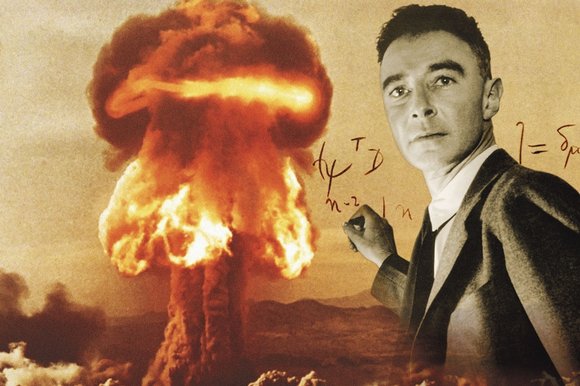
Oppenheimer next to an H Bomb test. Is science and technology the real danger to the World?
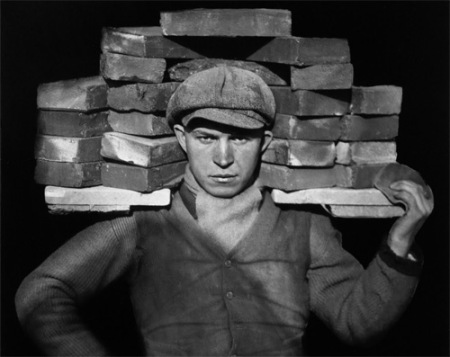
If you haven’t been recently you really should go to Leicester museum and Art Gallery on New Walk. It has recently been refurbished (not quite finished yet) and looks great. Currently there is an exhibition of photographs by August Sander that is really worth a look. I realise that in my wanderings I have come across exhibitions with the subtitle Artist Rooms. I have discovered that this refers to art dealer Anthony D’Offay who donated most of his art collection to the nation in 2008.
” In 2008 Anthony donated hundreds of his own works, including many Warhols, to the nation. This collection is known as ARTIST ROOMS and is managed by Tate and the National Galleries of Scotland. Artworks from it are lent to national and regional museums and galleries with the opportunity of receiving funding to attract young audiences. This was an incredibly generous thing to do and really makes d’Offay one of the ‘good guys’.” (From the Sheffield Art Gallery web site).
Both the Warhol exhibitions in Sheffield and Hull are part of this and so is the exhibition in Leicester of August Sander.
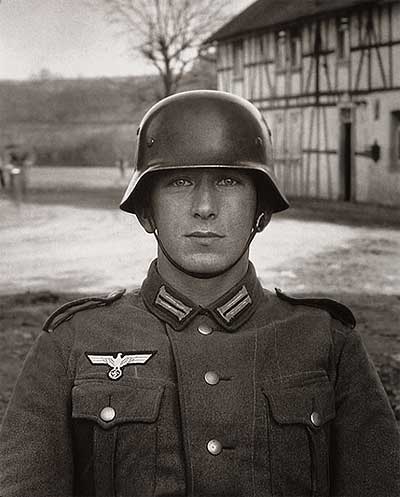
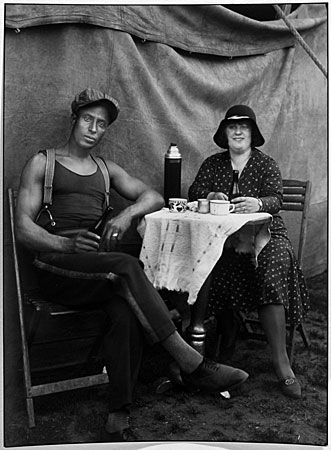
Soldier by August Sander
This is what the programme says of his work:
“The exhibition of German photographer August Sander (1876-1964) draws together 175 photographs and a wide range of archival material from the collections of Tate, National Galleries of Scotland, Anthony d’Offay and Gerd Sander.
This presentation creates a unique opportunity to see the different facets of August Sander’s photographic practice, including his celebrated portraits alongside less well known aspects of his work.
August Sander’s most significant project was ‘The People of the Twentieth Century’. Sander wanted to create an encyclopaedic survey of different types of people from the first half of the twentieth century. His working life in Germany spanned the First World War, the interwar years, the rise of the Nazi party, the Second World War and its aftermath.
The Artist
His photographs are unflinching documents of a society going through huge change. The work reflects both the catastrophic political convulsions that Germany was enduring and a society slowly coming to terms with the impact of industrialisation. The clarity and breadth of his vision remains powerful and his vocational portraits still resonate today.”
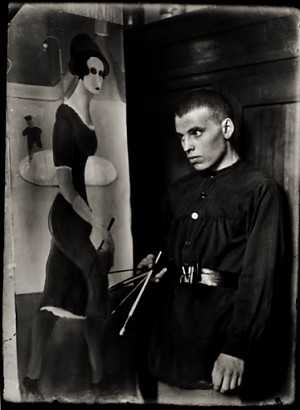
It is a fascinating exhibition with incredibly sharp black and white pictures. He attempts to photograph all types of people in his native Germany but it inevitably becomes much darker as the Nazis take power and the build up to World War 2. By this time the sections include The Soldier, The Victims and The National Socialist!
Victim Of Persecution
Here is a short biography of him:
“August Sander(17 November 1876 – 20 April 1964) was a German portrait and documentary photographer. Sander’s first book Face of our Time (German title: Antlitz der Zeit) was published in 1929. Sander has been described as “the most important German portrait photographer of the early twentieth century.” Sander was born in Herdorf, the son of a carpenter working in the mining industry. While working at a local mine, Sander first learned about photography by assisting a photographer who was working for a mining company. With financial support from his uncle, he bought photographic equipment and set up his own darkroom. He spent his military service (1897–99) as a photographer’s assistant and the next years wandering across Germany. In 1901, he started working for a photo studio in Linz, Austria, eventually becoming a partner (1902), and then its sole proprietor (1904). He left Linz at the end of 1909 and set up a new studio in Cologne. In the early 1920s, Sander joined the “Group of Progressive Artists” in Cologne and began plans to document contemporary society in a portrait series. In 1927, Sander and writer de:Ludwig Mathar travelled through Sardinia for three months, where he took around 500 photographs. However, a planned book detailing his travels was not completed. Sander’s Face of our Time was published in 1929. It contains a selection of 60 portraits from his series People of the 20th Century. Under the Nazi regime, his work and personal life were greatly constrained. His son Erich, who was a member of the left wing Socialist Workers’ Party (SAP), was arrested in 1934 and sentenced to 10 years in prison, where he died in 1944, shortly before the end of his sentence. Sander’s book Face of our Time was seized in 1936 and the photographic plates destroyed. Around 1942, during World War II, he left Cologne and moved to a rural area, allowing him to save most of his negatives. His studio was destroyed in a 1944 bombing raid. Sander died in Cologne. His work includes landscape, nature, architecture, and street photography, but he is best known for his portraits, as exemplified by his series People of the 20th Century. In this series, he aims to show a cross-section of society during the Weimar Republic. The series is divided into seven sections: The Farmer, The Skilled Tradesman, Woman, Classes and Professions, The Artists, The City, and The Last People (homeless persons, veterans, etc.). By 1945, Sander’s archive included over 40,000 images. In 2002, the August Sander Archiv and scholar Susanne Lange published a seven-volume collection comprising some 650 of Sander’s photographs (August Sander: People of the 20th Century, Harry N. Abrams).”
I woke up early this morning and decided to go somewhere. But where? Well, there are many places I have never been to that I want to see. Not all of them are pretty or picturesque but there is always something worth seeing and interesting people to meet. So, I decided on Hull. It’s not a place with the best reputation and it’s not the sort of place you pass through. You have to make a deliberate decision to go there. So, here I am on a train headed for Sheffield, then to Doncaster, then to Hull. Total travelling time three hours but you couldn’t drive it any quicker. I’m quite excited really. What will I find when I get there? Many interesting things no doubt. It will also be nice to be by the sea although I won’t be doing any sunbathing today, or any bathing for that matter!
Humber Bridge
Travelled on a tiny two coach train from Doncaster to Hull that stopped at every station. Had a good view of the Humber bridge which is pretty amazing. The Hull station is very nice with a statue of poet Philip Larkin who lived in Hull for thirty years. He’s the one who came out with the famous line about sex being invented in 1963 between the trial of Lady Chatterley and the Beatles first LP. Good stuff. Initial impression of Hull is quite good. It’s got a nice feel about it and the people are friendly with a great accent. Now to find the interesting bits.
Philip Larkin at Hull station
Hull is bigger than I expected and there are many grand civic buildings attesting to it’s obvious great wealth in the past as a major port. It is also colder than Leicester presumably because of it’s proximity to the sea. Actually, it’s not as near the sea as I thought. The main tributaries are the mighty Humber River and the River Hull where the main docks were. There are some nice anomalies like the cream telephone boxes . Very strange after a lifetime of seeing red boxes (although I know many are just glass now!) There are also some really nice Victorian shopping arcades with delightful specialty shops.
Cream telephone boxes!
Lovely shopping arcades!
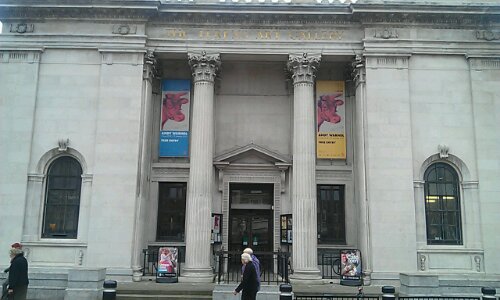
Of course, my first stop was Caffe Nero where I had a nice cappuccino. Then I walked into the centre of town where there are many museums and galleries. I was amazed to find a major Andy Warhol exhibition at the Ferens Art Gallery. This was totally unexpected. I hadn’t done any research before I came so to find this was quite strange. Warhol seems to be everywhere! I’m beginning to think that rather than being famous, in the future everyone will be Andy Warhol for 15 minutes. This exhibition is huge. There is a room full of later paintings, a room with stitched pictures and a room full of posters for the many events and films he was involved with.
Ferens Art Gallery
I’d never come aross the stitched pictures before. There are his trade mark multiple representations of the same picture but not like his silk screen prints. They are exactly the same picture but sewn together with thread, with bits of cotton dangling down which show exactly how they are done. Venus In A Shell alludes to Boticcelli but is set in the garden of a 60s Las Vegas house. Very intriguing. One of the remarkable things about the early screen printed multiple images is the way they change across the canvas because of the random way the technique works. They are all the same, but different. Like the images of Elvis that gradually fade away. There are no changes in the photographs. The only changes are caused by the dangling thread.
Venus in a Shell by Andy Warhol
Poster for Chelsea Girls
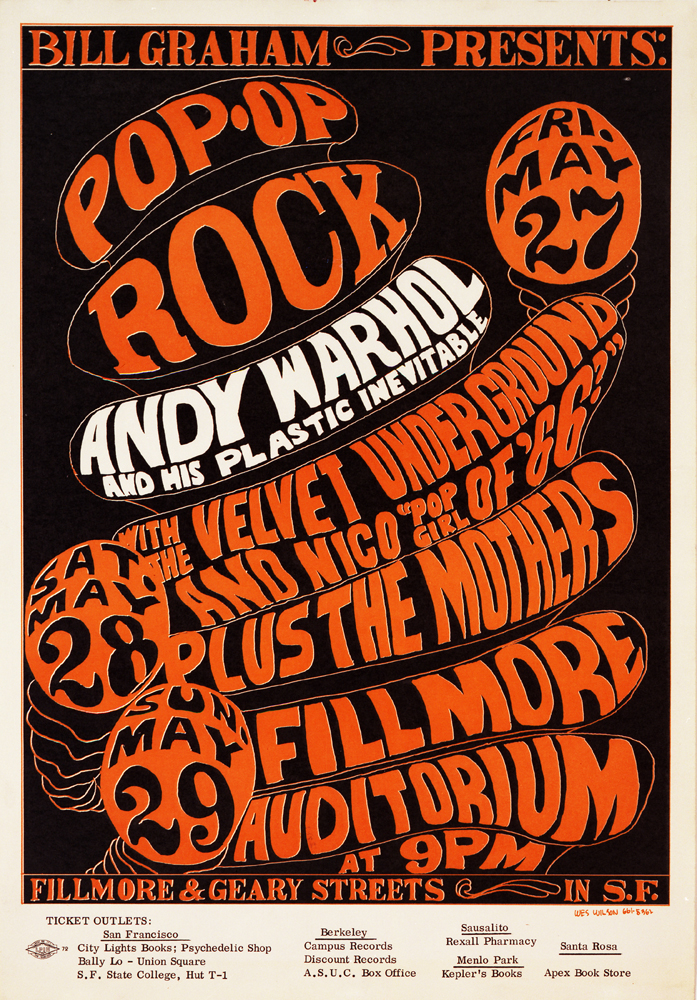
The room full of posters is very interesting and evocative. There is the iconic poster for the film Chelsea Girls and many of the other films he made. There are also some great ones of live performances like The Exploding Plastic Inevitable (although I see it’s called Andy Warhol and his Plastic Inevitable on the poster) which advertises a residency at the Filmore West on the same weekend as my birthday a year before the first Velvet Undergound album was released. What great joys I encounter!
Poster for The Exploding Plastic Inevitable. I like the bit that says Nico “Pop Girl of 66”! Doesn’t quite fit the ominous ballads she comes out with!
The room with the large later paintings sees Warhol returning to his earlier themes. There are soup cans, Brillo boxes and multiple screen prints. The one that attracted me most, although I’m not sure why, is the huge canvas called Repent And Sin No More. This is a typical evangelical statement that doesn’t quite seem to make sense. There is an element of contradiction and irony in it. Warhol would no doubt insist that it has no meaning beneath the surface.
Repent and and sin no more
The permanent displays in the gallery are very good. Some really nice Renaissance pictures.
Ferens Gallery. Renaissance section.
More Renaissance!
Of interest in the gallery are pictures by two women artists from the 19th Century, Rosa Bonheur and Emma Sandys. It is one of the few galleries I have visited recently that have work by women. Rosa Bonheur’s painting is on a large scale and is quite striking.
Rosa Bonheur Lions at Home 1881
Emma Sandys The Beautiful Wallflower
Well, time for lunch before I go on to see the Transport Museum and Wilberforce House. Went to Wetherspoons and actually did have a curry this time which was pretty good. Not bad to have a drink and a meal for just over £6!
The Transport Museum was fun with interactive displays and film shows. A great place to take the kids. There is a good display of early cars including electrical powered ones from the 19th century. It seems strange because electric cars seem like a new idea. There is also a tram and various buses and reconstructed streets and shops. Great fun and quite nostalgic.
Bus in Transport Museum with the tram behind it.
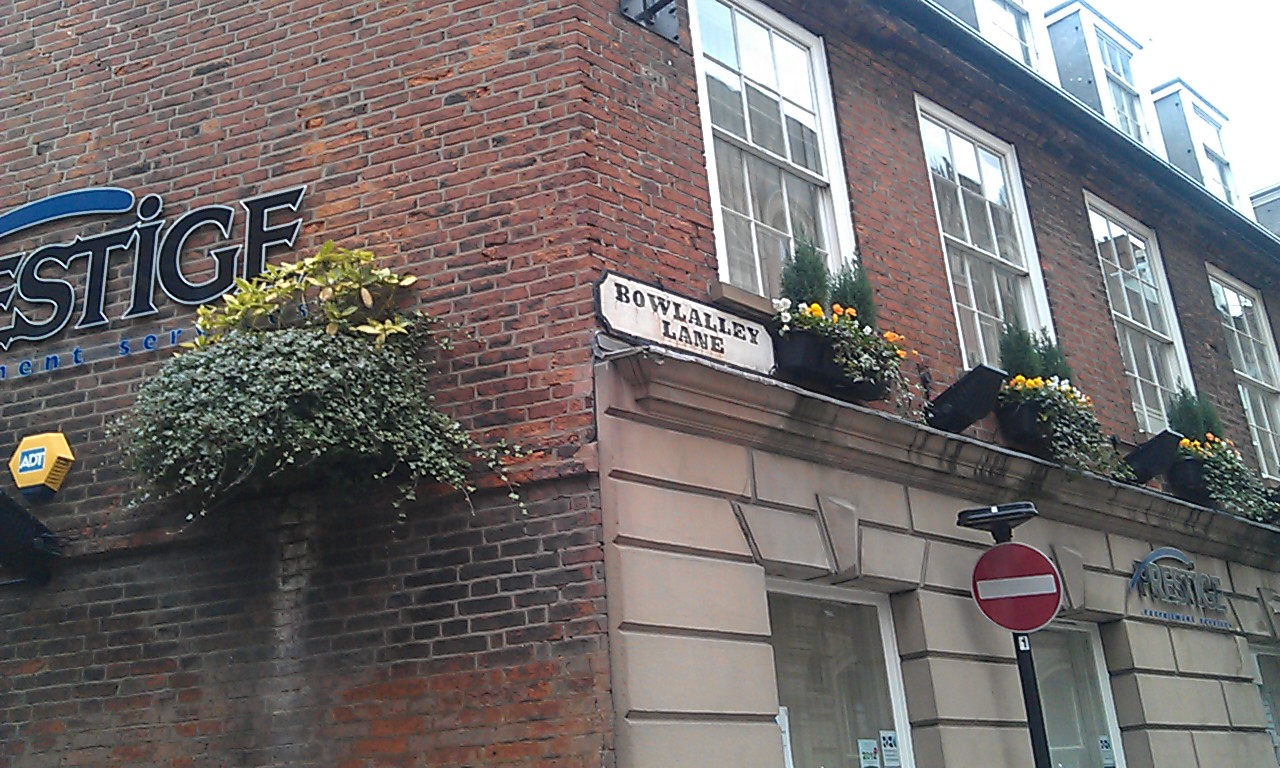
Actually, the bus looks like something out of Harry Potter and as I walk around the old town the street names seem to be out of Harry Potter too. You can’t help but like a place that has a road called Land of GreenGinger or Bowlalley Lane.
Land of Green Ginger
Bowlalley Lane
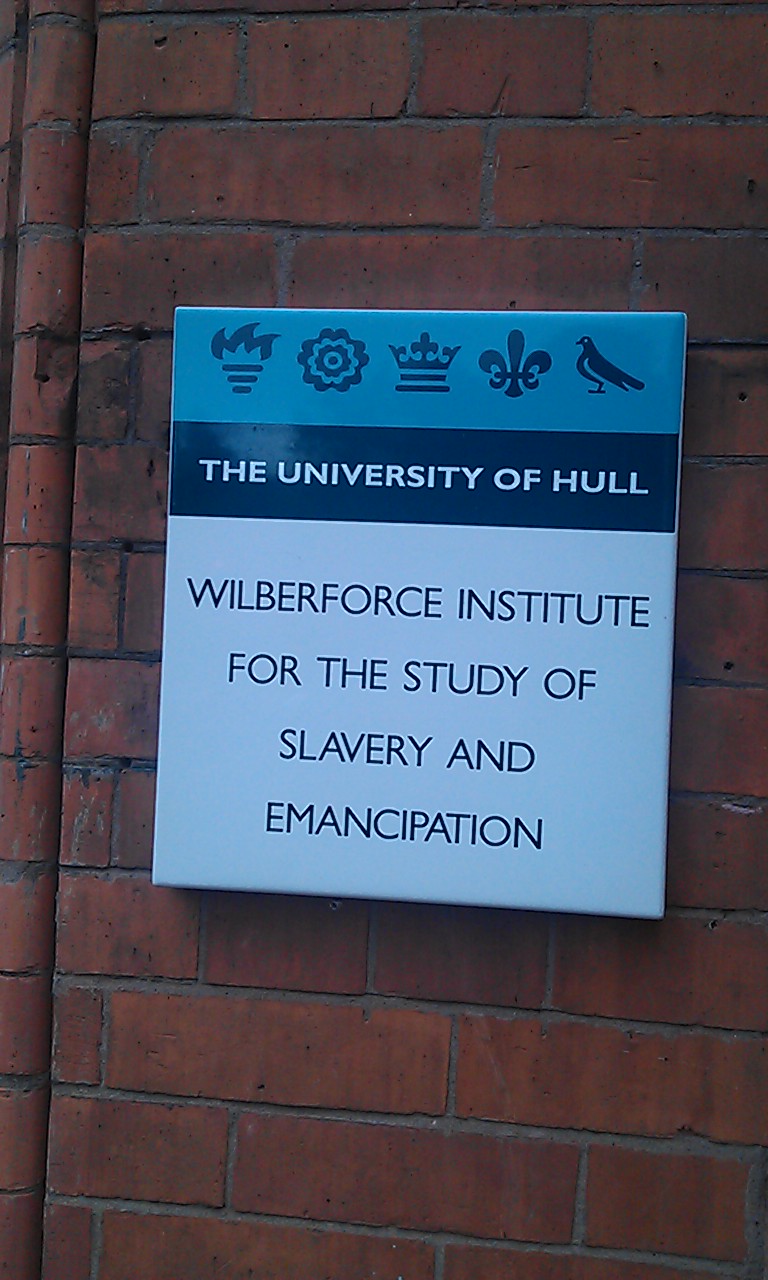
Yes, Hull is a nice place. The last place I visit is Wilberforce House. William Wilberforce was one of the most prominent slavery abolitionists in the 18th/19th Centuries. It took him years to get an anti-slavery bill through Parliament but eventually succeeded and deserves great credit for this. It seems incredible that the slave trade lasted as long as it did and makes a mockery of the idea of Free Trade. There is a hard hitting exhibition about the history and background of slavery in the museum that, quite frankly, left me in tears. It is astonishing that supposedly civilised people could have allowed it to continue for so long. As a crime against humanity it is as great as the holocaust and lasted much longer. Almost contradictorily, Wilberforce didn’t seem to share the same concerns about working conditions in England at the time. In a period when William Blake referred to Dark Satanic Mills and the exploitation of children was rife Wilberforce was a signatory to an act that outlawed trades unions. Of course, this doesn’t lessen the importance of what he did but it does raise other questions. Namely, WHY? It could be said that wage slavery is not much different to actual slavery. Still, it is an important and sobering exhibition.
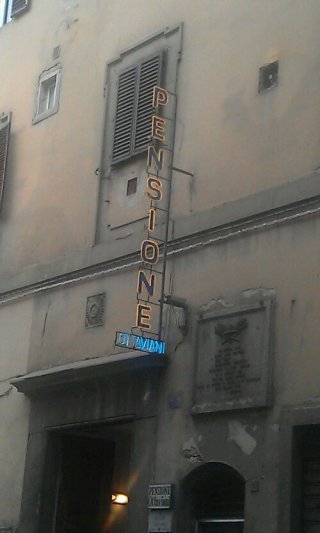
Pensione Ottaviani where we were staying. Excellent and friendly small hotel in the heart of the city.
Here we are. First day on a trip to Florence staying at a delightful little hotel called Pensione Ottaviani right in the heart of the city. The beautiful church of Santa Maria Novella is just across the road and the Duomo is a short walk away. The weather is good but not too hot. Perfect weather for sightseeing. The only problem is deciding where to go first. It’s Sunday so there may be problems visiting churches unless we attend mass. No, I think maybe the best thing is to visit the Piazza del Duomo and then to the Ponte Vecchio and across the river to the Boboli gardens and the Palazzo Pitti. Yes, that’s a good idea.
Palazzo Pitti. Grim palace that looks a bit like a prison. Home of the Medicis at one time. The Boboli Gardens behind are very nice.
The Palazzo Pitti is a pretty grim looking place that was the residence of one of the wealthy dukes that dominated Florence. It looks a bit like a prison from the outside and there are no benches or chairs to sit on in the square in front. They obviously still want the peasants to suffer! The Boboli Gardens in the rear are very pleasant and afford a very good walk if you can afford it. The reason for going inside is to view one of the best exhibitions of Renaissance art there is with works by Raphael and Titian and many others. They are hung in the way they would have been presented originally and so give a different perspective to the paintings than in a normal gallery. There are some excellent pictures in there but also quite a few that I would consider mediocre. In some ways I found it quite a depressing litany of images of the rich and powerful who don’t really deserve to be remembered. They stare blankly from the walls and you feel they are trapped forever in their own conceit. The whole experience is like a homage to a vacant and meaningless materialism. The religious pictures sit uneasily with the portraits. Why did they want pictures of the dieing Christ on their walls? The sheer scale of the opulence of the palace scream out against any kind of humility or charity. This is a truly bizarre experience and one that is quite tiring because there are so few chairs and benches inside as well. Time for a nice cappuccino I think.
Florence, place of great cappuccinos!! Or should that be cappuccini!
OK, time to move on. The Duomo is a truly astonishing place. It’s size is immense. Apparently, it took over a hundred years and the genius of Bruneleschi to work out how to put a roof on it without it falling down. It represents an amazing ambition to create something that had never been done before. This cathedral dominates the city of Florence and is clearly visible from all the vantage points in the surrounding hills.
Another view of the Cathedral and the Campanile. Astonishing buildings and so big!
Florence is a lovely city and is very self contained. The people are also very friendly even though it is packed with tourists, even in October. It is easy to walk to all the main attractions and the restaurants are also good. It’s a bit on the expensive side but I suppose that’s to be expected. Next stop is Ponte Vecchio which is truly remarkable lined mainly with jewelry shops.
Ponte Vecchio
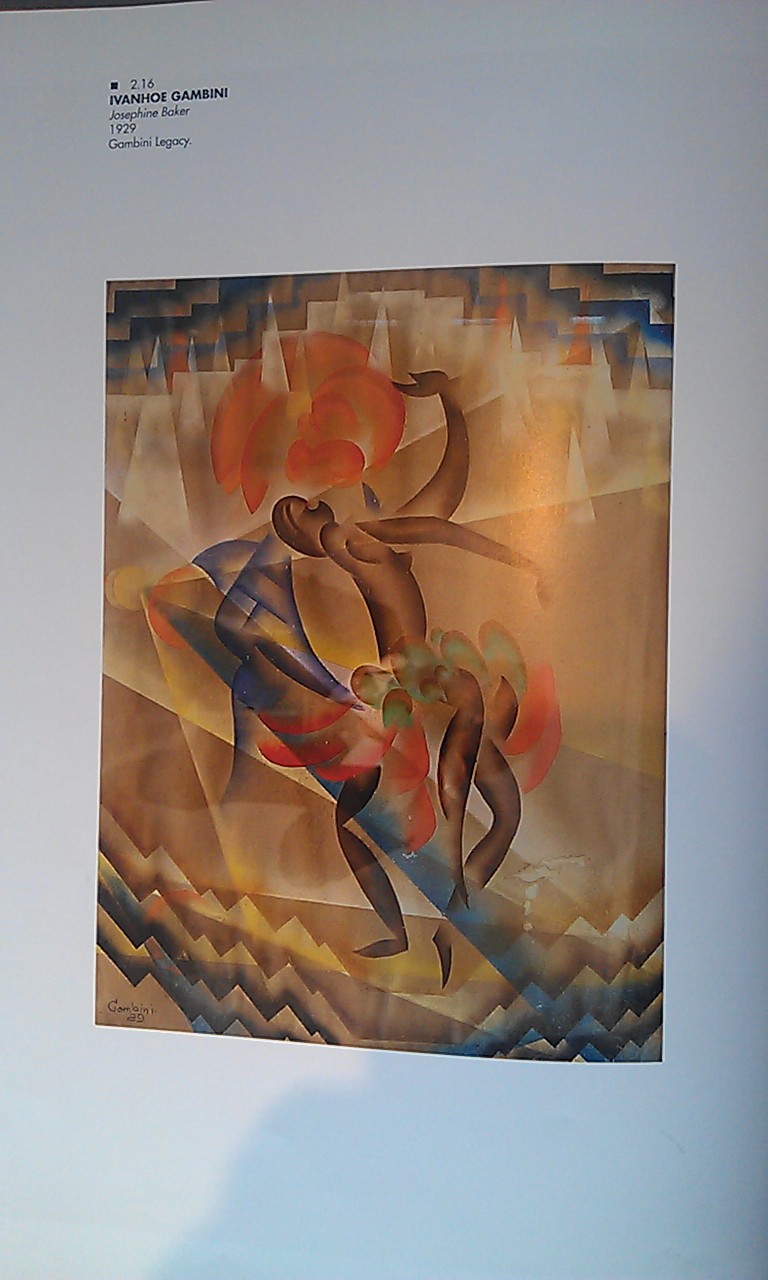
The first big exhibition we went to was at the Palazzo Strozzi called “The Thirties. The Arts in Italy Beyond Fascism”. This was a fascinating exhibition that demonstrated the variety of artistic expression that was taking place even under the cultural,totalitarian restrictions of Fascism. There were some disturbing examples of Fascist and Nazi art alongside experimentalism and expressionistic work. Things got really bad in 1938 though when Italy enacted it’s own racial law under pressure from the Nazis. The holocaust had reached Italy! This is what the curator says about the exhibition:
“The Thirties. The Arts in Italy Beyond Fascism comprises 96 paintings, 17 sculptures and 20 objects of design and tells the story of a crucial era characterised by an extremely vigorous arts scene in the years of the Fascist regime, against a backdrop that included the embryonic development of mass communication in Italy – radio, cinema and illustrated magazines – which stole numerous ideas from the “fine” arts and transmitted them to a broader audience. This retrospective illustrates an era that profoundly changed the history of Italy. The 1930s also witnessed the increasing mass production of household objects, which led to dramatic changes in people’s lifestyle, allowing ordinary families to live out a dream of modernity surrounded by designer objects, a practice that continues to this day”.
I would recommend this exhibition if it comes your way.
Programme for the exhibition
Palazzo Strozzi
Josephine Baker.
Crude propaganda using Futurist techniques with a touch of Art Deco!
Dream Complex No.1
It’s a hard slog walking around exhibitions (but in this case worth it). Time for a nice sit down and a rest outside the Santa Maria Novella church.
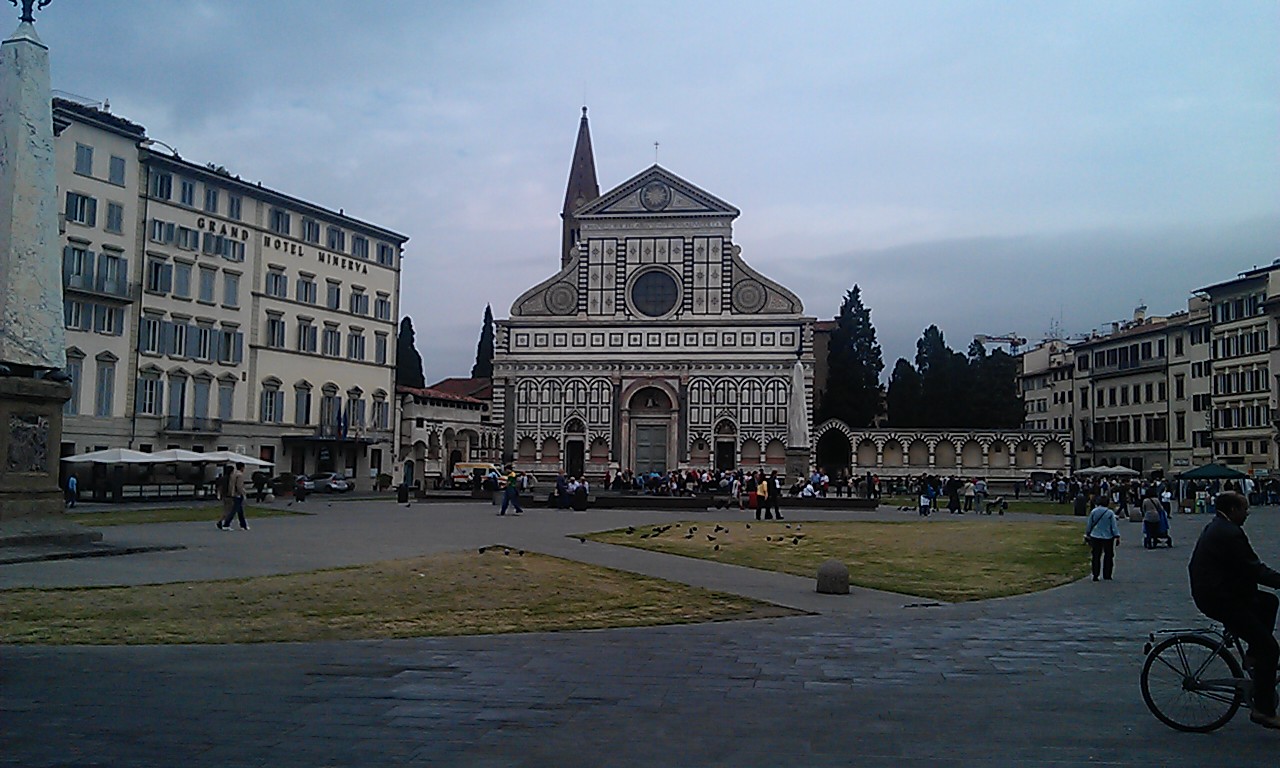
Santa Maria Novella
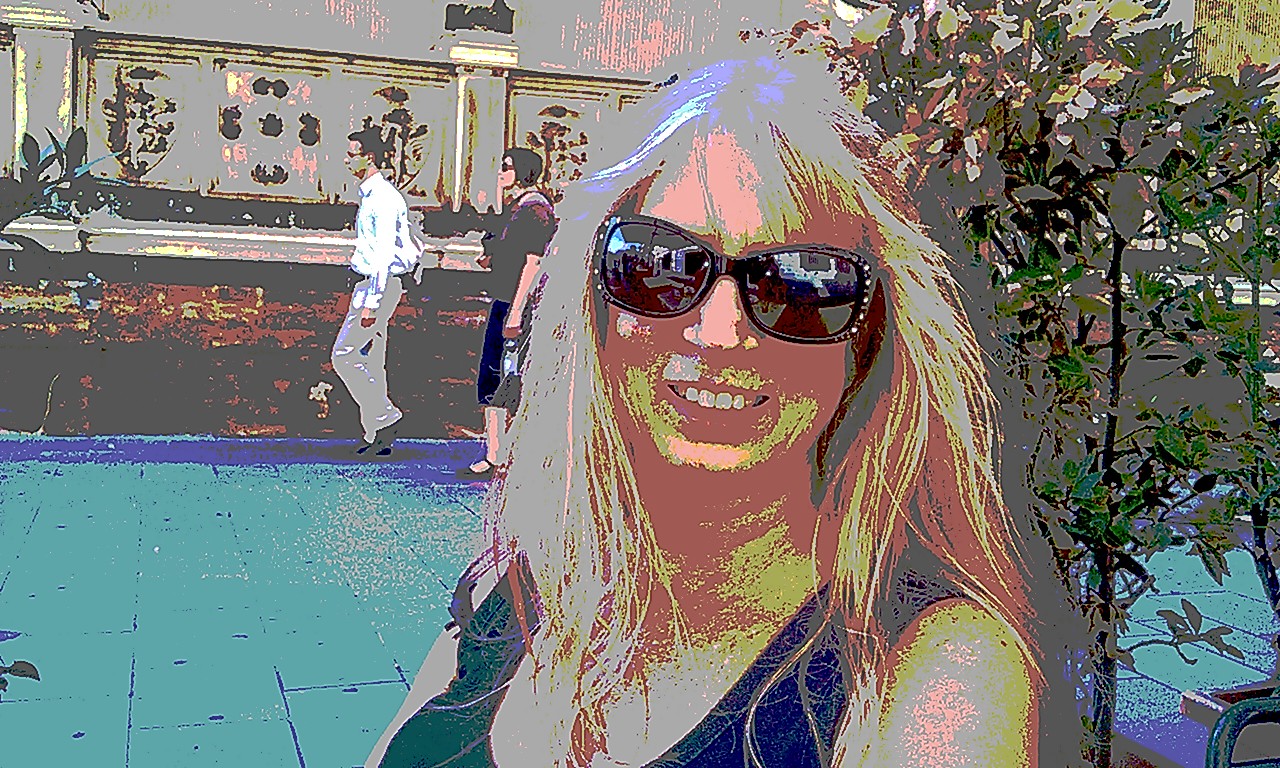
Sue outside Santa Maria Novella
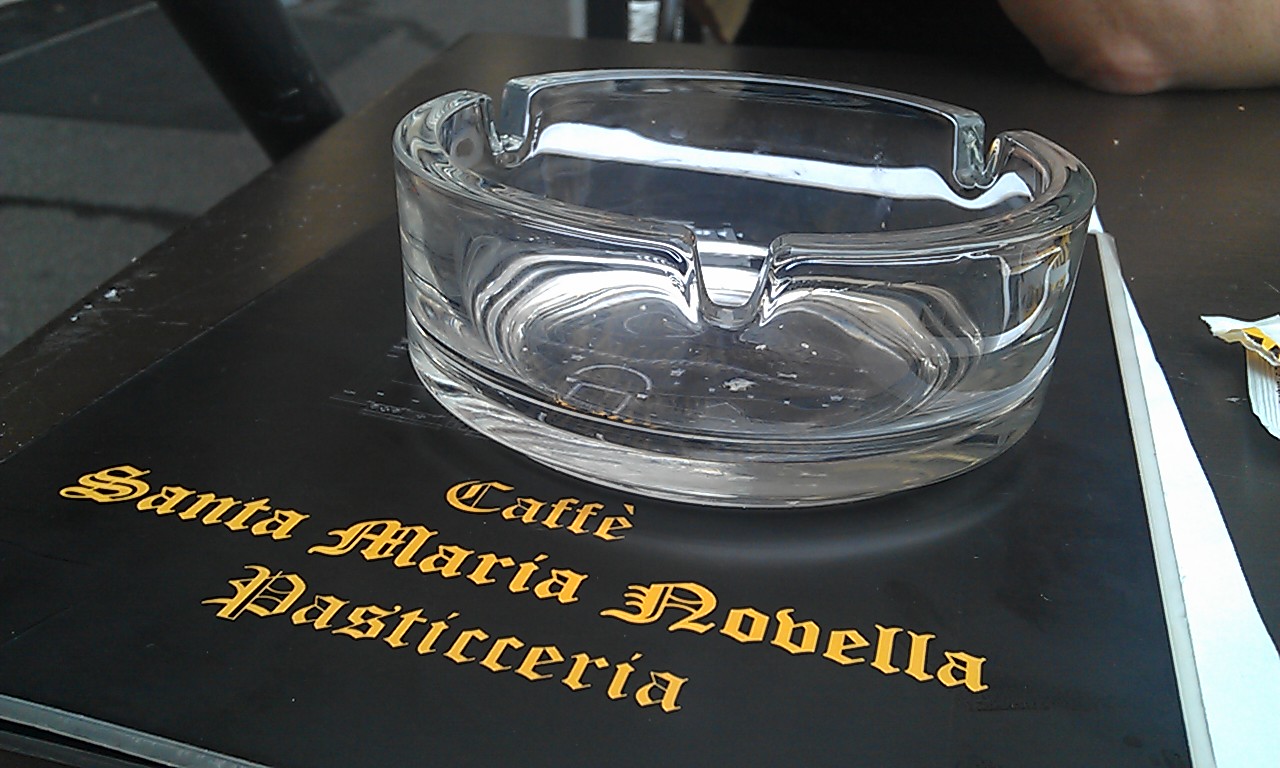
Nice caffe!!
Beautiful cloisters at Santa Maria Novella.
Mmm, Special Effects! That’s what that button does!!
The church of Santa Maria Novella is beautiful and contains many astounding frescoes. Unfortunately they don’t allow you to take photos ( a common thing in most museums and art galleries which I think is a bit mean really). The stand out feature though is the crucifix painted by Giotto. It is a sublime and beautiful piece of work.
Crucifix painted by Giotto.
We spent two days travelling round Florence on an open top bus. Fortunately, the weather remained good for most of the time although there were a few heavy showers at times. The view from Piazzale Michelangelo is breathtaking and it contains one of the many copies of David, the sculpture of which Vasali said that once you’ve seen it you’ll never need to see another sculpture. The original is in the Accademia which we visited and it really is breathtaking. The hands and feet look like they might start moving any minute! It is enormous and seems to be alive!
Michelangelo’s David
Thursday night we went to the open mic at the Irish pub “The Fiddler’s Elbow” on Piazza Santa Maria Novello. Not many people there but had a really good time. Was asked to play at a Bob Festival to be held next May. That’ll be fun!
On the last day we went to Pisa where we were flying from. Spent the afternoon having a meal with the leaning tower in the background. Very nice!
The news item that interested me most in the past week is about the vandalising of a Mark Rothko canvas in the Tate gallery. The kind of outcry that this caused was quite interesting. An article by Jonathon Jones in The Guardian described it as virtually a sacrilegious act even though it’s not a religious painting. He displays a sense of awe and wonder that puts all Great Artists on a pinnacle and compares their work to some kind of deep spiritual experience. Other articles in the same paper either give a history of the grand tradition of vandalising art or described works of art that might be improved by vandalism!
The vandalised Rothko. He writes “a potential piece of Yellowism”. But how will it become an actual piece of Yellowism? Will this improve the value of the painting as Umanets has suggested?
Included in his article Jonathon Jones expresses outrage concerning the vandalism of Michelangelo’s Pieta with a hammer. I dare say many people share this outrage and agree with the many comments on Twitter that would condemn these perpetrators to torture, death or worse. However, there as been a long history of vandalising Great works of art. I am writing this in Florence, Italy and found out before this recent act that Michelangelo’s iconic sculpture David was vandalised with a hammer shortly after it was erected. It seems that hammers, knives and machetes are the most favoured weapons of destruction for vandalising art but shotguns and sulphuric acid have also been used. The statue symbolised Florence’s republican resistance to the autocracy of the Medicis (David versus Goliath) and was seen as a legitimate target by the supporters of the aristocracy! But perhaps the biggest collective act of vandalism occured during the English Civil War when a massive amount of art work and buildings were destroyed by the Puritans. Henry VIII was quite a major perpetrator as well when he dissolved the monasteries in search of loot!
Showing the damage done to Michelangelo’s Pieta with a hammer.
Vladimir Umanets was an unknown Pole until last week. Now he has achieved celebrity by tagging Rothko’s “Black on Maroon” at the Tate Modern. He compares himself to Marcel Duchamp who signed a urinal and presented it for exhibition in 1917 thus creating perhaps the first piece of conceptual art. He also likens himself to Damian Hurst who has signed his name to work he has not done. Umanets has said he is part of a new art movement (consisting of him and one other) called Yellowism. He expresses an appreciation of Rothko’s work who he sees as a seminal Yellowist. Now, is this guy crazy or is he making a valid point?
Duchamp famously produced a post card featuring the Mona Lisa on which he drew a moustache and goatee beard. No doubt, he would have preferred to have defaced the real picture but was either unable to or too scared of the consequences. Either way it was a controversial act that blew a giant raspberry at the art establishment and became iconic in it’s own right and later, in a parody of the conventions of classical art, was copied by Salvador Dali albeit with a different moustache. Dali had his own style in vandalism. When presented with a picture by Andy Warhol, apparently he threw it on the floor and pissed on it. Warhol remained calm and detached throughout. Perhaps he couldn’t decide whether it was a compliment or an insult!
Duchamp’s great masterpiece!!
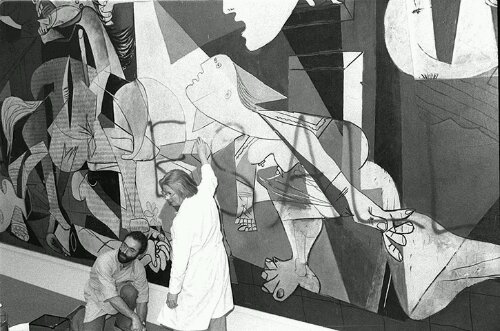
I think Umanets was quite brave in what he did. Witnesses say he sat quietly for a long time and then wrote on the painting with a black pen. He knew he would be caught and was ready with his explanation. Unfortunately, he either hasn’t said (or it hasn’t been reported) what Yellowism actually is. This would make it more meaningful like the anti-war protest perpetrated on Picasso’s Guernica. Defacing Great works of art will always get you attention and will guarantee you a place in history (although maybe for all the wrong reasons)!
“Lies all Lies” written on Picasso’s Guernica. This is a strange protest considering the painting is already anti -war. Why didn’t he pick a painting that glorified war of which there are many?
Another remarkable case of vandalism was when suffragette Mary Richardson attacked Rokeby’s Venus with a meat cleaver. This actually became a picture in itself. She was drawing attention to the hunger strike of Mrs. Pankhurst that was happening at the time. Considering the subject matter of the painting it could also been seen as an act of proto-feminism.
Mary Richardson being apprehended at the National Gallery, London after attacking Rokesby’s Venus with a meat cleaver.
Personally, my favourite piece of art vandalism is when two Chinese students stripped to the waist and had a pillow fight on Tracy Emin’s Bed. Although, in this case, a more effective piece of vandalism would be if someone sneaked in and tidied it up and washed the sheets. Now that would be hilarious!
Decided to go to Sheffield today and give a running commentary of while I am here. Just got off the train and am now in the town centre sitting in a Caffe Nero. You probably realise by now that my life centres around Caffe Neros and Wetherspoons. One sells expensive coffee and the other sells cheap beer. They both use the same free WiFi provider though and I can use the same login details. God, this is even beginning to bore me! Sorry!
Caffe Nero. Town Hall in the background. It looks a bit like a fairy tale castle. Incredibly grandiose!
Sheffield is amazing. This is the first time I’ve looked around the city although I’ve been here times in the past doing gigs. Same thing happened in Derby. I felt like I knew the places but I don’t at all. Well, at least I’m making up for it now.
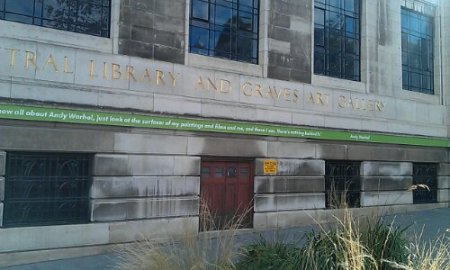
Graves Gallery
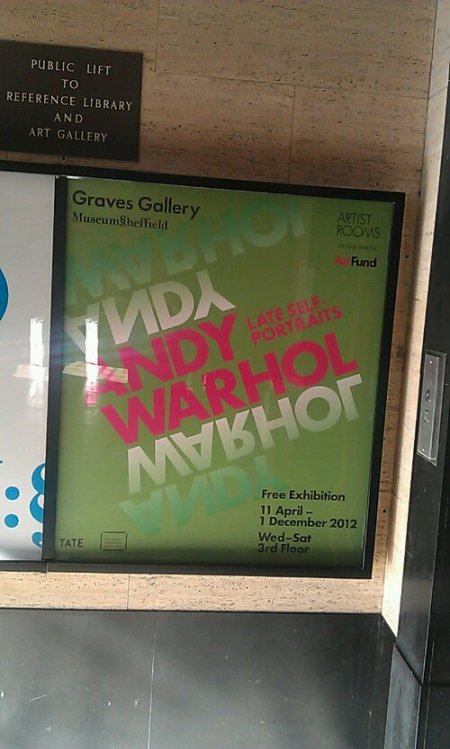
One of the reasons for coming here was to visit Graves Art Gallery where there is an exhibition of Andy Warhol self portraits. I’ve been interested in Warhol since the heady days of the 60s. Initially it was because of his association with the Velvet Underground and the hedonistic partying of the Factory. This became the stuff of legends and was attractive to an impressionable teenager like me. We tried to create our own version of The Factory in Leicester. At that time Warhol was the pre-eminent underground film maker and many of his films were shown in Leicester at our self created Arts Lab. I was impressed by their extreme nature and humour. I then became interested in his art but saw it mainly as iconoclastic and nihilistic which suited my state of mind at the time. I’ve since seen many of his paintings in galleries and realise he was a great stylist who had much to say. Even his car crash pictures have a strange kind of beauty about them and I never realised how big they were! It is clear he loved baiting the art establishment and he also loved critics and intellectuals who found a meaning in his work he never thought was there. His real achievement was to create profundity out of the ordinary, something I respect and have always tried to emulate. The mundane can be interesting with the right mental attitude. In fact, I believe everything is interesting! By making a Brillo box and Campbell’s soup cans ART he exposed the shallow commercialism of all art. They are ordinary objects in a supermarket but display them in a gallery and they become ART. There is no difference between a Warhol on the art market and a Van Gogh or a Da Vinci. Van Gogh may have been a tortured genius attempting to communicate with the world but his work is now seen as a high value commodity. Da Vinci was a product of the patronage of the Medicis of Florence. Their works are just expensive and rare products that the rich invest in, more valuable than gold! Essentially, they are all the same. Even the Abstract Expressionists played the same game. They may not have liked it but they were just part of the system. Warhol knew exactly what it was about: MONEY. When he moved from advertising to being an ARTIST he really saw no difference in the two areas apart from the fact that ART could be far more lucrative to the artist and give him fame and celebrity. That’s why the art establishment hated him so much. He exposed it’s commercial core. Some of his comments like “everyone in the future will be famous for 15 minutes” ,”art is what you can get away with” and “I’m a deeply superficial person” show a real insight into the workings of the art and culture industries. Notice the emphasis on “deeply“. He wasn’t totally superficial he was deeply superficial. The ultimate post-modernist statement!
Andy Warhol poster
Well, true to form I came on the day when the Graves Gallery was closed. I seem to make a habit of this. So, I didn’t see the self portraits of Andy Warhol but I did see the public library that it is part of. Very impressive as is the square that it belongs to. I went to the Millenium Gallery nearby that has several exhibitions in it. The John Ruskin gallery is nice but didn’t really rock my boat.
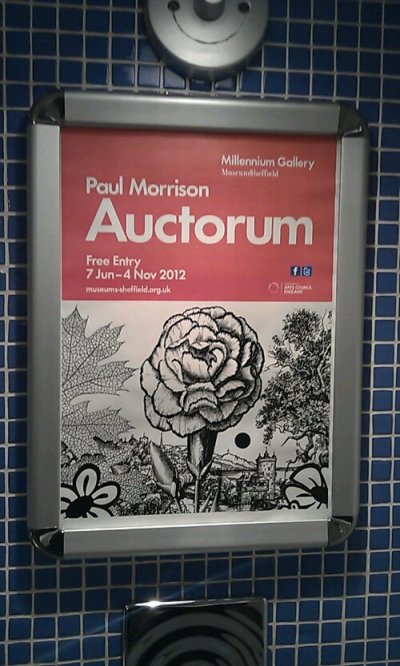
Paul Morrison poster
The exhibition of Paul Morrison was far more impressive. He is a local Sheffield artist who has achieved some fame and renown around the world. I really liked his work. He creates weird landscapes that seem strangely normal until you look closer and realise the anomalies. His video art is also interesting with changing views of water and aquarian growth. He is truly post-modern borrowing from nearly everything. I particularly liked his Bridget Riley inspired op-art piece which unfortunately did not translate into my photograph. Sheffield, I WILL be back!























 Kenny Wilson's Blog