
The Bride and the Bachelors: delighting in Duchamp
Infinity Blue a poem/song by Kenny Wilson!
This is a poem/song I wrote in 2005. It was inspired by the name and the view of a restaurant on the island of Skiathos in Greece. I was trying to connect with the space between consciousness and sleep, that space when thoughts drift without any idea of rationality, when words just connect with each other and everything makes sense! I composed a backing that I recently rediscovered and will record it again!

The first time that I saw you
I was dressed in black.
The last time that I saw you
You said you won’t be back.
Oh Infinity Blue
There were times
When I thought I could be with you
To be a real lover
And always be true.
Oh Infinity Blue
The angels came down once
And they spoke to me.
They gave me a message
That would set me free.
Oh Infinity Blue
The sun it was setting
It set in the east.
And somewhere inside me
It unleashed the beast.
Oh Infinity Blue
I walked through the centre line
Of what’s right and wrong.
And I tried to find freedom
In the words of a song!
Oh Infinity Blue
The words they controlled me
They forced me to stand.
When I was lost at sea
They showed me the land.
Oh Infinity Blue
And as I was waiting
For wisdom to come.
The words came and showed me
The warmth of the Sun.
Oh Infinity Blue
Between what is lost
And what cannot be
The words are like diamonds,
The words set you free.
Oh Infinity Blue
I was looking for mercy
I was looking for love
The words they came to me
Like a snowy white dove.
Oh Infinity Blue
I looked in your eyes
And I found mystery
And love, peace and mercy
Was our destiny!
Oh Infinity Blue

Lullaby of Birdland
This is a cover version of me playing jazz classic Lullaby of Birdland by George Shearing featuring Jenny Carter on violin.
Poem: The City Was a Golden Sea by Kenny Wilson
The city was a golden sea
Where angels played with destiny
The clouds were bouncing snowy white
And disappeared into the night
I came upon a diamond orb
That glowed satanic ghostly white
What has become of all these things?
“The City changed” the angels sing
The city was a golden sea
Where people learned what they must be
The stars were like daggers in the sky
That stuck like needles in my eye
Is this the meaning of the word
That linked the real to what’s absurd?
The city was a golden sea
It changed my life it made me free
I chose to wander aimlessly
Amongst the ancient symmetry
And there I found the meaning of the word
That linked the real to the absurd
Film Review: Les Miserables
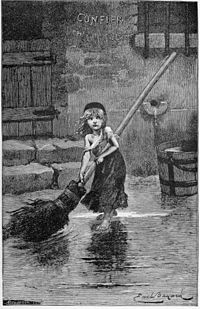
Original illustration from the book of Cosette. Notice the huge broom held by the tiny girl. This image has been used extensively to promote the musical and the film.
It had to be done. I had two free tickets for Showcase Cinema De Luxe, Leicester last Sunday. Haven’t seen the Hobbit yet or Jack Reacher but I decided to opt for Les Mis. The reason for this isn’t because I’m a big fan of the musical. I’ve never seen it! I’ve been intending to see it for the past thirty years but never made it! I’m going to make a special effort now though. No, the reason is that it is my favourite book of all time. Written by Victor Hugo in the 19th Century it is a literary tour de force, one of the best books ever written.
It is incredibly long, over 1500 pages in English and covers a multitude of things. You find out about the Paris sewer system, the language (argot) of the Parisian underclass, discussion about Napoleon and the monarchy and many other things. The main story though is that of Jean Valjean and his progress from criminal and convict to prosperity as a business man and factory owner and eventually as a benefactor and saviour of Cosette, daughter of a woman who works in his factory, Fantine, who falls on hard times and dies. While all this is happening Jean Valjean is pursued by police inspector Javert who becomes convinced that the mayor is in fact the same man as Valjean who had broken his parole years before and needed to be arrested and put back in gaol. The reason for breaking his parole is missing from the film and is quite an important omission. After getting away with stealing the Bishop’s silver he steals a small amount from a young, poor boy. He becomes totally disgusted with himself and tries to find the boy to give it back but can’t find him. The boy reports it to the police and that is how he broke his parole. This is why Valjean feels that Javert is justified in pursuing him!
The story is quite melodramatic although brilliantly told and is similar to the kind of themes used by Thomas Hardy and Balzac. The characters are very well drawn and serve to bring out the moral ambiguities of the story. Javert is possibly the most interesting character. Although he appears to be remote and cruel and obsessive, his motives are born out of total honesty and respect for the law. Jean Valjean actually respects this about him even though his aim is to bring him down.
Later on the narrative becomes about the love story between Cosette and young middle class revolutionary Marius who is rescued by Valjean from the barricades of the 1832 rebellion against the restored monarchy. This is NOT the French Revolution as many people think but an event that might have been forgotten were it not for it’s inclusion in the book of Les Miserables. It was a storm in a tea cup. At the end of the story both Javert and Valjean, in very different ways, experience a kind of redemption and the world is left a better place. Apparently, Hugo based the two characters on the same person and this is a reason why they are so intrinsically linked. They are two sides of the same man.
In many ways the film is very good and it has really affected audiences emotionally. It is impossible to make a film of the book without seriously compromising the story in many ways but the basic meaning of it remains. I would say the second half is much better than the first although there are some strong episodes in the first like the opening galley scene and Fantine’s rendition of I Dreamed a Dream. I found this very powerful even though the song has become devalued and over familiarised by the Subo and X Factor effect (or was it the other one. Can’t remember!). Anne Hathaway’s performance as Fantine is astonishing! Despite winning Golden Globes recently I think Russel Crowe and Hugh Jackman are miscast. I think Crowe would have been better as Valjean and Jackman as Javert. An earlier French version had Gerard Depardieu as Valjean and John Malkovich as Javert. This is a superb version and worth seeing if you can get hold of it. Somehow I ended up with a DVD of it that had been given away free with the Daily Express and I have never knowingly bought the Daily Express so I don’t know where I got it from! It is a condensed version of a TV series and gets very close to the original story with some brilliant performances.
Seeing the recent film has renewed my interest in seeing the live theatre production. Film rarely captures the atmosphere and excitement of a live show but, with the live singing on set which is a first, this film is moving in the right direction. Although flawed I think this film is well worth seeing.
Richard Hamilton Late Works at the National Gallery
I had a lovely time visiting London this week. Like New York it is a place that makes me feel good just by being there, walking around! This time I went to The National Gallery to see the Richard Hamilton exhibition before it closed.

Richard Hamilton is one of the first artists to describe what he was doing as Pop Art a long time before Andy Warhol started using the term. His iconic picture from 1957 is called “Just what is it that makes today’s homes so different, so appealing?“

Just what is it that makes today’s homes so different, so appealing? Notice the word Pop on the lollipop.
Here is his potential manifesto for Pop Art written in January 1957:
“16th January 1957
Dear Peter and Alison,
I have been thinking about our conversation of the other evening and thought that it might be a good idea to get something on paper, as much to sort it out for myself as to put a point of view to you.
There have been a number of manifestations in the post-war years in London which I would select as important and which have a bearing on what I take to be an objective:
Parallel of Life and Art
(investigation into an imagery of general value)
Man, Machine and Motion
(investigation into a particular technological imagery)
Reyner Banham’s research on automobile styling
Ad image research (Paolozzi, Smithson, McHale)
Independent Group discussion on Pop Art – Fine Art relationship
House of the Future
(conversion of Pop Art attitudes in industrial design to scale of domestic architecture)
This is Tomorrow
Group 2 presentation of Pop Art and perception material attempted impersonal treatment. Group 6 presentation of human needs in terms of a strong personal idiom.
Looking at this list is is clear that the Pop Art/Technology background emerges as the important feature.
The disadvantage (as well as the great virtue) of the TIT show was its incoherence and obscurity of language.
My view is that another show should be as highly disciplined and unified in conception as this one was chaotic. Is it possible that the participants could relinquish their existing personal solutions and try to bring about some new formal conception complying with a strict, mutually agreed programme?
Suppose we were to start with the objective of providing a unique solution to the specific requirement of a domestic environment e.g. some kind of shelter, some kind of equipment, some kind of art. This solution could then be formulated and rated on the basis of compliance with a table of characteristics of Pop Art.
Pop Art is:
Popular (designed for a mass audience)
Transient (short-term solution)
Expendable (easily-forgotten)
Low cost
Mass produced
Young (aimed at youth)
Witty
Sexy
Gimmicky
Glamorous
Big Business
This is just a beginning. Perhaps the first part of our task is the analysis of Pop Art and the production of a table. I find I am not yet sure about the “sincerity” of Pop Art. It is not a characteristic of all but it is of some – at least, a pseudo-sincerity is. Maybe we have to subdivide Pop Art into its various categories and decide into which category each of the subdivisions of our project fits. What do you think?
Yours,
(The letter was unanswered but I used the suggestion made in it as the theoretical basis for a painting called Hommage á Chrylsler Corp., the first product of a slowly contrived programme. R.H.)”(Collected Words 1953-1982)
The exhibition for the Late Works was in preparation before Hamilton died on 13th September 2011. It seems odd to have such contemporary images in the conservative National Gallery but it is based on his studies of works that are in there. There is a particular interest in Renaissance perspective. There are also allusions to work by his hero Marcel Duchamp.
I found the exhibition very interesting although I know some others were disappointed. I am most impressed that right into old age Hamilton was still experimenting and using computers and Photoshop to create his images. I was particularly impressed by the culmination of the exhibition Le chef-d’oeuvre inconnu in which three great painters contemplate a reclining nude. This is very evocative and emotional.
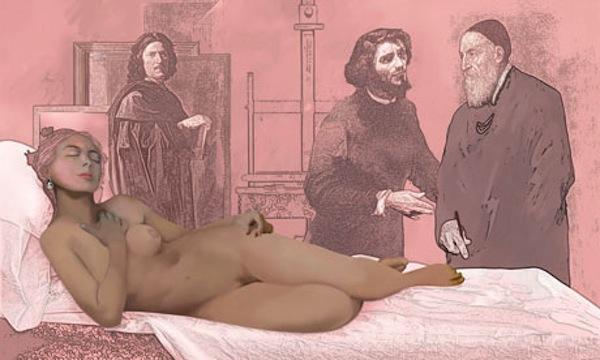
Le chef-d’oeuvre inconnu
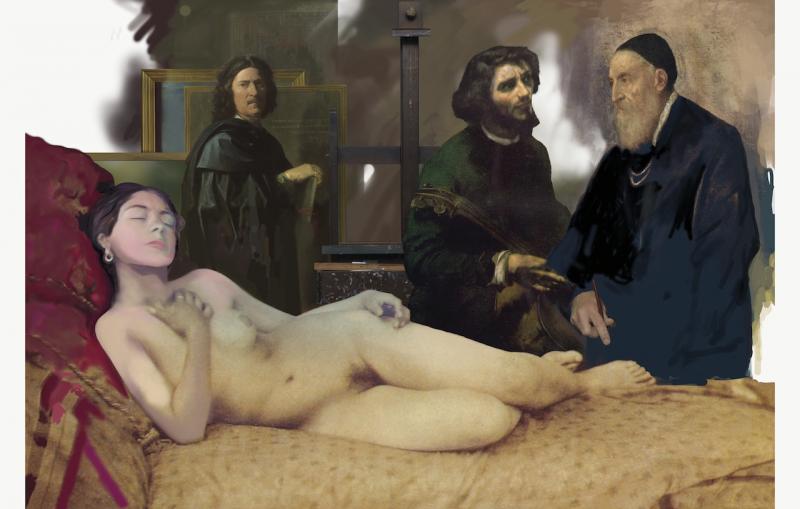
Le chef-d’oeuvre inconnu

An evocation of Marcel Duchamp
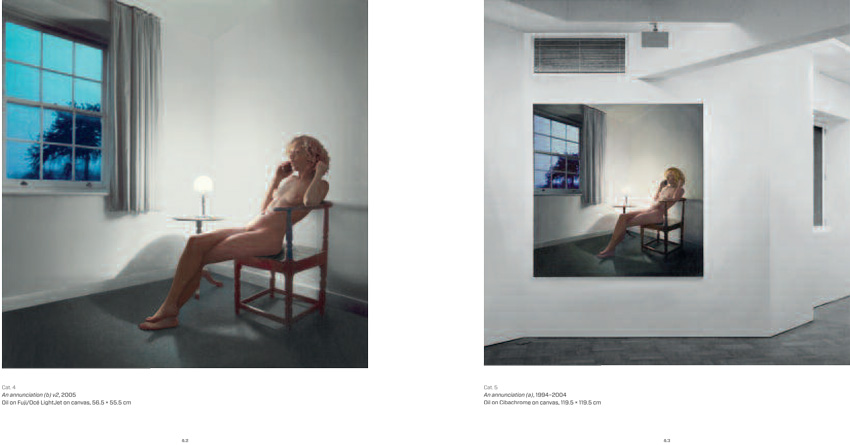
An annunciation

The Passage of the Angel to the Virgin, 2007
Yes, I am very impressed by these pictures and would recommend this exhibition if it moves somewhere else although I think it was particularly curated for the National Gallery with it’s many references to pictures in it’s collection and the building itself.
Radio interview in New York May 2012
Poem: Since You Went Away by Kenny Wilson
Since you went away
The silence fills my room
My head feels like a tomb
And I am lost inside.
Since you went away
I see a hollow grin
The emptiness within
The groom without a bride.
Since you went away
The air smells just like death
I struggle for my breath
There’s nothing here but grief
Since you went away
There are no truths to hear
I live alone in fear
I’m like a fallen leaf.
Since you went away
I can do nothing but cry
I no longer ask why
I just live from day to day.
Since you went away
Strangers haunt the street
I gaze down at my feet
There is no place to stay
Since you went away.

 Kenny Wilson's Blog