

 “There is a great deal to be silent about” by Emmett Grogan, 4/11/1969.
“The Diggers were a radical community-action group of activists and Street Theatre actors operating from 1966 to 1968, based in the Haight-Ashbury neighborhood of San Francisco. Their politics have been categorized as ‘left-wing’; more accurately, they were ‘community anarchists’ who blended a desire for freedom with a consciousness of the community in which they lived. They were closely associated and shared a number of members with the guerrilla theater group San Francisco Mime Troupe. The Diggers were formed out of after-hours Mime Troupe discussions between Emmett Grogan, Peter Coyote, Peter Berg, and Billy Landout. …”
W – Diggers (theater)
Articles By… and About the Diggers
Gleeson Gleanings
The Digger Papers – August 1968
The Realist: Issue No. 81 – August 1968 Article in the March 10, 1967 issue of the Foghorn.
The Digger Papers

“… In a more recent manifestation, the Diggers reappeared in 20th-century San Francisco. Challenging modern industrialization, they referred to it as bureaucratic excess, or garbage. Norman Cohn makes note of the original Diggers in the appendix of his book, The Pursuit of the Millennium. He recognizes the 17th-century Diggers as contemporaries of the Ranters, another very interesting group of ‘spiritual libertines.’ The Ranters were associated with the doctrines of the ‘Brethren of the Free Spirit,’ a millennial movement from the Middle Ages. In giving the background of the Ranters’ formation, Cohn references their contemporaries, the Diggers, a fairly interesting group in their own right, and one that would turn up again in history, in a much different time and place. … Fast forward about 300 years, and cross continents to San Francisco, California. We find evidence of the second coming of the Diggers in an electrifying and remarkable collection…
View original post 201 more words
Columbia University protests of 1968
 Mark Rudd, Chairman of the Students for Democratic Society, talks to reporters.
“The Columbia University protests of 1968 were among the many student demonstrations that occurred around the world in that year. The Columbia protests erupted over the spring of that year after students discovered links between the university and the institutional apparatus supporting the United States’ involvement in the Vietnam War, as well as their concern over an allegedly segregated gymnasium to be constructed in the nearby Morningside Park. The protests resulted in the student occupation of many university buildings and the eventual violent removal of protesters by the New York City Police Department. In early March 1967, a Columbia UniversityStudents for a Democratic Society activist named Bob Feldman discovered documents in the International Law Library detailing Columbia’s institutional affiliation with the Institute for Defense Analyses (IDA), a weapons research think-tank affiliated with the U.S…
View original post 244 more words
Folk City: New York and the American Folk Music Revival – Stephen Petrus and Ronald D. Cohen

“The Village Scene in the Early 1960s. Recalling the peak years of the folk music revival in Greenwich Village, singer-songwriter Tom Paxton reflected on the importance of the clubs, taverns, and coffeehouses in the Washington Square vicinity. These venues mattered, he noted, for both artistic reasons and social purposes. Paxton singled out the two preeminent Greenwich Village folk music clubs in the early 1960s: Gerde’s Folk City and the Gaslight. They booked many of the same acts but had distinct identities. While the Gaslight, a coffeehouse, did not sell alcohol, it was in a central location on MacDougal Street between Bleecker and West 3rd Streets. Folk City was several blocks away, on the corner of West 4th and Mercer Streets. For drinks and conversation, some folksingers ventured to the White Horse Tavern, on Hudson Street in the West Village. The Lion’s Head on Christopher Street and the Limelight on…
View original post 117 more words
The Diary of Che Guevara: Bolivia: November 7, 1966-October 7, 1967

“Ernesto ‘Che’ Guevara (1928-1967) was an Argentine Marxist revolutionary and author (as well as a physician) who was a major factor in the Cuban Revolution. During the 1960s, he was lionized by intellectuals such as Jean-Paul Sartre and Bertrand Russell, and was well-used (if not accurately known) in ’60s popular culture. This diary was written during the period of 1966-1967, when he attempted to assist the revolutionary movement in Bolivia (unaware that the anti-insurrectionary Bolivian forces were being aided by the CIA and its Special Activities Division commandos); he was captured and executed by Bolivian soldiers. Less interesting than Che’s earlier book Guerrilla Warfare, the diary nevertheless contains some interesting information: such as his note that ‘I have to write to Sartre and B. Russell to have them organize an international fund to help the Bolivian Liberation Movement.’ (Pg. 79) He receives a message requesting his authorization to put…
View original post 134 more words
Living the Bohemian Student Dream in 1960s Paris

I love to find a good Paris photo story that I haven’t seen before, and this one that I found buried in Life magazine’s archives is a quite a treat. Veteran photographer for the magazine Loomis Dean followed a group of young students in 1961, getting an intimate peek into their lives as they pursued the bohemian dream in mid-century Paris.
And you know what? It doesn’t seem like much has changed. Clicking through, I noticed the routines didn’t seem so different from the Paris I’ve come to know today. Whether you start out in a tiny attic room or student dorms, throw yourself into the café culture or lose yourself in art museums, Paris is more recogniseable than ever in this photo story from decades past…
Monday nights at the local…


The mid-week hangovers…

Actual photo caption: “Student with a hangover”.

To the Café! (and make it a double)…


Close living quarters (the dorm room years)…

A college dormitory at number 57 Rue Lacépède in the 5th arrondissement (Latin Quarter).

There is still a café under this building called La Contrescarpe (see it here on Google earth).


A student looking through his music.


A Classroom in Paris

Students studying in a park.

Art students visiting a gallery.

Every hour is Apéro Hour!

Getting to know the locals…

(over Pastis-fuelled philosophical debates)

Beatnik shindigs in old wine cellars…


Ending up at a house parties, having no idea who the apartment belongs to.

Saturday nights in.


Inspiration-searching Sundays…


Strolling down the Seine…


Art students “picnicking” with their models…

Not forgetting Springtime loves…


And of course, too many damn cigarettes.


All photos (c) LIFE
Interview with Dave Andrews of Radio Leicester about iconic music venue “Il Rondo”
This is an interview by Dave Andrews of Radio Leicester with me, Shaun Knapp, and Sue Barton about the iconic music venue Il Rondo that is now a store room for an Italian restaurant! It was amazing to see it and realise it was still there virtually unchanged but rather derelict.
The Il Rondo hosted some of the greats of popular music including The Rolling Stones, The Who, Howlin’ Wolf, Fleetwood Mac and a host of others!
Heaven and Hell Coffee Lounge in Soho, W1 |Eric Lindsay
This is a brilliant blog post about the Heaven and Hell Coffee Bar in Soho written by it’s founder Eric Lindsay (link at end). Sadly not with us anymore. Check it out!!
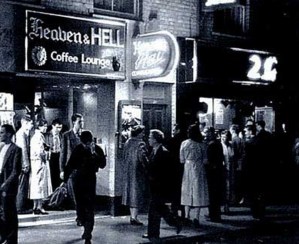
Ray Jackson and I opened Heaven and Hell in late 1955. I had the idea from when I had been working in Paris, where there was a type of cheap cabaret called “Ciel at l’Enfer” “Heaven and Hell” in Pigalle. The name and the place intrigued me, so later when I was in Paris again with Ray, I took him along to see the place and he also thought it was tacky but great.
The name stayed in my memory for a later date.
Here are some old photographs that I have just come across to show you how much the original impressed me. “Ciel et l’Enfer” was an intriguing name.


We had already sold the Regency Coffee Bar in East Sheen, which we opened with £200, £100 each, sometime in 1953. The Regency look was in, so we bought chairs from an antique shop in Putney for 5/- each and the owner of the shop taught me how to give them the antique look. We bought cheap floor covering, Ray’s uncle hung the wallpaper and my mother made the tablecloths and curtains. I used the same red Regency striped material to upholster the chairs, it was all a bit make do and mend, but the final result looked great. The major expense was the Gaggia Coffee Machine, which we paid off for. So espresso coffee came to East Sheen!
We thought we would do business, well forget it! I thought we would be stuck there for the rest of our lives. East Sheen was half way on the bus route between Hammersmith and Richmond, and really one should never get off the bus. I was convinced it was a place that people just stopped off to die. There was literally no business. Although everybody who lived there had the airs and graces of society toffs, they had no cash flow to buy a cup of coffee. In fact they hadn’t got a pot to piss in! But they lived in East Sheen so they had a little status. (They thought!)
Fortunately both Ray and I continued working in Theatre and TV, and Ray in films because we needed something extra to survive.
We were ‘so busy’ at the Regency that one person could run the whole place – serve coffee, do the cooking, the lot. So Ray and I worked alternate days. When I was on duty I would take an order and call out to the kitchen and then rush round talking to myself (the invisible chef). At least it was a good way to pass the time and it gave the customers the idea that we had staff. I thought I was going to be stuck there forever. We earned £10 a week each. My bus fares cost me £5, so you can see I was really in pocket! Finally we managed to sell the place to a guy who had retired from Claridges Hotel with a pension who wanted something easy to do in his retirement years. Well I could have told him that he wouldn’t be rushed off his feet here, but I didn’t and we sold the Regency for the princely sum of £1000, which was a profit, and we both breathed a sigh of relief!

We then started searching around for empty premises in Soho because I certainly wasn’t going out of town again. It had to be a shop and basement so that Heaven could be on the ground floor and Hell downstairs. We finally came across a little shop with a basement at 57 Old Compton Street. The ground floor had a small jewelry shop sharing the premises called of all things “Going Gay”. Do you think it was an omen? The gentleman who owned the freehold was called Harry Shanson, and he owned all the freeholds of 55, 57 and 59 Old Compton Street W.1.
Shaws the estate agents who were handling the property arranged for Ray and myself to see Mr. Shanson in his office in the City. Well, somehow it must have been our lucky day, because we talked to him and told him we were actors and what we wanted to do with the premises and the name we were going to call the coffee bar and the whole theme. He was interested in everything we had to say. Finally the question of rent came up and Ray and I nearly fell of the chairs when he told us what he wanted. It was far too much for us to afford. We got up to leave and explained that we just couldn’t afford to pay that sort of rent. He asked us how much we could afford. I told him half of what he was asking, to which he replied, “O.K.” With that, we both nearly passed out. Ray and I left his office floating on air.
We started work at 57 Old Compton Street. From the St. Martins School of Art we found a designer to make the plaster casts for the lights in Heaven and also Hell. Beforehand, Ray and I decided that Heaven should have an ethereal theme with sun flowers for lights with cherub faces. The staircase leading to Hell was a giant Devil’s mouth, which you walked down into. Hell was totally black with red flames climbing up the walls.

Out of the walls for lights we had these arms holding lighted Devil masks. The emergency exit, which we had to have, was a ladder in the middle of the room closed on 3 sides with a red curtain on which was a full length painting of the Devil with horns, tail and pitch fork. It was all very atmospheric and the customers adored it. On the street wall we had a light box with a colour transparency of Heaven and below it Hell. From the moment we opened, the place was full, at lunchtimes and evenings. I used to have to stand on the door letting customers in as a seat became vacant whilst they were queuing out in the street. Not many people wanted to stay in Heaven, they all wanted to go to Hell. No pun intended. As you may gather, business was fabulous, especially when the Soho Fair was on.


Over the years Harry Shanson and his wife became firm friends. He was one of the kindest people in the world. One day when we had been running quite a few years, Harry’s son, who was a bit of a monster when he was young, came in and said to me, “My daddy owns this place! It’s ours.” So I politely said to him “Fuck off!”
There was never a dull moment in Old Compton Street. The 2 I’s was next door. The customers would go from coffee bar to coffee bar. The 2 I’s used to have their windows smashed in regularly. We fortunately were left alone. Everyone seemed to making money and at 9 pence a coffee it was some hard going.

Two prostitutes in 1950s Soho
Prostitutes were on every street corner. The flat above Heaven and Hell was occupied by Suzy, an elegant French lady of the night who really would have been more at home in Mayfair, but I suppose she wanted a quick turn over! She wore the stair carpet out all the time. Next door at No. 57, Jackie, another French beauty, much younger than Suzy, could turn 100 customers a day. My mother, who used to come up to town regularly, used to sit in the window in Heaven and keep score. She was so intrigued by it all.
Well, the time came when Ray and I decided that we would like to get a flat together, so I spoke to Harry Shanson. The lovely Suzy got her marching orders and Ray and I moved into Flat 1, 57 Old Compton Street at a rent that he asked us what we would like to pay, so that also was very reasonable. It was a known fact that he could always get at least double from the tarts. I did think she might send the ‘heavies’ in after being thrown out and when she found out that we had taken the flat, but no, she was always pleased to see me and talk when I saw her on her new beat at the corner of Greek St. and Old Compton St. Working ‘flats’ were not that difficult for the ‘girls’ to come by.
Suzy had kept the place spotless, after all she had he own French maid who was on duty full time during the working hours. The bedroom looked as though it had seen plenty of action. But after we had redecorated the whole place even Suzy wouldn’t have recognized it as her own little bordello.
We never had live music in Heaven and Hell, just two jukeboxes one in Heaven and one in Hell, with the same records in each. It was easier than all the hassle with live music because the customers never left. With us, they stayed about an hour and left, rather than sitting there all night. Also it was much more profitable as we would get loads of double plays from the 2 machines.
So the money rolled in and we were ready to roll out onto our next venture which was:
“THE CASINO de PARIS STRIPTEASE THEATRE CLUB”
P.S. If any of you ‘older readers’ happen to come across a picture of yourselves taken inside “Heaven and Hell,” I would be very happy to include it into my blog.
Source: Heaven and Hell Coffee Lounge in Soho, W.I. | ericlindsay
 Kenny Wilson's Blog