Second part of Kenny Wilson’s gig at the Criterion cut short by the camera battery dying. The first part can be found here Kenny Wilson Live at the Criterion Part One

Second part of Kenny Wilson’s gig at the Criterion cut short by the camera battery dying. The first part can be found here Kenny Wilson Live at the Criterion Part One
March was one of the coldest on record and April wasn’t much better. I had some gigs in Florence, Italy at the end of May and was looking forward to that but in the meantime I was freezing in Leicester. Time to get some Sun. Found some cheap flights and even cheaper hotel on the island of Malta for the first two weeks in May and, yes, the weather was beautiful. Every day was mainly sunny with the occasional shower and the temperature was warm but not too hot. Still warm enough to sit out at night! Superb! Only downside was that on the second day I had my pocket picked on a bus going to Valletta. It was all good after that though. Yes, Malta is a beautiful and historic island and will become part of my yearly schedule I think. Anything to get away from the cold!!
In Malta a lot of people live in a small space. It is the smallest country in the European Union and has the biggest density of population. It doesn’t feel claustrophobic though and most people live in the areas around the capital city Valletta. Valletta is a beautiful town which is a World Heritage Site. It was built by the Knights of St. John and is extremely well preserved and traffic free. A nice place to sit outside drinking coffee and watching the world go by. There is a magnificent cathedral there as well.

St. John’s Co-Cathedral, Malta
Here you can see one of the most remarkable and famous paintings by Caravaggio “The Beheading of John the Baptist“.
You need to get here early as it closes at 3.30 p.m. and 12.30 p.m. on Saturdays. You can’t visit at all on Sundays or public holidays but you can attend services on those days. Their web site is here: St John’s Co-Cathedral, Malta

The Beheading of John the Baptist by Caravaggio.
Apart from this blast of culture we spent most of the time driving round the island and visiting Gozo, a tiny island you can go to free on the ferry. Mind you, you have to pay to get back! Mdina is very interesting and old and was the original capital city. There are lots of great beaches and some unique neolithic monuments. There are some amazing sights and the restaurants and bars are generally good. Here are some pictures I took of the trip. They are from all over the island:
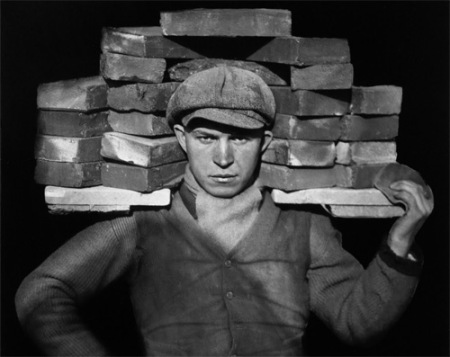
Bricklayer by August Sander
If you haven’t been recently you really should go to Leicester museum and Art Gallery on New Walk. It has recently been refurbished (not quite finished yet) and looks great. Currently there is an exhibition of photographs by August Sander that is really worth a look. I realise that in my wanderings I have come across exhibitions with the subtitle Artist Rooms. I have discovered that this refers to art dealer Anthony D’Offay who donated most of his art collection to the nation in 2008.
” In 2008 Anthony donated hundreds of his own works, including many Warhols, to the nation. This collection is known as ARTIST ROOMS and is managed by Tate and the National Galleries of Scotland. Artworks from it are lent to national and regional museums and galleries with the opportunity of receiving funding to attract young audiences. This was an incredibly generous thing to do and really makes d’Offay one of the ‘good guys’.” (From the Sheffield Art Gallery web site).
Both the Warhol exhibitions in Sheffield and Hull are part of this and so is the exhibition in Leicester of August Sander.
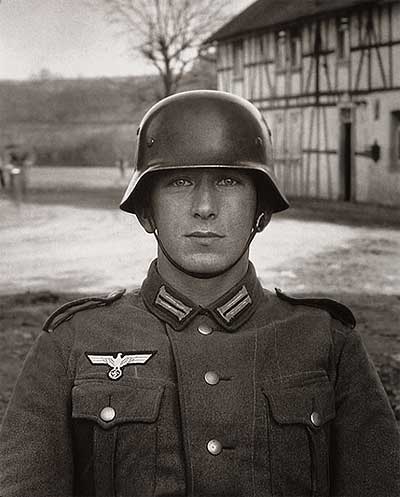
Soldier by August Sander
This is what the programme says of his work:
“The exhibition of German photographer August Sander (1876-1964) draws together 175 photographs and a wide range of archival material from the collections of Tate, National Galleries of Scotland, Anthony d’Offay and Gerd Sander.
This presentation creates a unique opportunity to see the different facets of August Sander’s photographic practice, including his celebrated portraits alongside less well known aspects of his work.
August Sander’s most significant project was ‘The People of the Twentieth Century’. Sander wanted to create an encyclopaedic survey of different types of people from the first half of the twentieth century. His working life in Germany spanned the First World War, the interwar years, the rise of the Nazi party, the Second World War and its aftermath.
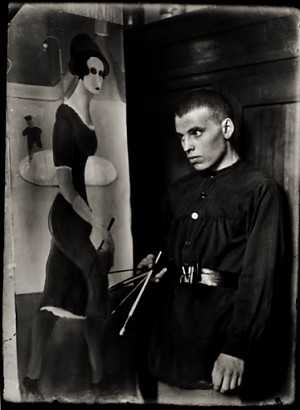
The Artist
His photographs are unflinching documents of a society going through huge change. The work reflects both the catastrophic political convulsions that Germany was enduring and a society slowly coming to terms with the impact of industrialisation. The clarity and breadth of his vision remains powerful and his vocational portraits still resonate today.”
It is a fascinating exhibition with incredibly sharp black and white pictures. He attempts to photograph all types of people in his native Germany but it inevitably becomes much darker as the Nazis take power and the build up to World War 2. By this time the sections include The Soldier, The Victims and The National Socialist!

Victim Of Persecution
Here is a short biography of him:
“August Sander (17 November 1876 – 20 April 1964) was a German portrait and documentary photographer. Sander’s first book Face of our Time (German title: Antlitz der Zeit) was published in 1929. Sander has been described as “the most important German portrait photographer of the early twentieth century.”
Sander was born in Herdorf, the son of a carpenter working in the mining industry. While working at a local mine, Sander first learned about photography by assisting a photographer who was working for a mining company. With financial support from his uncle, he bought photographic equipment and set up his own darkroom.
He spent his military service (1897–99) as a photographer’s assistant and the next years wandering across Germany. In 1901, he started working for a photo studio in Linz, Austria, eventually becoming a partner (1902), and then its sole proprietor (1904). He left Linz at the end of 1909 and set up a new studio in Cologne.
In the early 1920s, Sander joined the “Group of Progressive Artists” in Cologne and began plans to document contemporary society in a portrait series. In 1927, Sander and writer de:Ludwig Mathar travelled through Sardinia for three months, where he took around 500 photographs. However, a planned book detailing his travels was not completed.
Sander’s Face of our Time was published in 1929. It contains a selection of 60 portraits from his series People of the 20th Century. Under the Nazi regime, his work and personal life were greatly constrained. His son Erich, who was a member of the left wing Socialist Workers’ Party (SAP), was arrested in 1934 and sentenced to 10 years in prison, where he died in 1944, shortly before the end of his sentence. Sander’s book Face of our Time was seized in 1936 and the photographic plates destroyed. Around 1942, during World War II, he left Cologne and moved to a rural area, allowing him to save most of his negatives. His studio was destroyed in a 1944 bombing raid.
Sander died in Cologne. His work includes landscape, nature, architecture, and street photography, but he is best known for his portraits, as exemplified by his series People of the 20th Century. In this series, he aims to show a cross-section of society during the Weimar Republic. The series is divided into seven sections: The Farmer, The Skilled Tradesman, Woman, Classes and Professions, The Artists, The City, and The Last People (homeless persons, veterans, etc.). By 1945, Sander’s archive included over 40,000 images.
In 2002, the August Sander Archiv and scholar Susanne Lange published a seven-volume collection comprising some 650 of Sander’s photographs (August Sander: People of the 20th Century, Harry N. Abrams).”
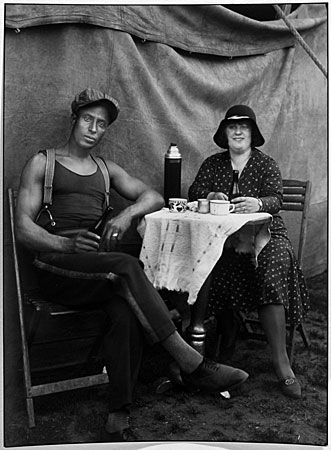
Circus Workers

SS Captain
Had a busy weekend just gone preparing for a Woody Guthrie memorial concert at the Musician Venue, Leicester. On Saturday morning I decided I needed to practice and learn some new songs so that I had enough for the night. I didn’t think I needed too many though because a film was being played and there were going to be other participants, I thought.
I was practicing and enjoying what I was doing then I decided to record some of them so I could hear what they sounded like. Well, I was quite pleased with the results so I decided to make a CD of my versions of Woody songs that I would give away to the audience on the night. From that moment my whole weekend was involved with recording, mixing and manufacturing CDs with covers. I made 20 and then gave up. It’s so time consuming!
Sunday night and the concert came around. I got there early and set up and sound checked. Then I found the film was not being shown and there were no other participants! It was entirely my own show! This was when I panicked. Fortunately, my friend Jenny Carter turned up and joined me on violin. I did two sets and did a lot of talking between numbers explaining the background of the songs and also about Woody’s guitar style which was a big influence on me. The whole night went really well and I found I had enough songs. It was quite inspirational for me and reignited my love of Woody’s music and his superb lyrics. He manages to combine simplicity with profundity. A remarkable writer.
The gigs are coming in rapidly at the moment. Am playing tonight at the Leicester O2 Academy for University overseas students and have just got a gig for the Hind pub, Leicester on Saturday. Am looking forward to this. I used to play there regularly but the pub changed hands. It’s a great place to play and, hopefully, I will get more gigs out of it.
Check out one of my Woody recordings below.
Books reviews with the occasional interview thrown in for good measure
The art we all forgot, and rightly so.
Words for the mind, body and spirit
Classic Rock: More than meets the eye... and ear!
a group of singer/songwriters based in Leicestershire U.K.
Vanlife 4x4 | Adventure Motorhome Travel
It's what life throws at you and sometimes quite unexpectedly
Our adventures in Boris our motorhome
He not busy being born, is busy dying.
Uncovering the silent era
07825640991 kenny.wilson@outlook.com
0782 564 0991 kenny.wilson@outlook.com
A food and drink blog for Leicestershire
 Kenny Wilson's Blog