Phil Riley is part of a group I belong to called “Reynard Collective”. We are all singer/songwriters promoting and developing our work. It is already yielding results. Here is a link to a Spotify playlist of Phil’s new E.P. “Such a Tiny Boat”
“Such a Tiny Boat” by Phil Riley
Out on June 1st, ‘Such a Tiny Boat’ is the latest digital-only release from Phil Riley. Available on Spotify, YouTube Music, Amazon and other major streaming platforms, it is a five song EP of original material, recorded in-home in true lockdown fashion, mixed, mastered and produced by Phil. Two tracks feature Chris Chambers on lap-steel, dobro and electric guitar. Listen carefully too for a special backing vocal guest appearance from Deborah Seabrook.
Two new songs recently released by Kenny Wilson available on Spotify, Amazon and Apple Music. Listen to them in their entirety here. Produced and Recorded in his home studio in Leicester, U.K. February 2020.
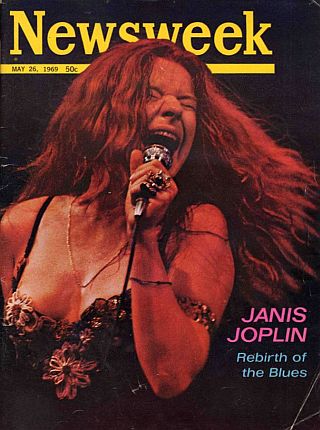
Janis Joplin featured in a ‘Newsweek’ cover story, ‘Rebirth of the Blues,’ May 26, 1969.
In the rock ‘n roll firmament of the 1960s, Janis Joplin was a shooting star who burned white hot for five short years. She died of a heroin overdose at age 27. Joplin sang her own brand of the blues in an incendiary style. Yet in her short time — between 1966 and 1970 — she carved out a piece of music history that was distinctly her own. During these years, she traveled from the conservative community of Port Arthur, Texas to the expansive and unpredictable world that was the drug/hippie/music scene of 1960s San Francisco — and mostly in the glare of national stardom. Joplin was born in Port Arthur, an oil refinery town, in 1943. As a teenager in the late 1950s, she had read about Jack Kerouac and the Beatniks, began to dress in her own style, and started listening to blues music with a few high school friends. Black blues singers Bessie Smith and Leadbelly were among her heroes.
An outcast in Port Arthur by the early 1960s, Joplin had made her way to California a time or two, and eventually came to San Francisco’s music and hippie scene. At the June 1967 Monterey Pop Festival she captured national attention with a stunning blues performance of “Ball and Chain.” From that point on, she became something of national phenomenon.
But not everyone loved Janis Joplin. Her stage antics and whiskey-swilling, devil-may-care style put many people off. Some were convinced she had a death wish and was killing herself slowly with each performance and each day’s excesses, so that when she sang “Piece of My Heart,” the meaning was for real. The article that follows here covers some of the main events in the last four years of her life, from her rapid rise to stardom to her untimely death.
Janis Joplin performing at the Monterey Pop Festival in June 1967 where she would do a stunning version of ‘Ball and Chain’ that would mark her as an overnight blues sensation. Photo, Ted Streshinsky.
Rock Epiphany
Janis Joplin did not initially see herself as a big-time performer or a major talent. But in 1966, when she first teamed up with a real rock band she had met through friends, Joplin had a kind of epiphany. Chet Helms, a fellow Texan and one of San Francisco’s music promoters, introduced her to a then little-known band called Big Brother and the Holding Company. Up to that point, Joplin was thinking she had a good enough voice for local gigs, but that was about it. “… All of a sudden someone threw me into this rock band,” she would later explain, recalling her Big Brother session. “They threw these musicians at me, man, and the sound was coming from behind, the bass was charging me, and I decided then and there that was it, I never wanted to do anything else. It was better than it had been with any man, you know… Maybe that’s the trouble…”
Joplin joined Big Brother in June 1966. Her first public performance with them was at the Avalon Ballroom in San Francisco where they became the house band. In the following year, they cut their first album, Big Brother and The Holding Company, and gained a following with songs from that album, including, “Bye Bye Baby,” “Blind Man” and “Down On Me.” Then on June 17, 1967 she an Big Brother performed their show-stopping set on the second day of the Monterey International Pop Festival, setting them on a path to national stardom.
Janis Joplin shown with members of the band, Big Brother and the Holding Co., on album cover for live performance at Winterland in San Francisco.
After Monterey, and after signing with Bob Dylan’s manager, Albert Grossman in November 1967, Joplin and Big Brother were playing all over the country. Grossman got them a whopping recording contract with CBS/Columbia Records. They were soon making about $10,000 a performance, with Joplin’s annual income rising to about $150,000 — then very big money. In February 1968, they began an East Coast tour in Philadelphia, and also played Anderson Hall in in New York where Joplin revealed her raw power over an audience. On the last day of their East Coast swing, April 7, 1968, Joplin and Big Brother performed at the “Wake For Martin Luther King Jr.” concert in New York along with Jimi Hendrix, Buddy Guy, Joni Mitchell, Richie Havens, Paul Butterfield and Elvin Bishop. The next month or so was spent recording the album Cheap Thrills, which would be released later that summer. In July 1968 she hit the Newport Jazz Festival in Rhode Island. In August, Cheap Thirlls was released and debuted at No. 1 on the Billboard album charts. It sold one million copies in the first month featuring songs such as “Piece Of My Heart,” among others. Joplin and Big Brother appeared on the West coast TV show, Hollywood Palace on October 26, 1968, performing two songs: “Summertime” and “I Need a Man to Love.”
Janis Joplin on the cover of the March 15th, 1969 edition of Rolling Stone, featuring a story that asks if she is “the Judy Garland of Rock?”
By early December 1968 Joplin decided to leave Big Brother, and by the end of the year she had formed a new band called the Kozmic Blues Band, a soul revue band with a complete horn section. Their first performance playing soul music was in late December in Memphis, TN. However, the band’s performances at the Fillmore East in February 1969 received mixed reviews. Elsewhere though, Janis and her band were getting more notice.In March 1969 there was a TV appearance on CBS’s 60 Minutes with Mike Wallace and a Rolling Stone cover story that month posing the question: “Janis: The Judy Garland of Rock?” Also in March, Joplin and her band appeared on The Ed Sullivan Show. Then it was back to San Francisco to Winterland and The Fillmore West.
A European tour came in April-May 1969 — Frankfurt, Stockholm, Amsterdam, Copenhagen, and Paris. Her debut in London at Albert Hall that April produced rave reviews in the papers and trade press — Disc, Melody Maker, and The Telegraph. Back in the States, studio work for another album,Kozmic Blues, began in Hollywood in June. Joplin also appeared on The Dick Cavett Show for the first time July 18,1969. She would appear on Cavett’s show two more times in 1970. She and her band also played various music festivals that summer–Devonshire Downs in Northridge, CA, and the Atlanta Pop Festival in Georgia in July. At the Atlantic City, New Jersey Pop Festival in early August, she sang with Little Richard.
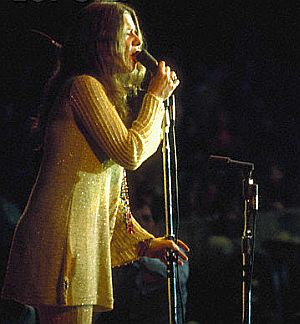
Janis Joplin performing at Woodstock, 1969.
Then in mid-August came Woodstock where she performed on the second day of the festival, singing a ten-song set that included such tunes as: “To Love Somebody,” “Summertime,” “Try (Just a Little Bit Harder),” Piece of My Heart,” and “Ball & Chain.” Joplin by then had parted ways with Big Brother & the Holding Company. Still, she had a full compliment of musicians backing her at Woodstock, where she performed in the wee hours, Saturday-to-Sunday, at about 2:00 a.m. Some reported that without her normal band, Joplin’s performance lacked its usual punch, but others found it a solid performance.Henry Diltz was an official photographer at Woodstock and had an “all-access pass” that got him to the stage, and more importantly, “a little catwalk built just under the lip of the stage” where he took photographs of Joplin performing. “I was literally feet in front of her while she was singing — the absolutely best seat in the entire house of 400,000 people.” Diltz said of Joplin’s performance: “Everything I saw her sing, it was nothing held back.”
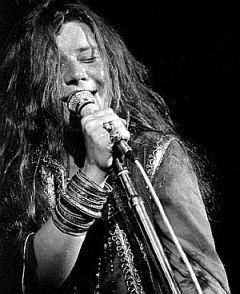
A younger Janis Joplin performing at an unidentified rock-festival venue sometime in the 1960s.
Following Woodstock, and through the remainder of 1969, there were other outings for Joplin and her band. In September they played the New Orleans Pop Festival at Baton Rouge International Speedway in Louisiana and at the Hollywood Bowl in L.A. In October there were gigs in Austin and Houston, Texas. In November she appeared at Curtis Hall concert in Tampa, Florida where she was charged with two counts of using vulgar and obscene language on stage. Later that month she appeared at Auditorium Hall in Chicago, and also Madison Square Garden in New York where she sang with Tina Turner at a Rolling Stones concert. Her first solo effort, I Got Dem Ol’ Kozmic Blues Again Mama!, with the Kozmic Blues Band, was released about that time, and received mixed reviews. It included songs such as “Try (Just a Little Bit Harder)” and “To Love Somebody,” a cover of a Bee Gees’ tune.
At the end of November 1969 Joplin played the West Palm Beach Rock Festival. In December there was an appearance in Nashville and another at Madison Square Garden — called a “rousing display of blues and rock” by the New York Times — where she was joined on stage by Johnny Winter and Paul Butterfield. It was about this time that she was “romantically linked” with Joe Namath in the New York papers, which appears to have been exaggerated beyond a meeting and a date or two. Other appearances in 1969 included ABC-TV’s Tom Jones Show, the Quaker City Rock Festival/Philadelphia, the Civic Center/Baltimore, ABC-TV’s show Music Scene, and the Toronto Pop Festival. Back home in California, meanwhile, Joplin moved into to a secluded home in a Redwood forest in the Larkspur area of Marin County, California, north of San Francisco, a beautiful spot between Mount Tamalpais and the San Francisco Bay. But toward the end of 1969, Joplin decided to take some time off.
Janis Joplin & David Niehaus on Copacabana Beach in Brazil, 1970, where Janis was surrounded by, and talking with, reporters.
R&R in Brazil
In January of 1970, Janis and her Kozmic Blues band parted ways, and in February, she traveled to Brazil with her friend and costume designer Linda Gravenites. Gravenites had been with Joplin since 1966 and had lived a clean and sober life and was traveling with Joplin in part to help her kick her drug and alcohol habits.
In Brazil, Joplin met and became involved with David Niehaus, a clean and sober American schoolteacher who was traveling around the world at the time. The two were later photographed as happy revelers at Carnival in Rio de Janeiro, described as a “carefree” couple having a great time. Niehaus was one of the first men in Janis’s life at the time who saw her as a woman and not a rock star, and Janis was quite taken with him. By April she reported from Rio that she was “going off into the jungle with a big bear of a man.” But when Joplin returned to the U.S. she began using heroin again and her relationship with Niehaus ended as a result. Still, some friends would say that Niehuas was the lost love of her life.
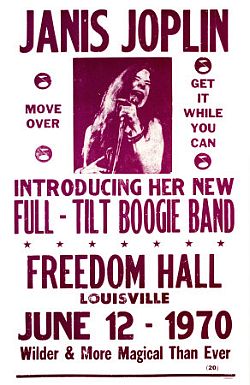
Poster for a Janis Joplin concert on June 12, 1970 in Louisville, KY with her new Full-Tilt Boogie Band.
Back in San Francisco, meanwhile, Joplin had formed her new band, the Full Tilt Boogie Band — a band composed mostly of young Canadian musicians; a band that Joplin had taken a more active role in forming than she did with her prior group. She would later describe this band as more fully her own. Joplin began touring with the Full Tilt Boogie Band in May 1970 and was quite happy with their performances and the feedback from fans and critics. Still, earlier that year, she had done a few performances with her former bandmates.On April 4th in San Francisco, she performed a reunion gig with Big Brother & The Holding Co. at the Fillmore West. Again, on April 12th, she appeared with Big Brother at Winterland where she and group were found in excellent form. By the time she began touring with Full Tilt Boogie in May 1970, Joplin had told friends she was drug-free. In fact, the young Canadians in her new band were also drug free and had no association with her old San Francisco crowd. Still, some noticed that her drinking had increased.
In late June 1970, she appeared on TV’s The Dick Cavett Show, where she announced she would attend her ten-year high school class reunion later that summer in Port Arthur, Texas. High school had not been a happy time for Joplin, noting at one point that her classmates, “laughed me out of class, out of town and out of the state.” More on the high school visit later.
1970 poster advertising Canada’s Trans Continental Festival Express.
Festival Express logo sticker.
The Festival Express
In late June and early July 1970, Joplin and her new band joined the all-star Festival Express tour through Canada. On this tour, Joplin and her band performed on the same bill with other acts including: the Grateful Dead, Delaney and Bonnie, Rick Danko and The Band, Eric Andersen, Ian and Sylvia, and others.
The Festival Express was unique among rock festivals. Rather than flying to each city — Toronto, Winnipeg, Calgary and Vancouver were each scheduled — the musicians would travel by chartered Canadian National Railways train. The idea was to foster an atmosphere of musical creativity and closeness between the performers. The trips between cities were a mix of jam sessions and partying, with no shortage of drugs and alcohol. One of these sessions became quite notable — with Rick Danko of The Band, Jerry Garcia and Bob Weir of the Grateful Dead, and Janis Joplin all having a rollicking good time.
During the actual Festival Express series of concerts — which saw the Vancouver concert cancelled due to the mayor’s “anti-hippie” edicts — Janis Joplin gave some memorable performances. Footage of Joplin singing “Tell Mama” in Calgary would later become an MTV video in the 1980s. This performance would also be included on later Joplin albums and DVDs.
The Festival Express Tour ended in early July 1970, but some 30 years later, in 2003, a “rockumentary” was produced featuring the original Festival Express tour, its music, and travels. That film would reap more than $1.2 million at the U.S. box office, and the DVD would become a hot seller as well. Shortly after the Festival Express, Joplin and the Full Tilt Boogie Band traveled to Honolulu, Hawaii where they performed in early July 1970 at the International Center Arena. But then it was back to California.
Poster for July 1970 Janis Joplin concert.
San Diego
On July 11th, Joplin and the Full Tilt Boogie Band arrived in San Diego for a concert there at the Sports Arena. They were joined in San Diego by longtime Doors producer, Paul Rothchild, who was being considered to work with Joplin on her next album. Janis’s sister, Laura, would later write of Rothchild in her book, Love, Janis:
“In San Diego, Janis gave him a stopwatch, saying ‘Look, I’ve got thirty-five good minutes in me. You stand behind the amps and I’ll look you over, you flash me how much time I have left.’ Paul thought it was a good sign that she was pacing herself like a runner.”
Joplin was fighting her alcohol and drug demons at the time.
Psychedelic-style poster for the July 11, 1970 concert in San Diego with Janis Joplin photo.
Rothchild later said of watching Joplin’s performance as she was singing:“. . . I was enraptured because I was listening to one of the most brilliant vocalists I ever heard, in classical, pop, or jazz music. What a voice. . . all of the woman was revealed. The vessel of Janis vanished. For somebody like me, who was always talking about the inner beauty and all that stuff, it got me big. So I was totally hooked from that moment on, on every single possible level.”
Several weeks later, Rothchild would help Janis work on her final album, Pearl.
On the plane ride back to San Francisco after the San Diego concert, Janis was upbeat, as the presence of old friends at the concert had energized her. She bought drinks for everyone on the plane.
But some of those with her, like Big Brother guitarist James Gurley, thought she was a bit “too exuberant, trying to be the life of the party.”
Joplin was still on an emotional roller coaster; high and then low. She was struggling to maintain her equilibrium.
Shea Stadium
In early August 1970, Joplin again appeared on The Dick Cavett Show, and a few days later, on August 6, 1970, performed as a surprise guest at the Festival for Peace at Shea Stadium in Queens. Joplin was not on the original roster of performers for the concert, but since she was in New York and her former band, Big Brother, was on the bill, she agreed to do the concert. By some accounts, at least 50,000 fans attended Joplin’s performance, re- portedly aided by a bottle of Southern Comfort whiskey. This concert — also called the Summer Festival for Peace — followed a Winter Festival for Peace that had been staged earlier that year at Madison Square Garden. These concerts were among the first ever in the U.S. to be used for political fund raising and anti-war purposes. Such concerts were not generally seen prior to 1970, but became more common thereafter. The acts at the Peace Festivals generally donated their time and performances. Among the performers at Shea Stadium that August were Peter Yarrow, Pacific Gas & Electric, Tom Paxton, Dionne Warwick, Poco, Ten Wheel Drive, Al Kooper, Richie Havens, Sha-Na-Na, The Young Rascals, Paul Simon, Creedence Clearwater Revival, Steppenwolf, The James Gang, Miles Davis, Johnny Winter, Herbie Hancock and others. The show ran from 10:00 a.m. to midnight. And by some accounts, at least 50,000 fans attended. Joplin’s performance — reportedly aided by a bottle of Southern Comfort whiskey — included at least four of her songs: “Ball & Chain,” “Summertime,” “Turtle Blues” and “Piece of My Heart.”
Bessie’s Marker
Headstone for Bessie Smith’s grave site that Janis Joplin helped pay for. Inscription:‘The greatest blues singer in the world will never stop singing.’
One of Joplin’s idols growing up had been Bessie Smith, the famous blues and jazz singer of the 1920 and 1930s. Smith’s music had been an early influence on Joplin. But when Joplin learned that Smith’s grave site had no marker, she moved to help provide a major portion of the funds to obtain one. A few days following her concert at Shea Stadium, on August 8, 1970, Joplin provided at least part of the financing to provide a headstone for Smith’s unmarked grave at Philadelphia’s Mount Lawn Cemetery. An inscription on the installed headstone reads: ‘The greatest blues singer in the world will never stop singing.’ Joplin’s next scheduled appearance in 1970 was in Boston, at Harvard College, but her band’s equipment was stolen. The group managed to make their performance at Harvard Stadium on August 12 th before 40,000 fans using borrowed equipment. Still, they seemed to have delivered a decent concert, as a front-page story in Harvard Crimson newspaper gave the concert a positive review. It would be Joplin’s last public appearance with the Full Tilt Boogie Band and her last public performance. Her next stop was her former home town, Port Arthur, Texas for the tenth year reunion of her high school class.
Janis’ Texas Hurt1956-1964
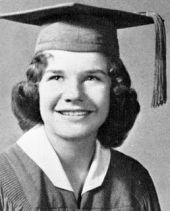
Joplin as she appeared in her 1960 high school photo.
Growing up in the conservative oil refining town of Port Arthur, Texas in the 1950s was not easy for young Janis Joplin. Although she was loved by her family while growing up there, her high school and local college experiences in Texas appeared to have scarred her deeply. As a teenager she had read the Beatniks, began to dress in her own style, and started singing folk and blues music locally. But in high school, she had gained weight and developed bad skin, and was called “pig” by some of the other kids. After graduating high school in 1960, she attended Lamar State College that summer, at nearby Beaumont Texas, and continued there in the fall. Ridiculed there as well, and not comfortable in class, she dropped out. In 1961, after passing a secretarial exam, Joplin’s parents sent her to Los Angeles to live with her aunts, but she soon found a place of her own in Venice Beach where drugs became part of her life. The visit home to Port Arthur for the reunion did not achieve what Joplin had hoped, and once again she left town feeling rejected and unloved. By the end of the year, she returned home to Port Arthur. In 1962, she enrolled in fine arts at the University of Texas in Austin and was also singing locally, blues mostly, but also with a blue grass band. Her experiences on the University of Texas campus, however, weren’t much better than in Port Arthur or Beaumont, as she was nominated for the “Ugliest Man on Campus” award at one point, a deep cut. After hearing about the post-Beat scene in San Francisco, Joplin made her way to North Beach in San Francisco and then Haight-Ashbury, then becoming more heavily involved with alcohol and drugs. After a near-death experience, and reportedly dropping to a weight of about 88 pounds at one point, she returned to Port Arthur in 1965. Back home, she tried college again at Lamar, this time enrolling as a sociology major. She kicked her drug habit, changed her look to a more conservative style, but still, her experiences at Lamar were no better. In Austin, meanwhile, she continued singing blues at a few clubs in late 1965 and early 1966. By mid-1966 she returned to California for good, pursuing her music career in San Francisco by joining Big Brother and the Holding Company. By late 1967, following her debut at the Monterey Festival, she was on her way to national stardom.
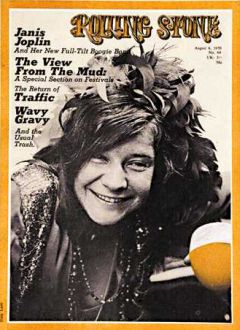
Janis Joplin on the cover of “Rolling Stone,” August 6, 1970.
In mid-August 1970, when Joplin returned to Port Arthur for her 10th year high school reunion, she was coming back, in part, to make a statement about her success, and specifically for those who had treated her badly as a teenager. But during the visit, Joplin was drinking hard and she did not attempt to “tone down” her dress or her style. She had also previously made negative remarks about Port Arthur in the national press — or as one New York Times writer put it — “never missed a chance to dismiss her blue-collar hometown as a bastion of small-town intolerance.” On August 14th, Joplin attended her high school reunion at Thomas Jefferson High School. She was accompanied by fellow musician and friend Bob Neuwirth, road manager John Cooke, and her younger sister, Laura. Dressed in the popular San Francisco hippie fashion of the day with feathers and beads and her trademark purple-tinted glasses, Joplin answered questions at a press conference, during which some of her more painful high school days came up again. All in all, it wasn’t a pleasant visit for Joplin. Generally, this visit home to Port Arthur for the reunion did not achieve what she had hoped, and once again she left town feeling rejected and unloved. She soon returned to California to work on her music.
Final Days
During late August, Joplin arrived in Los Angeles to begin work on a new album. Sessions were planned for the Sunset Sound Studio with producer Paul Rothchild. Joplin checked into the nearby Landmark Motel. She had been seeing a steady new boyfriend, a younger and wealthy easterner named Seth Morgan, and they were rumored to be engaged. But Joplin at the time threw herself into her recording sessions and the work on her new album.When he entered her motel room, Cooke found Joplin dead on the floor. She also had a bit of fun at the session, at one point recording a birthday greeting for John Lennon that would be sent to him later — using the Roy Rogers / Dale Evens tune, “Happy Trails.”
On Saturday, October 3, 1970, Joplin visited the Sunset Studios to listen to the instrumental track for the song “Buried Alive in the Blues” prior to recording her vocal track with it, scheduled for the next day. But on Sunday afternoon, she failed to show up at the studio. Producer Rothchild and road manager John Cooke became concerned. Cooke drove to the Landmark Motel where he found Joplin’s psychedelically painted Porsche still in the parking lot. When he entered her motel room, Cooke found Joplin dead on the floor. The official cause of death was later determined as an overdose of heroin, possibly combined with the effects of alcohol. Janis Joplin was 27 years old. Her ashes were later scattered into the Pacific Ocean along Stinson Beach north of San Francisco.
Cover of Janis Joplin’s “Me & Bobby McGee” single from her posthumous ‘Pearl’ album, 1971.
Joplin’s newly recorded material from her Los Angeles studio sessions, meanwhile, had not gone to market. Four months after her death, in February 1971, the new material was released under the album name, Pearl, a nickname sometimes used for Joplin. The album included the songs “Mercedes Benz,” “Get It While You Can,” and “Me and Bobby McGee.” Pearl topped the album charts for nine weeks, and “Me and Bobby McGee” became a No. 1 single in 1971 and one of her biggest hits. But the one song on that album without Joplin’s lyrics — the performance she never showed up for the weekend of her death — was left as an instrumental, “Buried Alive in The Blues.” Part of the verse in that song goes as follows: “All caught up in a landslide / Bad luck pressing in from all sides / Just got knocked off my easy ride / Buried alive in the blues.” And as Joplin herself once said: “People, whether they know it or not, like their blues singer’s miserable. They like their blues singers to die afterwards.”
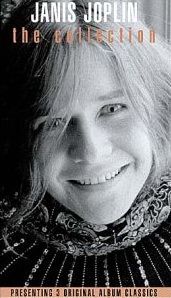
Cover photo of a young Janis Joplin from boxed set of 3 CDs.
Joplin as Icon
Joplin’s death was a blow to her fans and the music world, especially since only weeks earlier, Jimi Hendrix had also died. Joplin was remembered as a musical force and an icon for her own times as well as the ages. Many thought Joplin was just hitting her stride with Pearl, and might have gone on to much greater things had she overcome her demons. Tom Moon, writing in his book, 1,000 Recordings to Hear Before You Die, calls Pearl, “the precious last testament of a belter.” By her last year, Moon says, Joplin had grown into “a devastatingly original voice, the rare white interpreter of African American music who resisted the ready cliche. She treated old Delta songs and ’50s R&B ballads as theatrical platforms, ripe for large-scale rethinking. Her blues woe was never typical blues woe. …[S]he could turn out a plea that made listeners feel like they were part of a fateful make-or-break moment happening right then.”
Jon Pareles of the New York Times wrote that Joplin was: “overpowering and deeply vulnerable, brassy and shy, stylized and direct, indomitable and masochistic. She took the tough rasp of old blues shouters and made it her own by bringing out pain and tension to match the bravado. With magnificent timing Joplin made it seem as if she was pouring out unvarnished emotion.”
The Rock ‘n Roll Hall of Fame, writing her 1995 induction description, adds: “Janis Joplin has passed into the realm of legend: an outwardly brash yet inwardly vulnerable and troubled personality who possessed one of the most passionate voices in rock history.”
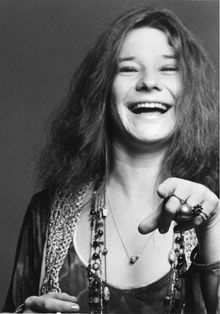
Janis Joplin, undated photo.
Megan Terry, among other authors writing in the book, Notable American Women, observes: “Joplin brought to her music a distinctive sound and look, passion and an honest interpretive ability. Her hold over an audience was as great as that of Elvis Presley and her success was an extraordinary and unprecedented feat in the male- dominated rock and music world.”
In fact, along with Grace Slick of The Jefferson Airplane, Joplin is credited with opening doors for women who would follow her in the rock ‘n roll business. And finally, music journalist Ellen Wills noted that “Joplin belonged to that select group of pop figures who mattered as much for themselves as for their music. Among American rock performers, she was second only to Bob Dylan in importance as a creator-recorder-embodiment of her generation’s mythology.” Joplin was inducted into the Rock and Roll Hall of Fame in 1995, and was given a Grammy Lifetime Achievement Award in 2005. Musicologists and historians continue to revisit her work. In November 2009, Case Western Reserve University and the Rock and Roll Hall of Fame and Museum celebrated the music of Janis Joplin during the 14th annual American Music Masters series, calling her one of rock ‘n roll’s most passionate and influential artists.
Janis Joplin photograph, undated.
Back in Port Arthur, Texas, meanwhile, and nearly two decades after her death, some of the love and recognition Janis Joplin had sought from her hometown began coming her way in after-the-fact fashion. In 1988, Joplin’s life and achievements were showcased and recognized at a January Convention Center gathering — an event, wrote Peter Applebome of the New York Times, “that perhaps had as much to do with economics as with affection.” Some 5,000 people came out for the ceremony, a major turn out for Port Arthur. There was a dedication of a Janis Joplin Memorial, which included a multi-image bronze sculpture of Joplin. The sculpture, along with momentos of Joplin’s career, as well as that of other local musicians including the Big Bopper (Jiles Perry Richardson, Jr.) and Johnny Winter, would eventually become part of the Museum of the Gulf Coast, housing a permanent Joplin exhibit on the second floor.In January 2008, Port Arthur celebrated Joplin’s 65th birthday by putting a historical marker in front of her childhood home. The town now proclaims its link to Joplin with billboards, brochures, an annual concert, and local tours of various Joplin landmarks. “She was a very popular figure in the ’60s, and she had a lot to do with the style of music that evolved at that time,” said Yvonne Sutherlin of Jefferson County Historical Commission in January 2008. “We just want people to know that she’s from here.”
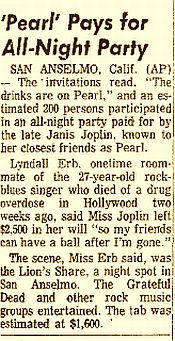
Associated Press, November 7th, 1970.
Beyond Port Arthur, the life and career of Janis Joplin has been explored on stage and screen in a number of productions and documentaries. In 1974-75, Janis, a Canadian film about her career using archival footage was produced. In 1979, the Hollywood film, The Rose, starring Bette Midler, was loosely based on Joplin’s life. In 1992,the biography, Love, Janis was published, written by Joplin’s sister, Laura. A musical stage show with the same title, Love, Janis, ran off-Broadway during 2001-2003 for more than 700 performances. In Washington, D.C., the Arena Stage featured a 2013 production – A Night with Janis Joplin – which includes the Janis character telling stories of inspiration from other artists such as Odetta and Aretha Franklin. A star on the Hollywood Walk of Fame came for Joplin in 2013, and a U.S. Postal Service commemorative stamp was issued in her honor in 2014. And in 2015, the documentary film, Janis: Little Girl Blue, directed by Amy J. Berg, was shown at the Toronto film festival, since airing to positive reviews in early 2016 on the American Masters PBS-TV series. See also at this website: “Selling Janis Joplin, 1995,” about a Mercedes-Benz TV ad using a Joplin song, and “White Rabbit,” a profile of a Jefferson Airplane song, its politics, and the group’s lead singer, Grace Slick. Other stories on notable women can be found at the topics page, “Noteworthy Ladies.” Thanks for visiting – and if you like what you find here, please make a donation to help support the research and writing at this website. Thank you. — Jack Doyle
Making the Scene: Yorkville and Hip Toronto in the 1960s
Stuart Henderson
University of Toronto Press, 2011
394 pages, Paperback and ebook $29.95, Cloth $70.00
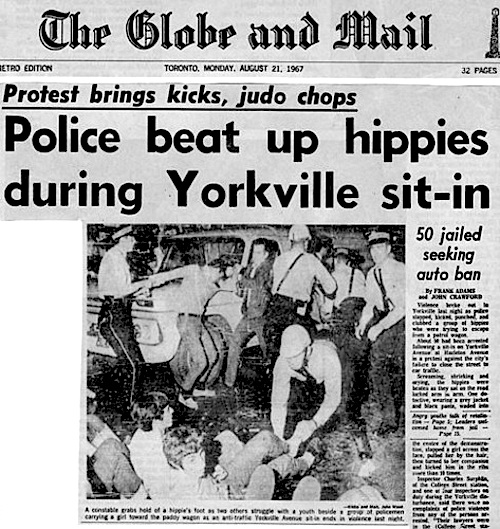
Stuart Henderson’s Making the Scene: Yorkville and Hip Toronto in the 1960s is an adventure back in time to Yorkville at what many would consider the pinnacle of its cultural history. Fifty years ago, the Yorkville Coffee Mill opened, among the first of many to become a hub for youth exploring counterculture through music and mysticism. Henderson’s book, which stemmed from his doctoral dissertation at Queen’s University, is rich with oral histories and underground press coverage of the day.
Personal experience drew me to Henderson’s work. I grew up in London (Ontario) in the 1990s. My father worked in Toronto for a time and stayed in an apartment on Bay Street near Bloor. Visiting on weekends, my mother and I would wander the “Mink Mile”. By then, Yorkville was a hub of elite consumerism, with couture boutiques and flagship stories. It was cultured, rather than counterculture.
Making the Scene tells the stories of the Toronto neighbourhood of Yorkville and the hip culture that pervaded the district in the 1960s. Henderson argues that, for roughly a decade, Yorkville served as the site in Canada for youth seeking an alternative to the dominant Canadian culture. He asserts that being part of a counterculture – defined as a subculture with values and practices that deviate from mainstream culture – involves the performance of identity. “A hippie,” he notes in the introduction, “does not, never can, exist wholly outside his or her cultural process” (5). In short, counterculture is a negotiation of identity, with cultural hegemony in play.
The book is organized chronologically in sections. Within each section is two chapters, one providing a political and cultural history of the period and the other assessing how the cultural identities in Yorkville were performed at the time. The book’s chronological organization makes Henderson’s argument easy to follow. However, there exists a strong historiography on counterculture-as-performance. Henderson does not especially take advantage of this material, and unfortunately relies on his readers to be familiar with the literature. For example, the performativity of “making the scene” requires the crossing of a threshold. Henderson even states that “as a geographic location, Yorkville was … metaphorically cut off,” and that Toronto was a divided cityscape, with Yorkville a zone of local “foreignness” (17)– both a cultural attraction and a destination. As a historian caught up in the meaning of place, this excited me until I realized that Henderson was not going to explore from where these people were being attracted, and how Yorkville was situated in the context of a rapidly expanding Toronto. In particular, it struck me that there were opportunities for the use of historical maps to tell these types of stories and to better illustrate the growth of the Yorkville coffee houses, followed by their retreat.
While Henderson situates Yorkville very well within its chronological context, the book seemed geographically isolated. The relationship between countercultures, identity, and place has been widely explored, so why not make better use of New York’s Greenwich Village or San Fransisco’s Haight-Ashbury to show what made Yorkville unique? Here, again, I think that the general reader may be disappointed that Henderson expects a high level of familiarity with the themes. Early in the work, I found myself asking questions about other countercultures in other cities and about the history of the 1960s counterculture phenomenon more broadly.
Similarly, the act of performing an identity that Henderson claims is part of “making the scene” requires the crossing of a boundary. Henderson states that “as a geographic location, Yorkville was metaphorically cut off” (268). I interpreted this to mean either that it was fully autonomous or that it had to be filled with people coming from elsewhere—by those who needed to cross the threshold from the dominant culture to the counterculture. Bloor Street between Yonge Street and Avenue Road remains, to this day, a cultural border best crossed under the right economic or social circumstances. I had hoped that Henderson would explore this idea further. Where were the people coming from? How was Yorkville situated in and affected by its geographic context of a rapidly changing and growing Toronto? Most of the images in the book are taken from underground press. There is one map, at the beginning, which shows the streets of Yorkville and their coffeehouses. Indeed, Henderson refers to Yorkville as “tied to a map of meaning which treated it as a circumscribed island of difference within the wider cityscape” (268), but we aren’t shown what exists around the island.
Henderson relies on dialogue from the film The Big Lebowski (1998) to describe the legacy of hip Yorkville:
‘Your revolution is over,’ counsels the conservative figure, as the bemused [Jeff] Bridges turns away. ‘My condolences. The bums lost. My advice is do what your parents did: get a job, sir. The bums will always lose. Do you hear me?’ But he doesn’t. Do we? (273)
The end of a rebellion is nothing new. The 19th century French statesman Francois Guizot has been attributed with the following: “Not to be a republican at 20 is proof of want of heart; to be one at 30 is proof of want of head.” What makes Yorkville and the 1960s counterculture unique, according to Henderson’s conclusion, is that it influenced the mainstream culture that we see today. That may be the case. He also suggests that the struggle for physical space was ultimately insignificant. This statement ignores the post-1970 gentrification of Yorkville that occurred, in part, because of the displacement of youth from this space.
It felt at times like Henderson was writing for those who were there, or who wished they could have been there. There were moments throughout when I felt like I had to have been there to understand why the event or place being described was important. The writing, much of which is done in first-person narration, is at times valourising in its tone. The book’s strength lies in its archival research and oral histories, and from reading it came some interesting debates about the nature of culture and place in the city of Toronto. I would recommend it for readers interested in the history of the Yorkville neighbourhood, Canadian culture in the 1960s, or youth culture in Canada. I will no doubt return to it for projects that reference these subjects. It would be a good supplemental work for those interested in counterculture, the history of Toronto, oral history, and underground media.
Kaitlin Wainwright is a graduate of Carleton University’s Public History program. She’s currently the Plaques and Markers Program Coordinator at Heritage Toronto.
The venues, schools, record labels, stores, and other landmarks that have created the sound of our city and shaped its music history.
The 1960s was the decade in which Toronto’s music scene took shape. With twin focal points in Yorkville and along the Yonge Street strip, the city produced highly regarded folk, rock, and R&B-influenced sounds. Though many of the venues from the decade are long gone, acts that developed their reputations in them, such as the Band and Gordon Lightfoot, became known around the globe.
1 Village Corner (174 Avenue Road, north of Davenport)
Another early folk venue, one where music duo Ian & Sylvia launched their career. As a member of the duo the Two Tones, Gordon Lightfoot recorded his first album here in January 1962.
2 Rockpile (northwest corner of Yonge and Davenport)
For a time in the late 1960s, the main space of the Masonic Temple (now home to MTV Canada) was a Fillmore-style concert hall. It is usually associated with Led Zeppelin, who played there twice in 1969. Before their August 18 gig, manager Peter Grant noticed the extensive lineup outside and threatened to cancel the show if the band didn’t get more money. The burly former bouncer got his way, but the amount handed over played a role in the venue’s closing soon after.
3 Penny Farthing (112 Yorkville Avenue)
Far more respectable than its next door neighbour, this spot specialized in blues and jazz. Veteran bluesman Lonnie Johnson played for several weeks in 1965, resulting in an album with one the venue’s regular acts, Stompin’ at the Penny with Jim McHarg’s Metro Stompers, featuring Lonnie Johnson. Johnson enjoyed playing in Toronto and spent the last five years of his life in the city.
4 Riverboat (134 Yorkville Avenue)
Opened in October 1964 and run by Bernie Fielder for 14 years, the Riverboat was usually considered the top venue in Yorkville thanks to a steady stream of high-level blues and folk acts. Sometimes timing worked in the Riverboat’s favour: in order to book bluesmen Sorry Terry and Brownie McGhee, Fielder was pressured by their agent to also slot in a rising folk duo named Simon & Garfunkel. By the time the pair was to perform in early 1966, their songs were rising up the charts. The duo wanted out of their commitment, but a compromise was reached, and Torontonians had what proved to be a rare opportunity to catch the pair in an intimate setting.
5 Mynah Bird (114 Yorkville Avenue, at Hazelton)
Named in honour of owner Colin Kerr’s pet, who could be found at this coffeehouse’s entrance, the Mynah Bird loved drawing attention to itself. For a period, it trotted out the latest innovations in topless entertainment, including Wyche, “the world’s first topless folksinger” (though her long hair covered her bosoms). Kerr also managed a rock group named after the venue, fronted by Rick James—after they separated from Kerr, Neil Young was among the musicians who passed through the group’s ranks.
6 Varsity Stadium (Bloor Street and Bedford Road)
Two major music festivals were held here in 1969. The bill for June’s Toronto Pop Festival ranged from southern soulsters (Carla Thomas) to Quebeçois chansonniers (Robert Charlebois). Local favourite Ronnie Hawkins managed to get a teenager named Jeanne Beker to jump onto the stage. September’s Toronto Rock and Roll Revival went down in history for being the live debut of the Plastic Ono Band featuring John Lennon and the Alice Cooper “chicken incident.”
7 Bohemian Embassy (7 St. Nicholas Street)
Situated at various places around the city over its history, and not to be confused with the condo bearing the same name, the venue founded by Don Cullen called the Yonge-Wellesley area home from 1960 to 1966. One of the city’s first major coffeehouses, it offered up a mix of folk, jazz, comedy, and literary readings—among those whose careers were boosted by appearances at the Bohemian Embassy were Margaret Atwood and Sylvia Tyson.
8 RCA Studios (225 Mutual Street)
Once home to CHUM radio, 225 Mutual Street became one of the city’s busiest recording studios. Operated by RCA during the 1960s and 1970s, then McClear Place, the studios saw acts ranging from Rosemary Clooney to Rush use its facilities over half a century of sound recording. The building was demolished in 2010.
9 Club Blue Note (372A Yonge Street)
A key venue for developing the mix of rock and R&B that came to be known as the “Toronto Sound.” As George Olliver, who sang with the house band The Five Rogues (later Mandala) told the National Post last year, “so many of the hit artists who used to work at the Maple Leaf Gardens came here after hours—people like Stevie Wonder, The Righteous Brothers.”
10 Hawk’s Nest (above Le Coq D’Or, 333 Yonge Street)
Having proven a popular attraction at Le Coq D’Or, Ronnie Hawkins made a deal with its owners: in exchange for free use of the building’s third floor (which ended up housing an office, gym, and after hours parties), he would run an all-ages club on the second floor. The Hawk’s Nest proved a blessing for music fans too young to go into the other venues along the Yonge Street strip.
11 Friar’s Tavern (283 Yonge Street)
Now the Hard Rock Café, the Friar’s Tavern was another stop for bands gigging along the Yonge Street strip. A plaque inside commemorates the morning of September 15, 1965, when Bob Dylan caught a performance by Levon and the Hawks, Ronnie Hawkins’ former backing band. For the next two nights, Dylan and the group that became the Band rehearsed at the Friar’s before going out on Dylan’s first electrified tour.
12 Colonial Tavern (203 Yonge Street)
Situated between two historic banks across from the present-day Eaton Centre, the Colonial Tavern attracted a steady stream of blues, jazz and rock acts during its existence. A parkette currently graces the site.
13 Electric Circus (99 Queen Street East) Opened in December 1968, the Electric Circus was intended by its backers to bring a New York–style trendy nightclub to Toronto. Partner Jerry Brandt told the Globe and Mail that “we think a person should be free to do what he wants. He can dance, he can watch, he can disappear for a while into an environment room…We have set up the facilities for you to have an experience. It’s not what you do, but how you do it.” After its run as a club/music venue, the site was used as the original studio for Citytv, who later resurrected the name for its dance show.
14 King Edward Hotel (37 King Street East)
Between their afternoon and evening performances at Maple Leaf Gardens on August 17, 1966, the Beatles attended a press conference at the venerable King Eddy. John Lennon refused to apologize for his recent statements that the band was more popular than Jesus. They also admitted that the scariest fans they encountered so far on what proved to be their final tour were found in Cleveland.
15 O’Keefe Centre (Yonge and Front)
This all-purpose concert hall, now known as the Sony Centre for the Performing Arts, was one of the most versatile venues of the decade in terms of performers. The pre-Broadway tryout of the musical Camelot, starring Julie Andrews and Richard Burton, opened the O’Keefe in October 1960. Acts that trod its stage during the 1960s ranged from grand opera to the Grateful Dead.
Additional material from Before the Gold Rush by Nicholas Jennings (Toronto: Penguin, 1997) and the December 21, 1968 edition of the Globe and Mail.
In September, 1974, Bob Dylan spent four days in the old Studio A, his favorite recording haunt in Manhattan, and emerged with the greatest, darkest album of his career. It is a ten-song study in romantic devastation, as beautiful as it is bleak, worthy of comparison with Schubert’s “Winterreise.” Yet the record in question—“Blood on the Tracks”—has never officially seen the light of day. The Columbia label released an album with that title in January, 1975, but Dylan had reworked five of the songs in last-minute sessions in Minnesota, resulting in a substantial change of tone. Mournfulness and wistfulness gave way to a feisty, festive air. According to Andy Gill and Kevin Odegard, the authors of the book “A Simple Twist of Fate: Bob Dylan and the Making of ‘Blood on the Tracks,’ ” from 2004, Dylan feared a commercial failure. The revised “Blood” sold extremely well, reaching the top of the Billboard album chart, and it ended talk of Dylan’s creative decline. It was not, however, the masterwork of melancholy that he created in Studio A.
For decades, the first “Blood” circulated on a bootleg called the New York Sessions. The compact disc that I picked up in a basement Greenwich Village store had a pleasant overlay of vinyl noise—the result of a transfer from a test pressing. Although several of the tracks have shown up in Columbia’s long-running Bootleg Series, the perennial absence of the full album has made fans wonder whether Dylan is wary of revisiting a turbulent time of his life, when his first marriage, to Sara Lownds, was dissolving. Dylan has denied that “Blood” is autobiographical; in his memoir, “Chronicles: Volume One,” he suggests that the songs were based on Chekhov. Artists tend to dislike personal readings of their most personal work.
Last month, Columbia issued “More Blood, More Tracks: The Bootleg Series, Vol. 14.” Available both as a single-disk compilation and as a six-CD “deluxe edition,” it is both more and less than what Dylan obsessives have been tiresomely clamoring for. The logical move would have been to include the entire album in its initial guise. Yet the single disk gives you only two of the test-pressing tracks, alongside some admittedly riveting outtakes. The box set has all of the discarded tracks, but they are scattered through a complete chronological survey of the four days of sessions—five and a half hours of Dylan at the height of his powers. You will have to study the track listings to assemble the original record. The elusiveness of “Blood on the Tracks” has been integral to its allure, and so it remains.
The Morgan Library, which owns the autograph manuscript of “Winterreise,” also possesses a five-inch-by-three-inch red spiral notebook in which Dylan wrote down lyrics for “Blood on the Tracks.” A hardback book included with Columbia’s “deluxe edition” reproduces forty pages of sketches. Some of them are sung more or less as written on both incarnations of the album:
He woke up, the room was bare
He could didn’t see her anywhere
He told himself he didn’t care,
pushed the window open wide
Then felt an emptiness inside
to which he just could not relate
Brought on by a Simple Twist of Fate
Other lyrics never saw the light of day, and are brutally confessional: “Doomed (led) by a heart that wanders astray / Trapped by a brain that I can’t throw away . . . Was it really 12 years ago, well, it seems like just the other day . . . And it’s Breaking me up with only myself to blame.”
Clichés about heartbreak feeding genius fail to explain the singular potency of “Blood on the Tracks.” The rawness of feeling is certainly there, but it is joined to meticulous craftsmanship in the working-out of words and music. The notebook shows constant, obsessive revision—a sort of perfectionism of disaster. “Idiot Wind,” the extended primal scream at the heart of the album, is seen in drafts so crowded with marginal additions that they are hardly legible. Often Dylan doesn’t cross things out, instead superimposing alternatives:
The priest wore black on the seventh day and waltzed around on a tilted floor stepped all over me
After you (came down on me) you said you never saw my face before did me in done
(After you stepped all over my head, you said ya never wanted to see my face no more)
I BEG YOUR PARDON MADAM (thru the circles round your eyes)
IDIOT WIND – BLOWIN EVERY TIME YOU MOVE YOUR JAW
FROM THE GRAND COOLIE DAM TO THE MARDI GRAS (blowing thru the hot and dusty skies)
Such collisions of hallucinatory images and dour realism—the waltzing priest, the marital argument—are common in Dylan’s work, yet here the literary touches seem less an artful device than a form of extreme emphasis. What’s more, the writing process is open-ended: images are shuffled around through successive drafts and, later, through successive takes in the studio. That priest waltzes on a tilted floor; then he waltzes while a building burns; then he sits stone-faced. The wind blows from the Grand Coulee Dam to the Mardi Gras, then to the Capitol.
The music that Dylan wrote for these lyrics has a chilly, clammy air. His guitar is in open-E tuning, meaning that all six strings of the guitar are tuned to notes of the E-major triad: E, B, E, G#, B, E. As a result, the tonic chord rings rich and bright. But each verse begins with a jarring A-minor chord, which tends to land awkwardly. The middle note easily strays off center, souring the sound. Occasionally, a stray F-sharp bleeds through, adding a Romantic tinge. The unwieldiness of the progression is at one with the fraught atmosphere of the text.
The emotional violence is troubling. The word “idiot” is flung down twelve times. Some lines are openly assaultive: “One day you’ll be in the ditch, flies buzzing around your eyes, / Blood on your saddle.” Here, Dylan’s original approach makes a substantial difference. He made four complete takes in New York, plus several rehearsals and false starts. Each time, he has only a quiet bass guitar backing him. (A ghostly organ was later overdubbed.) The tempo is slow, the delivery subdued. All this is at odds with the song’s smoldering rage, and the contradiction gets resolved in the final chorus, where Dylan shifts from the second person to the first-person plural: “Idiot wind, blowing through the buttons of our coats / Blowing through the letters that we wrote . . . We’re idiots, babe, it’s a wonder we can even feed ourselves.”
Many Dylanists will disagree with me—the second “Blood” has eloquent defenders—but to my ears the later version, recorded with six pick-up musicians in Minnesota, cuts out much of the complexity. Mannerisms overtake the singer’s delivery. “Idiot” becomes “yidiot,” and a goofy pirate yowl periodically intrudes: “I woke up on the roadside, daydreaming about the way things sometimes aaahhhhhrrrre.” (When he does this on one of the New York takes, Tony Brown, the bass player, laughs out loud.) The admission of shared responsibility at the end doesn’t register: you’re carried away by the momentum of the band.
All through the New York sessions, you hear a persistent downward tug in the voice, a grimace of regret. Even the album’s livelier numbers, such as “You’re Gonna Make Me Lonesome When You Go,” can be wrenched into the abyss; on one take, the tempo drastically slows, giving an almost tragic tinge to a line like “I’ve only known careless love.” The potential downside is a tendency toward relentlessness: one piece after another in the key of E, spiralling through love and loss. The final album offers more variety. The Minnesota band gives a rollicking energy to the cinematic yarn of “Lily, Rosemary and the Jack of Hearts.” Arguably, that song suffers under the austere New York style, though I love it anyway.
Ultimately, the long-running debate over the competing incarnations of “Blood on the Tracks” misses the point of what makes this artist so infinitely interesting, at least for some of us. Jeff Slate, who wrote liner notes for “More Blood, More Tracks,” observes that Dylan’s work is always in flux. The process that is documented on these eighty-seven tracks is not one of looking for the “right” take; it’s the beginning of an endless sequence of variations, which are still unfolding on his Never-Ending Tour. In an article from 1999, I notated some of Dylan’s live revisions of “Simple Twist of Fate.” The “More Blood” book reproduces alternate lyrics that were written on stationery from the Hotel Drei Könige am Rhein, in Basel. Dylan is still at it. The other night, in Durham, North Carolina, he sang:
He woke up and she was gone
He didn’t see nothing but the dawn
Got out of bed and put his shoes back on
Then he pushed back the blinds
Found a note she left behind
What’d it say? It said you should have met me back in ‘58
We could have avoided this, ah, little simple twist of fate.
To assemble the original “Blood on the Tracks” from the eighty-seven takes on “More Blood, More Tracks,” select tracks 69 (CD 5, No. 3), 71 (CD 5, No. 5), 34 (CD 3, No. 3), 76 (CD 5, No. 10), 48 (CD 4, No. 2), 16 (CD 2, No. 5), 11 (CD 1, No. 11), 59 (CD 4, No. 13), 46 (CD 3, No. 15), and 58 (CD 4, No. 12).













 Kenny Wilson's Blog