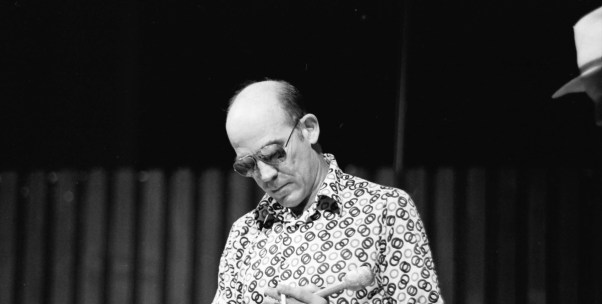
The Hippies // By Hunter S. Thompson 

The Hippies – By Hunter S. Thompson

The best year to be a hippie was 1965, but then there was not much to write about, because not much was happening in public and most of what was happening in private was illegal. The real year of the hippie was 1966, despite the lack of publicity, which in 1967 gave way to a nationwide avalanche in Look, Life, Time, Newsweek, the Atlantic, the New York Times, the Saturday Evening Post, and even the Aspen Illustrated News, which did a special issue on hippies in August of 1967 and made a record sale of all but 6 copies of a 3,500-copy press run. But 1967 was not really a good year to be a hippie. It was a good year for salesmen and exhibitionists who called themselves hippies and gave colorful interviews for the benefit of the mass media, but serious hippies, with nothing to sell, found that they had little to gain and a lot to lose by becoming public figures. Many were harassed and arrested for no other reason than their sudden identification with a so-called cult of sex and drugs. The publicity rumble, which seemed like a joke at first, turned into a menacing landslide. So quite a few people who might have been called the original hippies in 1965 had dropped out of sight by the time hippies became a national fad in 1967.

Ten years earlier the Beat Generation went the same confusing route. From 1955 to about 1959 there were thousands of young people involved in a thriving bohemian subculture that was only an echo by the time the mass media picked it up in 1960. Jack Kerouac was the novelist of the Beat Generation in the same way that Ernest Hemingway was the novelist of the Lost Generation, and Kerouac’s classic “beat” novel, On the Road, was published in 1957. Yet by the time Kerouac began appearing on television shows to explain the “thrust” of his book, the characters it was based on had already drifted off into limbo, to await their reincarnation as hippies some five years later. (The purest example of this was Neal Cassidy [Cassady], who served as a model for Dean Moriarity in On the Road and also for McMurphy in Ken Kesey’s One Flew Over the Cuckoo’s Nest.) Publicity follows reality, but only up to the point where a new kind of reality, created by publicity, begins to emerge. So the hippie in 1967 was put in the strange position of being an anti-culture hero at the same time as he was also becoming a hot commercial property. His banner of alienation appeared to be planted in quicksand. The very society he was trying to drop out of began idealizing him. He was famous in a hazy kind of way that was not quite infamy but still colorfully ambivalent and vaguely disturbing.

Despite the mass media publicity, hippies still suffer or perhaps not from a lack of definition. The Random House Dictionary of the English Language was a best seller in 1966, the year of its publication, but it had no definition for “hippie.” The closest it came was a definition of “hippy”: “having big hips; a hippy girl.” Its definition of “hip” was closer to contemporary usage. “Hip” is a slang word, said Random House, meaning “familiar with the latest ideas, styles, developments, etc.; informed, sophisticated, knowledgeable [?].” That question mark is a sneaky but meaningful piece of editorial comment.

Everyone seems to agree that hippies have some kind of widespread appeal, but nobody can say exactly what they stand for. Not even the hippies seem to know, although some can be very articulate when it comes to details.

“I love the whole world,” said a 23-year-old girl in San Francisco’s Haight-Ashbury district, the hippies’ world capital. “I am the divine mother, part of Buddha, part of God, part of everything.

“I live from meal to meal. I have no money, no possessions. Money is beautiful only when it’s flowing; when it piles up, it’s a hang-up. We take care of each other. There’s always something to buy beans and rice for the group, and someone always sees that I get ‘grass’ [marijuana] or ‘acid’ [LSD]. I was in a mental hospital once because I tried to conform and play the game. But now I’m free and happy.” She was then asked whether she used drugs often. “Fairly,” she replied. “When I find myself becoming confused I drop out and take a dose of acid. It’s a short cut to reality; it throws you right into it. Everyone should take it, even children. Why shouldn’t they be enlightened early, instead of waiting till they’re old? Human beings need total freedom. That’s where God is at. We need to shed hypocrisy, dishonesty, and phoniness and go back to the purity of our childhood values.”

The next question was “Do you ever pray?” “Oh yes,” she said. “I pray in the morning sun. It nourishes me with its energy so I can spread my love and beauty and nourish others. I never pray for anything; I don’t need anything. Whatever turns me on is a sacrament: LSD, sex, my bells, my colors…. That’s the holy communion, you dig?” That’s about the most definitive comment anybody’s ever going to get from a practicing hippie. Unlike beatniks, many of whom were writing poems and novels with the idea of becoming second-wave Kerouacs or Allen Ginsbergs, the hippie opinion makers have cultivated among their followers a strong distrust of the written word. Journalists are mocked, and writers are called “type freaks.” Because of this stylized ignorance, few hippies are really articulate. They prefer to communicate by dancing, or touching, or extrasensory perception (ESP). They talk, among themselves, about “love waves” and “vibrations” (“vibes”) that come from other people. That leaves a lot of room for subjective interpretation, and therein lies the key to the hippies’ widespread appeal.

This is not to say that hippies are universally loved. From coast to coast, the forces of law and order have confronted the hippies with extreme distaste. Here are some representative comments from a Denver, Colo., police lieutenant. Denver, he said, was becoming a refuge for “long-haired, vagrant, antisocial, psychopathic, dangerous drug users, who refer to themselves as a ‘hippie subculture a group which rebels against society and is bound together by the use and abuse of dangerous drugs and narcotics.” They range in age, he continued, from 13 to the early 20’s, and they pay for their minimal needs by “mooching, begging, and borrowing from each other, their friends, parents, and complete strangers…. It is not uncommon to find as many as 20 hippies living together in one small apartment, in communal fashion, with their garbage and trash piled halfway to the ceiling in some cases.”

One of his co-workers, a Denver detective, explained that hippies are easy prey for arrests, since “it is easy to search and locate their drugs and marijuana because they don’t have any furniture to speak of, except for mattresses lying on the floor. They don’t believe in any form of productivity,” he said, “and in addition to a distaste for work, money, and material wealth, hippies believe in free love, legalized use of marijuana, burning draft cards, mutual love and help, a peaceful planet, and love for love’s sake. They object to war and believe that everything and everybody except the police are beautiful.”

Many so-called hippies shout “love” as a cynical password and use it as a smokescreen to obscure their own greed, hypocrisy, or mental deformities. Many hippies sell drugs, and although the vast majority of such dealers sell only enough to cover their own living expenses, a few net upward of $20,000 a year. A kilogram (2.2 pounds) of marijuana, for instance, costs about $35 in Mexico. Once across the border it sells (as a kilo) for anywhere from $150 to $200. Broken down into 34 ounces, it sells for $15 to $25 an ounce, or $510 to $850 a kilo. The price varies from city to city, campus to campus, and coast to coast. “Grass” is generally cheaper in California than it is in the East. The profit margin becomes mind-boggling regardless of the geography when a $35 Mexican kilogram is broken down into individual “joints,” or marijuana cigarettes, which sell on urban street corners for about a dollar each. The risk naturally increases with the profit potential. It’s one thing to pay for a trip to Mexico by bringing back three kilos and selling two in a circle of friends: The only risk there is the possibility of being searched and seized at the border. But a man who gets arrested for selling hundreds of “joints” to high school students on a St. Louis street corner can expect the worst when his case comes to court.

The British historian Arnold Toynbee, at the age of 78, toured San Francisco’s Haight-Ashbury district and wrote his impressions for the London Observer. “The leaders of the Establishment,” he said, “will be making the mistake of their lives if they discount and ignore the revolt of the hippies and many of the hippies’ non hippie contemporaries on the grounds that these are either disgraceful wastrels or traitors, or else just silly kids who are sowing their wild oats.”

Toynbee never really endorsed the hippies; he explained his affinity in the longer focus of history. If the human race is to survive, he said, the ethical, moral, and social habits of the world must change: The emphasis must switch from nationalism to mankind. And Toynbee saw in the hippies a hopeful resurgence of the basic humanitarian values that were beginning to seem to him and other long-range thinkers like a tragically lost cause in the war-poisoned atmosphere of the 1960’s. He was not quite sure what the hippies really stood for, but since they were against the same things he was against (war, violence, and dehumanized profiteering), he was naturally on their side, and vice versa.

There is a definite continuity between the beatniks of the 1950’s and the hippies of the 1960’s. Many hippies deny this, but as an active participant in both scenes, I’m sure it’s true. I was living in Greenwich Village in New York City when the beatniks came to fame during 1957 and 1958. I moved to San Francisco in 1959 and then to the Big Sur coast for 1960 and 1961. Then after two years in South America and one in Colorado, I was back in San Francisco, living in the Haight-Ashbury district, during 1964, 1965, and 1966. None of these moves was intentional in terms of time or place; they just seemed to happen. When I moved into the Haight-Ashbury, for instance, I’d never even heard that name. But I’d just been evicted from another place on three days’ notice, and the first cheap apartment I found was on Parnassus Street, a few blocks above Haight.

At that time the bars on what is now called “the street” were predominantly Negro. Nobody had ever heard the word “hippie,” and all the live music was Charlie Parker-type jazz. Several miles away, down by the bay in the relatively posh and expensive Marina district, a new and completely unpublicized nightclub called the Matrix was featuring an equally unpublicized band called the Jefferson Airplane. At about the same time, hippie author Ken Kesey (One Flew Over the Cuckoo’s Nest, 1962, and Sometimes a Great Notion, 1964) was conducting experiments in light, sound, and drugs at his home at La Honda, in the wooded hills about 50 miles south of San Francisco. As the result of a network of circumstance, casual friendships, and connections in the drug underworld, Kesey’s band of Merry Pranksters was soon playing host to the Jefferson Airplane and then to the Grateful Dead, another wildly electric band that would later become known on both coasts along with the Airplane as the original heroes of the San Francisco acid-rock sound. During 1965, Kesey’s group staged several much-publicized Acid Tests, which featured music by the Grateful Dead and free Kool-Aid spiked with LSD. The same people showed up at the Matrix, the Acid Tests, and Kesey’s home in La Honda. They wore strange, colorful clothes and lived in a world of wild lights and loud music. These were the original hippies.

It was also in 1965 that I began writing a book on the Hell’s Angels, a notorious gang of motorcycle outlaws who had plagued California for years, and the same kind of weird coincidence that jelled the whole hippie phenomenon also made the Hell’s Angels part of the scene. I was having a beer with Kesey one afternoon in a San Francisco tavern when I mentioned that I was on my way out to the headquarters of the Frisco Angels to drop off a Brazilian drum record that one of them wanted to borrow. Kesey said he might as well go along, and when he met the Angels he invited them down to a weekend party in La Honda. The Angels went and thereby met a lot of people who were living in the Haight-Ashbury for the same reason I was (cheap rent for good apartments). People who lived two or three blocks from each other would never realize it until they met at some pre-hippie party. But suddenly everybody was living in the Haight-Ashbury, and this accidental unity took on a style of its own. All that it lacked was a label, and the San Francisco Chronicle quickly came up with one. These people were “hippies,” said the Chronicle, and, lo, the phenomenon was launched. The Airplane and the Grateful Dead began advertising their sparsely attended dances with psychedelic posters, which were given away at first and then sold for $1 each, until finally the poster advertisements became so popular that some of the originals were selling in the best San Francisco art galleries for more than $2,000. By this time both the Jefferson Airplane and the Grateful Dead had gold-plated record contracts, and one of the Airplane’s best numbers, “White Rabbit,” was among the best-selling singles in the nation.

By that time, too, the Haight-Ashbury had become such a noisy mecca for freaks, drug peddlers, and curiosity seekers that it was no longer a good place to live. Haight Street was so crowded that municipal buses had to be rerouted because of the traffic jams.

At the same time, the “Hashbury” was becoming a magnet for a whole generation of young dropouts, all those who had canceled their reservations on the great assembly line: the high-rolling, soul-bending competition for status and security in the ever-fattening yet ever-narrowing American economy of the late 1960’s. As the rewards of status grew richer, the competition grew stiffer. A failing grade in math on a high school report card carried far more serious implications than simply a reduced allowance: It could alter a boy’s chances of getting into college and, on the next level, of getting the “right job.” As the economy demanded higher and higher skills, it produced more and more technological dropouts. The main difference between hippies and other dropouts was that most hippies were white and voluntarily poor. Their backgrounds were largely middle class; many had gone to college for a while before opting out for the “natural life”à an easy, unpressured existence on the fringe of the money economy. Their parents, they said, were walking proof of the fallacy of the American notion that says “work and suffer now; live and relax later.”

The hippies reversed that ethic. “Enjoy life now,” they said, “and worry about the future tomorrow.” Most take the question of survival for granted, but in 1967, as their enclaves in New York and San Francisco filled up with penniless pilgrims, it became obvious that there was simply not enough food and lodging.

A partial solution emerged in the form of a group called the Diggers, sometimes referred to as the “worker-priests” of the hippie movement. The Diggers are young and aggressively pragmatic; they set up free lodging centers, free soup kitchens, and free clothing distribution centers. They comb hippie neighborhoods, soliciting donations of everything from money to stale bread and camping equipment. In the Hashbury, Diggers’ signs are posted in local stores, asking for donations of hammers, saws, shovels, shoes, and anything else that vagrant hippies might use to make themselves at least partially self-supporting. The Hashbury Diggers were able, for a while, to serve free meals, however meager, each afternoon in Golden Gate Park, but the demand soon swamped the supply. More and more hungry hippies showed up to eat, and the Diggers were forced to roam far afield to get food.

The concept of mass sharing goes along with the American Indian tribal motif that is basic to the whole hippie movement. The cult of tribalism is regarded by many as the key to survival. Poet Gary Snyder, one of the hippie gurus, or spiritual guides, sees a “back to the land” movement as the answer to the food and lodging problem. He urges hippies to move out of the cities, form tribes, purchase land, and live communally in remote areas. By early 1967 there were already a half dozen functioning hippie settlements in California, Nevada, Colorado, and upstate New York. They were primitive shack-towns, with communal kitchens, half-alive fruit and vegetable gardens, and spectacularly uncertain futures. Back in the cities the vast majority of hippies were still living from day to day. On Haight Street those without gainful employment could easily pick up a few dollars a day by panhandling. The influx of nervous voyeurs and curiosity seekers was a handy money-tree for the legion of psychedelic beggars. Regular visitors to the Hashbury found it convenient to keep a supply of quarters in their pockets so that they wouldn’t have to haggle about change. The panhandlers were usually barefoot, always young, and never apologetic. They would share what they collected anyway, so it seemed entirely reasonable that strangers should share with them. Unlike the beatniks, few hippies are given to strong drink. Booze is superfluous in the drug culture, and food is regarded as a necessity to be acquired at the least possible expense. A “family” of hippies will work for hours over an exotic stew or curry, but the idea of paying three dollars for a meal in a restaurant is out of the question.

Some hippies work, others live on money from home, and many get by with part-time jobs, loans from old friends, or occasional transactions on the drug market. In San Francisco the post office is a major source of hippie income. Jobs like sorting mail don’t require much thought or effort. The sole support of one “clan” (or “family,” or “tribe”) was a middle-aged hippie known as Admiral Love, of the Psychedelic Rangers, who had a regular job delivering special delivery letters at night. There was also a hippie-run employment agency on Haight Street; anyone needing temporary labor or some kind of specialized work could call up and order whatever suitable talents were available at the moment. Significantly, the hippies have attracted more serious criticism from their former compatriots of the New Left than they have from what would seem to be their natural antagonists on the political right. Conservative William Buckley’s National Review, for instance, says, “The hippies are trying to forget about original sin and it may go hard with them hereafter.” The National Review editors completely miss the point that serious hippies have already dismissed the concept of original sin and that the idea of a hereafter strikes them as a foolish, anachronistic joke. The concept of some vengeful God sitting in judgment on sinners is foreign to the whole hippie ethic. Its God is a gentle abstract deity not concerned with sin or forgiveness but manifesting himself in the purest instincts of “his children.”

The New Left brand of criticism has nothing to do with theology. Until 1964, in fact, the hippies were so much a part of the New Left that nobody knew the difference. “New Left,” like “hippie” and “beatnik,” was a term coined by journalists and headline writers, who need quick definitions of any subject they deal with. The term came out of the student rebellion at the University of California’s Berkeley campus in 1964 and 1965. What began as a Free Speech Movement in Berkeley soon spread to other campuses in the East and Midwest and was seen in the national press as an outburst of student activism in politics, a healthy confrontation with the status quo.

On the strength of the free speech publicity, Berkeley became the axis of the New Left. Its leaders were radical, but they were also deeply committed to the society they wanted to change. A prestigious University of California faculty committee said the activists were the vanguard of a “moral revolution among the young,” and many professors approved. Those who were worried about the radicalism of the young rebels at least agreed with the direction they were taking: civil rights, economic justice, and a new morality in politics. The anger and optimism of the New Left seemed without limits. The time had come, they said, to throw off the yoke of a politico-economic establishment that was obviously incapable of dealing with new realities.

The year of the New Left publicity was 1965. About the same time there was mention of something called the pot (marijuana) left. Its members were generally younger than the serious political types, and the press dismissed them as a frivolous gang of “druggies” and sex “kooks” who were only along for the ride.

Yet as early as the spring of 1966, political rallies in Berkeley were beginning to have overtones of music, madness, and absurdity. Dr. Timothy Leary the ex-Harvard professor whose early experiments with LSD made him, by 1966, a sort of high priest, martyr, and public relations man for the drug was replacing Mario Savio, leader of the Free Speech Movement, as the number-one underground hero. Students who were once angry activists began to lie back in their pads and smile at the world through a fog of marijuana smoke or to dress like clowns and Indians and stay “zonked” on LSD for days at a time. The hippies were more interested in dropping out of society than they were in changing it. The break came in late 1966, when Ronald Reagan was elected governor of California by almost a million-vote plurality. In that same November the GOP gained 50 seats in Congress and served a clear warning on the Johnson administration that despite all the headlines about the New Left, most of the electorate was a lot more conservative than the White House antennae had indicated. The lesson was not lost on the hippies, many of whom considered themselves at least part-time political activists. One of the most obvious casualties of the 1966 elections was the New Left’s illusion of its own leverage. The radical-hippie alliance had been counting on the voters to repudiate the “right-wing, warmonger” elements in Congress, but instead it was the “liberal” Democrats who got stomped. The hippies saw the election returns as brutal confirmation of the futility of fighting the Establishment on its own terms. There had to be a whole new scene, they said, and the only way to do it was to make the big move either figuratively or literally from Berkeley to the Haight-Ashbury, from pragmatism to mysticism, from politics to dope, from the involvement of protest to the peaceful disengagement of love, nature, and spontaneity. The mushrooming popularity of the hippie scene was a matter of desperate concern to the young political activists. They saw a whole generation of rebels drifting off to a drugged limbo, ready to accept almost anything as long as it came with enough “soma” (as Aldous Huxley named the psychic escape drug of the future in his science-fiction novel Brave New World, 1932). New Left writers and critics at first commended the hippies for their frankness and originality. But it soon became obvious that few hippies cared at all for the difference between political left and right, much less between the New Left and the Old Left. “Flower Power” (their term for the power of love), they said, was nonpolitical. And the New Left quickly responded with charges that hippies were “intellectually flabby,” that they lacked “energy” and “stability,” that they were actually “nihilists” whose concept of love was “so generalized and impersonal as to be meaningless.”

And it was all true. Most hippies are too drug oriented to feel any sense of urgency beyond the moment. Their slogan is “Now,” and that means instantly. Unlike political activists of any stripe, hippies have no coherent vision of the future which might or might not exist. The hippies are afflicted by an enervating sort of fatalism that is, in fact, deplorable. And the New Left critics are heroic, in their fashion, for railing at it. But the awful possibility exists that the hippies may be right, that the future itself is deplorable and so why not live for Now? Why not reject the whole fabric of American society, with all its obligations, and make a separate peace? The hippies believe they are asking this question for a whole generation and echoing the doubts of an older generation.

Source: The Hippies // By Hunter S. Thompson | +diStRito47+

Kenny Wilson Talks about Bob Dylan at Secular Hall Leicester 5th October 7 p.m.

Q&A: A.J. Weberman on Dylan, Lennon, Garbage, New York, and the JDL – Tablet Magazine

Good interview and article about A.J. Weberman by David Samuels of the Tablet.

Source: Q&A: A.J. Weberman on Dylan, Lennon, Garbage, New York, and the JDL – Tablet Magazine

Alan Weberman is a stone cold meshugganeh. He is by no means a reliable news source. Yet, by the same token, the legalese that these days must precede any printed record of the former Yippie, drug dealer, JDO activist, and pioneering garbologist’s nonstop provocations should not be taken as evidence that Weberman is somehow innately any less truthful than the celebrities, political figures, and power structures that he delighted in tweaking, torturing, and maligning for the past half-century. Weberman is no more or less corrosive than he always was, and politicians and rock stars are no more honest.

What’s changed, in the meanwhile, is us. We don’t see the point of Webermans anymore. They’re too abrasive. Or maybe, we are all Webermans now, thanks to the Internet, which flushed away the grittiness of a true oppositional culture down the social media toilet bowl. Thanks to Google, Facebook, and Twitter, there is no longer anything thrilling or shocking about calling celebrities bad names and going through their garbage. Or maybe it’s because famous people have more money, and better lawyers. Or because what’s left of the press is run by Ivy League conformist-types who are eager to maintain the pure ivory of their permanent records and are very anxious about keeping up institutional appearances, which are the only real form of capital they have, because the press is broke, which is a fool-proof recipe for boring.

If it helps, you can think of Weberman as a bullet-headed human keyhole into the oppositional culture that New York City nurtured in the bad old days, before Giuliani and Bloomberg cleaned the place up and turned it into one big dormitory for knowledge workers who were good with numbers and would die before eating at the wrong restaurant or sending their kids to the wrong preschool. Everything that was wrong about the old New York is right about Weberman, and everything that is right about the new New York is wrong about Weberman. So, like most things in life, it depends on your angle. Without Weberman, the world will become an even colder and less hospitable place for weirdos, which is something that I oppose.

I met Alan Weberman in his high-rise apartment, which is located in the upper part of the Upper East Side and offers a spectacular view of Queens. Through a haze of smoke, he offered me some of his memories, while being interrupted by the incessant demands of an ill-mannered bulldog, who is clearly the main focus of his affections. An edited transcript of our conversation was then redacted by a lawyer. I put the lawyer’s version aside, as I wrestled with the question of whether a lawyered version of Weberman was even worth publishing.

After an appropriate period of prayerful reflection, which lasted over a year, I have decided that it is important to hear Weberman speak about Bob Dylan, John Lennon, Meir Kahane, being a drug dealer, and some of his other pet subjects. It’s good to remember that being Jewish once meant being half-crazy, in addition to being neurotic and annoying. Anyone who wants to hear a recording of Weberman talking to Bob Dylan on the telephone can click here.

Where did your obsessive focus come from? Were you that way as a kid?

It started when I was in Washington, D.C. on Nov. 22, 1973, as part of an organized demonstration to find out who stole John F. Kennedy’s brain from the National Archives. You know, because the brain was missing. A New York Times reporter came across that. There was an article recently that some people say RFK took it.

So, we had this demonstration, and this guy Bernard Fensterwald was having a conference on the same day. I’d gotten vibes from working with Fensterwald that there was more to him than really met the eye. So, I’d been working all week, not smoking pot, putting up posters, handing out leaflets all over D.C. Then I came back and gave a little speech at Fensterwald’s conference.

Then I met this girl who was working for Fensterwald, and I says, “Let’s get high,” you know. So we started, I had a little hash, but it was Georgetown University, and these nuns were coming in and out. And so I said let’s go back to your dorm room so we went back to her dorm room, getting high and listening to rock and roll. And then somebody starts yelling from downstairs. It’s Steven Soter, you know Carl Sagan’s sidekick. And he shows me these pictures of the tramps who were picked up an hour after the assassination in a freight car you know behind the Texas schoolbook depository. So, you know so one of them looks like, says oh I thought this one was Frank Sturges, but Bernard Fensterwald said he went down to D.C. to Dallas and did a fucking study and it wasn’t the guy.

And I says, “You believe Fensterwald man? Fensterwald’s probably working for the CIA.” I looked at the tramp shots and I says, “Hmm, one of them looks like Howard Hunt, one of them looks like Frank Sturgis, and the other one looks like this guy who I rented a room to when I was going to Michigan State before I got expelled for dealing pot.” So I says, “Wait a minute, how can one guy, one tramp, can look like Sturgis, the other looked like Hunt, they’re both Nixon’s plumbers in Watergate?” Howard Hunt was involved in Bay of Pigs, and Frank Sturgis was involved with every goddamn thing imaginable.

So, I went to the National Archives, and that’s when I started speed-reading documents, and I read every document in the National Archives about the Kennedy assassination. Then I hooked up with this guy Mike Canfield, and Canfield convinced Congressman Gonzalez to introduce a bill to investigate the Kennedy assassination. And that’s how the House Select Committee on Assassinations was formed.

Did you ever read Norman Mailer’s novel Harlot’s Ghost?

No. I went through his garbage, though.

What did you find?

Betting slips.

Haha.

He’s a chicken shit, though. I was there going through his garbage and he came out of his house in Brooklyn Heights and I expected a big confrontation. But I was wearing a trench coat, so he must have thought I was a Fed or something. He just moved along.

I lived on that block, just up the hill from that big Jehovah’s Witness “Watchtower” building. Do you think Dylan was inspired to write “All Along the Watchtower” because of his view of that sign from downtown Manhattan?

(Photo courtesy of A.J. Weberman)

No, no. All along the watchtower, princes kept the view, while all the women came and went, it’s about his career. Before, when I was at a very primitive stage of Dylanology, I thought the wind began to howl meant Dylan, the wind, like blowing in the windbegan to howl, like Ginsberg’s poem “Howl.” So, I went and asked Ginsberg about it. He comes to the door naked. He says, “No, Weberman no, no.”

But he would ask me for advice. He got mugged a lot, and he wanted to know what to do.

He is a human being.

You know, he fucked around with needles and he got fucking hepatitis. And then he finally got some money.

Why did everybody love the needle so much back then?

Don’t ask me. I didn’t mess with needles. But it’s just a very pleasurable thing, apparently. And when I knew Lennon, he was an addict. See the way he looks at the end of his life: He’s skinny, he’s emaciated. Him and Yoko, time and time again, they didn’t have clothes on. I would follow him into the fucking bathroom and watch him take a piss. You know, what difference did it make, he was nude anyway.

I feel like gestures that seemed perverse and counter-cultural when you made them first back in the day, like digging through Bob Dylan’s garbage, have become widely shared social instincts. In a way, garbage-ology is the soul of the Internet.

You know, the term garbologist existed—in Australian, it meant a garbage collector—but there was no garbology, which is the study of garbage. So, I invented the word “garbology.” It’s come to mean studying garbage to see what you can know, to increase recycling and understand socioeconomic divides and this and that. I did it just to spy on Dylan, essentially.

I’ve read some of the stuff you’ve written about your purported—and in some cases, recorded—phone conversations with Bob Dylan, which are hilarious. Why do you think he kept talking to you?

Well, I brought my Dylan class over to his house on a field trip. And he came out and he says, “Al, whatchu bringing all these people around for?” So I says, “Oh, it’s a field trip for my Dylanology class. But actually it’s a demonstration against all you’ve come to represent.” You know, and so it went. He rolled up his sleeves and he says, “Look, I’m not a junkie.”

Then Dylan called me later on, when I got back to Sixth and Bleecker, and he says “Hey, how’d you like a job as my bodyguard or a chauffeur?” So I says, “You’re trying to buy me off, man. You’re trying to co-opt me and it’s not going to work.” And I started hanging around the studio with him and we had a great time. He writes about it in Chronicles, you know—allegorically.

You know, we always moved in the same circles, druggie-type circles in the West Village. The guy who lived next door to me in the West Village was the guy who Dylan originally crashed with, Ray Gooch. So, there was a connection right there. There were generally fewer people around back then.

Then Dylan wrote “Dear Landlord,” which was the first song about the Dylan- Weberman relationship, and it’s full of threats.

He was right to see you as threatening, no?

No. He was threatening my life and stuff. He could get into a really creepy fucking head, where we’ll be sitting around and he wouldn’t turn the lights on in Houston Street, and he’d be looking at that church on Houston and Sullivan—St. Anthony’s—and it would all get real gray and everything. And then he’d say, “Al, if you get into my life, I might gain a soul.”

I says, “Gain a soul? What do you mean, man? Are you threatening to kill me, are you gonna kill me?” He says, “No, but I know some mafia people who might.”

But guess what. He didn’t want to be blackmailed by the mob for the rest of his life. You know so he went around, he did a number on me himself. He caught me on Bleecker Street and beat the shit out of me.

(Photo courtesy of A.J. Weberman)

You were like something he couldn’t get off his shoe.

I was threatening his whole thing. He couldn’t shoot junk in peace. And then I chased him out of Greenwich Village by having a birthday party in front of his house and it was in the centerfold of the Daily News. After that, he couldn’t live in that neighborhood anymore. There were too many hippies camping out in front of his house and stuff.

You could have just left the man in peace. Why did you bother him?

I thought he was a sellout. You know, he sold out the left. But guess what, Dylan was never a leftist. He just fell into the easiest thing that would make him famous.

It was a big fuckin’ laugh what Dylan did. He had people singing how many years can the cannonballs fly before they’re forever banned? And if you look at Dylan in other contexts, he says “catch a cannonball bring me down the line, my bag is sinking low and I do believe it’s time.” So he’s saying, “Let’s find a black heroin connection, my bag is sinking low”—i.e., I’m running out of dope. “How many times must the cannonballs fly”—cannonballs are out of control, namely black people, “before they’re forever banned.” And what he means by banned is, people were banned in South Africa who were part of the ANC, because they opposed Apartheid.

That’s nuts.

Dylan sings racist sub-content, pro-apartheid sub-content, in his lyrics.

You understand that this is your own, very personal interpretation of Dylan’s lyrics, right?

Time after time these things come up. You used to ride on the chrome horse with your diplomat, you used to have diplomatic relations with the biggest exporter of chrome, South Africa. Who carried on his shoulder—Who shouldered the white man’s burden—a siamese cat, slang for a black man, a nigger. Ain’t it hard when you discovered that he really wasn’t where it’s at—wasn’t it hard for you to rationalize what you’d done when you decided to break diplomatic relations with South Africa.

So, that’s where Dylan’s head is at, man. He’s a fucking racist, he’s a fucking Holocaust revisionist, and he’s a Nazi fucking sympathizer. But when I knew him he was a proud Jew, OK? And I was a self-hating fucking Jew, pro-Palestinian, digging my own grave. And not just because I was Jewish. I was a hippie, too.

But then in the eighties, when Dylan wrote “Neighborhood Bully” about the scapegoating of Israel, did you feel some sense that maybe the two of you were on the same trajectory, after all?

Oh, it was a great song, you know. But then Dylan became a Christian. So, he sang, your father was an outlaw and a wanderer by trade, he taught me how to pick and choose and how to throw a blade. OK, so your father is an outlaw—your antecedents killed Christ—and a wanderer by trade, and they were forced to wander the world because of that. He taught you how to pick and choose—the chosen people—and how to throw the blade, circumcision. He oversees his kingdom so no stranger does intrude—he watches very carefully who he takes in and allows to convert to Judaism.

I also discovered backwards masking. You know, when I played “If Dogs Weren’t Free” backwards, it said “If Mars Invades Us” or something. I was friends with Jann Wenner, and so Jann ran it on Random Notes in Rolling Stone. Then people began to play records backwards and they got “Paul Is Dead.”

When you look at Jann Wenner now, he’s buff, right?

I don’t know how he did it, he must be taking steroids or something. When I knew him he was a little wimp I could push around. You know, I got him in the Eastside Bookstore once and threw him up against the wall. But now, I don’t know.

Do you believe that decoding Dylan lyrics for the past 50 years has really been the best use of your highly original mind?

It was like, you know, when you’d buy Ovaltine and if you get enough wrappers they would give you the Ovaltine secret decoder ring, where each number on the ring represented a letter. So, you’d tune into the Ovaltine hour and then you’d copy a letter and then another letter and then what was the message? Drink Ovaltine.

This is another case of that. I wasted my fucking life trying to fucking understand this stuff.

So, you went from Dylanology to Meir Kahane and his followers or proteges in the JDO, the Jewish Defense Organization.

It was Mordechai Levy who came by to spy on the Yippies for the secret service, essentially. Levy came across to spy on me and he didn’t find much anti-Israel stuff among the Yippies. It was all basically, you know, pro-pot single-issue politics. And then he started doing data mining on Nazis. You know, he would find a Nazi’s phone number, call up the business office and say “Could you read me back the numbers that were called from this number.” And then from those records he’d do another search on everyone that the Nazis called. And in that sense he sort of unraveled the neo-Nazi network in the United States at the time.

I was very impressed by his methodology. And essentially he rolled me over. He let me hear calls with Palestinians where he would get them to admit they were working with the Klan. Then he started the Jewish Defense Organization, and then any alleged acts of, shall we say, vandalism, ceased after we formed the JDO, because you can’t do both things at once.

What is the point of what you do now?

The purpose is to fight the Nazis essentially. I’m not like an armchair anarchist or revolutionary. You know, when we were fighting against the war in Vietnam, we were instigating riots.

Well, it would hard to get the Jews of America to riot about anything these days. You could give Iran, say, a nuclear bomb in broad daylight, and you would barely hear a peep from these folks. You could round up all the Gypsies, or the Guatemalans, and put them into concentration camps. Regardless of their political orientation, Jews in America are some pretty wealthy, self-satisfied white people these days, and they are largely ignorant of their own history. That’s why I like hearing stories from people like you.

You’re just mad at Bob Dylan, because you wanted to have a relationship with him that he clearly didn’t want to have, because he thought you were a nut.
No, I’m not. I’m telling you the truth, so you know.

Back in the days of the JDO, a lot of Jews were being put into schools that were integrated for the first time. And then you had the whole Bed-Stuy-Brownsville, community control of the school of school boards, where they threw out the Jewish teachers. So, a lot of Jewish kids were radicalized.

What turned me off to the JDL was the “nigger, nigger, nigger” all the time, you know. The Yippies were opposed to the JDL. We published their credit card numbers in the Yipster Times, and then they came around with baseball bats to beat my head in. I said, “Hey, you’re getting all these charges on your bill, you know what you can do you can get the legitimate charges taken off too you know while you’re at it.”

Kahane was an interesting guy, got kosher food in the prisons. Common fare. That benefited the Muslims, too.

What do you think of Kahane now?

He was a theocrat. He wanted religious police. He was a racist. Israelis decided he was a racist. Ultimately it’s their call.

The Soviet Jewry issue was one place that he had a positive impact. His violence was appropriate there. It threw a scare into people, especially the brain-dead Jews who ran the national Jewish organizations in America, both then and now. It also scared the Russians.

Yeah, absolutely. He put a lot of heat on the Russians. There’s no doubt about it. He went to prison for it, too.

And what do you think about the fact that Kahane worked for the FBI all those years?

He hated the left essentially. But I would have to file an FOIA request and see if I can get his reports to the Feds or his contact sheets or whatever.

Kahane gets out of school and becomes an undercover informant for the FBI infiltrating Klan activity, so he almost looks like a civil rights guy. Then he moves to the Russians and the Soviet Jewry thing, and then he is revealed as an extreme theocrat and a racist. What I’ve always wondered is, did he continue working for the FBI the whole time?

No. Once he started with the so-called terrorists, they don’t want to touch him. You know he’s committing, he’s inciting the commission of illegal acts, he’s participating to some degree. You know they dropped him after that.

Then, of course, in an irony of history, Kahane is the one that al-Qaida ends up targeting first, because they recognized him. They’re like, “That guy’s is really dangerous, because he’s the Jewish version of us.” And the failure to really follow up on the investigative leads in the Kahane assassination—because everyone thought that Kahane was simply a crazy Jewish racist who embarrassed everyone and probably did deserve to get shot—opened the door to the first World Trade Center attack, and then to the success of the Sept. 11 plot.

It was stupid. They had Emad Salem in there for the first World Trade Center bombing, this guy Carson Dunbar took him out, he was head of the New York FBI office. Then the bombing occurred, they put him back in the cell, and then they arrested everyone including Sheikh Rahman, and they made tapes of Sheikh Rahman talking to Emad Salem. And Emad Salem is saying, “Let’s bomb the FBI building.” And Rahman says, “Slow down slow down. It took us three years to train the one who killed Kennedy.” You know, and when this came up on trial, everybody the U.S. attorney, Lynn Stewart, the whole fucking crew, they weren’t going to say, “Hey, that could have been Robert Kennedy.” They all just laughed and said, “Oh, how could it be John Kennedy?”

And guess what: Rahman was close to Mohammad [M.T.] Mehdi, and Mehdi was close to Sirhan Sirhan, who did kill Robert Kennedy.

When you read accounts of the assassination of Robert Kennedy, it’s always presented as some inexplicable Oswald-like lone gunman event—except the man who did it, Sirhan Sirhan, had a very clear political purpose, which was to mark the anniversary of the Six Day War and to protest American support for Israel. He killed Robert Kennedy because he understood him to be a powerful American Zionist who was running for President.

Robert Kennedy was going to send U.S. fighter jets to Israel. Sirhan Sirhan was a Palestinian, and he was trained by a Muslim Brotherhood cell. The FBI still won’t give me documents about this one suspicious guy who ran a little study group in which Sirhan Sirhan participated, an Egyptian. They won’t give me his name.

Let’s talk about your relationship with John Lennon.

How that started was that we invaded Allen Klein’s office, he did the fucking Concert for Bangladesh album, and he kept all the money instead of giving it to the Muzzies in Bangladesh. So, New York magazine does a whole story on it, and we figure, “Hey, if this guy has to rip off the starving people of Bangladesh, he must be one hungry motherfucker.” So, we had our free lunch for starving music executives program where we went to the dumpsters on 1st Avenue near the fruit stands, got all this rotten fruit, came into Klein’s office, and tossed it around. Fucking Phil Spector was there man, he attacked my old lady, Anne. So, then he had the bodyguards throw us out.

So then, John and Yoko call me. And Yoko says, “Come on over for tea with you and Anne.” You know, so we went over to Bank Street. And then the friendship started.

What do you think they wanted? Did they want protection, because they were new to New York?

No, no. They were pissed off at Allen Klein, they liked what we did, you know. We spoke for them, too. They liked activism.

That guy John Lennon was a revolutionary. You know, “working-class hero.” He was into that fucking IRA. I met IRA guys over there who were selling hash and smurfing arms and sending it back to the IRA in Ireland. He was crazy, you know. He gave me money to start riots in Miami, at the Republican Convention.

So, Lennon believed in his politics, unlike Dylan?

You know, Lennon, he was using smack a lot of the time. You’d go there and they’d say, “Oh he’s depressed, you can’t go in the room.” They’d just load me up with records and Yoko’s art and everything, you know. And, in retrospect, you know, I would say he was going through cold turkey. He had no track marks, he was snorting at the time.

Back when Lennon convinced me he was up to revolutionary shit, we went and we put a phone line, we went to the back of the house, to John Cage’s phone line, and put an extension into Lennon’s house so when Cage went to sleep at night, Lennon could make his calls on Cage’s line without the FBI tapping them.

Did John Cage ever know that?

I don’t think so. I know Andy Warhol knew that we stole his furniture. What happened was, we’d just moved, we got back from Miami and we had the Yippie headquarters on 3rd Street and 2nd Avenue in a basement on the Angels block. So, we were looking for like a space heater or something. So, I was walking by Cooper Square and I saw this door was busted open. So, I walked upstairs and then holy shit, there was all this art deco stuff was there. You know bureaus and lamps and clocks made out of marble. I said, “Wow, somebody abandoned this.”

So, I had this guy come with a truck and loaded it all into a truck and brought it back to my loft and to the Yippie house. A week later, I read in New York magazine that somebody looted Andy Warhol’s art deco stash. So, later at a party, Dana Beal went over and told him, “Andy, we were the ones that took it, we thought it was abandoned property.” Andy says, “I don’t care, as long as you didn’t sell it, it’s OK with me.”

What did Lennon want from America?

What did he want? He loved New York, you know. He liked Jerry Rubin and Abbie Hoffman. You know, they’re entertaining people. And David Peel, of course. He was a revolutionary, so he just fit right into the crew basically. He came to demonstrations.

I had one, you know, “Paul Is Dead,” we were demonstrating outside Linda Eastman’s parents’ house. You know we had a hearse and we had a big mock funeral for Paul McCartney because his album was so apolitical. So, he and Yoko, they showed up in bags and read a whole statement.

When did you stop seeing him?

After he moved to the Dakota. Then they got real heavy into heroin. Really heavy, you know. They became addicts.

Did you ever see John Lennon use heroin?

No, he knew I was opposed to it. Because I was saying that Dylan was an addict, and he had sold out his left-wing thinking to use heroin—when of course there was no left-wing thinking. He just became the Marxist minstrel, because that’s what was happening at the time.

You’re just mad at Bob Dylan, because you wanted to have a relationship with him that he clearly didn’t want to have, because he thought you were a nut.

No, I’m not. I’m telling you the truth, so you know.

But you admire Dylan. You think he is very smart.

Oh yeah, he’s smart. He’s a freak. He played at Hubert’s Flea Circus. You know, you could ask him to sing any song and he’d sing it, like some kind of machine on 42nd Street. I’m waiting for him to write about that, because I used to go to Hubert’s all the time. He loved it in New York at the time, the gaslight. The Café Wha? I worked at the Wha? I paid Jimmy Hendrix $30 a night for three sets.

Jimi Hendrix is the one person in music history that I would trade everything I own for the chance to spend three hours in a small room where he was playing live.

(Photo courtesy of A.J. Weberman)

Oh, I heard him all the time. We would drop the actual glassware on the floor when he started to play, and then sweep it up later on, you know, so we wouldn’t miss a second. We’d go out and listen to him. Man, he’d go crazy, he’d play with his tongue, he’d play behind his back, he had all kinds of stuff—a lot of Dylan covers, “All Along the Watchtower,” “Like a Rolling Stone,” “Wild Thing.”

I remember Jimi saying to me when Eric Burdon was in the audience one night—“He’s going to sign me to go to England, I’m going to have plenty of money man, and I’m going to take every drug there is.” And I says, “You sure you want to take every one?” He says, “Yeah, I’m sure.”

He was a nice guy. Friendly, not condescending. He saw himself as basically a black Yippie. He gave the money to Abbie Hoffman to send joints to Congress. Every congressman got a joint. And, according to Abbie, a big percentage of them didn’t turn their joints over to the FBI.

Did you believe that pot was going to change people’s heads and change American society for the better?

And acid. We were going to squirt the cops with DMSO and LSD in water guns. DMSO would make their skin a permeable membrane. And of course the LSD would be psychotomimetic, it would make them crazy. But people don’t take acid anymore.

I don’t even know where I’d get acid in New York City these days. And if I did drop acid in my present condition, I would probably flip out and become a real-estate broker at Corcoran or something. So that part of my life is clearly over with.

It became an ordeal. But it could end regressive behaviors it can end alcoholism, it has good therapeutic value if taken under the right circumstances.

What do you make of the speed at which pot is being legalized in America?

I’m happy about it. You know, I got radicalized when I sold five joints to a fuckin’ undercover cop at Michigan State. I was facing 20 years on the sail, minimum mandatory, 10 years, when they vacuumed my pockets and found little minute amounts of cannabis. I had to come to New York City, get a job from the Lawrence employment agency, go see a shrink, you know, and then pay the district attorney 5,000 to let me off the fucking hook.

I turned Dana Beal on to pot, and then Dana came to New York City, escaped from a mental hospital where his mother put him for attacking someone in his class, he got a job at Klein’s on Union Square, in the record department, and then he moved on to the Record Hunter on 5th Avenue and 42nd, enrolled at NYU, was an A student. And then I turned him on to LSD. And he said, I want to be a revolutionary. So we had the first smoke-in in Tompkins Square Park, in 1967 in the Summer of Love. The East Village Other gave us an office on Avenue A and 10th Street, and we put a big sign in the window, Psychedelic Revolution. And anyone, we had marches. Anyone, anytime there was a pot bust we’d march through the East Village, and people were very happy to have us doing that. They’d throw flowers at us. Including the fucking flower pot.

So, then we opened three stores, Dana got busted, he had to go underground, and he hooked up with the Weather Underground in Wisconsin, and we continued to push for legalized marijuana. Myself, publisher Rex Weiner, and some other people, we had the first Marijuana Day Parade. May Day is J Day. John and Yoko sponsored it one year. We had a giant joint on stage. Yossarian, the underground cartoonist, would do the posters. We had had somebody smoking pot in an iron lung, had a hippie tied a little kid in a wheelchair or a high chair and a hippie forcing him to smoke pot, you know all kinds of weird, bizarre stuff. And then NORML came along, and so it became more widespread.

The current President of the United States writes in his memoirs about smoking pot.

Yeah, he lived next door here, in the adjoining building. You can see from the terrace downstairs, that fire escape where Obama said he went out to smoke dope. I think it’s a progressive thing. But then you know you’ve got Nazis like Ron Paul who want to make all drugs legal for people who are looking for a shortcut to happiness, who are never going to be able to find that happiness via traditional economic means. That’s part of his hidden agenda to fuck up the African American community, because he is basically a Nazi at heart.

I was staying at Grover Norquist’s town house, right—

Grover Norquist, the Republican direct-mail guru?

He was like a libertarian, he loved rock and roll, he had the greatest collection of rock records, man.

You were friends with Grover Norquist because of his record collection?

We had a friend in common, and I needed a place to stay in D.C. So, my friend takes me over to Spotlight, which was a real right-wing John Birch-type magazine, right, because I’ve done research for [late Congressman Henry] Gonzalez and [Sen. Richard] Schweiker, who created a Congressional Commission to investigate the conclusions of the Warren Commission about the circumstances around Kennedy’s death. And so I show them the tramp shots.

And so they say, “Oh this is very interesting. What’s your name?” And I say, “Allen Jules Weberman.” And then the guy says “Allen Jew Weberman?” And so I say, “Who are these fucking guys?” So, then I went back and listened to their stinking broadcast and I says, “Holy shit, it’s fucking Father Coughlin has come to life again.” And then I started to subscribe to the Spotlight. And in every issue, it was Ron Paul this, and Ron Paul that. Ron Paul was at this meeting. Ron Paul was their hero. That was his fan club, his base.

To have somebody like Ron Paul alive is like having a cancer. His big catch-phrase is “the New World Order.” Do you know what the new world order is? The new world order is where the Jews control everything. It’s another way of saying ZOG, the Zionist Occupation Government. It’s dog-whistle politics.

Do you feel the same way about Ron’s kid, Rand Paul?

Yeah. He wants to cut off aid to Israel. And he goes to Israel and says how much he likes the place and then ultimately he wants to destroy it. You know what he was named after? The Rand, the South African currency.

That’s hilarious. But is that true?

That’s what I believe. Ask Ron Paul.

What do you think of this city now? I was born here, I grew up here, but I stay out of Manhattan these days, because it generally depresses me.

Well, it’s lost a lot of its interesting places, really, like 4th Avenue and the bookstores, the electronic places on Courtland Street. You know it’s become pretty homogenous—Payless Shoes, Starbucks, ATMs, Duane Reade. And basically you have de facto segregation now, in that you need to have an income that’s like 40 times the amount of the rent per year or something.

Right. No one is a racist anymore, because even that would mean that they had an allegiance to something other than money. But then I remember the shooting galleries and the junkies, the people living in abandoned buildings, and that time wasn’t so good, either. I hate that fake nostalgia for the New York I grew up in from people who came here in 2011 to be stockbrokers or work for some crappy Internet company. The old New York City had its virtues, but it was pretty dangerous and shitty.

Everybody was getting ripped off. You know you work at a job, make $50 a week and you buy something and then next thing you know the junkies have come and stolen it from you. My customers at low numbers in the East 60s were getting home and people were trying to break down their doors in home invasions.

The city was fucking chaos, you know. But for me, it was wonderful. Because they were taking riff-raff. Everybody wanted to rent to me, even on MacDougal Alley, a little town house they were going to rent opposite Washington Square. I finally settled on 240 Central Park South, overlooking the park there. Antoine Saint Exupery’s old apartment. It was a love nest for somebody who owned 6th Avenue Electronics. So I had a terrace, wood-burning fireplace, in a tower of 240 Central Park South. And it was rent stabilized. I had to pay money to get the guy out and pay a fee to the broker, but they didn’t really scrutinize your records so much, because it was a buyer’s market.

But the city was deteriorating. There were pornography places on every block. There were all kinds of roving gangs around 8th Avenue and 42nd Street and 9th Avenue.

Was it fun being a drug dealer in the city?

Yeah, except for the rips.

Did you have guys with guns take stuff from you?

No, just once. What happened was this idiot guy from High Times was doing some story on coke dealers. So he calls me up and he says, “Oh do you want me to bring my friend around, he’s a big coke smuggler.” I says, “No, don’t bring him around.” So, he brought him around anyway. Then the guy sent his crew back to rip me off. You know so when somebody left, they came up, they cuffed me up, you know hit me a couple of times with a gun, kicked the dog, and stole a bunch of reefer from Gainesville, but they missed the mushrooms, you know. So, I says, “Aw fuck.”

So, what I did was I put double doors on there so you got buzzed in one door, and you’re in a little hallway and then you get buzzed in the other door with a TV camera to see who it was and then tear gas that could be remotely controlled. I hired somebody to put the doors in.

And sure enough the rips came back. And what they did was there was next door we had Studio 10 at 10 Bleecker Street, Quiet Riot played there and other bands of note. So I look out the window and all of the sudden, the black guards are white. The rips had kidnapped the guards, they’d kidnapped the black guards and tied ’em up and put ’em inside 10 Bleecker, and got their uniforms and were outside the door. So then this woman comes who was not a criminal herself, but comes from a crime family whose name would be easily recognizable, and she refused to open the door.

So they let her go, and then I buzzed the guy in. You know, so he comes in and then all of a sudden, the lights go out, the tear gas goes off, and then me and this guy who later actually ended up working in Times Square as a bouncer in one of the peep shows, cleaning up the semen with a fucking mop, and this other guy Smitty, who was also happened to have organized crime connections, but was forced into it by his father. And they come down and we have two fuckin shotguns, Ithacas—we cocked the fuckin Ithacas and said “We’re gonna fuckin blow you away.” And then boom, we hear a fuckin shot goes off. I release the front door and he goes limping away. He shot himself in the leg!

So that was the Wild West back then, man. The cops saw everybody going in and out in and out, all these people like Jim Jarmusch, I ran into him the other day, he was a customer. Ginsburg brought a whole bunch of people around. The President’s brother [name has been excised at lawyer’s request]. Other people I don’t want to mention. That photographer dude who did the pictures of the young kids, Robert Mapplethorpe, brought his crew around. The people from Saturday Night Live, the writers, it was a salon. You know, everybody you could get jobs, you could meet, advance your career, meet other people. And then the cops chased us out and I had to start a delivery service.

And now you comment on stories on the Internet. What’s the pleasure in that?

Well, a lot of my comments are pretty absurd. Like this woman today, she ran, she came in number 75 in the marathon. So she said, “Oh I finished in 5 and 40.” So I says, “How can you finish in 5 minutes and 40 seconds?”

What are your favorite sites to comment on?

Well, I’m barred from Huffington Post, and I’m barred from the Gothamist. Wenner got me barred. You know because when they came out with the Rolling Stone thing, with the Chechen bomber’s picture on the cover of Rolling Stone, you know, then I said “Aw, man, Wenner is doing intellectual limbo. He’s reached a new fuckin low.” You know, I knew the guy was a fucking low-life from years back. But I didn’t realize it went this deep. Even his own writer Matt Taibbi wouldn’t defend him, put his heart in the defense, because he was almost killed by Chechnyan separatists in Moscow. And the Daily News, somehow I got banned from there.

The Forward, I was banned for a little while because I said that a lot of gay Jews don’t like Israel, because they were maltreated when they were younger by other Jews.

Do you think the open information culture that the Internet has created has been a good thing for American democracy?

It spread a lot of ignorance. It gives a lot of ignorant people a chance to express themselves. When you see some kind of a factoid, a lot of times it’s repeated time after time, so you just put it in quote marks and put it in the Google search, and then you can see that it comes up in certain groups over and over again. So you know that somebody’s started it and the rest of the idiots just promulgated it. But the big thing is that Facebook has changed a lot of people’s lives.

You like Facebook?

Facebook is good. It gives people a chance to express themselves.

There was something in your spirit, in good ways and bad, that is now widely diffused throughout the culture because of the Internet. It’s become part of our cultural DNA. You had so much passion and aggression and interest and you had tools and you were an obsessive. I think that energy is part of what makes the Internet run. That, and porn.

Right, right. Well, you know we were tied in with Cap’n Crunch, you know he lived at 9 Bleecker, and he was making the—

Yeah, the long-distance phone hacks. Ron Rosenbaum wrote a great magazine article about that, in the days when there were great magazine articles.

In Esquire.

[Stops to take a phone call]

They’re putting up like a garbage transfer point here, so all the wealthy people at Asphalt Green are pissed off. But guess what? Asphalt Green used to be an asphalt plant that the mob used to make inferior cement and stuff. So what are they so afraid of? It’s not going to be toxic, it’s just going to be people’s garbage. Rich people’s garbage!

How Coffee Bars Fueled the Vietnam Peace Movement – The New York Times

Further evidence of the importance of coffee bars in the radical culture of the 1960s. (From the New York Times.)

In the summer of 1967, Fred Gardner arrived in San Francisco with the Vietnam War weighing heavily on his mind. Gardner was 25 years old, a Harvard graduate and a freelance journalist for a number of major publications. He was attracted to Northern California’s mix of counterculture and radical politics, and hoped to become more actively involved in the movement to end the war. He was particularly interested in the revolutionary potential of American servicemen and couldn’t understand why antiwar activists and organisers weren’t paying more attention to such a powerful group of potential allies.

Ever since completing a two-year stint in the Army Reserves in 1965, Gardner had been closely watching the increasing instances of military insubordination, resistance and outright refusal that were accompanying the war’s escalation. From the case of the Fort Hood Three — G.I.s arrested in 1966 for publicly declaring their opposition to the war and refusal to deploy — to the case of Howard Levy, an Army dermatologist who refused his assignment to provide medical training for Special Forces troops headed to Vietnam, it was clear that the Army was fast becoming the central site of an unprecedented uprising. By 1967, the “G.I. movement” was capturing national headlines.

And it wasn’t just the war that was aggravating American servicemen. The military’s pervasive racial discrimination — unequal opportunities for promotion, unfair housing practices, persistent harassment and abuse — fueled increasing outrage among black G.I.s as the war progressed. Influenced by the civil rights and black liberation movements, black soldiers participated in widespread and diverse acts of resistance throughout the Vietnam era. Racial tensions were particularly high in the Army, where a vast majority of draftees were being sent, and where evasion, desertion and insubordination rates among black G.I.s exploded in the war’s later years. An antiwar movement in the military was beginning to take shape, with black soldiers often its vanguard.

Photo

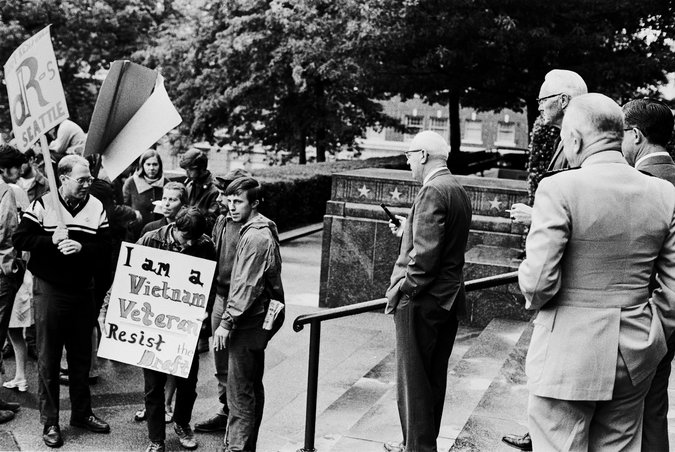
Antiwar veterans protest at the Federal Building in Seattle, September 1968. CreditFred Lonidier

As Gardner sat in the radical coffeehouses of San Francisco’s North Beach neighborhood that summer, he thought about the explosive power of servicemen turning against the war and wondered how that power could be supported and nurtured by the civilian antiwar movement. Most of all, he wanted to find a way to reach out to disaffected young G.I.s, to show them that there was a whole community of antiwar activists and organizers who were on their side. He finally settled on an idea: opening a network of youth-culture-oriented coffeehouses, just like the ones in North Beach, in towns outside military bases around the country.

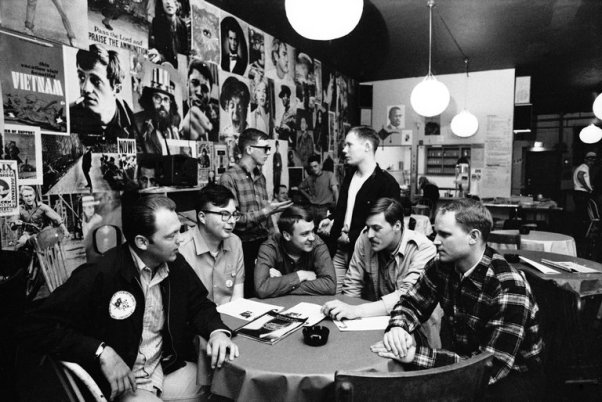
In January 1968 he did just that, travelling with a fellow activist, Donna Mickleson, to Columbia, S.C., home of Fort Jackson, one of the Army’s largest training bases and the crown jewel of the state’s many military installations. The UFO coffeehouse, decorated with rock ’n’ roll posters donated from the San Francisco promoter Bill Graham, quickly became a popular hangout for G.I.s — and a target of significant hostility from military officials, city authorities and outraged local citizens (“It’s a sore spot in our craw,” a Columbia official said.) The coffeehouse was located just off base, out of the military’s reach but close enough for soldiers to visit during their free time — places where active-duty servicemen, veterans and civilian activists could meet to plan demonstrations, publish underground newspapers and work to build the nascent peace movement within the military.

By the summer of 1968, major antiwar organizations took notice of the controversy the UFO was stirring up in Columbia and initiated a “Summer of Support” to organize funds for more coffeehouse projects around the country. In ensuing years, more than 25 “G.I. coffeehouses” opened up near military bases in the United States and at a number of bases overseas.

Over the course of six years, the coffeehouse network would play a central role in some of the G.I. movement’s most significant actions. At the Oleo Strut coffeehouse in Killeen, Tex., local staff and G.I.s mobilized to support the Fort Hood 43 — a large group of black soldiers who were arrested at a meeting to discuss their refusal to deploy for riot control duty at the Democratic National Convention in Chicago. A black veteran present at the meeting described its mood: “A lot of black G.I.s knew what the thing was going to be about and they weren’t going to go and fight their own people.” Army authorities were caught off guard by the publicity the coffeehouse brought to the case, and began to examine their strategies for dealing with political expression among the ranks.

When eight black G.I.s, each of them leaders of the group G.I.s United Against the War in Vietnam, were arrested in 1969 for holding an illegal demonstration at Fort Jackson, the UFO coffeehouse served as a local operations center, drumming up funds for lawyers and promoting the “Fort Jackson Eight” story to the national media. After G.I. and civilian activists created intense public pressure, officials quietly dropped all charges, signaling a shift in how the military would respond to soldiers expressing dissent.

During its brief lifetime, the G.I. coffeehouse network was subjected to attacks from all sides — investigated by the F.B.I. and congressional committees, infiltrated by law enforcement, harassed by military authorities and, in a number of startling cases, terrorized by local vigilantes. In 1970, at the Fort Dix coffeehouse project in Wrightstown, N.J., G.I.s and civilians were celebrating Valentine’s Day when a live grenade flew in through an open door; it exploded, seriously injuring two Fort Dix soldiers and a civilian. Another popular coffeehouse, the Covered Wagon in Mountain Home, Idaho (near a major Air Force base), was a frequent target of harassment by outraged locals, who finally burned it to the ground.

Though their numbers dwindled as the war drew to a close in the mid-1970s, G.I. coffeehouses left an indelible mark on the Vietnam era. While popular mythology often places the antiwar movement at odds with American troops, the history of G.I. coffeehouses, and the G.I. movement of which they were a part, paints a very different picture. Over the course of the war, thousands of military service members from every branch — active-duty G.I.s, veterans, nurses and even officers — expressed their opposition to American policy in Vietnam. They joined forces with civilian antiwar organizations that, particularly after 1968, focused significant energy and resources on developing social and political bonds with American service members. Hoping to build the resistance that was already taking shape in the Army, activists at G.I. coffeehouses worked directly with service members on hundreds of political projects and demonstrations, despite relentless government surveillance, infiltration and harassment.

The unprecedented eruption of resistance and activism by American troops is critical to understanding the history of the Vietnam War. The G.I. movement and related phenomenon created a significant crisis for the American military, which feared exactly the kind of alliance between civilians and soldiers that Fred Gardner had in mind when he opened the first G.I. coffeehouse in 1968. Despite the extraordinary political and cultural impact that dissenting soldiers made throughout the Vietnam era, their voices have been nearly erased from history, replaced by a stereotypical image of loyal, patriotic soldiers antagonized and spat upon by ungrateful antiwar activists. In the decades since the war’s end, countless Hollywood movies, books, political speeches and celebrated documentaries have repeated this image, obscuring the war’s deep unpopularity among the ranks and the countless ways that American troops expressed their opposition.

This historical erasure serves a distinct purpose, casting dissent — from wearing an antiwar T-shirt to kneeling during the national anthem — as inherently disrespectful, even abusive, to American soldiers. A fuller reckoning with the era’s history would begin by acknowledging the countless G.I.s and civilians who stood together against the war. G.I. coffeehouses are a vital window onto this history, showing us places where men and women came together to share their common revulsion at the war in Vietnam, and to begin organizing a collective effort to make it stop.

From Folk to Acid Rock, How Marty Balin Launched the San Francisco Music Scene | Collectors Weekly

This article was written by Ben Marks and first published in Collectors Weekly

Bill Graham, Janis Joplin, Jerry Garcia—half a century on, these names still evoke the sound of San Francisco in the late 1960s. To be sure, the city’s greatest concert promoter, singer, and guitarist all deserve their status as cultural icons, but it was another guy whose name you might notimmediately recognize, Marty Balin, who drew the world’s attention to San Francisco in the first place. That’s because in 1965, Balin undertook two inextricably linked projects that together changed rock-music history—he helped open a small but highly influential club called the Matrix, and he founded a new band, Jefferson Airplane, which played its first gig on his club’s opening night.

“You could predict how a show would go according to the drugs lined up on the back of the amps.”

Those two acts would have been enough to secure Balin’s place in music history, but the singer was just getting started. That fall, Balin encouraged an ambitious impresario named Bill Graham to host a benefit concert for a theater group Graham was managing, offering up Jefferson Airplane for the occasion. A second benefit at the Fillmore Auditorium, also featuring the Airplane, followed that December. By February of 1966, Jefferson Airplane was headlining the first non-benefit concert at the Fillmore for Graham—during that year, Balin’s band would play more than 30 dates at the hall.

Top: Marty Balin at Monterey Pop, 1967. Photo by Suki Hill. Above. Jefferson Airplane enjoyed a close relationship with promoter Bill Graham, who booked the band, which he managed during most of 1967, into the Fillmore in San Francisco and beyond.

The following year, 1967, the Airplane performed more than 100 times, including an electrifying appearance at Monterey Pop. In the winter of 1968, Balin and company briefly partnered with Jerry Garcia and the Grateful Dead to produce their own shows at the Carousel Ballroom. And then, in 1969, after performing at Woodstock that summer, the Airplane ended the decade as one of the openers for a free Rolling Stones concert at Altamont, where Balin was knocked unconscious by a Hells Angel when Balin came to the aid of a fan who was being beaten with pool cues by multiple members of the notorious motorcycle gang.

For Balin and the Airplane, the trajectory to that fateful day had been fast and steep. But like most musicians, Balin’s “overnight” success was years in the making. His first record deal, inked in 1962 when he was just 20, was with Challenge Records of Los Angeles, whose claim to fame had been a catchy single by The Champs called “Tequila.” For Challenge, Balin recorded four songs (only one of which he co-wrote), which were pressed onto a pair of 45s.

Balin recorded his first record in 1962 at age 20. This copy is inscribed to his mother and father.

Like a lot of Johnny Mathis and Paul Anka wannabes cutting records in those days, Balin was given a stage name—he was born Martyn Jerel Buchwald. In the studio, Balin sang with the L.A. music industry’s go-to backup band, the Wrecking Crew. “The lead guitar player at the session was Glen Campbell,” Balin remembers. “He was the hot guy in town at the time.” Also at the session—which his father, Joe Buchwald, paid for—was guitarist Barney Kessel, bassist Red Callender, Jack Nitzsche on piano, and Hal Blaine on drums, with the Blossoms providing the backing vocals and Ricky Nelson’s arranger, Jimmie Haskell, conducting the strings. “They put me in a little room with a window and said ‘sing.’” Balin recalls.

Balin sang, although his debut went unnoticed by radio stations and, hence, the public. Still, Balin had his first taste of the music business, and he wanted more. He got it in the summer of 1963, while hanging out one evening in a San Francisco folk-music spot on Union Street called the Drinking Gourd. There, Balin met three other musicians who were looking to form a group. From that chance encounter, the Town Criers were formed. Before long, they were playing the Drinking Gourd and clubs like the hungry i and the Purple Onion, on one occasion opening for the great comedian Dick Gregory—within few years, Gregory would be sharing bills with the Airplane.

Between is solo career and Jefferson Airplane, Balin (top right) sang with a folk outfit called the Town Criers.

The year 1964 was a transitional one for American pop music. By then, the folk revival of the 1950s and early ’60s was feeling the competition from the British Invasion. The Beatles had arrived in February with Little Richard and Chuck Berry numbers in their repertoire. The Rolling Stones followed in June, introducing white American kids to black American blues. And in November, the Animals had an unlikely hit with a traditional American folk song called “The House of the Rising Son.”

By 1965, folk-rock hybrids were popping up all over the place. That spring, The Byrds had a hit with Bob Dylan’s “Mr. Tambourine Man,” which was recorded in an L.A. studio with many of the same musicians who had backed Balin for Challenge Records. During the summer, Bob Dylan famously “went electric” at the Newport Folk Festival, a new San Francisco group called the Charlatansperformed for six weeks straight—but not “straight”—at the Red Dog Saloon in Virginia City, Nevada, and the Lovin’ Spoonful burst on the scene with the release of its first single, “Do You Believe in Magic?”

What San Francisco lacked in 1965 was a reliable performance space for this new genre, which is partly what had sent the Charlatans to Virginia City. “When I was in the Town Criers,” Balin says, “I wanted to use electric guitars and drums, but places like the Drinking Gourd didn’t want that because it was too loud.” Still, Balin performed frequently at the Drinking Gourd, often on “hootenanny” night, accompanying his beseeching tenor with a nylon-string Martin guitar.

This 18-foot wide painting hung in the Matrix when Balin opened the club in 1965. The "JA" in the right panel is a nod to the club's house band, Jefferson Airplane. Years later, Balin found the painting in a gallery in Los Angeles. He purchased it and donated it to the Rock & Roll Hall of Fame, where the center three panels are currently on view. Courtesy of the Rock & Roll Hall of Fame.

It was a meager act, but Balin played those hootenanny nights for all he was worth, and that passion was enough to earn him a small following. “These nurses would come in and see me,” Balin remembers. “I guess they kind of liked what I did. One night, they brought their boyfriends, and after my set, I joined them at their table. The boyfriends, who were engineers, were talking about how they each had $3,000 to invest and didn’t know what to do with the money. I immediately jumped in and said, ‘Hey, give it to me.’ They said, ‘What would you do with it?’ And I said, “I’d open a nightclub and put a band in it. You can have the nightclub, I’ll keep the band.’”

That may have seemed like a bold proposal coming from a nobody who was still covering Rod McKuen tunes, but Balin was one of those people who had a natural knack for making things happen. “I’m an Energizer Bunny,” he says, “a stimulator. I have ideas and then I get other people to show off their talents and abilities, too.”

The 1965 lineup for the incarnation of Jefferson Airplane that recorded the band's first album was (from left to right) Paul Kantner, Jack Casady, Signe Anderson, Jorma Kaukonen, Marty Balin, and Skip Spence.

Indeed, on that night at the Drinking Gourd, Balin already had some of the pieces for his still-unnamed band in place. In March of 1965, Balin had found his first recruit, Paul Kantner, at one of the Drinking Gourd’s open-mic nights, as Balin told Got a Revolution author Jeff Tamarkin for a 1993 interview published in “Relix Magazine.” “I remember I was standing at the door and he came in and the guy said, ‘No more room, we’re filled up.’ I said, ‘Give him my spot,’ because he looked interesting; he had two guitars, one in each hand, which was rare. Kind of a weird-looking dude. So he came in and he had a 12-string and a six and he came out onstage and tuned up, like he still does, and started to play this song and then stopped. He was embarrassed or something. And he walked off.”

According to Kantner in Got a Revolution, embarrassment had nothing to do with it. “It was a noisy, drinking kind of crowd. So I said, ‘This sucks. I’ve had enough, good-bye.’” For some reason, Balin was smitten. “As I was leaving Marty said, “Hey, you want to start a band?’” Kantner did.

The Matrix was a hit from the day it opened on August 13, 1965.

The Drinking Gourd was also where Balin and Kantner met Bob Harvey, the Airplane’s first bassist, who briefly played an upright before Jack Casady gave the band its signature, and very electric, bottom end. Signe Anderson, the band’s first female vocalist, was also a Drinking Gourd regular, and she sang with the Airplane for more than a year before leaving the group to raise her child, her memory as an original member of Jefferson Airplane all but obliterated by the arrival of Grace Slick, who had been fronting a competing group called the Great Society. The band’s first drummer, Jerry Peloquin, was an acquaintance of Balin’s, although he was quickly replaced by Skip Spence, who was fired less than a year later for disappearing one day to Mexico—Skippy, as friends called him, eventually resurfaced to help form Moby Grape. The last puzzle piece, lead guitarist Jorma Kaukonen, arrived via Kantner, although it was Balin who chased him down. In addition to a blues-infused guitar, Kaukonen also contributed the band’s absurdist name, a shortened version of a nickname Kaukonen had been given by a friend (as a proper name, the words “Jefferson Airplane” are never preceded by “the”).

By 1966, the Matrix was still booking blues musicians like Lightin' Hopkins and the club's house band, Jefferson Airplane.

While all this was going on, the nurses’ three boyfriends—Elliot Sazer, Ted Saunders, and Paul Sedlewicz—were scouting locations, finally settling on a 40-by-80-foot pizza joint called the Syndicate, which was located on Fillmore Street a handful of blocks away from the Drinking Gourd. Renamed the Matrix by Sazer, the club was literally designed for the group Balin was assembling. “I built the stage to fit the band,” Balin says. “It was a little bigger than most stages.” It would have to be to support two guitarists, a pair of singers, and a rhythm section—six pieces in an era when four Beatles or five Stones were the rule.

And then, finally, it was opening night: Friday August 13, 1965. “The Matrix was a going thing from the day it opened,” Balin says. “That first night, representatives from every record company in the world were sitting in the audience. They all gave me their business cards, and I pinned them up in the dressing room. Everybody was going, ‘Oh man, let’s sign, let’s get a record deal!’ We knew about six songs,”—Balin described them to San Francisco Chroniclewriter John L. Wasserman as “social blues”—“and we extended those songs as instrumentals. So even though we didn’t have that many tunes, everybody wanted us.”

In late 1965 (left) and early 1966 (right), the Airplane often shared the bill with the Charlatans, who were on the scene a bit earlier than Jefferson Airplane but were soon eclipsed by the Airplane's fan base and acclaim.

Balin tried to put the brakes on his bandmates’ enthusiasm. “I said, ‘No, no, guys, we’re not going to sign anything until we hear from Phil Spector. And then the second night we played, Phil’s sister, Shirley, was in the audience, and she came up and said, ‘Phil Spector wants you to come to L.A.’ Things happened very fast.”

Although not with Phil Spector. “We didn’t get along with him at all,” Balin says. “He was too crazy for us.” No matter—by November, the band would sign with RCA Records, securing a then-staggering $25,000 advance in the deal.

Throughout the summer and into the fall, the band’s personnel solidified and its sound tightened as its members got in lots of practice at the Matrix, often backing whoever Balin had booked. “Mainly I hired the old blues guys I had played with,” Balin says, “like Lightnin’ Hopkins, J.C Burris, cats like that who would play for 300 or 400 bucks a night. Whoever was in the Airplane at the time would back them. We knew how to play the blues,” he adds, “but some of these guys would play like 15- and 15-and-a-half-bar blues, instead of the standard 12 or 16, and you’d be, like, ‘What the hell, man?’ It was a great education.”

In February of 1966, Jefferson Airplane headlined the first two non-benefit shows at the Fillmore Auditorium for two different promoters—Bill Graham (left) and Chet Helms of the Family Dog (right).

In September and October of 1965, Jefferson Airplane backed both Hopkins and Burris at the Matrix, as well as performing there under its own name. That October, the band also played the first of three Family Dog produced concerts at Longshoremen’s Hall—almost immediately, the San Francisco music scene had outgrown the cozy confines of the Matrix. The Bill Graham benefits followed in November and December, which is also when Jefferson Airplane went to L.A. to record its first album, “Jefferson Airplane Takes Off,” for RCA.

Bill Graham (walking toward camera at center) ran the Fillmore Auditorium from 1966 though the summer of 1968, when he moved operations across town to the Carousel Ballroom, which he renamed the Fillmore West. He was always a hands-on promoter.

By January of 1966, the Airplane, Charlatans, and Family Dog had teamed up for a packed show at California Hall, and while Balin was ready to do more, George Hunter of the Charlatans wasn’t. “The Charlatans were very popular,” Balin remembers. “They were one of my favorite bands, and George and I were good friends.” But Balin didn’t have time to be disappointed. On February 4, Jefferson Airplane was headlining the official opening of the Fillmore Auditorium. Now it was the Fillmore’s turn to be packed. The Airplane was also the top-billed act when Chet Helms and the Family Dog produced their first Fillmore show on February 19. Within six months, Jefferson Airplane had gone from being the house band in a former pizza joint to being the supergroup of San Francisco.

By April, Helms had moved the Family Dog from the Fillmore to the Avalon Ballroom—sharing the Fillmore with a competitor had proved too much for Graham. Although the Airplane had opened the Fillmore for both promoters, the band would only play one subsequent weekend at the Avalon, in no small part because Balin was so comfortable with the way Bill Graham ran the Fillmore.

“Bill was the best promoter ever,” Balin says. “He just took care of every little detail. When you walked out onto his stage, it was ready for you. Everybody was calm, everybody was quiet. There was no rushing around. And Bill would be there, and he’d say, ‘The stage is yours.’ And you’d go out and there and everything would be perfect. It was just the best stage you could ever play.”

Graham helped cement the ritual of New Year's Eve concerts, often tapping Jefferson Airplane to be his headliner.

During most of 1967, Graham and the Airplane had more than a promoter-performer relationship because Graham was now managing the band. Given this close association, it’s perhaps not too surprising that in May of 1967, when Graham’s regular poster printer went out of business, Graham gave the work to Neal, Stratford & Kerr, where Balin’s dad, Joe Buchwald, worked as a pressman. Ironically, this was just a few months before Neal, Stratford & Kerr went bankrupt. Fortunately, its lead pressman, Levon Mosgofian, acquired the company’s presses and other printing hardware to form what would become Tea Lautrec Litho, and just as fortuitously, Buchwald stayed on with Mosgofian.

That almost sounds like Graham decided to hire Balin’s father’s firm for sentimental reasons, but Balin cautions against this kind of thinking. “Bill never did anything out of romance, unless it was for a woman,” he says. “He had a big sign behind his desk that read, ‘Though I walk in the Valley of Death, I am the meanest son of a bitch in that valley.’” So why did Graham go with Tea Lautrec if not because of his father? “Graham probably got a good deal,” Balin says.

From a proof sheet of photos of Marty Balin with his dad, Joe Buchwald. Courtesy Marty and Susan Balin.

In fact, Buchwald had been a part of his son’s professional life since he coughed up the dough for that first Challenge Records session in 1962. Buchwald also helped make the Matrix a reality, putting Balin in the unique position—for those times, anyway—of constantly bumping into one of his parents. “He was in the scene real tight,” Balin says of his dad. “I’d go to these dark, acid parties, and there would be my pops. I remember one time I was really stoned on LSD and found myself at this new thing called a light show. All these blobs of color and music were forming out of the darkness; man, was that crazy. I was coming on to the acid pretty strong when I noticed my dad sitting about two rows in front of me. I said, ‘Hey, Pop, get me out of here. I’m so stoned I can’t even walk!’ And he just said, ‘Relax! Let’s see the rest of the show, then I’ll take you home.’”

Naturally, Buchwald’s participation in the scene expanded when he and Levon Mosgofian began printing Fillmore posters for Bill Graham. As a pressman for San Francisco’s premier printer of psychedelic concert posters, Buchwald worked closely with the best rock-poster artists of the 20th century. These artists held Buchwald’s ability to coax their visions out of Tea Lautrec’s Miehle 29 offset printing presses in high esteem. Consequently, Buchwald was invited to countless concerts, parties, you name it. To hear Balin tell it, his pops rarely declined, which sometimes proved awkward—not for him, but for his pops.

The Airplane's second album, released in 1967, rose to No. 3 on the Billboard charts. Signe Anderson was replaced by Grace Slick (top center), who would provide the album's biggest hit, "White Rabbit." Skip Spence was replaced by Spencer Dryden (bottom right). Herb Greene shot the photo for the album's cover, while Balin is credited with its design.

“He was always backstage when the Airplane played the Fillmore and Winterland,” Balin remembers. “I’d also run into him on the road, be it somewhere in the Midwest or Europe, even. I’d look over to the side of the stage, and there’d be my father with some chickie of his. I’d say, ‘Hey, Pop, how are you doing?’ After the show, though, he’d be gone. He wouldn’t even stick around to say ‘hi.’ He was embarrassed, I guess, because although he was still married to my mom, he had all these girlfriends. But I didn’t get uptight. I told him, ‘I’m not going to judge you. I understand Mom doesn’t want to go out and doesn’t stay up late. You’re a late-night go-getter. I dig it.’ After that, we became closer and friendlier.”

Graham managed Jefferson Airplane until early 1968, when Grace Slick and Spencer Dryden, who were a couple at this point, delivered an ‘either he goes or we go’ ultimatum. Among other reasons for the rupture, Slick and Dryden were tired of Graham’s argumentative style, and Slick in particular felt like Graham was working the band too hard.

Jerry Garcia of the Grateful Dead smoking a joint with Marty Balin during a free summer concert at Speedway Meadow in Golden Gate Park, 1967. Courtesy of the Estate of Clay Geerdes.

Balin was more sanguine. He understood where Graham was coming from, and he liked the fringe benefits the band enjoyed thanks to its privileged relationship with the volatile promoter, even after Graham was no longer their manager. These benefits extended beyond regular bookings at Graham’s venues, including the fabled Fillmore East in New York City.

“After we’d played our gig,” Balin says, “we’d go back to his apartment in New York. Bill used to have his security guards take pot away from the audience because it was against the law at the time. So, he had this huge stash of confiscated weed in his apartment, which we’d all smoke after the show. It was great.”

Which is not to say that Balin was unfailingly loyal to Graham. Around the same time Jefferson Airplane decided to drop Bill Graham as their manager, replacing him with an old friend of Balin’s named Bill Thompson, Jefferson Airplane and the Grateful Dead agreed to be partners in a venerable San Francisco dance hall called the Carousel Ballroom. There, they would produce their own shows without the help of Bill Graham, Chet Helms, or anyone else.

During the first half of 1968, Jefferson Airplane and the Grateful Dead tried to run the Carousel Ballroom themselves, often sharing billing (as seen in this Alton Kelley poster) to keep the enterprise afloat. When Bill Graham took it over in the summer of 1968, he kept the Carousel sign and put one bearing the words "Fillmore West" above it.

“That was great,” Balin says. “We finally had our own ballroom!” Unfortunately, the rent was too high and tons of people got in free. To make ends meet, the bands behind the Carousel were obliged to play it regularly, usually for little or no money, just to keep the enterprise afloat—between January and June of 1968, the Dead or its various members played the Carousel Ballroom almost 20 times, while the Airplane or its personnel put in eight appearances.

Coincidentally, as Graham recalled in Robert Greenfield’s Bill Graham Presents: My Life Inside Rock And Out, Graham decided he had to get out of the predominantly African-American neighborhood for which the Fillmore Auditorium was named because the area had gotten too dangerous for his mainly white audience in the aftermath of the assassination of Rev. Dr. Martin Luther King, Jr., on April 4. Graham had heard that the Carousel had turned into a money pit for the Dead and Airplane, so to secure the lease on the ballroom, Graham flew to Ireland to personally make his case to the building’s owner. After numerous rounds of bourbon, Graham had the Carousel’s lease, which was probably just as well for the Grateful Dead and Jefferson Airplane.

From 1968 to 1971, Graham also ran a music hall in New York City called, naturally, Fillmore East. The Airplane played numerous gigs there, as seen in this David Byrd poster from 1968.

“We were too scattered, too hippie to run the Carousel,” Balin says. “I don’t know anybody who was as good a businessman as Bill was. Bill was primo, top of the line, a former New Yorker, so he had the hustle.”

Of course, the transfer of the Carousel Ballroom’s lease from two rock bands to Bill Graham was hardly the most important event of 1968, a year when the American public was becoming increasingly impatient with the war in Vietnam. That disenchantment led indirectly to the assassination of yet another major political leader, Senator Robert F. Kennedy, who only got into the 1968 presidential race when the incumbent, Lyndon B. Johnson, pulled out.

Meanwhile, back in San Francisco, hard drugs like heroin and speed had flooded former hippie havens such as the Haight-Ashbury neighborhood, with predictably corrosive results. In addition, the bands themselves were starting to come apart, seen most dramatically in the exit by year’s end of Janis Joplin from Big Brother and the Holding Company. Not surprisingly, Balin played a part in that story, too.

“We were playing a concert down the coast,” Balin begins, referring to the Northern California Folk-Rock Festival held on May 18, 1968, at the Santa Clara County Fairgrounds. “I was sitting out in the audience, watching Jim Morrison and The Doors. And Janis, who was also performing, came up to me and said, ‘I want to talk to you. Come on.’ So we’re walking along, and we pass Jerry Garcia, and she said, ‘Jerry, come on, I want to talk to you.’ So we got in this old pickup truck and started driving, with Jerry behind the wheel, Janis in the center, and me riding shotgun.”

During the Northern California Folk-Rock Festival in 1968, Janis Joplin confided her conflicted feeling about leaving Big Brother and the Holding Company for a solo career to Marty Balin and Jerry Garcia.

Joplin was distraught because her new manager, Albert Grossman, who also managed Bob Dylan, wanted her to leave Big Brother. “He wanted her to have a better band,” Balin says, “but there was something so raw and funky about Big Brother. They just fit her so perfectly, with Jim Gurley on that crazy heroin guitar of his. But that’s what the record companies did to everybody—they always wanted to break the girl away from the band. I’m sure they tried to do that with Grace and the Airplane, saying, ‘Oh, you’re better than they are. We can make you a superstar. You don’t need these people.’ I don’t know, but I’m sure she got the same hassle.

“Anyway, Janis was upset because these were her friends. Big Brother was who she had started out with, so she wanted our advice about whether she should leave her old buddies, or not. We told her to follow her heart, and to follow the path that would be best for her music. In the end,” Balin says, “I don’t know if she made the best decision, but it was tough for her because Grossman was telling her that he was going to make her a big, big star. She didn’t realize,” he adds, “that she was already a big, big star.”

By the summer of 1968, Jefferson Airplane had made the cover of "LIFE" magazine, but the band's members were already starting to break into little independent units, as the art direction of the magazine's cover unwittingly suggests.

Nor was Joplin the only one struggling with success. In 1966, Balin had given Jefferson Airplane its first single, “It’s No Secret,” a rockin’ love song on its debut LP, “Jefferson Airplane Takes Off.” But when Grace Slick entered the picture in the fall of 1967, she brought “Somebody to Love” with her from the Great Society (her former Great Society bandmate and brother-in-law, Darby Slick, had written it as “Someone to Love”), as well as a song of her own called “White Rabbit.” Both would make it onto the Airplane’s next album, “Surrealistic Pillow,” along with three tracks written by Balin (“Comin’ Back to Me,” “3/5 of a Mile in 10 Seconds,” and “Plastic Fantastic Lover”) plus two more Balin co-wrote, including “Today,” one of several tracks on the album featuring Jerry Garcia on lead guitar.

Despite Balin’s prodigious output, Slick’s “Somebody to Love” and “White Rabbit” became the songs people remembered most from “Surrealistic Pillow,” which reached No. 3 on the “Billboard” charts. Those two songs and the hype around their singer may be why D. A. Pennebaker, the director of the film version of Monterey Pop, kept his cameras on Grace Slick, even while Marty Balin was singing. Those two songs could also be why the editors of “LIFE” magazine decided to put Jefferson Airplane on the cover of its June 28, 1968, issue, with Grace Slick sitting in the top cube of a plexiglass pyramid. In fact, in the opinion of lead guitarist Jorma Kaukonen, those two songs are probably why Jefferson Airplane was inducted into the Rock & Roll Hall of Fame in 1996.

The AIrplane's biggest successes often had little to do with Balin, which left him the odd man out in the band that he'd founded.

By his own admission, Balin struggled at times with Slick’s fame from the 1967 release of “Surrealistic Pillow” until he left the group in 1971—the Airplane lumbered on for another year or so without him. Even after Balin rejoined Kantner and Slick in 1975 for one of the many incarnations of Jefferson Starship, and several of that band’s biggest early hits—“Caroline,” “Miracles”— it was always Slick who got the spotlight. “For a while, the radio stations were playing ‘Miracles’ every hour on the hour,” Balin says, “and every time they played it, they’d say, ‘That was Grace Slick and Jefferson Starship.’ They never said ‘Marty Balin and Jefferson Starship,’ but I got my check, thank God.”

To hear Balin tell it today, Jefferson Starship was your classic rock ’n’ roll nightmare, whose creative sparks were extinguished by egos, drugs, and alcohol. Even before he left the band in 1978, he was so burned out that he turned down the chance to front an up-and-coming group called Journey, leaving the door open for Steve Perry, whose voice was very much in the Balin mold. For its part, the Starship replaced Balin with Mickey Thomas, who, in 1985, would share lead vocals with Grace Slick on “We Built This City,” which “Rolling Stone” readers voted the worst song of the decade and “GQ” magazine labeled “the most detested song in human history.” Not to put too fine a point on it, but Balin had nothing to do with that tune.

Jefferson Airplane's third album, "After Bathing at Baxter's," 1967, featured several tracks that were simply designed to sound good to a listener high on LSD, but the studio indulged the excess because "Surrealistic Pillow" had been such a big hit.

Balin’s Starship experience may have been exhausting, but the unraveling of Jefferson Airplane broke his heart. It wasn’t even that Slick had stolen his spotlight. Rather, Balin hated the way the Airplane had balkanized into discrete units—Kantner and Slick, Kaukonen and Casady—each of which was carving out its own musical niche, and neither of which seemed to want to have much to do with him.

“I’d go to these dark, acid parties, and there would be my pops.”

“When the Airplane became famous, everybody was pretty much into their own little ego. ‘I want to do my thing.’ Well, I always thought it was our thing, or the band thing. Pretty soon, Jorma didn’t want to play with me because the songs I was writing were too square. Grace was off in her own little world, and Paul was doing his massive military-march songs. We used to write together, but after a while, Paul didn’t want to write with me, either. I felt kind of left out because everyone was just separating off into their own little worlds. We came together and did the same old show on stage, but making records and working together became harder and harder.”

Jorma Kaukonen sees the band’s struggles with success a bit differently, as he explained in Got a Revolution. “Marty really had this thing about ‘my band,’ and maybe it started that way. But it really wasn’t anybody’s band. I don’t think Marty’s ever gotten over the fact that we didn’t just back him up and do what he said. We did drive him nuts, but when he left, the Airplane was pretty much without direction.”

The harmonies achieved by Grace Slick and Marty Balin were sublime. Indeed, after Balin left the band in the spring of 1971, Slick insisted that he be replaced with another male singer so that she'd have a male voice to complement her own.

On the other hand, Kaukonen completely cops to being seduced by success, as he explained to Nick Hasted in a 2016 interview published in Uncut. “We became rock stars,” he says of the period in 1967, when Jefferson Airplane was in the studio working on its third album, the very psychedelic “After Bathing at Baxter’s.” “The Beatles had rented this house when they came to L.A., so of course we had to rent it, and it had all kinds of absurd amenities. A pistol range, and a window into the pool underwater. I think we enjoyed being famous and enjoyed having money, and I’m sure some abuses went along with it. It was a nonstop carnival.”

In the same Hasted interview, Jack Casady puts it this way: “Was Marty on the outside by then? It sounds so neat and tidy, [but] at the time I’m not so sure. Marty was dealing with the fact that there was another hugely strong personality in Grace Slick, and you’ve gotta understand, at the time, hardly anyone had seen a woman in a rock band really strong like that. But Marty was opening up his singing style, too, to match the improvisatory style of the way Jorma and I were driving the band. Jorma and I were starting to faction off together as a musical entity, and Marty was left on his own a little bit. ‘Crown Of Creation’ [the band’s fourth album] displayed some of those different directions on the record.”

In 1969, when a free Rolling Stones concert at the Altamont Motor Speedway turned violent due to the overly aggressive policing of the show by members of the Hells Angels, who'd been hired as security, Marty Balin (at center, in white hat) stepped into the fray to stop a member of the gang from beating up a fan. He was knocked unconscious for his trouble. Courtesy Robert Altman.

And then there were the drugs. “There was a period after acid when cocaine, methedrine, and all this crap heroin came in,” Balin says. “I wasn’t into that, but it changed everything. It for sure changed my band. When I used to walk out onto the stage, I’d look at the back of the amps and see a pile of cocaine, methedrine, and I don’t even know what. And I’d say to myself, ‘Oh, so this is how we’re going to play tonight,’ and sure enough you could predict how a show would go according to the drugs lined up on the back of the amps. That stuff made everybody crazy.”

By 1969, the bloom was long since off the rose, even before the decade ended in violence at Altamont. But Balin had one more Airplane album in him, “Volunteers,” for which he wrote the lyrics and sang the lead vocal on the title track. After Altamont, in 1970, the band toured only sporadically, kept off the road by drummer Spencer Dryden’s departure, Grace Slick’s pregnancy, and Kaukonen and Casady’s increasing interest in their offshoot project, Hot Tuna, which continues to perform to this day. But it was an event unrelated to the palace intrigue surrounding members of Jefferson Airplane that really caused Marty Balin, in April of 1971, to leave the band he’d founded—the death of his friend Janis Joplin, from an overdose of heroin, on October 4, 1970.

Balin's last album with Jefferson Airplane was "Volunteers," 1969, for which he wrote the lyrics and sang lead vocals on the title track. His band performed on October 4, 1970, the night his good friend Janis Joplin died of a heroin overdose, but he did not.

“I remember one night I was at RCA Victor,” Balin says of an evening a few days before Joplin died. “It was late and nobody was there but me. I was listening to some tapes, and in comes Janis, and she says, ‘Marty, I’ve just made the greatest record ever! You’ve got to hear it! ’ So we got a couple bottles, went over to Sunset Sound, got drunk, and enjoyed her record, ‘Pearl,’ over and over and over.

“She would be sitting up there on the mixing board, and I would be sitting in a chair,” Balin recalls, “and after every track, she would go, ‘Listen to that. Am I greatest singer in the world or what?’ And I’d say, ‘Yes, Janis, you’re the greatest singer who ever lived. You’re it. You’re the main man.’ And the truth is,” he adds, “she was the greatest singer in the world at the time.” The night of Joplin’s death, Jefferson Airplane would be on stage at Winterland, co-headlining the first of two nights with the Grateful Dead and each band’s offshoot, Hot Tuna and the New Riders of the Purple Sage. Balin was too distraught to attend.

(To learn more about Marty Balin, or to purchase a copy of his latest album, “The Greatest Love,” visit his website and Facebook page.)

Overloaded: The Story Of White Light/White Heat | MOJO

BY DAVID FRICKE (Mojo Magazine)

“NO ONE LISTENED TO IT. BUT THERE IT IS, FOREVER – THE QUINTESSENCE OF ARTICULATED PUNK. AND NO ONE GOES NEAR IT.”– Lou Reed, August, 2013

BY MID-1967, ONLY a few months after The Velvet Underground’s debut album was released, their iconic ice queen singer Nico was a solo artist, and pop art svengali Andy Warhol was no longer managing and feeding the group. Warhol’s parting gift: the all-black cover idea for their follow-up – the album they would name White Light/White Heat. Meanwhile, the band scrabbled to survive in the drug-soaked art-scene demi-monde of Manhattan’s Lower East Side.

“Our lives were chaos,” VU guitarist Sterling Morrison told me in 1994. “Things were insane, day in and day out: the people we knew, the excesses of all sorts. For a long time, we were living in various places, afraid of the police. At the height of my musical career, I had no permanent address.”

Test Pressing White Light/White Heat
Test pressing of Lady Godiva’s Operation, the “experimental noir” from the White Light/White Heat sessions.

There were mounting internal tensions, too, over direction and control between Lou Reed and John Cale, the group’s founders, especially after their debut album’s failure to launch. “White Light/White Heat was definitely the raucous end of what we did,” Morrison affirmed. But, he insisted, “We were all pulling in the same direction. We may have been dragging each other off a cliff, but we were definitely all going in the same direction.”

From that turbulence and frustration, Reed, Cale, Morrison and drummer Moe Tucker created their second straight classic. Where The Velvet Underground And Nico was a demonstration of breadth and vision, developed in near-invisibility even before the band met Warhol – “We rehearsed for a year for that album, without doing anything else,” Cale claims – White Light/White Heat was a more compact whiplash: the exhilarating guitar violence starting with the title track, peaking in Reed’s atonal-flamethrower solo in I Heard Her Call My Name; the experimental sung and spoken noir of Lady Godiva’s Operation and The Gift; the propulsive, distorted eternity of sexual candour and twilight drug life, rendered dry and real in Reed’s lethal monotone, in Sister Ray.

“By this time, we were a touring band,” Cale explains. “And the sound we could get on stage – we wanted to get that on the record. In some performances, Moe would go up first, start a backbeat, then I would come out and put a drone on the keyboard. Sterling would start playing, then Lou would come out, maybe turn into a Southern preacher at the mike. That idea of us coming out one after the other, doing whatever we wanted, that individualism – it’s there on Sister Ray, in spades.”

White Light/White Heat was also the Velvets’ truest record, the most direct, uncompromised document of their deep, personal connections to New York’s avant-garde in the mid-’60s; the raw, independent cinema of Jack Smith, Jonas Mekas and Piero Heliczer; Cale’s pre-Velvets experiences in drone, improvisation and radical composition with John Cage and the early minimalists La Monte Young and Tony Conrad; Reed’s dual immersion, from his days at Syracuse University, in the free jazz of Ornette Coleman and Cecil Taylor and the metropolitan-underworld literature of William Burroughs and Hubert Selby, Jr.

“I’m in there with a B.A. in English – I’m no naif,” Reed told me shortly before his death. “And being in with that crowd, the improvisers, the film-makers, of course it would affect where I was going. We said it a hundred times; people thought we were being arrogant and conceited. We’re reading those authors, watching those Jack Smith movies. What did you think we were going to come out with?”

The Velvet Underground White Light/White Heat

The Velvet Underground as they were on the eve of White Light/White Heat’s release. Clockwise from top left: Maureen “Moe” Tucker, Lou Reed, Sterling Morrison, John Cale.

“WE WERE ALL PULLING IN THE SAME DIRECTION. WE MAY HAVE BEEN DRAGGING EACH OTHER OFF A CLIFF…”– Sterling Morrison

The Velvets were also a rock band, with roots in that ferment but ambitions charged by the other modern action around them. “There was close competition with Bob Dylan,” Cale admits. “He was getting into people’s heads. We thought we could do that.”“Maybe our frustrations led the way,” Morrison said of White Light/White Heat. “But we were already pretty much into it. We had good amps, good distortion devices. We were the first American band to have an endorsement deal with Vox.” The album, he contended, “was just us using the Vox amps and playing them emphatically.”“They say rock is life-affirming music,” Reed says. “You feel bad, you put on two minutes of this – boom. There’s something implicit in it. And we were the best, the real thing. You listen to the Gymnasium tape [the live set included with December’s Deluxe reissue], this album – there is the real stuff. It’s aggressive, yes. But it’s not aggressive-bad. This is aggressive, going to God.”

The Players

Lou Reed
LOU REED

1942-2013. Guitarist/vocalist and primary songwriter. “No one censured it,” he said of WL/WH. “Because no one listened to it.”

John Cale
JOHN CALE

Bass guitar/viola/keyboards. The classically trained Welshman provided the deadpan monologue for The Gift: “Everyone was hellbent on being heard.”

Sterling Morrison
STERLING MORRISON

1942-1995. Guitar and “medical sound effects” on Lady Godiva’s Operation: “Maybe our frustrations led the way.”

Moe Tucker
MOE TUCKER

Drums. Provider of the group’s relentless, unfussy propulsion. “The songs were the songs,” she drily notes.

Andy Warhol
ANDY WARHOL

1928-1987. Pop art icon, art-director and manager of The Velvet Underground. Parted ways with the group in the run-in to White Light/White Heat.

Ornette Coleman
TOM WILSON

1931-1978. WL/WH producer and babe magnet. Notable track record with Dylan, Zappa, Simon & Garfunkel, the VU and Nico (pictured).

Hubert Selby Jr
HUBERT SELBY JR.

1928-2004. Novelist/poet of the New York demi-monde. Inspired Sister Ray: “It’s a taste of Selby, uptown,” said Reed.

Ornette Coleman
ORNETTE COLEMAN

Saxophonist/composer, architect of free jazz. His lines influenced Reed’s splintering lead guitar approach on I Heard Her Call My Name.

Cecil Taylor
CECIL TAYLOR

Jazz pianist and poet admired by Lou Reed. His experimental approach fed into WL/WH. Tom Wilson produced his 1956 album, Jazz Advance.

Players Photos: Getty / Rex

II.

White Light/White Heat Test Pressing
That’s the single! Test pressing of the ill-fated White Light/White Heat 45.

In September 1967 at Mayfair Studios – located on Seventh Avenue near Times Square and the only eight-track operation in town – The Velvet Underground put White Light/White Heat to tape. “I think it was five days,” Cale once told me.

Gary Kellgren, Mayfair’s house engineer, previously worked with the Velvets on part of the debut ‘Banana’ album and engineered the spring-’67 recording of Nico’s solo debut, Chelsea Girl. The producer, officially, was Tom Wilson, also with a track record with the group. In 1965, when the producer was still at Columbia, he invited Reed and Cale to play for him in his office. “We dragged Lou’s guitar, my viola and one amplifier up there,” said Cale. “We played Black Angel’s Death Song for him. He knew there was energy and potential.” At Mayfair, Cale mostly remembered Wilson’s “parade of beautiful girls, coming through all the time. He had an incredible style with women.”

But the Velvets’ volume and aggression posed problems for the recording men, and Reed insisted that Kellgren simply walked out during Sister Ray. “At one point, he turns to us and says, ‘You do this. When you’re done, call me.’ Which wasn’t far from the record company’s attitude. Everything we did – it came out. No one censured it. Because no one listened to it.”

White Light/White Heat Magazine Ad
Press ad for WhiteLight/White Heat. None, none more black.

On Sister Ray, Reed sang live across the feral seesawing of the guitars, drums and Cale’s Vox organ as each pressed for dominance in the mix. “It was competition,” Cale says. “Everyone was hellbent on being heard.” The ending, though, was easy. “We just knew when it was over,” Morrison remembered. “It felt like ending. And it did.”

There was a real Sister Ray: “This black queen,” Reed says. “John and I were uptown, out on the street, and up comes this person – very nice, but flaming.” Reed wrote the words, a set of incidents and character studies, on a train ride from Connecticut after a bad Velvets show there. “It was a propos of nothing. ‘Duck and Sally inside’ – it’s a taste of Selby, uptown. And the music was just a jam we had been working on” – provisionally titled Searchin’, after one of the lyrics (“I’m searchin’ for my mainline”).

“The lyrics aren’t negative,” Reed argues. “White Light/White Heat – it has to do with methamphetamine. Sister Ray is all about that. But they are telling you stories – and feelings. They are not stupid. And the rhythm is interesting. But you’d think that. I studied long enough.”

White Light/White Heat is renowned for its distortion and unforgiving thrust. But it also features the simple, airy yearning of Here She Comes Now, one of the Velvets’ finest ballads. And there are telling, human details even in the noise, like the breakdown at the end of White Light/White Heat, when Cale’s frantic, repetitive bass playing leaps forward in an out-of-time spasm. “I’m pretty sure it broke down,” he says of his part, “because my hand was falling off.”

White Light/White Heat Magazine Ad
The WL/WH press campaign hots up: “Reverberate in exploding whispers, electrifying echoes.”

Lady Godiva’s Operation was, Cale explains, “a radio-theatre piece, trying to use the studio to create this panorama of a story” – lust, transfiguration and ominously vague surgery that goes fatally wrong. The Gift was just the band and Cale’s rich Welsh intonation. Reed wrote the story – an examination of nerd-ish obsession peppered with wily minutiae (the Clarence Darrow Post Office) and ending in sudden death – at Syracuse University, for a creative writing class. Reed: “The idea was two things going at once” – Cale in one stereo channel, music in the other. “If you got tired of the words, you could just listen to the instrumental.”

Cale’s reading was a first take. The sound of the blade plunging through the cardboard, “right through the centre of Waldo Jeffers’ head,” was Reed stabbing a canteloupe with a knife. Frank Zappa, also working at Mayfair with The Mothers Of Invention, was there. “He said, ‘You’ll get a better sound if you do it this way,’” Reed recalled. “And then he says, ‘You know, I’m really surprised how much I like your album,’” referring to the ‘Banana’ LP. “Surprised? OK.” Reed smiled. “He was being friendly.”

Wayne McGuire’s ecstatic review of White Light/White Heat, in a 1968 issue of rock magazine Crawdaddy, cited Reed’s playing in “I Heard Her Call My Name” as “the most advanced lead guitar work I think you’re going to hear for at least a year or two.” McGuire also noted the jazz in there, comparing the album – especially Sister Ray – to recordings by Cecil Taylor and the saxophonists John Coltrane and Albert Ayler. “Sister Ray is much like [Coltrane’s] Impressions,” McGuire wrote, “in that it is a sustained exercise in emotional stampede and modal in the deepest sense: mode as spiritual motif, mode as infinite musical universe.”

It was rare understanding for the time. A brief review in the February 24, 1968 edition of Billboard was more measured: “Although the words tend to be drowned out by pulsating instrumentation, those not minding to cuddle up to the speakers will joy [sic] to narrative songs such as The Gift, the story of a boy and girl.” Still, the trade bible promised, “Dealers who cater to the underground market will find this disk a hot seller.”

“THERE WAS CLOSE COMPETITION WITH BOB DYLAN. HE WAS GETTING INTO PEOPLE’S HEADS. WE THOUGHT WE COULD DO THAT.”– John Cale

The Velvet Underground 1968

III.

That didn’t happen. There was a single, the title track coupled with Here She Comes Now. It didn’t help. By the fall of 1968, Cale was gone. Forced to leave the group he co-founded, the Welshman embarked on a second career as a producer, composer and solo artist that continues to this day.

The Velvets went back on the road, and soon into the studio, with a new bassist, Doug Yule. They found a new power in quiet and more decorative pop on their next two albums, until Reed left in 1970 to begin, eventually, his own extraordinary solo life. Live, without Cale, the Velvets still played Sister Ray.

This new Deluxe collection includes Cale’s last studio sessions with The Velvet Underground. Temptation Inside Your Heart and Stephanie Says were recorded in New York in February, 1968, produced by the band for a prospective single (according to Cale and Morrison). Temptation was their idea of a Motown dance party, with congas and comic asides caught by accident as Reed, Cale and Morrison overdubbed their male-Marvelettes harmony vocals. Stephanie Says was the first of Reed’s portrait songs, named after women in crisis and overheard conversation (Candy Says, Lisa Says, Caroline Says I and II). Cale’s viola hovered through the arrangement like another singer: graceful and comforting.

White Light/White Heat Master Tape
Original studio tape box for I Think I’m Falling In Love, aka Guess I’m Falling In Love. An instrumental outtake on the WL/WH reissue, a vocal version also appears on the Live At The Gymnasium disc.
White Light/White Heat Master Tape
The original mono master tape of the White Light/White Heat album. Note correction of “Searching”, the original title of Sister Ray.

On a spare day in May, 1968, between shows in Los Angeles and San Francisco, the Velvets returned to L.A.’s T.T.G. Studios – where they had worked on The Velvet Underground And Nico – and taped two versions of another viola feature, Hey Mr. Rain. In a 1994 interview, Cale described the song’s droning melancholy and rhythmic suspense as “trying to have a pressure cooker. That’s what those songs were about – Sister Ray, European Son [on The Velvet Underground And Nico], Hey Mr. Rain. They were things we could exploit on stage, flesh out and improvise. But we were driving it into the ground. We hadn’t spent any time quietly puttering around the way we did before the first album.”

The classic quartet cut another song at T.T.G., a recently unearthed attempt at Reed’s Beginning To See The Light. The song, briskly redone with Yule, would open Side Two of the Velvets’ third album. This take has a vintage kick – Martha & The Vandellas’ Dancing In The Street taken at the gait of I’m Waiting For The Man. You also hear the impending change. “Here comes two of you/Which one would you choose?,” Reed sings, an intimation of the cleaving that would alter the Velvets for good.

“John has said we didn’t get to finish what we started – that is sadly true,” Reed acknowledged. “However, as far as we got, that was monumental.” White Light/White Heat, everything leading to it and gathered here – “I would match it,” he says, “with anything by anybody, anywhere, ever. No group in the world can touch what we did.”

Back in 1994, I asked Moe Tucker about the fuzz and chaos of White Light/White Heat – how much they reflected the daily trials and tensions of being The Velvet Underground, always first and alone in their ideals and attack. She replied with her usual, common sense: “I don’t know if I go along with that. The songs were the songs, and the way we played them was the way we each wanted to play them.”

Anything else, she declared with a grin, was “a little too philosophical.”

“THAT WAS MONUMENTAL. I WOULD MATCH IT WITH ANYTHING BY ANYBODY, ANYWHERE, EVER. NO GROUP IN THE WORLD CAN TOUCH WHAT WE DID.”– Lou Reed

New York Street 1960s


My Own Mag | RealityStudio

Reports from the Bibliographic Bunker

Jed Birmingham on William S. Burroughs Collecting

In the introduction to the bibliography of his work prepared by Joe Maynard and Barry Miles, William Burroughs spoke about how the “little mags” were a lifeline for him at a time when he had very few hopes for publishing his work. One of the most important of these independent publications was Jeff Nuttall’s My Own Mag: “1964… No. 4, Calle Larachi, Tangier. My Own Mag…smell of kerosene heaters, hostile neighbors, stones thudding against the door. Jeff Nuttall sent me a copy of My Own Mag and asked me to contribute. I recall that delivery of the first copies to which I had contributed was heralded by a wooden top crashing through the skylight.”

RealityStudio is proud to present a comprehensive archive of Jeff Nuttall’s influential zine. This archive features every page of every now rare issue, bibliographies, context and discussion by Jed Birmingham and Robert Bank. Special thanks are due in particular to Bank, curator of jeff-nuttall.co.uk, who provided the imagery and ample documentation of the archive. In an essay, Bank also explains how Nuttall’s cartoon “Perfume Jack” provides evidence for the publication history of My Own Mag.

To explore My Own Mag, you can read the essays and bibliographies listed below. You can also view every page of every issue of My Own Mag by following the links to each issue.

My Own Mag Archive

My Own Mag 1

My Own Mag #1
November 1963

No Burroughs appearance. (Bunker Note: Sinclair 1. Copies of this first issue were sent to Ray Gosling, Anselm Hollo, and William Burroughs.)

Download Complete Issue

My Own Mag 2

My Own Mag #2
December 1963

“From H.B. William Burroughs” (2:3) (C93) January or February 1964. The cover describes it as “An Odour Fill Periodical.” (Bunker Note: Sinclair 2. Acknowledged by Burroughs as his first appearance in inscription at Lyon Sale. Gosling believed this to be the first issue.)

Download Complete Issue

My Own Mag 3

My Own Mag #3
February 1964

No Burroughs appearance. (Bunker Note: Sinclair 3)

Download Complete Issue

My Own Mag 4

My Own Mag #4
March 1964

“Warning Warning Warning Warning Warning Warning Warning Warning Warning” (4:4) (C94). Contains a 32 square grid manuscript. The cover describes the issue as “very late edition” and it is burned away in part on the bottom. (Bunker Note: Sinclair 4)

Download Complete Issue

My Own Mag 5

My Own Mag #5
May 1964

“The Moving Times” (5:3-4) (C100). Described as “Special Tangiers Edition,” the cover has a full-page drawing of William Burroughs wearing a fez. (Bunker Note: Sinclair 5. Bomb Culture and Bank’s reading of Perfume Jack supports this conclusion)

Download Complete Issue

My Own Mag 6

My Own Mag #6
July 1964

“Afternoon Ticker Tape” (6: 1-2) (C95). The Burrough (p. 1-2) edited by WSB and mimeographed by Nuttall, and it appears as the last two pages of My Own Mag. Run-off pages from the My Own Mag insertion were sent by Nuttall to WSB in Tangier who issued them there in Ex 3, Tangier 1964. A folder containing a variety of loose and stapled sections in no fixed order, one of which was The Burrough. Described on the cover as “Cut Up Issue,” most pages have been cut into eight squares which are stapled at edges to backing sheet. (Bunker Note: Sinclair 6)

Download Complete Issue

My Own Mag 7

My Own Mag #7
July 1964

“Bring Your Problems to Lady Sutton Fix” (7:2,4) (C97); “Over the Last Skyscrapers a Silent Kite” (7:7-9) (C98). The title of the magazine is on page three and shows through a hole burned on first page. (Bunker Note: Sinclair 7. Burroughs cut-up comes from an article dated May 1964. I suggested that this could be issue 8. As the date for the Festival and Bank’s essay proves, such a reliance on Burroughs to date the magazines is a mistake.)

Download Complete Issue

My Own Mag 8

My Own Mag #8
August 1964

“What in Horton Hotel Rue Vernet” (8:9-10) (C99). Described as “Special Festival Issue.” (Bunker Note: Sinclair 8; Burroughs’ cut-up includes a dateline from April 1964 prompting me to suggest this issue was Issue 7. As the date for the Festival and Bank’s essay proves, such a reliance on Burroughs to date the magazines is a mistake.)

Download Complete Issue

My Own Mag 9

My Own Mag #9
November 1964

“Extracts from Letter to Homosap” (9:11) (C101); “Personals Special to The Moving Times” (9:12) (C102). Has a special “Fall Out Shelter” cover and a brown-green stain running down the front. A small square has been cut from bottom of front page. “Special Post-Election” issue. (Bunker Note: Sinclair 9)

Download Complete Issue

My Own Mag 10

My Own Mag #10
December 1964

All British Issue; No Burroughs appearance. (Bunker Note: Sinclair 10)

Download Complete Issue

My Own Mag 11

My Own Mag #11
February 1965

“Dec. 29: Tuesday Was the Last Day for Singing Years” (11:14) (C105); Letter to Jeff Nuttall (11:12) (C106); Collage (11:13) (C107). In the form of a letter to Nuttall. (Bunker Note: Sinclair 11)

Download Complete Issue

My Own Mag 12

My Own Mag #12
May 1965

“The Last Words of Dutch Schultz” (12:12-14) (C111); Letter to Sunday Times (12:15-16) (C113). (Bunker Note: Sinclair 12)

Download Complete Issue

My Own Mag 13

My Own Mag #13
August 1965

“The Dead Star” (13:7-13) (C122). One of 500 numbered copies. (Bunker Note: Sinclair 13)

Download Complete Issue

My Own Mag 14

My Own Mag #14
December 1965

Burroughs provides quotes to a Carl Weissner piece. (Bunker Note: Sinclair 14)

Download Complete Issue

My Own Mag 15

My Own Mag #15
April 1966

“Nut Note on the Column Cut up Thing” (15:15) (C137); “WB Talking” (15:15) (C138); “Quantities of the Gas Girls” (15:16) (C139); Untitled (15:19) (C140). (Bunker Note: Sinclair 15)

Download Complete Issue

My Own Mag 16

My Own Mag #16
May 1966

No Burroughs appearance (Bunker Note: Sinclair 16)

Download Complete Issue

My Own Mag 17
My Own Mag #17
September 1966No Burroughs appearance. (Bunker Note: Sinclair 17)

Download Complete Issue

Moving Times MOM Parody

The Moving Times
My Own Mag Parody

Written by Jed Birmingham and published by RealityStudio on 28 February 2006. Updated with Moving Times (MOM Parody) on 13 March 2009.

Source: My Own Mag | RealityStudio

Tom Rapp, ’60s Folk Experimentalist And Civil Rights Attorney, Dead At 70 | BPR

I found this link on the Middle Earth Facebook group. Tom Rapp was part of a great late 60s band called Pearls Before Swine. They were one of my favourites. He was a really great songwriter and a big influence on me. He wrote a song called Rocket Man which inspired Elton John to write his version, which obviously became a big hit. Tom’s was better in my opinion, though.

Tom Rapp, a civil rights attorney and musician best known for his late-’60s and early-’70s recordings under the name Pearls Before Swine, has died while in hospice care at his home in Melbourne, Fla., his publicist confirmed to NPR Music. He was 70 years old.

Like many of his generation, Rapp was inspired by Elvis and The Everly Brothers. But it was hearing Bob Dylan‘s “Blowin’ in the Wind” in the early ’60s that finally galvanized him to begin writing music in earnest. (A possibly apocryphal tale goes that Rapp and Dylan actually competed as children in the same talent contest, with Dylan placing fifth, Rapp second.)

Pearls Before Swine’s first record, One Nation Underground, released in 1967, wore that influence plainly on its sleeve — not so much the fraught Hieronymous Bosch extract that adorned its cover, but in the Xeroxing of Dylan’s vocal delivery (with the addition of Rapp’s notable and endearing speech impediment) heard on the song “Playmate.” While Rapp may have been emulating on the mic there, the rest of the music on “Playmate” is woven with forward-thinking threads of psychedelia and garage rock. Further on, Rapp steps into his own, even presaging punk’s approach to institutional fealty (don’t) in the lyrics of “Drop Out!” and an avant-garde approach to a cursing word, spelled out in Morse code, on “(Oh Dear) Miss Morse.”

The album would go on to sell “about 250,000,” Rapp told NPR Music’s Bob Boilen last fall during a conversation centered on its 50th anniversary reissue. Despite the impressive sales, Rapp and his bandmates received next to no money from them. Bernard Stollman, who ran the label ESP-Disk’ that released One Nation Underground and its follow-up, told them that “the CIA and the Mafia were putting [the records] out themselves,” and so the sales weren’t ending with money in the pocket of ESP-Disk’ and, by extension, Pearls Before Swine. (Or many of the label’s other artists, the story goes.)

Rapp would go on to release eight more well-regarded records — Balaclava, the follow-up to One Nation Underground, perhaps highest among them — before utterly disappearing from music in 1974, not long after opening a concert for Patti Smith.

Infused with the spirit of the counterculture, but not willing to take his own advice and “drop out,” Rapp headed to college and, from there, law school, graduating from the University of Pennsylvania Law School in 1984. Rapp was a civil rights attorney in Philadelphia until 2001, after which he returned again to Florida. His practice emphasized reining in corporations and local governments.

As much as his music, Rapp’s work as a lawyer and his attitude towards his rediscovery in the popular imagination were illustrative of his spirit. Nearly 17 years ago, Rapp’s career was profiled for Weekend Edition by Peter Clowney. Rapp was bemused at the bloom of his late-in-life celebrity, treating it with a humbled, arm’s-length detachment, the attitude of someone who had long since filled his life.

Describing that rediscovery, which began around 1992 while he was in Philadelphia, Rapp said: “They call me a psychedelic godfather and they have these articles about how I’m a legend. The way that works is, you do some albums in the ’60s that are OK, you go away for 30 years, and you don’t die — then you’re a legend.”

During that piece, Rapp shared his “lessons from the ’60s.” They began with a dark half-joke: “One of the lessons of the ’60s was that assassination works.” He continued: “Love is real. Justice is real. Countries have no morals; you have to kick them to get them to do the right thing. Honesty is possible and necessary. And everything is not for sale.”

Source: Tom Rapp, ’60s Folk Experimentalist And Civil Rights Attorney, Dead At 70 | BPR