Tom Rapp, ’60s Folk Experimentalist And Civil Rights Attorney, Dead At 70 | BPR

I found this link on the Middle Earth Facebook group. Tom Rapp was part of a great late 60s band called Pearls Before Swine. They were one of my favourites. He was a really great songwriter and a big influence on me. He wrote a song called Rocket Man which inspired Elton John to write his version, which obviously became a big hit. Tom’s was better in my opinion, though.

Tom Rapp, a civil rights attorney and musician best known for his late-’60s and early-’70s recordings under the name Pearls Before Swine, has died while in hospice care at his home in Melbourne, Fla., his publicist confirmed to NPR Music. He was 70 years old.

Like many of his generation, Rapp was inspired by Elvis and The Everly Brothers. But it was hearing Bob Dylan‘s “Blowin’ in the Wind” in the early ’60s that finally galvanized him to begin writing music in earnest. (A possibly apocryphal tale goes that Rapp and Dylan actually competed as children in the same talent contest, with Dylan placing fifth, Rapp second.)

Pearls Before Swine’s first record, One Nation Underground, released in 1967, wore that influence plainly on its sleeve — not so much the fraught Hieronymous Bosch extract that adorned its cover, but in the Xeroxing of Dylan’s vocal delivery (with the addition of Rapp’s notable and endearing speech impediment) heard on the song “Playmate.” While Rapp may have been emulating on the mic there, the rest of the music on “Playmate” is woven with forward-thinking threads of psychedelia and garage rock. Further on, Rapp steps into his own, even presaging punk’s approach to institutional fealty (don’t) in the lyrics of “Drop Out!” and an avant-garde approach to a cursing word, spelled out in Morse code, on “(Oh Dear) Miss Morse.”

The album would go on to sell “about 250,000,” Rapp told NPR Music’s Bob Boilen last fall during a conversation centered on its 50th anniversary reissue. Despite the impressive sales, Rapp and his bandmates received next to no money from them. Bernard Stollman, who ran the label ESP-Disk’ that released One Nation Underground and its follow-up, told them that “the CIA and the Mafia were putting [the records] out themselves,” and so the sales weren’t ending with money in the pocket of ESP-Disk’ and, by extension, Pearls Before Swine. (Or many of the label’s other artists, the story goes.)

Rapp would go on to release eight more well-regarded records — Balaclava, the follow-up to One Nation Underground, perhaps highest among them — before utterly disappearing from music in 1974, not long after opening a concert for Patti Smith.

Infused with the spirit of the counterculture, but not willing to take his own advice and “drop out,” Rapp headed to college and, from there, law school, graduating from the University of Pennsylvania Law School in 1984. Rapp was a civil rights attorney in Philadelphia until 2001, after which he returned again to Florida. His practice emphasized reining in corporations and local governments.

As much as his music, Rapp’s work as a lawyer and his attitude towards his rediscovery in the popular imagination were illustrative of his spirit. Nearly 17 years ago, Rapp’s career was profiled for Weekend Edition by Peter Clowney. Rapp was bemused at the bloom of his late-in-life celebrity, treating it with a humbled, arm’s-length detachment, the attitude of someone who had long since filled his life.

Describing that rediscovery, which began around 1992 while he was in Philadelphia, Rapp said: “They call me a psychedelic godfather and they have these articles about how I’m a legend. The way that works is, you do some albums in the ’60s that are OK, you go away for 30 years, and you don’t die — then you’re a legend.”

During that piece, Rapp shared his “lessons from the ’60s.” They began with a dark half-joke: “One of the lessons of the ’60s was that assassination works.” He continued: “Love is real. Justice is real. Countries have no morals; you have to kick them to get them to do the right thing. Honesty is possible and necessary. And everything is not for sale.”

Source: Tom Rapp, ’60s Folk Experimentalist And Civil Rights Attorney, Dead At 70 | BPR

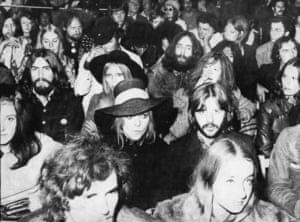
‘Bob Dylan was 10 feet away from me’: Isle of Wight festival, 1969

“Ringo Starr, George Harrison, John Lennon and Yoko Ono were sitting behind us. The talk of the festival was that they might join Dylan on stage.”

Penny Warder

Bob Dylan concert

Penny Warder, front right, waits for Bob Dylan at the Isle of Wight festival, 31 August 1969. Photograph: Medina Publishing

The organisers of the 1969 Isle of Wight festival, brothers Ronnie and Ray Foulk, had managed to pull off the amazing coup of getting Bob Dylan to headline. Woodstock, which had taken place two weeks earlier on his doorstep in upstate New York, had tried to persuade him but he’d turned them down. He’d been in semi-retirement for three years after a motorbike accident, and this was his comeback.

In this picture, we’re waiting in the VIP area just below the stage for him to come on; it took about two hours because there were some problems with microphones. The chap sitting next to me is Vernon Warder, my boyfriend of the time. He had long holidays from art college and was working at the festival, doing artwork for the signs on the front of the stage, and helping with security and management. As a result, he had a VIP pass and, being his partner, I got one, too. Otherwise it was £2 for a ticket.

I was aware that Ringo Starr, George Harrison, John Lennon and Yoko Ono were sitting behind us. The talk of the festival was that they might join Dylan on stage. It never happened. I was a huge Beatles fan, but had not seen them live; I kept turning round to look at them. We were about three rows from the front and could smell the hash that someone was smoking behind us.

When Dylan finally came on, he was barely 10 feet away from me. It was so exciting. He played for only an hour, for which he got some stick in the press, but it was incredibly exhilarating. He did two encores.

After he finished, I went back to my parents’ house on the island, where I grew up. Even though I had been away at college for two years, there was no way they would allow me to stay out all night. I remember it was a real struggle trying to find a lift, because we didn’t have cars and couldn’t afford taxis.

Throughout the festival, I went back and forth between the VIP arena and backstage. I once bumped into Lennon and remember thinking, “Oh, he’s not very tall, is he?” I remember being really excited about going into a portable toilet after Ono had been in there. I wasn’t even aware of the celebrities: Jane Fonda, Elizabeth Taylor and Eric Clapton were all there. That’s how young and naive I was.

I first saw this photo last summer. Some friends of mine who live on the Isle of Wight went to the launch of Ray Foulk’s book, Stealing Dylan From Woodstock, his account of the festival. One of them texted me: “Were you sitting in front of the Beatles at the 1969 festival?” I said yes, and she wrote back: “Your photo’s in the book!”

This was my first festival. I went to the Isle of Wight the following year, when Jimi Hendrix played shortly before his death. I’ve been to others since, but nothing will match those two experiences.

Interview: Erica Buist (Guardian 5/8/16)

My Thoughts on Bob Dylan and “Highway 61 Revisited”

Highway+61+Revisited+Bob+Dylan++Highway+61+Revisite

Next Sunday (27th September 2015) I am organising a night commemorating the 50th anniversary of the song “Like a Rolling Stone” and the album it is from “Highway 61 Revisited”, at the Musician Pub in Leicester. I’ve got a few days to go and I’m beginning to get a bit nervous now. Some of Leicester’s best are coming to perform their favourite tracks from the album and other songs from the other great mid 60s records, when Dylan decided to “plug in” (“Bringing It All Back Home” and “Blonde on Blonde”). 50 years is a long time but the songs and music have not lost their power. In fact, to my ears, they seem even more startling and profoundly modern. Not only have they stood the test of time but they are in the pantheon of great 20th Century Art along with T.S. Eliot’s “The Waste Land”, Jackson Pollock’s evocative splatterings and Charlie Parker’s mindbending improvisations. It had never been done before and it will never be done again. It stands alone!

Of the three great “electric” records “Highway 61 Revisited” is the pinnacle. It is the first Dylan album that he was part of a real band rather than a soloist with backing musicians. “Bringing It All Back Home” paved the way with some really exciting performances, especially “Subterranean Homesick Blues” and “Bob Dylan’s 115th Dream” but half of it was acoustic although the songs were like nothing heard before. Dylan had rejected political protest and replaced it with a kind of explosive, image laden, nihilistic stream of consciousness. Popular music had never experienced anything like it. “It’s Alright Ma (I’m Only Bleeding)” takes an Everly Brothers lick and creates a blast of vitriolic energy which is mindblowing: ” Old lady judges watch people in pairs, limited in sex they dare, to push fake morals insult and stare, while money doesn’t talk, it swears, obscenity who really cares, propaganda all is phony”. But, in this record he is still making sense. “Highway 61″ moves the song writing into a different realm. This is a world in which the songs seem to mean something but you can’t quite place what it is. ” Ballad of a Thin Man” epitomises this: “Something is happening but you don’t know what it is, do you Mr. Jones?”. A series of bizarre incidents follow involving sword swallowers, professors and geeks and how your imagination is being attacked! This is the ultimate statement of the Hip/Straight divide that was emerging in the growing counterculture of the 1960s. Most of the songs on “Highway 61” defy logic. They are absurdist and mysterious and yet seem to pertain to a deeper meaning that washes over us and draws us in. “They’re selling post cards of the hanging, they’re painting the passports brown, the beauty parlour is full of sailors, the circus is in town” and all through the song we learn that “Desolation Row” is either the place to be or the place you are prevented from going. “Right now I can’t read too good, don’t send me no more letters no, not unless you mail them from Desolation Row”.

Perhaps the ultimate Dylan song is “Like a Rolling Stone”. Bruce Springsteen described the beginning of this, the opening song on “Highway 61 Revisited”, as the “snare shot that sounded like somebody’d kicked open the door to your mind.” Folk singer Phil Ochs was even more rhapsodic about the LP: “It’s impossibly good… How can a human mind do this?” When I first heard this song I moved from being a fan of Pop Music to someone who wanted to play and write songs and that desire has never left me. That’s why I’m looking forward to the gig next Sunday and am also quite nervous about it. It is commemorating something that changed my life!!

Photo Videos of Some of My Trips

I have recently got into making videos of the photos of some of my trips accompanied by music that has been important to me over the years. This includes tracks by the likes of the Velvet Underground, Country Joe and the Fish and Bix Beiderbecke. Quite a variety really. It is amazing how the music changes the way I look at the photos, and they seem to take on a different meaning. It’s quite an eye opener really.

The first one is of Essex and Suffolk when I went on a tour playing with my old friends, folk group Bodger’s Mate. It is accompanied by “I’m Coming Virginia”, one of my favourite tracks by Bix Beiderbecke from 1927. I’m amazed how well the music stands up. It could almost be contemporary. The guitar playing by Eddie Lang is incredibly subtle, considering it is the main rhythm part.

The next one is of the Old Town of Marbella with “Grace” by Country Joe and the Fish. “Electric Music for the Mind and Body” was one of my favourite albums when I was young, along with the even better “I Feel Like I’m Fixin’ to Die”. I first went to Marbella in 1971 and didn’t go back there until last year. It was virtually unrecognisable until I found the Old Town, which was actually the only bit that existed when I went there before, and it was just the same and the memories came flooding back.

The last one is of my photos of New York when I visited there in 2012. This was the first time I had ever been to America and I had a brilliant time. I went to all the places I had heard of when I first started playing the guitar and it felt like I had gone home. I think New York is the only place I have been where people seem to know what I’m talking about. Fantastic! Greenwich Village may have changed but it resonated with meaning for me. This is accompanied by “Sister Ray” by the Velvet Underground who were one of my favourite bands in 1968. It’s worth watching this just to hear “Sister Ray” all the way through although it is very long.

Kenny Wilson sings Bob Dylan’s “Like a Rolling Stone”

Kenny Wilson sings Bob Dylan’s “Like a Rolling Stone” at The Cradock Pub Open Mic, Leicester U.K. 11th September 2013

Kenny Wilson Live at the Criterion, Leicester U.K. Part Two

Second part of Kenny Wilson’s gig at the Criterion cut short by the camera battery dying. The first part can be found here Kenny Wilson Live at the Criterion Part One

My Favourite Albums of All Time (Part Two)

This is the second part of my favourite albums of all time. You can find the first part here My Favourite Albums of All Time Part One.

6. Astral Weeks by Van Morrison

VanMorrisonAstralWeeks

Astral Weeks is unique like many of the albums on my list. I’m not that much of a Van Morrison fan. I find most of his records fairly bland and stylised. I’ve heard most of them and am not that impressed apart from his early work with the seminal rock band Them. Here Comes The Night  is a genius three minutes of pop and Baby Please Don’t Go is the essence of R&B. Astral Weeks was recorded and released soon after Them split up. As already said, it is unique and genre busting. Yes, it’s kind of jazz, kind of folk and kind of poetry but more of an amalgam of all three with a dose of unintentional classical music thrown in. How it ever came to be recorded by a major label is one of the wonders of the late sixties when good music came to be commercial. Or was it? It was quite a long time before anyone heard it or was aware of it. However, it ranks as one of the most creative records released by a commercial record company ever.

Without knowing the full details behind the creation of this album I feel that it contains the essence of a real sadness and sense of loss. I don’t know this, I feel it! It is like a folk/jazz equivalent of T.S. Eliot’s The Waste Land with it’s evocative phrases and overwhelming sense of sorrow and psychic pain. This really IS the blues. Not the black American blues of the southern plantations and urban ghettos but the white blues of a psychologically dislocated Brit in the heart of Belfast, Northern Ireland. To add to the sense of alienation it was recorded in New York in 1968.

You know you’re in a different creative universe right from the word go. The first song Astral Weeks tells the listener that he is nothing but a stranger in this world and would like to be born again. The final song Slim Slow Slider describes a woman who has a brand new boy and a Cadillac but who is dying and every time I see you
I just don’t know what to do. The song ends in a blast of free jazz. Pretty bleak stuff!

In the meantime we have various shades of misery apart from The Way Young Lovers Do which is surprisingly upbeat and even optimistic. The real standout track is Madam George which in his Belfast/American drawl seems to sound like Madam JOY. He seems to plaintively be singing say goodbye to Madam JOY, wonder why for Madam JOY while the violins weep and intertwine around the three chord riff . Amazing stuff!!

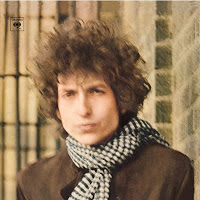
7. Blonde on Blonde by Bob Dylan

blondeblonde

Blonde on Blonde is a truly amazing album. The first double album in history with a price tag to match. How did anyone afford to buy it? I don’t know but I certainly couldn’t. I had to make do with the single releases until years later when I had a girlfriend who owned it. No, it wasn’t her only attraction!

This record continues the surreal imagery of Highway 61 Revisited but his voice has changed and the playing seems thinner and less aggressive. It was a thin, mercurial sound. When I first heard I Want You on a radio in Glasgow I thought it was a joke, a bad imitation of Dylan but I was wrong. I bought the single and soon realized it’s brilliance. The B side contained the rarely heard since version of Just Like Tom Thumbs Blues recorded live in Liverpool 1966. With screaming feedback and yelled lyrics it’s a complete contrast to the studio version.

Dylan in the 60s never stood still and he was a complete enigma. Not only did his voice change with each record so did the way he looked. It was like he was trying to stay one step ahead of everyone but he couldn’t, especially the growing army of crazies who were hanging on to his every word and before long were going through his garbage in search of even deeper meanings.

The real standout tracks on this album in my opinion are Visions of JohannaSad Eyed Lady of the Lowlands, Just Like a Woman and I Want You but the rest is incredibly interesting. The anger has been dissipated and he is investigating relationships and general absurdity. He’s like the bastard offspring of Albert Camus lost in an absurd universe. In fact, throughout the album there is an expressed desire not to have to go through all of these things twice. A really brilliant record!
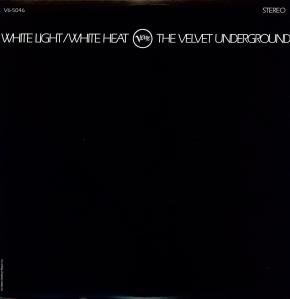
8. White Light, White Heat by The Velvet Underground

163132

Dylan had the thin, mercurial sound but the Velvet Underground had the loud, distorted, grating  sound delivered to perfection on this second album. Nico is no longer present and the soft, folky ballads have gone apart from the song Here She Comes Now. The rest of it is self-consciously anti-beauty. According to Lou Reed the producer, Tom Wilson ( who also produced Bob Dylan’s Like a Rolling Stone), was so pissed off with the cacophony of Sister Ray that he left the studio and showed them the record button and told them to do it themselves. Fantastic, it’s one of my favourite tracks. Although, Andy Warhol was no longer involved with the Velvets his influence is still felt with the extremity of the lyrics and the overall sound.

Although it sold few copies when first released it became one of the biggest influences on British Punk Rock. Apparently The Buzzcocks formed  after members followed an advertisement looking for musicians who could collaborate on a Sister Ray cover.

Apart from the title song another truly great track is I Heard Her Call My Name which features uncontrolled guitar feedback accompanied with the cry of And then my mind split open by Lou Reed. It seems the band were disappointed with the recording of this because it didn’t match the energy or intensity of their live performance. Mercy!!

I actually bought this record when it was first released but I couldn’t convince many of my friends to share my love of it. In fact most of them thought it was terrible. How wrong they were!! Interestingly, Lou Reed was a very reluctant hero of Punk and, in fact, he had no time for it even though he is often presented as the ultimate Junkie Punk Persona. Many of his songs are quite complex both musically and lyrically and don’t fit into the simplistic barbarism of Punk. Okay, White Light, White Heat is the exception!

9. Hunky Dory by David Bowie

tumblr_l0hdtmBmwk1qa86nxo1_500

White Light, White Heat leads neatly into this album because David Bowie was a big fan of the Velvets. He featured that song in his live sets and even recorded it twice. He also references the Velvet Underground on the sleeve notes of Hunky Dory as an influence on the song Queen Bitch.

Hunky Dory didn’t sell much when it was released in 1971 but people in the right places were aware of it and liked it. Bowie says that it was the first album he made that other people talked about and were interested in. Until then he was a promising singer/songwriter who had had one big hit with Space Oddity. His record company still had a lot of confidence in him, obviously.

It is a surprisingly mature piece of work for someone who is still finding his voice. It ranges from total all out pop to introspective gloom. He includes songs about Bob Dylan and Andy Warhol which are hard to fathom. Are they hero-worship or sneering sarcasm? There seems to be a bit of both there. Andy Warhol looks a scream hanging on my wall, Andy Warhol silver screen can’t tell them apart at all. The sleeve is interesting in that he deliberately creates an androgynous image, based on a picture of Marlene Dietrich apparently. He is developing and extending the kind of cross-dressing and gender-bending that had already begun with Mick Jagger who wore a dress at the Hyde Park Free Concert in 1969. Bowie also wears a dress on the cover of his album The Man Who Sold The World.

This really is a seminal album that throws up all kinds of interesting things. When William Burroughs interviewed Bowie he said that he thought the 8 Line Poem was referring to T.S. Eliot’s The Waste Land. Bowie professed to know nothing about T.S. Eliot but, almost certainly, went away and found out about him because he was so in awe of William BurroughsBurroughs describes The Waste Land as the first cut-up poem, a technique that Bowie used in many of his songs.

One of the standout tracks is Life On Mars which along with O You Pretty Things illustrates one of the aspects I find most disturbing about Bowie’s work i.e. his flirtation with Nietzscheanism and the idea of the Superman. This idea features in many of Bowie’s songs e.g. The Man Who Sold The World, The Supermen etc.  I’m not saying he is a Nazi but he comes dangerously close at times, especially when he gave a Nazi salute in Berlin in the mid 70s (he blamed it on the coke!). Oh you pretty things don’t you know you’re driving your Mamas and Papas insane let me make it plain, you’ve got to make way for the Homo Superior! Hippie ideology this aint!! And it’s all wrapped up in a fluffy pop package.

This is a brilliant record, though and gets better with each play. I particularly like the Bewley Brothers. This song has a sense of mystery and loss about a musical group who obviously make a big impact but maybe were never famous (or were they like the Beatles?). Like all good poems you can draw your own conclusions and read many different things into it.

This album became a hit after the success of Ziggy Stardust and the Spiders From Mars. Ziggy made Bowie a big star but the standout record of this time, I think, is Hunky Dory.

10.  GP/Grievous Angel by Gram Parsons

Gram_Parsons-Gp_Grievous_Angel-Frontal

I discovered this record in 1975 about the first time I met Ric Grech. I was running a folk club in the top room of the Town Arms, Leicester U.K.at the time where many aspirational songwriters turned up. One night Ric arrived in his Ferrari with a violin and joined in. He had recently arrived from America having just made a record with super-group KGB. Okay, why he left LA and came to Leicester I don’t know but he was in awe of Gram Parsons and was interested in forming a country group with Leicester musicians playing his ( Ric’s) songs which were actually very good. He had collaborated with Gram on his two solo albums before he inconveniently died (Parsons that is. Ric inconveniently died some time later!) and two of the songs are written by him Kiss the Children and Las Vegas. He also had Gram’s guitar, a Gibson Dove, with him.

Gram Parsons had a big effect on people he met. English musician and hippie doctor Hank Wangford became a country singer because of his influence. By proxy, through Ric, he became a big influence on the local Leicester scene where many people turned to Country which had previously been a much maligned genre and was considered reactionary, corny and simplistic.

Parsons is considered the inventor of Country Rock but this isn’t apparent from his solo records which are actually quite traditional in many ways. He certainly didn’t like the sound of the Eagles who were becoming very successful at the time, members of which had played in various groups with him. What really stands out in his records are the ethereal quality of his songs, his voice, the brilliance of the band that included many top musicians like guitarist James Burton and the duets he sang with Emmylou Harris. In fact, after his death Emmylou Harris became a major star in her own right and continued Gram’s ideas for many years.

These records don’t leap out at you like Astral Weeks and others on this list but they definitely grow on you. Standout tracks include $1000 Dollar Wedding and Love Hurts. Gram and Emmylou are outstanding together, something that Bob Dylan picked up on when he hired Emmylou to sing on the Desire album. He also makes you aware of some really great country singers and songwriters that were not well-known at the time like The Louvin Brothers.

Definitely worth listening to, but give it time!

New Bob Dylan Bootleg Series 10 from the Self Portrait period 1969-71

This is an interesting addition to the Bootleg Series from the much maligned Self Portrait period. I always thought there was more to it than many critics allowed.Time for a reappraisal!