
Decided to go to Sheffield today and give a running commentary of while I am here. Just got off the train and am now in the town centre sitting in a Caffe Nero. You probably realise by now that my life centres around Caffe Neros and Wetherspoons. One sells expensive coffee and the other sells cheap beer. They both use the same free WiFi provider though and I can use the same login details. God, this is even beginning to bore me! Sorry!

Caffe Nero. Town Hall in the background. It looks a bit like a fairy tale castle. Incredibly grandiose!
Sheffield is amazing. This is the first time I’ve looked around the city although I’ve been here times in the past doing gigs. Same thing happened in Derby. I felt like I knew the places but I don’t at all. Well, at least I’m making up for it now.
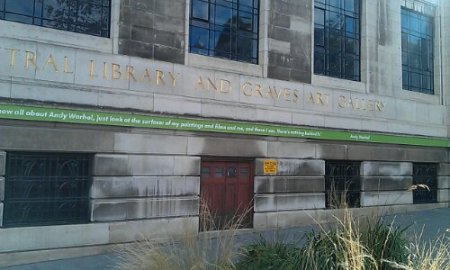
Graves Gallery
One of the reasons for coming here was to visit Graves Art Gallery where there is an exhibition of Andy Warhol self portraits. I’ve been interested in Warhol since the heady days of the 60s. Initially it was because of his association with the Velvet Underground and the hedonistic partying of the Factory. This became the stuff of legends and was attractive to an impressionable teenager like me. We tried to create our own version of The Factory in Leicester. At that time Warhol was the pre-eminent underground film maker and many of his films were shown in Leicester at our self created Arts Lab. I was impressed by their extreme nature and humour. I then became interested in his art but saw it mainly as iconoclastic and nihilistic which suited my state of mind at the time. I’ve since seen many of his paintings in galleries and realise he was a great stylist who had much to say. Even his car crash pictures have a strange kind of beauty about them and I never realised how big they were! It is clear he loved baiting the art establishment and he also loved critics and intellectuals who found a meaning in his work he never thought was there. His real achievement was to create profundity out of the ordinary, something I respect and have always tried to emulate. The mundane can be interesting with the right mental attitude. In fact, I believe everything is interesting! By making a Brillo box and Campbell’s soup cans ART he exposed the shallow commercialism of all art. They are ordinary objects in a supermarket but display them in a gallery and they become ART. There is no difference between a Warhol on the art market and a Van Gogh or a Da Vinci. Van Gogh may have been a tortured genius attempting to communicate with the world but his work is now seen as a high value commodity. Da Vinci was a product of the patronage of the Medicis of Florence. Their works are just expensive and rare products that the rich invest in, more valuable than gold! Essentially, they are all the same. Even the Abstract Expressionists played the same game. They may not have liked it but they were just part of the system. Warhol knew exactly what it was about: MONEY. When he moved from advertising to being an ARTIST he really saw no difference in the two areas apart from the fact that ART could be far more lucrative to the artist and give him fame and celebrity. That’s why the art establishment hated him so much. He exposed it’s commercial core. Some of his comments like “everyone in the future will be famous for 15 minutes” ,”art is what you can get away with” and “I’m a deeply superficial person” show a real insight into the workings of the art and culture industries. Notice the emphasis on “deeply“. He wasn’t totally superficial he was deeply superficial. The ultimate post-modernist statement!
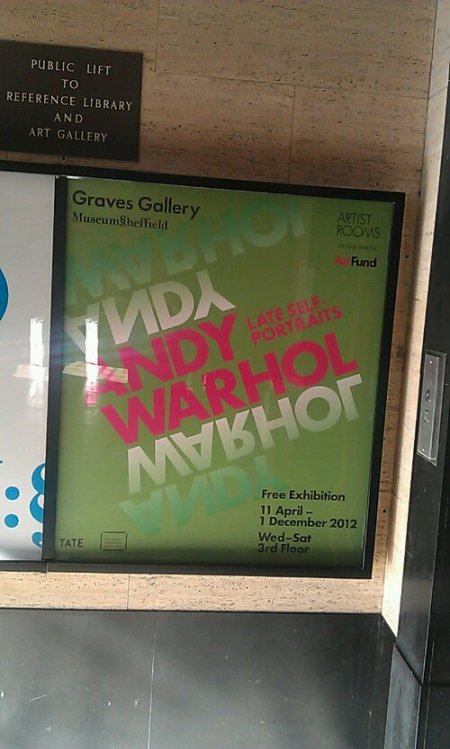
Andy Warhol poster
Well, true to form I came on the day when the Graves Gallery was closed. I seem to make a habit of this. So, I didn’t see the self portraits of Andy Warhol but I did see the public library that it is part of. Very impressive as is the square that it belongs to. I went to the Millenium Gallery nearby that has several exhibitions in it. The John Ruskin gallery is nice but didn’t really rock my boat.
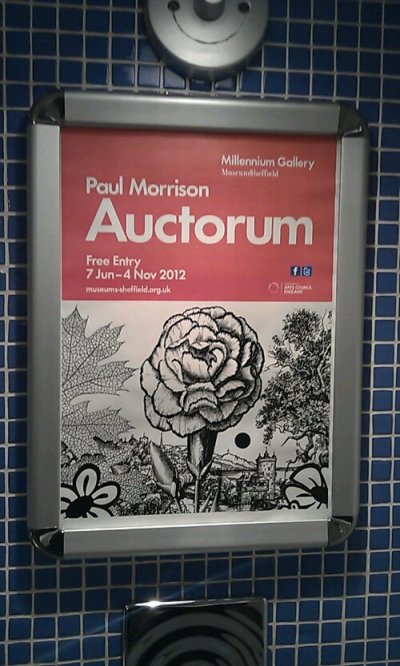
Paul Morrison poster
The exhibition of Paul Morrison was far more impressive. He is a local Sheffield artist who has achieved some fame and renown around the world. I really liked his work. He creates weird landscapes that seem strangely normal until you look closer and realise the anomalies. His video art is also interesting with changing views of water and aquarian growth. He is truly post-modern borrowing from nearly everything. I particularly liked his Bridget Riley inspired op-art piece which unfortunately did not translate into my photograph. Sheffield, I WILL be back!

Paul Morrison op-art flower

 Kenny Wilson's Blog