Guy Debord’s The Society of the Spectacle | Will Self 

Guy Debord

“What other text from the 60s so accurately describes the shit we’re in?’ – Will Self on Debord’s The Society of the Spectacle. Photograph: Situationist International

Will Self takes a walk through the banlieues of Paris and is astonished by the prescience of Debord’s 1967 masterpiece, which so accurately describes ‘the shit we’re in’

A small green tent was pitched on the small daisy-spotted patch of greenish grass. It looked tidily enough done; suitable perhaps for a summer rock festival. But this was just outside the Saint-Gratien RER station, north of the rundown riverine port of Gennevilliers, on the outer whorl of the Parisian fingerprint; and the tent – which had the limp-wristed bough of an evergreen touching its flysheet in benediction – was quite clearly being lived in.

The mental picture the non-Parisian has of the city’s banlieues is framed by the fictive: gangster movies such as La Haine, or TV cop shows such as Spiral that do battle with similar Danish, Swedish, British and, of course, American vehicles, in a race to see which can sandblast its respective society with the greatest quantity of grit. But within this framing, content and dimensionality are provided by recent history, and in particular by the widespread rioting of 2005 that thrust these under-imagined locales on to TV screens worldwide. Not since the événements of 1968 had Parisian street fighting commanded such attention, but whereas the soixante-huitardscould be characterised as the vanguard of a stillborn revolution, the young second-, third- and probably fourth-generation immigrants who chucked molotov cocktails at the flics and the CRS during the émeutes neither donned, nor were measured up for, any such ideological camouflage.

Instead, the violent eruption of the Parisian banlieues was anatomised by reference to a body politic sickening with pathological metaphors. Implicitly, explicitly … ineluctably, the rioters were the Muslim Other, which, having been almost accidentally ingurgitated as part of the colonialist couscous, was now playing havoc with Gallic digestion. The French state had found itself – willingly or not – as a fellow-traveller on the neocons’ coach trip to the rapturous intersection of medieval chiliasm and Fukuyama’s neoliberal end-point.

Walking from the RER station towards the Seine, I passed not through what the fictive might lead you to expect, but rather low and hummocky hills, the swoop of a B-class road, outcroppings of commerce, small apartment blocks, car parks, duff public sculpture, off-cuts of quasi-open space – over it all an ambiguous miasma of street furniture and signage: this was France, certainly, but a France at once decoupled from any sense of pays, and divorced from the least suggestion of the urbane. In a comparable district of London – picture, if you are able to, Ruislip or Hounslow, Abbey Wood or Enfield – there would be myriad subliminally registered cues, all of which would combine to force on the spectator the unavoidability of her metropolitan condition. In London, the interwar spread of municipal socialism through the arteries of the tube system was accompanied by the soft-modernism of the suburban stations and Harry Beck’s matching diagram, which completes their connectivity. In London, the map really is the territory, because the territory really is the map. Not here.

The vexed relationship between the map and the territory suffuses The Society of the Spectacle, Guy Debord’s 1967 masterpiece, which argues that not only authentic social relations, but even the bricks and mortar that frame them, and the tarmac that connects one to another, have all been replaced with their representation; a 1:1 scale model. Moreover, for Debord, as a sequel to the paralysis of “historical development”, the contrast between town and country has become submerged in a sclerotic suburbia. He is at pains to point out that this annulling is no cod-utopian “supersession” but rather an “erosion … visible in the eclectic mélange of … decayed elements”.

From the beige depths of a heavily shuttered house beside a hillock from which I could spy the Eiffel Tower, a deep, dark voice spoke: “Qu’est-ce que vous cherchez?” I suppose, had I been the ghost of Jane Jacobs I would have experienced this as reassurance: the eyes, even if unseen themselves, remained on the street. But, instead, I muttered pacifications: “Nothing … just having a look … about”, then walked on down and around the hill through a scree of crushed fag packets, centrifugally impelled aluminium trim and the petrified tears shed by long dead cars. Dragon’s teeth were sewn across the scabrous roadway – I queased between them and found myself within 100 metres of the riverbank. The A15 soared overhead: two pilotisplanted this side of the river, the next pair on the far bank, its two carriageways separated by curved air. Up there was the city, conceived of however you so pleased. Down here, however, was this un-place, an inter-zone, under-imagined and thus free to be itself. Sprays of cherry blossom mimicked by tangles of wire and a shaggy pelt of weedy grass. Two small brown kids sat beside an oblong concrete depression filled with dank water, one had her hair tied in pigtails. They were playing with tin cans, cups and a bucket. Beyond them, right on the river’s edge was their Paris: a bidonville of shacks built from bits of scavenged packing cases, plastic tarpaulin, car tyres and all sorts of other stuff.

Many of its most sympathetic readers experience The Society of the Spectacleas a concerted howl of disgust. I cannot agree – for me it is the Spectacle that, far from being the creation of some malevolent or false god, emerges instead as the hero of the piece, inasmuch as any hero can be conceived of as the unconscious product of insensate historical processes. The Spectacle, Debord writes, “is the heart of the unrealism of the real society”. We are all jammed up against the plate glass of the Spectacle, our faces crushed as we “lèche-vitrine” in search of the same old commodified poison.

The entirely manmade nature of the world from which the individual subject experiences alienation is not, for Debord, a factual programme to be passively viewed on the TV screens of the global village, but a belief that is actively entered into. It is the genius of Debord to have characterised the totalising capability of late capitalism so early in its post-industrial manifestation. The Society of the Spectacle reads – if you will savour a cliche – as fresh as paint. Debord’s analysis of time itself as a series of epochs is dizzying: such “pseudo-festivals” as sporting events (the Olympics springs immediately to mind), act to convince the denizens of the Spectacle that they are still living in a cyclical and eternal go-round, while only the anointed few, the celebrities, are imbued with the attributes of money and power that signify the ability to make choices – to progress into a better future. “Being a star,” Debord writes, “means specialising in the seemingly lived.” Sound familiar, “Sir” Peter Bazalgette?

But it is most of all in its analysis of the ideology of the Spectacle that Debord’s text repays close reading. It is the Spectacle’s genius to have “turned need against life” and thus effected “the separation and estrangement between man and man”. Hence the Spectacle’s embrace of economics as the only form of instrumental – indeed “scientific” – knowledge worth possessing; hence ritual obeisance made before the gods who will confer growth, and hence the fact that more or less any contemporary western politician – from Hollande, to Merkel, to Cameron, to Obama, and back again – who had eyes to see, could find their own Caliban image raging back at them from the pages of The Society of the Spectacle.

At Argenteuil centre-ville, I found echoic pedestrian underpasses, faux-19th century streetlamps of twirled iron and postmodern apartment blocks built of scaled-up children’s construction toys. I walked on across the oxbow of Gennevilliers, still feeling that I was nowhere at all in particular – standing beside a grocery store or an office block, then crossing between parked cars. The bridge across the re-encountered Seine that led to Clichy was lined with cheerful window boxes, planted with a gaily patriotic tricolour of blooms pinker, pinker and pinkest. Where there are window boxes there must, of course, be a window – this one framed the mirrored cuboids of La Défenseto the west, structures that might have been designed expressly to conform to the Debordian paradigm.

And then, some way past the Porte de Clichy, I was quite suddenly – if at an indefinable point – in Paris, a city to this day that defines itself by the micro-associations of its smaller parts: the awning of an alimentation, a drain cover, the angle of a pissing dog’s leg, the furl of paper around a stick of bread, the white apron around a smoking waiter – quite as much as the high extravaganza of its grand boulevards and gold-leafed public buildings. Rereading The Society of the Spectacle, I was struck yet again not only by Debord’s astonishing prescience – for what other text from the late 1960s so accurately describes the shit we’re still in? – but also wondered how it was that his dérives across the Paris of the time could have so attuned him to the way in which the urban environment of the near future would become quite so decoupled from any element of the felt or experienced life. After all, Pariswas by no means the most Spectacular city of the late 1950s and early 60s; indeed, it’s still not on an equal footing to London. Unplanned London, which has just arrived at its square miles of parametrically designed junk space, its CCTV-overseen gated business cantonments and Chinese party cadre-owned luxury encampments, its logo skyscrapers and purpose-built “iconic” tourist destinations.

It occurs to me that Haussmann’s attempt to impose civic order and authority on the medieval jumble of mid-19th century Paris had not only paved the way for the Spectacle, but it had also afforded its – and his – enemies with the material to rip up for their barricades. There seems a nice congruence between the go-rounds of the Grands Boulevards and centrifugal/centripetal current of French theorising, whereby notions given form in the cafes of the Boulevard Saint-Germain and the classrooms of the Sorbonne and the Ecole Normale Supérieure swirl out in widening circles from the metropolis, only to then gurgle back in again, before eventually disappearing up the arses of their originators.

Seen like this, The Society of the Spectacle is at once the bastard progeny of the French Enlightenment – out of Diderot, by means of the Napoleonic Code – and a salutary reminder of how the pursuit of some millenarian ideological purity only ever results – if successful – in the rumbling of tumbrels; or, if a failure, in its wholesale co-option by its stated enemies. That we no longer hear quite so much about “the spectacle” as shorthand for any of the following: the ludic element of consumer society, the post-ideological character of western “democracy”, the web-cum-matrix woven by the internet, the glocal character of late capitalism, may be because Debord’s concept has now been so thoroughly appropriated – one might fairly say détourned – that there’s nothing left of it but its coldly numerical bones.

Had Debord not shot himself in 1994 in his rural fastness of Bellevue-la-Montagne, he probably would have turned his gun on the likes of Tony Wilson and Malcolm McLaren (and no doubt me as well); pop music impresarios whose much-trumpeted situationist influence – such as it was – consisted only in a series of pranks, that, while they may have given succour to the culturally anomic nonetheless only resulted in the profitable sale of records, posters and other memorabilia. I doubt, somehow, that either Wilson – chiefly known for managing Joy Division and the Happy Mondays, and setting up Factory Records – or McLaren, rather more famous for his role as the Sex Pistols’ svengali, can have subjected The Society of the Spectacle to a sustained critical reading. Had they done so, they would’ve realised that their antics were anathema to Debord; that the playful elements of situationist practice – the bowdlerising of cartoons, the daubing on walls of whacky slogans, the exaltation of drunkenness – were only ever to be sanctioned if constitutive of a genuine insurrection, such as the few short weeks of 68, and as precursors of that revolution of everyday life (to adapt the title of the competing situationist theoretical work, written by Debord’s greatest rival, Raoul Vaneigem), which was to follow the final and complete dissolution of the Spectacle.

The relative success of the Situationist International during les évènementsalso sowed the seeds for the détournement of The Society of the Spectacleitself. I say relative success because it can be doubted – and will always be disputed – the extent to which Debord and his loose confraternity of freelance bully-boys and wannabe revolutionists actually succeeded in either manning the barricades themselves, or screwing the courage of the mob to CRS’s sticking post. But the important thing was that the situationists were perceived as having been in the thick of things – as instigators and ideological choreographers of the distinctively ludic elements of this particular civil disorder. The sneering, de haut en bas reception of The Society of the Spectacle on its publication the year before in French, was followed the year after by its rhapsodic one when it appeared in translation. By then, of course, the game was effectively up – something Debord, a man obsessed by war games and strategising, undoubtedly grasped. The Society of the Spectacle so far as being an animator of events, had in a matter of months become simply another text to be subjected to scores, hundreds, thousands of exhaustive academic analyses. The best that could be said for the thing – from its author’s point of view – was that the royalties paid his wine bills, and helped to supplement a lifetime of unabashed – and indeed, self-righteous – sponging.

Of course, The Society of the Spectacle still animates serious protest to this day – or, rather, since to admit to having been one of the Invisible Committee that authored the highly Debordian The Coming Insurrection (2007) is to court arrest on those grounds alone, the very style of the earlier work remains inflammatory. As to its content, The Coming Insurrection has nothing much to add – how can it, when, as I say, never before has Debord’s work seemed quite as relevant as it does now, in the permanent present that he so accurately foretold? Open his book, read it, be amazed, pour yourself a glass of supermarket wine – as he would wish – and then forget all about it, which is what the Spectacle wants.

“Fulfillment was already there”: Debord & ’68 | Situationist International

Andy Merrifield discusses the influence of Guy Debord and the Situationist International on the events of May ’68.

On the brink of working class and student insurgency came Guy Debord’s The Society of the Spectacle (1967), the radical book of the 1960s, perhaps the most radical radical book ever written. Its 221 strange theses give us stirring crescendos of literary power, compelling evocations of an epoch in which unity spelt division, essence appearance, truth falsity. A topsy-turvy world where everything and everybody partook in a perverse paradox. Debord mocked the reality of this non-reality, an absurd world in which ugliness signified beauty, stupidity intelligence, subjecting it to his own dialectical inversion, his own spirit of negation. This was theory that identified enemy minefields and plotted a Northwest Passage, getting daubed on the walls of Paris and other cities during May 1968: “POWER TO THE WORKERS’ COUNCILS,” “DOWN WITH THE SPECTACULAR COMMODITY ECONOMY,” “THE END OF THE UNIVERSITY.”

Its refrains were all over the modern high-rise environment at the University of Paris-Nanterre, a classic scene of urban isolation and separation, a “suburban Vietnam,” where a peripheral new town university coexisted with working-class slums and Arab and Portuguese shantytowns. The place was sterile, sexually and socially repressive, and totalitarian. This was the spirit of a society without any spirit. The same centralisation, hierarchy, and bureaucratic obsession persisting in the educational sector persisted in other aspects of the French state. Tough rules governed student dorms and freedom of movement; classes were overcrowded, resources stretched; professors were distant, student alienation rife. The right-wing Gaullist regime attempted to modernise the economy, in line with Common Market membership, and unemployment was growing.

At the University of Strasbourg, two years prior, a handful of Situationists had intervened; angry students of Henri Lefebvre and friends of Debord. They’d riled and denounce, tried to revolutionise students with an influential pamphlet called “On the Poverty of Student Life—Considered in its Economic, Political, Psychological, Sexual and especially Intellectual Aspects, with a Modest Proposal for its Remedy.” They’d infiltrated the National Union of French Students (UNEF), accused students at Strasbourg of pandering to a society dominated by the commodity and the spectacle. Student poverty was a poverty of ideas, a poverty of guts. Students were really “submissive children,” labour-power in the making, without class consciousness. They accepted the business and institutional roles for which the “university-factory” prepared them, never questioning the system of production that alienated all activity, products, people, and ideas. The Situationist’s text struck a chord; translated reprints extended its audience, notably to the U.S., Britain and Italy. In Strasbourg, the document caused a scandal; a coterie of students refused to be integrated. Critical awareness gathered steam over the next year and a bit, until, in late March of 1968, it blew a gasket at Nanterre.

On Friday, March 22nd, assorted Situationists, young communists, Trotskyists, anarchists, and Maoists invaded the university’s administration building, and began occupying it. The week before, the “Committee of the Enragés and the Situationist International” had been established. Its members put up posters and scribbled slogans on the walls of Nanterre and the Sorbonne in the Latin Quarter: “TAKE YOUR DESIRES FOR REALITY,” “NEVER WORK,” “BOREDOM IS COUNTER-REVOLUTIONARY,” “TRADE UNIONS ARE BROTHELS,” “PROFESSORS, YOU MAKE US GROW OLD,” “IF YOU RUN INTO A COP, SMASH HIS FACE IN.” In early May, “the March 22 Movement” met with UNEF at the Sorbonne. The authorities tried to break up the meeting; instead they only unleashed its latent power. The gendarmerie mobile poured into the Sorbonne’s courtyard and encircled its buildings. Several thousand students fought back, inside and outside, ripping up paving stones on the street. Skirmishes broke out elsewhere, spreading both sides of the Seine, flaring up at Châtelet and Les Halles. On May 6 and 7 a huge student demonstration took over the Boulevard Saint Michel and thoroughfares near rue Gay-Lussac; protesters overturned cars, set them ablaze, dispatched Molotov cocktails, and manned the barricades.

On May 13 there was a one-day general strike. With the French Communist Party (PCF) and general worker’s union (CGT) joining the action, “student-worker” solidarity suddenly looked possible. Situationists and students took over the Sorbonne. On one revered fresco they emblazoned the caption: “HUMANITY WILL ONLY BE HAPPY THE DAY THE LAST BUREAUCRAT IS HUNG BY THE GUTS OF THE LAST CAPITALIST.” Exams had been cancelled at the barricades; sociologists and psychologists became the new cops. Next day, in Nantes, workers at the Sud-Aviation plant occupied their factory and locked out the bosses. Meanwhile, Renault workers at Cléon in Seine-Maritime followed suit. Then the Nouvelles Messageries de la Presse Parisienne launched a wildcat action, halting newspaper distribution. Workers’ councils linked up with students’ councils, becoming comrades in arms. The working class, at last, declared its unequivocal support for the student movement when rank and filers at Renault-Billancourt took over France’s largest factory.

By May 20 strikes and occupations became contagious. Nationwide, around 10 million workers downed tools and froze assembly lines. France seemed on the precipice of revolution; a festival of people was glimpsed. Alienation was cast off, momentarily; freedom was real; capitalised time abandoned. Without trains, cars, Metro and work, leisure time was reclaimed, time lived. Students and workers seized the contingent situation, acted spontaneously, created new situations, realising something what no trade union or party could ever do, or wanted to do. And yet, as quickly as things erupted, they were almost as speedily repressed, by state and bourgeoisie, soon backed by the Communists and the CGT. The optimistic promise, the beach beneath the paving stones, had dissipated, for now. The music was over. There was no other side to break on through to.

The occupation of Paris was, and still is, seen throughout the world as an event of historical significance. Solidarity between workers and students had for a moment expressed itself; so too direct action militancy and student internationalism. From the LSE to Berkeley, from Columbia to Nantes, from the Sorbonne to Barcelona, dissatisfaction had spread like wildfire. At the same time, The Society of the Spectacle’s demands, as Debord would write (with Gianfranco Sanguinetti) in The Veritable Split in the Situationist International (1972), “were plastered in the factories of Milan as in the University of Coimra. Its principal theses, from California to Calabria, from Scotland to Spain, from Belfast to Leningrad, infiltrate clandestinely or are proclaimed in open struggles…The Situationist International imposed itself in a moment of universal history as the thought of the collapse of a world; a collapse which has now begun before our eyes.”

In old photos of the student occupations of the Sorbonne, Debord is visible in the thick of the action, lurking with intent. He was no student himself, nor was he particularly “youthful”: in May 1968, Debord, the freelance revolutionary, was thirty-six, older than a lot of junior professors, and almost twice the age of many student leaders (like Daniel Cohn-Bendit). He must have seemed like an old guy to many kids, somebody’s dad drinking in the student bar. Already his appearance had started to deteriorate. Surrounded by a large crowd of student activists, we can see him standing side on, without glasses, wearing a white jacket. His face is a lot puffier than a decade earlier; a boozer’s physiognomy was rapidly becoming apparent. By comparison with other ’68ers, who were mere political toddlers, he was a veteran provocateur.

Debord and other Situationists were genius agitators and organisers, and their presence was felt, practically and theoretically. The spirit of The Society of the Spectacle was there, even if some kids had never read nor fully understood it. On the other hand, Debord was frequently the most sectarian, invariably falling out with allies—especially falling out with allies, being most ruthless with old friends and former comrades. “Guy was a very tenacious person,” Jean-Michel Mension, a past oustee, remembered in his Situationist memoir The Tribe. “He was already very hard—very strict in the way he conceived of existence with this person or that.” There “were certainly jokers who became part of Guy’s group merely because they were friends of so and so, people who had no business there and who lasted only six months or a year before Guy found them really idiotic and kicked them out.”

Debord likewise dissed former pal Henri Lefebvre, the Nanterre Marxist professor, denouncing him as an “agent of recuperation.” He said the sexagenarian philosopher had stolen certain Situationist ideas. Debord reckoned Lefebvre’s take on the 1871 Paris Commune was almost entirely lifted from SI’s pamphlet, “Theses on the Commune” (1962). “This was a delicate subject,” Lefebvre recalled in a 1987 interview. “I was close to the Situationists…And then we had a quarrel that got worse and worse in conditions I don’t understand too well myself…I had this idea about the Commune as a festival, and I threw it into debate, after consulting an unpublished document about the Commune that is at the Feltrinelli Institute in Milan.”

Both Lefebvre and Debord believed the Commune some sort of historical antecedent of 1968. For seventy-three days, between March and May of 1871, when Prussian forces at war with France surrounded Paris, the city had become a liberated zone of people power. The barricades went up, even across Haussmann’s mighty boulevards, amid the carnivals and pranks. Freely elected workers, artists, and small business owners were suddenly at the helm. Their rally cries were territorial and urban; their practice was festive and spontaneous. The Communards, until the National Guard massacred 20,000 of them, launched a revolt in culture and everyday life, demanded freedom and self-determination, crushed Louis Napoleon’s authority as he’d once crushed their freedom, occupied the streets, shouted and sang for their “right to the city.”

For the first time, it looked like a working-class revolution wasn’t merely possible, but imminent. In “Theses on the Commune,” Debord said the Situationists believed that the “Commune was the biggest festival of the nineteenth-century” (Thesis #2). “Underlying the events of that spring of 1871,” he went on, “one can see the insurgents’ feeling that they had become the masters of their own history, not so much on the level of ‘governmental’ politics as on the level of their everyday life.” “The Commune,” Thesis #7 said, “represents the only realisation of a revolutionary urbanism to date.” It “succumbed less to the force of arms,” the next thesis explained, “than to the force of habit.” “Theoreticians who examine the history of this movement,” continued #11, importantly, “can easily prove that the Commune was objectively doomed to failure and could not have been fulfilled. They forget that for those who really lived it, the fulfillment was already there” (emphasis in original). “The audacity and inventiveness of the Commune,” #12 stated, “must obviously be measured not in relation to our time, but in terms of the prevailing political, intellectual and moral attitudes of its own time, in terms of the interdependence of all the prevailing banalities that it blasted to pieces.” “The social war of which the Commune was one moment,” declared the penultimate #13, “is still being fought today. In the task of ‘making conscious the unconscious tendencies of the Commune’ (Frederick Engels), the last word is still to be said.”

In the wake of May ’68, Debord released a film version of The Society of the Spectacle, dedicating it to wife Alice Becker-Ho, whose beautiful image, clad in flat cap, leaning on a wall with a cigarette drooping nonchalantly from her mouth, fills one frame. It evokes an Alice-cum-Brando’s Wild One pose: “Alice, whattya rebelling against?” “Whaddya got?” The film’s dialogue closely follows Debord’s original text, but the rapid-fire captions, disarming classical music, and exaggerated footage make it visually stunning. There are battle scenes and moody vistas of Paris, spliced between images of Lenin, Stalin, Mao and Castro, all giving speeches; Debord plainly disapproves. There are news clips from the ’68 Renault strike, with workers locked inside the factory by the unions; scenes from the Bourse alive with frenzied traders, participating in money mayhem; there’s a vision of the Tower of Babel amid pitched battles from Vietnam and Watts (Los Angeles), circa 1965; Paris’s streets are ablaze, and students can be seen fighting cops; there are burning barricades at night, the storming of the Winter Palace in 1917, street altercations in Italy in the 1960s, Italian police leaping from jeeps, truncheoning a crowd of young people; West German security forces patrol another street, while Soviet tanks push back German workers in Berlin in June 1953.

The Society of the Spectacle, the movie, sealed a magical era for Debord. “Whoever considers the life of the Situationists,” he contended a few years later, “finds there the history of the revolution. Nothing has been able to sour it.” It was how it’d been for the Communards, who really lived it, whose fulfillment was already there. Fulfillment was already there for Debord, too: he really did live it in ’68, and now the music was over. Nothing could sour it. Yet as the dust settled from 1968, emptiness prevailed in the ruins. Many soixante-huitards suddenly found themselves stuck between the rock and the hard place, between a degenerative past and an impossible future. For a moment, the dream of spontaneous freedom became real, in wide-awake time. An instant later, it disappeared in a puff of smoke.

Source: Verso

Overloaded: The Story Of White Light/White Heat | MOJO

BY DAVID FRICKE (Mojo Magazine)

“NO ONE LISTENED TO IT. BUT THERE IT IS, FOREVER – THE QUINTESSENCE OF ARTICULATED PUNK. AND NO ONE GOES NEAR IT.”– Lou Reed, August, 2013

BY MID-1967, ONLY a few months after The Velvet Underground’s debut album was released, their iconic ice queen singer Nico was a solo artist, and pop art svengali Andy Warhol was no longer managing and feeding the group. Warhol’s parting gift: the all-black cover idea for their follow-up – the album they would name White Light/White Heat. Meanwhile, the band scrabbled to survive in the drug-soaked art-scene demi-monde of Manhattan’s Lower East Side.

“Our lives were chaos,” VU guitarist Sterling Morrison told me in 1994. “Things were insane, day in and day out: the people we knew, the excesses of all sorts. For a long time, we were living in various places, afraid of the police. At the height of my musical career, I had no permanent address.”

Test Pressing White Light/White Heat
Test pressing of Lady Godiva’s Operation, the “experimental noir” from the White Light/White Heat sessions.

There were mounting internal tensions, too, over direction and control between Lou Reed and John Cale, the group’s founders, especially after their debut album’s failure to launch. “White Light/White Heat was definitely the raucous end of what we did,” Morrison affirmed. But, he insisted, “We were all pulling in the same direction. We may have been dragging each other off a cliff, but we were definitely all going in the same direction.”

From that turbulence and frustration, Reed, Cale, Morrison and drummer Moe Tucker created their second straight classic. Where The Velvet Underground And Nico was a demonstration of breadth and vision, developed in near-invisibility even before the band met Warhol – “We rehearsed for a year for that album, without doing anything else,” Cale claims – White Light/White Heat was a more compact whiplash: the exhilarating guitar violence starting with the title track, peaking in Reed’s atonal-flamethrower solo in I Heard Her Call My Name; the experimental sung and spoken noir of Lady Godiva’s Operation and The Gift; the propulsive, distorted eternity of sexual candour and twilight drug life, rendered dry and real in Reed’s lethal monotone, in Sister Ray.

“By this time, we were a touring band,” Cale explains. “And the sound we could get on stage – we wanted to get that on the record. In some performances, Moe would go up first, start a backbeat, then I would come out and put a drone on the keyboard. Sterling would start playing, then Lou would come out, maybe turn into a Southern preacher at the mike. That idea of us coming out one after the other, doing whatever we wanted, that individualism – it’s there on Sister Ray, in spades.”

White Light/White Heat was also the Velvets’ truest record, the most direct, uncompromised document of their deep, personal connections to New York’s avant-garde in the mid-’60s; the raw, independent cinema of Jack Smith, Jonas Mekas and Piero Heliczer; Cale’s pre-Velvets experiences in drone, improvisation and radical composition with John Cage and the early minimalists La Monte Young and Tony Conrad; Reed’s dual immersion, from his days at Syracuse University, in the free jazz of Ornette Coleman and Cecil Taylor and the metropolitan-underworld literature of William Burroughs and Hubert Selby, Jr.

“I’m in there with a B.A. in English – I’m no naif,” Reed told me shortly before his death. “And being in with that crowd, the improvisers, the film-makers, of course it would affect where I was going. We said it a hundred times; people thought we were being arrogant and conceited. We’re reading those authors, watching those Jack Smith movies. What did you think we were going to come out with?”

The Velvet Underground White Light/White Heat

The Velvet Underground as they were on the eve of White Light/White Heat’s release. Clockwise from top left: Maureen “Moe” Tucker, Lou Reed, Sterling Morrison, John Cale.

“WE WERE ALL PULLING IN THE SAME DIRECTION. WE MAY HAVE BEEN DRAGGING EACH OTHER OFF A CLIFF…”– Sterling Morrison

The Velvets were also a rock band, with roots in that ferment but ambitions charged by the other modern action around them. “There was close competition with Bob Dylan,” Cale admits. “He was getting into people’s heads. We thought we could do that.”“Maybe our frustrations led the way,” Morrison said of White Light/White Heat. “But we were already pretty much into it. We had good amps, good distortion devices. We were the first American band to have an endorsement deal with Vox.” The album, he contended, “was just us using the Vox amps and playing them emphatically.”“They say rock is life-affirming music,” Reed says. “You feel bad, you put on two minutes of this – boom. There’s something implicit in it. And we were the best, the real thing. You listen to the Gymnasium tape [the live set included with December’s Deluxe reissue], this album – there is the real stuff. It’s aggressive, yes. But it’s not aggressive-bad. This is aggressive, going to God.”

The Players

Lou Reed
LOU REED

1942-2013. Guitarist/vocalist and primary songwriter. “No one censured it,” he said of WL/WH. “Because no one listened to it.”

John Cale
JOHN CALE

Bass guitar/viola/keyboards. The classically trained Welshman provided the deadpan monologue for The Gift: “Everyone was hellbent on being heard.”

Sterling Morrison
STERLING MORRISON

1942-1995. Guitar and “medical sound effects” on Lady Godiva’s Operation: “Maybe our frustrations led the way.”

Moe Tucker
MOE TUCKER

Drums. Provider of the group’s relentless, unfussy propulsion. “The songs were the songs,” she drily notes.

Andy Warhol
ANDY WARHOL

1928-1987. Pop art icon, art-director and manager of The Velvet Underground. Parted ways with the group in the run-in to White Light/White Heat.

Ornette Coleman
TOM WILSON

1931-1978. WL/WH producer and babe magnet. Notable track record with Dylan, Zappa, Simon & Garfunkel, the VU and Nico (pictured).

Hubert Selby Jr
HUBERT SELBY JR.

1928-2004. Novelist/poet of the New York demi-monde. Inspired Sister Ray: “It’s a taste of Selby, uptown,” said Reed.

Ornette Coleman
ORNETTE COLEMAN

Saxophonist/composer, architect of free jazz. His lines influenced Reed’s splintering lead guitar approach on I Heard Her Call My Name.

Cecil Taylor
CECIL TAYLOR

Jazz pianist and poet admired by Lou Reed. His experimental approach fed into WL/WH. Tom Wilson produced his 1956 album, Jazz Advance.

Players Photos: Getty / Rex

II.

White Light/White Heat Test Pressing
That’s the single! Test pressing of the ill-fated White Light/White Heat 45.

In September 1967 at Mayfair Studios – located on Seventh Avenue near Times Square and the only eight-track operation in town – The Velvet Underground put White Light/White Heat to tape. “I think it was five days,” Cale once told me.

Gary Kellgren, Mayfair’s house engineer, previously worked with the Velvets on part of the debut ‘Banana’ album and engineered the spring-’67 recording of Nico’s solo debut, Chelsea Girl. The producer, officially, was Tom Wilson, also with a track record with the group. In 1965, when the producer was still at Columbia, he invited Reed and Cale to play for him in his office. “We dragged Lou’s guitar, my viola and one amplifier up there,” said Cale. “We played Black Angel’s Death Song for him. He knew there was energy and potential.” At Mayfair, Cale mostly remembered Wilson’s “parade of beautiful girls, coming through all the time. He had an incredible style with women.”

But the Velvets’ volume and aggression posed problems for the recording men, and Reed insisted that Kellgren simply walked out during Sister Ray. “At one point, he turns to us and says, ‘You do this. When you’re done, call me.’ Which wasn’t far from the record company’s attitude. Everything we did – it came out. No one censured it. Because no one listened to it.”

White Light/White Heat Magazine Ad
Press ad for WhiteLight/White Heat. None, none more black.

On Sister Ray, Reed sang live across the feral seesawing of the guitars, drums and Cale’s Vox organ as each pressed for dominance in the mix. “It was competition,” Cale says. “Everyone was hellbent on being heard.” The ending, though, was easy. “We just knew when it was over,” Morrison remembered. “It felt like ending. And it did.”

There was a real Sister Ray: “This black queen,” Reed says. “John and I were uptown, out on the street, and up comes this person – very nice, but flaming.” Reed wrote the words, a set of incidents and character studies, on a train ride from Connecticut after a bad Velvets show there. “It was a propos of nothing. ‘Duck and Sally inside’ – it’s a taste of Selby, uptown. And the music was just a jam we had been working on” – provisionally titled Searchin’, after one of the lyrics (“I’m searchin’ for my mainline”).

“The lyrics aren’t negative,” Reed argues. “White Light/White Heat – it has to do with methamphetamine. Sister Ray is all about that. But they are telling you stories – and feelings. They are not stupid. And the rhythm is interesting. But you’d think that. I studied long enough.”

White Light/White Heat is renowned for its distortion and unforgiving thrust. But it also features the simple, airy yearning of Here She Comes Now, one of the Velvets’ finest ballads. And there are telling, human details even in the noise, like the breakdown at the end of White Light/White Heat, when Cale’s frantic, repetitive bass playing leaps forward in an out-of-time spasm. “I’m pretty sure it broke down,” he says of his part, “because my hand was falling off.”

White Light/White Heat Magazine Ad
The WL/WH press campaign hots up: “Reverberate in exploding whispers, electrifying echoes.”

Lady Godiva’s Operation was, Cale explains, “a radio-theatre piece, trying to use the studio to create this panorama of a story” – lust, transfiguration and ominously vague surgery that goes fatally wrong. The Gift was just the band and Cale’s rich Welsh intonation. Reed wrote the story – an examination of nerd-ish obsession peppered with wily minutiae (the Clarence Darrow Post Office) and ending in sudden death – at Syracuse University, for a creative writing class. Reed: “The idea was two things going at once” – Cale in one stereo channel, music in the other. “If you got tired of the words, you could just listen to the instrumental.”

Cale’s reading was a first take. The sound of the blade plunging through the cardboard, “right through the centre of Waldo Jeffers’ head,” was Reed stabbing a canteloupe with a knife. Frank Zappa, also working at Mayfair with The Mothers Of Invention, was there. “He said, ‘You’ll get a better sound if you do it this way,’” Reed recalled. “And then he says, ‘You know, I’m really surprised how much I like your album,’” referring to the ‘Banana’ LP. “Surprised? OK.” Reed smiled. “He was being friendly.”

Wayne McGuire’s ecstatic review of White Light/White Heat, in a 1968 issue of rock magazine Crawdaddy, cited Reed’s playing in “I Heard Her Call My Name” as “the most advanced lead guitar work I think you’re going to hear for at least a year or two.” McGuire also noted the jazz in there, comparing the album – especially Sister Ray – to recordings by Cecil Taylor and the saxophonists John Coltrane and Albert Ayler. “Sister Ray is much like [Coltrane’s] Impressions,” McGuire wrote, “in that it is a sustained exercise in emotional stampede and modal in the deepest sense: mode as spiritual motif, mode as infinite musical universe.”

It was rare understanding for the time. A brief review in the February 24, 1968 edition of Billboard was more measured: “Although the words tend to be drowned out by pulsating instrumentation, those not minding to cuddle up to the speakers will joy [sic] to narrative songs such as The Gift, the story of a boy and girl.” Still, the trade bible promised, “Dealers who cater to the underground market will find this disk a hot seller.”

“THERE WAS CLOSE COMPETITION WITH BOB DYLAN. HE WAS GETTING INTO PEOPLE’S HEADS. WE THOUGHT WE COULD DO THAT.”– John Cale

The Velvet Underground 1968

III.

That didn’t happen. There was a single, the title track coupled with Here She Comes Now. It didn’t help. By the fall of 1968, Cale was gone. Forced to leave the group he co-founded, the Welshman embarked on a second career as a producer, composer and solo artist that continues to this day.

The Velvets went back on the road, and soon into the studio, with a new bassist, Doug Yule. They found a new power in quiet and more decorative pop on their next two albums, until Reed left in 1970 to begin, eventually, his own extraordinary solo life. Live, without Cale, the Velvets still played Sister Ray.

This new Deluxe collection includes Cale’s last studio sessions with The Velvet Underground. Temptation Inside Your Heart and Stephanie Says were recorded in New York in February, 1968, produced by the band for a prospective single (according to Cale and Morrison). Temptation was their idea of a Motown dance party, with congas and comic asides caught by accident as Reed, Cale and Morrison overdubbed their male-Marvelettes harmony vocals. Stephanie Says was the first of Reed’s portrait songs, named after women in crisis and overheard conversation (Candy Says, Lisa Says, Caroline Says I and II). Cale’s viola hovered through the arrangement like another singer: graceful and comforting.

White Light/White Heat Master Tape
Original studio tape box for I Think I’m Falling In Love, aka Guess I’m Falling In Love. An instrumental outtake on the WL/WH reissue, a vocal version also appears on the Live At The Gymnasium disc.
White Light/White Heat Master Tape
The original mono master tape of the White Light/White Heat album. Note correction of “Searching”, the original title of Sister Ray.

On a spare day in May, 1968, between shows in Los Angeles and San Francisco, the Velvets returned to L.A.’s T.T.G. Studios – where they had worked on The Velvet Underground And Nico – and taped two versions of another viola feature, Hey Mr. Rain. In a 1994 interview, Cale described the song’s droning melancholy and rhythmic suspense as “trying to have a pressure cooker. That’s what those songs were about – Sister Ray, European Son [on The Velvet Underground And Nico], Hey Mr. Rain. They were things we could exploit on stage, flesh out and improvise. But we were driving it into the ground. We hadn’t spent any time quietly puttering around the way we did before the first album.”

The classic quartet cut another song at T.T.G., a recently unearthed attempt at Reed’s Beginning To See The Light. The song, briskly redone with Yule, would open Side Two of the Velvets’ third album. This take has a vintage kick – Martha & The Vandellas’ Dancing In The Street taken at the gait of I’m Waiting For The Man. You also hear the impending change. “Here comes two of you/Which one would you choose?,” Reed sings, an intimation of the cleaving that would alter the Velvets for good.

“John has said we didn’t get to finish what we started – that is sadly true,” Reed acknowledged. “However, as far as we got, that was monumental.” White Light/White Heat, everything leading to it and gathered here – “I would match it,” he says, “with anything by anybody, anywhere, ever. No group in the world can touch what we did.”

Back in 1994, I asked Moe Tucker about the fuzz and chaos of White Light/White Heat – how much they reflected the daily trials and tensions of being The Velvet Underground, always first and alone in their ideals and attack. She replied with her usual, common sense: “I don’t know if I go along with that. The songs were the songs, and the way we played them was the way we each wanted to play them.”

Anything else, she declared with a grin, was “a little too philosophical.”

“THAT WAS MONUMENTAL. I WOULD MATCH IT WITH ANYTHING BY ANYBODY, ANYWHERE, EVER. NO GROUP IN THE WORLD CAN TOUCH WHAT WE DID.”– Lou Reed

New York Street 1960s


Kenny Wilson sings Leonard Cohen at Leicester Guildhall 9th November 2018

Guildhall Cohen Poster

My Own Mag | RealityStudio

Reports from the Bibliographic Bunker

Jed Birmingham on William S. Burroughs Collecting

In the introduction to the bibliography of his work prepared by Joe Maynard and Barry Miles, William Burroughs spoke about how the “little mags” were a lifeline for him at a time when he had very few hopes for publishing his work. One of the most important of these independent publications was Jeff Nuttall’s My Own Mag: “1964… No. 4, Calle Larachi, Tangier. My Own Mag…smell of kerosene heaters, hostile neighbors, stones thudding against the door. Jeff Nuttall sent me a copy of My Own Mag and asked me to contribute. I recall that delivery of the first copies to which I had contributed was heralded by a wooden top crashing through the skylight.”

RealityStudio is proud to present a comprehensive archive of Jeff Nuttall’s influential zine. This archive features every page of every now rare issue, bibliographies, context and discussion by Jed Birmingham and Robert Bank. Special thanks are due in particular to Bank, curator of jeff-nuttall.co.uk, who provided the imagery and ample documentation of the archive. In an essay, Bank also explains how Nuttall’s cartoon “Perfume Jack” provides evidence for the publication history of My Own Mag.

To explore My Own Mag, you can read the essays and bibliographies listed below. You can also view every page of every issue of My Own Mag by following the links to each issue.

My Own Mag Archive

My Own Mag 1

My Own Mag #1
November 1963

No Burroughs appearance. (Bunker Note: Sinclair 1. Copies of this first issue were sent to Ray Gosling, Anselm Hollo, and William Burroughs.)

Download Complete Issue

My Own Mag 2

My Own Mag #2
December 1963

“From H.B. William Burroughs” (2:3) (C93) January or February 1964. The cover describes it as “An Odour Fill Periodical.” (Bunker Note: Sinclair 2. Acknowledged by Burroughs as his first appearance in inscription at Lyon Sale. Gosling believed this to be the first issue.)

Download Complete Issue

My Own Mag 3

My Own Mag #3
February 1964

No Burroughs appearance. (Bunker Note: Sinclair 3)

Download Complete Issue

My Own Mag 4

My Own Mag #4
March 1964

“Warning Warning Warning Warning Warning Warning Warning Warning Warning” (4:4) (C94). Contains a 32 square grid manuscript. The cover describes the issue as “very late edition” and it is burned away in part on the bottom. (Bunker Note: Sinclair 4)

Download Complete Issue

My Own Mag 5

My Own Mag #5
May 1964

“The Moving Times” (5:3-4) (C100). Described as “Special Tangiers Edition,” the cover has a full-page drawing of William Burroughs wearing a fez. (Bunker Note: Sinclair 5. Bomb Culture and Bank’s reading of Perfume Jack supports this conclusion)

Download Complete Issue

My Own Mag 6

My Own Mag #6
July 1964

“Afternoon Ticker Tape” (6: 1-2) (C95). The Burrough (p. 1-2) edited by WSB and mimeographed by Nuttall, and it appears as the last two pages of My Own Mag. Run-off pages from the My Own Mag insertion were sent by Nuttall to WSB in Tangier who issued them there in Ex 3, Tangier 1964. A folder containing a variety of loose and stapled sections in no fixed order, one of which was The Burrough. Described on the cover as “Cut Up Issue,” most pages have been cut into eight squares which are stapled at edges to backing sheet. (Bunker Note: Sinclair 6)

Download Complete Issue

My Own Mag 7

My Own Mag #7
July 1964

“Bring Your Problems to Lady Sutton Fix” (7:2,4) (C97); “Over the Last Skyscrapers a Silent Kite” (7:7-9) (C98). The title of the magazine is on page three and shows through a hole burned on first page. (Bunker Note: Sinclair 7. Burroughs cut-up comes from an article dated May 1964. I suggested that this could be issue 8. As the date for the Festival and Bank’s essay proves, such a reliance on Burroughs to date the magazines is a mistake.)

Download Complete Issue

My Own Mag 8

My Own Mag #8
August 1964

“What in Horton Hotel Rue Vernet” (8:9-10) (C99). Described as “Special Festival Issue.” (Bunker Note: Sinclair 8; Burroughs’ cut-up includes a dateline from April 1964 prompting me to suggest this issue was Issue 7. As the date for the Festival and Bank’s essay proves, such a reliance on Burroughs to date the magazines is a mistake.)

Download Complete Issue

My Own Mag 9

My Own Mag #9
November 1964

“Extracts from Letter to Homosap” (9:11) (C101); “Personals Special to The Moving Times” (9:12) (C102). Has a special “Fall Out Shelter” cover and a brown-green stain running down the front. A small square has been cut from bottom of front page. “Special Post-Election” issue. (Bunker Note: Sinclair 9)

Download Complete Issue

My Own Mag 10

My Own Mag #10
December 1964

All British Issue; No Burroughs appearance. (Bunker Note: Sinclair 10)

Download Complete Issue

My Own Mag 11

My Own Mag #11
February 1965

“Dec. 29: Tuesday Was the Last Day for Singing Years” (11:14) (C105); Letter to Jeff Nuttall (11:12) (C106); Collage (11:13) (C107). In the form of a letter to Nuttall. (Bunker Note: Sinclair 11)

Download Complete Issue

My Own Mag 12

My Own Mag #12
May 1965

“The Last Words of Dutch Schultz” (12:12-14) (C111); Letter to Sunday Times (12:15-16) (C113). (Bunker Note: Sinclair 12)

Download Complete Issue

My Own Mag 13

My Own Mag #13
August 1965

“The Dead Star” (13:7-13) (C122). One of 500 numbered copies. (Bunker Note: Sinclair 13)

Download Complete Issue

My Own Mag 14

My Own Mag #14
December 1965

Burroughs provides quotes to a Carl Weissner piece. (Bunker Note: Sinclair 14)

Download Complete Issue

My Own Mag 15

My Own Mag #15
April 1966

“Nut Note on the Column Cut up Thing” (15:15) (C137); “WB Talking” (15:15) (C138); “Quantities of the Gas Girls” (15:16) (C139); Untitled (15:19) (C140). (Bunker Note: Sinclair 15)

Download Complete Issue

My Own Mag 16

My Own Mag #16
May 1966

No Burroughs appearance (Bunker Note: Sinclair 16)

Download Complete Issue

My Own Mag 17
My Own Mag #17
September 1966No Burroughs appearance. (Bunker Note: Sinclair 17)

Download Complete Issue

Moving Times MOM Parody

The Moving Times
My Own Mag Parody

Written by Jed Birmingham and published by RealityStudio on 28 February 2006. Updated with Moving Times (MOM Parody) on 13 March 2009.

Source: My Own Mag | RealityStudio

Kenny Wilson at Bath Royal Literary and Scientific Institution 12th July 2017

This is a video of my talk at BRLSI in July. It’s not great quality but you get the whole thing! I originally put it on YouTube but it got blocked because of my use of two Bob Dylan songs. This was a bit disappointing but I have decided to upload it here instead. I hope Bob won’t mind too much, he always seemed to understand the true value of copyright theft and plagiarism!

Me? I’m having trouble with the Tombstone Blues!


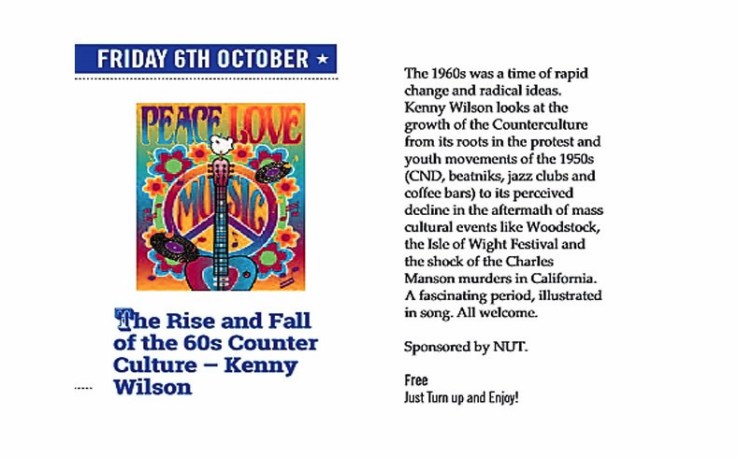
The 1960s Counterculture in Britain and America – a talk by Kenny Wilson at Secular Hall, Leicester on October 6th 7.00 p.m.

Counterculture Wide

I am doing a talk at The Secular Hall, Humberstone Gate, Leicester on the 6th October 7.00 p.m. Hope you can make it. It should last about an hour including audio and film clips, and there will be an opportunity for questions and comments at the end. Also, in the spirit of the time, it is free.

Counterculture Talkj

Counterculture Talk Leicester October 6th at Secular Hall

Summer of Love 50 Years On – London Then and Now

This is an article from the Guardian that cleverly shows how iconic sites in London looked in 1967 and how they look now. With a slider you can blend the two. Very impressive. It is amazing how little they have changed.

Related image


2017-09-19 (1)

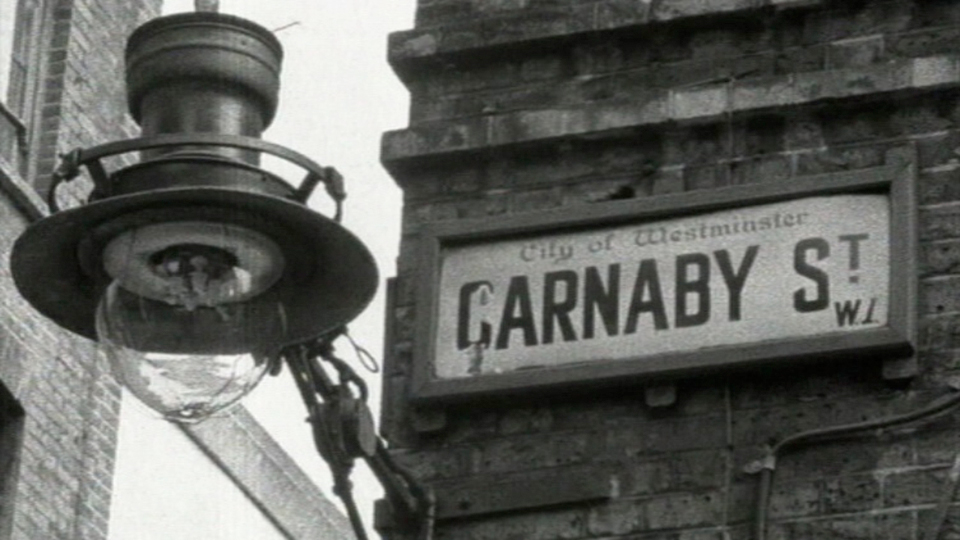
Newburgh Street (near Carnaby Street) London 1967

Newburgh Street 2017

Newburgh Street

Running parallel to Carnaby Street, Newburgh Street forms the boundary of what is known as the Newburgh Quarter, where fashionable concept stores and classic tailors sit alongside traditional pubs such as the White Horse.

Now pedestrianised and cobbled, back in 1967 it was a tarmacked road.

Summer of love 50 years on – London then and now:

https://www.theguardian.com/artanddesign/2017/aug/31/summer-of-love-50-years-on-london-then-and-now?CMP=Share_AndroidApp_WordPress