If you had asked me where I was on Saturday 5th January, I would have been inclined to say at a club in the heart of Paris. Listening to the band, Parisian Swing, I was honestly transported to another time and place, taking in the rich sound of the 1930’s Parisian Gypsy Jazz era.
Being the first band to perform at The Musician in Leicester this year, they certainly kicked off 2019 with a SWING! The four greatly talented band members performed to an enthusiastic audience that sat at little tables by candlelight and soaked in the atmosphere the musicians created.
Arthur Tyers (Photo: Kevin Gaughan)
With Arthur Tyers and Will Smith on Guitar, Kenny Wilson on the Accordion/vocals, and Mike Whittle on the Double Bass/vocals, this set up was all you needed to listen to some of Django Reinhardt’s most famous songs.
Nuages, a Django classic, set a slow, rich and velvety mood for the couples in the crowd and then the juxtaposition of Mack the Knife, described as ‘a mean song about a mean person’ brought laughter and bounce even over its darker lyrics. Beautifully played with speed and accuracy, each note was phenomenal from the guitars. Smith and Tyers were able to play incredibly fast but each note reached the audience perfectly.
The Parisian Swing Band (Photo: Kevin Gaughan)
Mike Whittle on the bass enchanted us all with his charisma and passionate dancing with his instrument throughout the evening. During the song It had to be you, each instrument had time to truly be appreciated as the focus was passed from the guitars to the bass, to the accordion. You were able to single out the gifts of each of the band members and appreciate how much talent and hard work goes into what they do.
My favourite song of the night had to be Autumn Leaves, originally by Edith Piaf, which Parisian Swing played with beautiful romantic justice. The audience was transported to a café in Paris with Kenny Wilson’s French vocals and accordion tying the scene together with Parisian passion.
Mike whittle, Arthur Tyers, Kenny Wilson(Photo: Kevin Gaughan)
The band played 18 songs from 8:30 onwards with a break halfway in which Music in Leicester was able to interview Mike and Kenny who were buzzing from their first half. With a quick ‘one-two-three’ the band were off in full swing with upbeat lifts that you couldn’t help tapping and nodding your head too.
The band also played Sweet Sue, Honeysuckle Rose, Minor Swing, Just a Gigolo, Douce Ambiance, Lady be Good and After You’ve Gone. The mix was a real treat for the crowd to experience a taste of the best of Parisian Gyspy Jazz.
After two ‘last’ songs from the band (as the audience asked for more) the evening concluded at 11 and I’m sure many people will be having jazzy-dreams for a long time to come!
I wish the best for Parisian Swing and hope to hear them again!
The Velvet Underground and Nico embodies a seldom realised idea: that music really can change the world. A financial failure in its time, the loose collection of these New York artists’ self-titled debut took a decade to sell 100,000 copies.
However, despite its commercial failings, The Velvets’humble flop was a primitively bright conceptual spark. While simultaneously hitting the bargain bins, greater forces were at play. Ripples of inspiration were subtlety mutating the face of popular culture. A powerful influence, the group’s deep-seated creative forces unified into something truly iconic.
Over a prolonged period of gestation word of mouth built in the musical underground. The innovative album passed hands while outspoken critics like Lester Bangs lionised the group’s achievement. To cite Brian Eno’sfamous remarks to the LA Times in 1982:
“I was talking to Lou Reed the other day, and he said that the first Velvet Underground record sold only 30,000 copies in its first five years. Yet, that was an enormously important record for so many people. I think everyone who bought one of those 30,000 copies started a band!”
The Velvet Underground and Nico embodied the ultimate album ideal: how the creative influence of five musicians could inform the next twenty years of music.
A central reference point in seemingly every shake-up in rock music since its release, generations of unrelated musical movements drew something different from between the vinyl grooves. Post-punk, glam rock, art rock, new wave, noise, and even industrial can trace their twisted lineages to the iconic album. Its influence still courses fluidly throughout modern music, and remains a seminal name-check for anything primal and completely outside the norm.
Commercial pressures, powerful personalities and creative impulse can often lead to compromise in a band. The Velvets were by no means immune to these factors, but what is remarkable is how true each creative contributor remained to their individual inspirations. Take a moment to profile the unlikely constituents which gave rise to the sonic schizophrenia of the band.
Lou Reed was the cantankerous black sheep of a middle-class Jewish family. Informed by literary studies and a stint in a mental institution at age 17, Reed looked to expand the idea of what popular music could entail. Musically the young songwriter cut his teeth churning out Motown, surf rock and bubblegum pop sound-alikes for the unscrupulous Pickwick Records.
Yet the Long Island native sought to follow in the steps of the visceral literature of William S. Burroughs and his beat generation forbears. Hidden behind the clichés of rock and roll, Reed saw an unlimited potential to accommodate a broader range of meaning.
Breaking down the barrier between rock music and poetic narrative, Lou injected sleaze and degradation into rock. At a time when puritanical values and obscenity laws could still place a chokehold on the avant-garde, Reed sang about heroin, transvestites and rent boys. Yet the band didn’t kick off as some grand artistic endeavour. Looking to capitalise on a more contrary sound Pickwick encouraged Reed to bring together a mock rock group to perform single Ostrich live. Known as The Primitives, the group started gigging live; securing a fortuitous residency at New York’s Cafe Bizarre in 1965.
Playing alongside Reed at this time was John Cale. A Welsh emigrant, Cale was an acolyte of the avant-garde. After finishing his study in London he relocated to New York in 1963 where he made a name for himself playing alongside influential neo-classical musicians like John Cage and Terry Riley. The young artist was probably just as happy to play a single piano chord 50 times with his elbows as anything else, but after meeting Reed at a party, he agreed to join his group.
Sterling Morrison was a Syracuse University graduate who was invited to play with The Primitives after a chance meeting with Reed, his old high school acquaintance, on a Manhattan subway. Contributing a more conventional grounding to his counterparts, he provided both rhythmic bedrocks and duelling solos to ground Reed’s more obtuse fretwork. Leaving the band in the early 70s, Morrison would evaporate from popular music entirely until a brief return in the early 90s.
Filling in for Primitives’ drummer Angus MacLise, Maureen “Mo” Tucker’s biting percussive edge kept the group together. Like Cale, Tucker looked to music from further afield when informing her self-tutored approach. While MacLise had introduced ideas from eastern music into the band’s sound, Tucker made an even greater impact with her appetite for the African beats of Babatunde Olatunji and the economic rhythms of Bo Diddly. The metronomic Tucker provided a viciously pervasive thump. She would only play standing.
Indirectly Andy Warhol remains one of the great unacknowledged influences in popular music. Although he did little in helping the group sculpt its sound, few would deny his influence in fostering their attitude and style. “The Velvet Underground was part of Andy’s group, and Andy wasn’t part of anything,” Reed told Spin in 2008.
Even prior to meeting The Velvets, Warhol shared many links with the group. Andy was familiar with avant-garde musicians La Monte Young and Marian Zazeela, both of whom had played with Cale in the Theatre of Eternal Music. This aristocrat of the New York scene also had associations with artist Walter De Maria, a drummer from an early iteration of The Primitives. Introduced through a shared acquaintance, Warhol quickly extended his patronage to the fledgling Velvets.
As art took an interest in popular culture and the mundane, pop and art collided with the Velvet Underground. Trashy could be classy. Ugly could be beautiful. He deconstructed consumer culture and captured unfiltered depictions of modern life. Like Warhol, Reed and company were particularly engrossed with that which was ignored or glossed over by the mainstream. As manager of the group, Warhol impressed into The Velvet Underground the idea that everything and anything could be art.
It was with Warhol’s patronage that the group was brought into the nexus of New York’s underground scene. The group transplanted from Cafe Bizarre to The Factory. With Warhol’s encouragement they become a house band and the sonic centrepiece of Warhol’s multimedia phenomena the Exploding Plastic Inevitable.
The group’s immersion within the polaroid art world of Warhol’s Factory placed them within a surrealistic scene where hustlers, transvestites, socialites and living theatre converged. Warhol would also help co-finance their debut album along with Norman Dolph, a Columbia Records sales exec.
Chanteuse Nico was a late addition to the band. Thrown in by Andy Warhol, it was his belief that the chic actor, model and vocalist could provide the group with some extra edge. In his on words the group were lacking a much needed “charisma.” Noted for her acting in French drama La Dolce Vita, the femme fatale’s icy persona belied a burgeoning (if moth-like) creative impulse. In line with Warhol’s fetish for film, she lent a detached and cinematic quality to the group.
Her injection into the band was far from a smooth transition. The German expat struggled to find acceptance amongst her peers. She would often clash with her bandmates due to her partial deafness and general eccentricity. But with her addition the cards were stacked; recording the album in early 1966 the group had few creative restrictions other than what the ubiquitous clarion call of “no blues.”
The deceptively tranquil Sunday Morning opens the album with sweetened pop. A crooning Reed embodies an effortless cool. Jangled guitar and beguiling innocence provide a moment of alluring misdirection, while subtly paranoiac lyrics anticipate the album’s darker undertow.
Things take a turn towards the more abrasive with Waiting For a Man. The second track’s lyrical world is intended to be real. Relating the details of a drug exchange, it weaves outsider depictions of the stark realities of street life and subterranean culture. A jilted piano echoes the Tucker’s juddering pulse.
With all the defiant deviance the group can muster, I’m Waiting For The Manconflates drugs and sexuality. The song lives within a reality aligned against the prevailing values of the day. It conveys a sense of moral decay which would see the record banned from major retailers and banned from radio airplay. Reed is the model of passivity and dependence. As raunchily as the song resounds, its feeling is voyeuristic.
While earlier tracks exude desperation and the idea of living on the edge, Femme Fatal swirls into gentle fantasy. The track places Nico in central focus. Her alluringly deadpan vocals are carried above a baroque chord progression.
The velour S&M fantasy of Venus in Furs verges on hypnotic. While the band averted themselves from the lysergic ripples of West Coast counterculture, it’s difficult to classify the paradoxical Venus in Furs as anything but psychedelic.
Run Run Run raggedly demonstrates the group’s celebration of stupidity and ugliness. Musically they revel in circular-minded banality. All Tomorrow’s Partiesmakes musical sketches of Warhol’s Factory scene.
Despite Reed’s contentions that he wasn’t glorifying anything in his music, Heroinprovided a directness and frankness about substance abuse which made the missives of counterculture seem childish in comparison. Cale’s sound experiments drone over the ostinato of a two-chord motif. Tucker’s percussion imitates a pulsing heart before inexplicably dropping out. Out of tune, primitive and never far from falling apart, here the group remain vital at every moment.
The punchy There She Goes Again situates itself as a straight ahead rocker, albeit one incorporating elastic time signatures. I’ll Be Your Mirror shimmers, while The Black Angel’s Death Song teeters into formless noise. Closer European Son pays homage to poet Delmore Schwartz while distortion and feedback dominate the album’s dissonant conclusion.
The black-clad Velvets would not last long. The group quickly parted ways with Warhol and exited The Factory scene in ’68. Nico and Cale would also depart. After dropping another two albums the group had all but disintegrated. 50 years onward the beauty and rawness of the group’s untamed innovation continues to resound throughout popular culture.
Much of music’s modern history has crossed currents with these New Yorkers’ commercial folly. It provides proof of concept that a group of individuals can instil music with a sense of intelligence and meaning. The Velvet Underground and Nico remains an enduring cornerstone of popular culture, echoing through time with an unwavering magnetism.
Making the Scene: Yorkville and Hip Toronto in the 1960s
Stuart Henderson
University of Toronto Press, 2011
394 pages, Paperback and ebook $29.95, Cloth $70.00
Stuart Henderson’s Making the Scene: Yorkville and Hip Toronto in the 1960s is an adventure back in time to Yorkville at what many would consider the pinnacle of its cultural history. Fifty years ago, the Yorkville Coffee Mill opened, among the first of many to become a hub for youth exploring counterculture through music and mysticism. Henderson’s book, which stemmed from his doctoral dissertation at Queen’s University, is rich with oral histories and underground press coverage of the day.
Personal experience drew me to Henderson’s work. I grew up in London (Ontario) in the 1990s. My father worked in Toronto for a time and stayed in an apartment on Bay Street near Bloor. Visiting on weekends, my mother and I would wander the “Mink Mile”. By then, Yorkville was a hub of elite consumerism, with couture boutiques and flagship stories. It was cultured, rather than counterculture.
Making the Scene tells the stories of the Toronto neighbourhood of Yorkville and the hip culture that pervaded the district in the 1960s. Henderson argues that, for roughly a decade, Yorkville served as the site in Canada for youth seeking an alternative to the dominant Canadian culture. He asserts that being part of a counterculture – defined as a subculture with values and practices that deviate from mainstream culture – involves the performance of identity. “A hippie,” he notes in the introduction, “does not, never can, exist wholly outside his or her cultural process” (5). In short, counterculture is a negotiation of identity, with cultural hegemony in play.
The book is organized chronologically in sections. Within each section is two chapters, one providing a political and cultural history of the period and the other assessing how the cultural identities in Yorkville were performed at the time. The book’s chronological organization makes Henderson’s argument easy to follow. However, there exists a strong historiography on counterculture-as-performance. Henderson does not especially take advantage of this material, and unfortunately relies on his readers to be familiar with the literature. For example, the performativity of “making the scene” requires the crossing of a threshold. Henderson even states that “as a geographic location, Yorkville was … metaphorically cut off,” and that Toronto was a divided cityscape, with Yorkville a zone of local “foreignness” (17)– both a cultural attraction and a destination. As a historian caught up in the meaning of place, this excited me until I realized that Henderson was not going to explore from where these people were being attracted, and how Yorkville was situated in the context of a rapidly expanding Toronto. In particular, it struck me that there were opportunities for the use of historical maps to tell these types of stories and to better illustrate the growth of the Yorkville coffee houses, followed by their retreat.
While Henderson situates Yorkville very well within its chronological context, the book seemed geographically isolated. The relationship between countercultures, identity, and place has been widely explored, so why not make better use of New York’s Greenwich Village or San Fransisco’s Haight-Ashbury to show what made Yorkville unique? Here, again, I think that the general reader may be disappointed that Henderson expects a high level of familiarity with the themes. Early in the work, I found myself asking questions about other countercultures in other cities and about the history of the 1960s counterculture phenomenon more broadly.
Similarly, the act of performing an identity that Henderson claims is part of “making the scene” requires the crossing of a boundary. Henderson states that “as a geographic location, Yorkville was metaphorically cut off” (268). I interpreted this to mean either that it was fully autonomous or that it had to be filled with people coming from elsewhere—by those who needed to cross the threshold from the dominant culture to the counterculture. Bloor Street between Yonge Street and Avenue Road remains, to this day, a cultural border best crossed under the right economic or social circumstances. I had hoped that Henderson would explore this idea further. Where were the people coming from? How was Yorkville situated in and affected by its geographic context of a rapidly changing and growing Toronto? Most of the images in the book are taken from underground press. There is one map, at the beginning, which shows the streets of Yorkville and their coffeehouses. Indeed, Henderson refers to Yorkville as “tied to a map of meaning which treated it as a circumscribed island of difference within the wider cityscape” (268), but we aren’t shown what exists around the island.
Henderson relies on dialogue from the film The Big Lebowski (1998) to describe the legacy of hip Yorkville:
‘Your revolution is over,’ counsels the conservative figure, as the bemused [Jeff] Bridges turns away. ‘My condolences. The bums lost. My advice is do what your parents did: get a job, sir. The bums will always lose. Do you hear me?’ But he doesn’t. Do we? (273)
The end of a rebellion is nothing new. The 19th century French statesman Francois Guizot has been attributed with the following: “Not to be a republican at 20 is proof of want of heart; to be one at 30 is proof of want of head.” What makes Yorkville and the 1960s counterculture unique, according to Henderson’s conclusion, is that it influenced the mainstream culture that we see today. That may be the case. He also suggests that the struggle for physical space was ultimately insignificant. This statement ignores the post-1970 gentrification of Yorkville that occurred, in part, because of the displacement of youth from this space.
It felt at times like Henderson was writing for those who were there, or who wished they could have been there. There were moments throughout when I felt like I had to have been there to understand why the event or place being described was important. The writing, much of which is done in first-person narration, is at times valourising in its tone. The book’s strength lies in its archival research and oral histories, and from reading it came some interesting debates about the nature of culture and place in the city of Toronto. I would recommend it for readers interested in the history of the Yorkville neighbourhood, Canadian culture in the 1960s, or youth culture in Canada. I will no doubt return to it for projects that reference these subjects. It would be a good supplemental work for those interested in counterculture, the history of Toronto, oral history, and underground media.
Kaitlin Wainwright is a graduate of Carleton University’s Public History program. She’s currently the Plaques and Markers Program Coordinator at Heritage Toronto.
The venues, schools, record labels, stores, and other landmarks that have created the sound of our city and shaped its music history.
The 1960s was the decade in which Toronto’s music scene took shape. With twin focal points in Yorkville and along the Yonge Street strip, the city produced highly regarded folk, rock, and R&B-influenced sounds. Though many of the venues from the decade are long gone, acts that developed their reputations in them, such as the Band and Gordon Lightfoot, became known around the globe.
1 Village Corner (174 Avenue Road, north of Davenport)
Another early folk venue, one where music duo Ian & Sylvia launched their career. As a member of the duo the Two Tones, Gordon Lightfoot recorded his first album here in January 1962.
2 Rockpile (northwest corner of Yonge and Davenport)
For a time in the late 1960s, the main space of the Masonic Temple (now home to MTV Canada) was a Fillmore-style concert hall. It is usually associated with Led Zeppelin, who played there twice in 1969. Before their August 18 gig, manager Peter Grant noticed the extensive lineup outside and threatened to cancel the show if the band didn’t get more money. The burly former bouncer got his way, but the amount handed over played a role in the venue’s closing soon after.
3 Penny Farthing (112 Yorkville Avenue)
Far more respectable than its next door neighbour, this spot specialized in blues and jazz. Veteran bluesman Lonnie Johnson played for several weeks in 1965, resulting in an album with one the venue’s regular acts, Stompin’ at the Penny with Jim McHarg’s Metro Stompers, featuring Lonnie Johnson. Johnson enjoyed playing in Toronto and spent the last five years of his life in the city.
4 Riverboat (134 Yorkville Avenue)
Opened in October 1964 and run by Bernie Fielder for 14 years, the Riverboat was usually considered the top venue in Yorkville thanks to a steady stream of high-level blues and folk acts. Sometimes timing worked in the Riverboat’s favour: in order to book bluesmen Sorry Terry and Brownie McGhee, Fielder was pressured by their agent to also slot in a rising folk duo named Simon & Garfunkel. By the time the pair was to perform in early 1966, their songs were rising up the charts. The duo wanted out of their commitment, but a compromise was reached, and Torontonians had what proved to be a rare opportunity to catch the pair in an intimate setting.
5 Mynah Bird (114 Yorkville Avenue, at Hazelton)
Named in honour of owner Colin Kerr’s pet, who could be found at this coffeehouse’s entrance, the Mynah Bird loved drawing attention to itself. For a period, it trotted out the latest innovations in topless entertainment, including Wyche, “the world’s first topless folksinger” (though her long hair covered her bosoms). Kerr also managed a rock group named after the venue, fronted by Rick James—after they separated from Kerr, Neil Young was among the musicians who passed through the group’s ranks.
6 Varsity Stadium (Bloor Street and Bedford Road)
Two major music festivals were held here in 1969. The bill for June’s Toronto Pop Festival ranged from southern soulsters (Carla Thomas) to Quebeçois chansonniers (Robert Charlebois). Local favourite Ronnie Hawkins managed to get a teenager named Jeanne Beker to jump onto the stage. September’s Toronto Rock and Roll Revival went down in history for being the live debut of the Plastic Ono Band featuring John Lennon and the Alice Cooper “chicken incident.”
7 Bohemian Embassy (7 St. Nicholas Street)
Situated at various places around the city over its history, and not to be confused with the condo bearing the same name, the venue founded by Don Cullen called the Yonge-Wellesley area home from 1960 to 1966. One of the city’s first major coffeehouses, it offered up a mix of folk, jazz, comedy, and literary readings—among those whose careers were boosted by appearances at the Bohemian Embassy were Margaret Atwood and Sylvia Tyson.
8 RCA Studios (225 Mutual Street)
Once home to CHUM radio, 225 Mutual Street became one of the city’s busiest recording studios. Operated by RCA during the 1960s and 1970s, then McClear Place, the studios saw acts ranging from Rosemary Clooney to Rush use its facilities over half a century of sound recording. The building was demolished in 2010.
9 Club Blue Note (372A Yonge Street)
A key venue for developing the mix of rock and R&B that came to be known as the “Toronto Sound.” As George Olliver, who sang with the house band The Five Rogues (later Mandala) told the National Post last year, “so many of the hit artists who used to work at the Maple Leaf Gardens came here after hours—people like Stevie Wonder, The Righteous Brothers.”
10 Hawk’s Nest (above Le Coq D’Or, 333 Yonge Street)
Having proven a popular attraction at Le Coq D’Or, Ronnie Hawkins made a deal with its owners: in exchange for free use of the building’s third floor (which ended up housing an office, gym, and after hours parties), he would run an all-ages club on the second floor. The Hawk’s Nest proved a blessing for music fans too young to go into the other venues along the Yonge Street strip.
11 Friar’s Tavern (283 Yonge Street)
Now the Hard Rock Café, the Friar’s Tavern was another stop for bands gigging along the Yonge Street strip. A plaque inside commemorates the morning of September 15, 1965, when Bob Dylan caught a performance by Levon and the Hawks, Ronnie Hawkins’ former backing band. For the next two nights, Dylan and the group that became the Band rehearsed at the Friar’s before going out on Dylan’s first electrified tour.
12 Colonial Tavern (203 Yonge Street)
Situated between two historic banks across from the present-day Eaton Centre, the Colonial Tavern attracted a steady stream of blues, jazz and rock acts during its existence. A parkette currently graces the site.
13 Electric Circus (99 Queen Street East) Opened in December 1968, the Electric Circus was intended by its backers to bring a New York–style trendy nightclub to Toronto. Partner Jerry Brandt told the Globe and Mail that “we think a person should be free to do what he wants. He can dance, he can watch, he can disappear for a while into an environment room…We have set up the facilities for you to have an experience. It’s not what you do, but how you do it.” After its run as a club/music venue, the site was used as the original studio for Citytv, who later resurrected the name for its dance show.
14 King Edward Hotel (37 King Street East)
Between their afternoon and evening performances at Maple Leaf Gardens on August 17, 1966, the Beatles attended a press conference at the venerable King Eddy. John Lennon refused to apologize for his recent statements that the band was more popular than Jesus. They also admitted that the scariest fans they encountered so far on what proved to be their final tour were found in Cleveland.
15 O’Keefe Centre (Yonge and Front)
This all-purpose concert hall, now known as the Sony Centre for the Performing Arts, was one of the most versatile venues of the decade in terms of performers. The pre-Broadway tryout of the musical Camelot, starring Julie Andrews and Richard Burton, opened the O’Keefe in October 1960. Acts that trod its stage during the 1960s ranged from grand opera to the Grateful Dead.
Additional material from Before the Gold Rush by Nicholas Jennings (Toronto: Penguin, 1997) and the December 21, 1968 edition of the Globe and Mail.
“Blind Faith were an Englishblues rock band, composed of Eric Clapton, Ginger Baker, Steve Winwood and Ric Grech. The band, which was one of the first supergroups, released their only album, Blind Faith, in August 1969. Stylistically similar to the bands in which Winwood, Baker and Clapton had most recently participated, Traffic and Cream, Blind Faith helped to pioneer the genre of blues/rock fusion. The beginnings of Blind Faith begin in mid-1968, with the break-up of Cream. Today considered to be the first true supergroup, Cream had become a financial powerhouse, selling millions of records within a few years and bringing international popularity to both the group and each individual member. Despite that success, the band was crumbling from within because of frequent animosity between Jack Bruce and Ginger Baker, with Eric Clapton doing his best to mediate. In addition…
In his book No One Else Could Play That Tune Clinton Heylin notes that the only contemporary radio interview in which Bob Dylan discussed Blood On The Tracks was with Mary Travers but he carefully steered her away from it after a brief exchange. This is said interview (just the talk, the commercials and music are edited out). They also talk Woody Guthrie, topical songs, and about the then forthcoming Basement Tapes release. At one stage the conversation gets a little philosophical until Bob points out to Travers that she is crossing another one of his red lines.
In the summer of 1967, Atlanta Journal reporter Michael Palmer went undercover as a hippie. Hoping to provide his readers with some insight into a movement that had recently made its way into the national consciousness, Palmer put on a “white, ruffled shirt, and old vest, levies [sic] frayed at the cuffs” and stealthily entered the city’s small but noticeable hippie community. In a series of articles that followed this experience, Palmer discussed with a mixture of dismissal and despair what he encountered during his five weeks of undercover research – from watching people take drugs in a “crash pad” to participating in a “love-in” at Piedmont Park. While Palmer ultimately provided little real insight into the countercultural mindset, he did make his readers very aware that something new and different was happening in Midtown Atlanta.1
POLICE PERFORMING A NIGHTTIME ANTI-DRUG RAID AGAINST HIPPIES, ATLANTA, GEORGIA, AUGUST 4, 1969. V003-600001-A24, TOM COFFIN PHOTOGRAPHS. SPECIAL COLLECTIONS AND ARCHIVES, GEORGIA STATE UNIVERSITY LIBRARY. COURTESY GEORGIA STATE UNIVERSITY.
Several factors, however, thwarted attempts by Strip residents to create a thriving and safe hip community in Atlanta.5 Business owners disliked them, local “straight” residents complained repeatedly to city officials about their presence, and the police engaged in an ongoing campaign of harassment that included arresting hippies for minor infractions. In July, 1968, a group of local business owners attended a meeting of the city’s Aldermanic Police Committee to complain how the hippie presence harmed the value of their businesses and made it “unsafe for residents to walk down the street.” That same month, Police Chief Herbert Jenkins launched a crackdown on the area’s hippie population.6While the city’s recently founded underground newspaper, the Great Speckled Bird, regularly reported on the ill-treatment the hip community suffered at the hands of business owners and the police, the straight press routinely ignored or downplayed these issues.7
INSPECTING THE DAMAGE: “ATLANTIS RISING BOMBING,” ATLANTA, GEORGIA, SEPTEMBER 11, 1969. V003-690911-A28, TOM COFFIN PHOTOGRAPHS. SPECIAL COLLECTIONS AND ARCHIVES, GEORGIA STATE UNIVERSITY LIBRARY. COURTESY GEORGIA STATE UNIVERSITY.
These issues worsened considerably during the first six months of 1969. The Great Speckled Bird speculated that a recent wave of suspicious fires in the area was an attempt to scare away hippies.8 In addition, the number of sexual assaults against hip women in the Strip increased, as did the number of physical confrontations between Strip residents and straight locals, some of which included the exchange of gunfire.9 In August, a near riot erupted in the Strip when hippies and political radicals clashed with local police and agents from the Georgia Bureau of Investigation during yet another in a series of drug raids in the neighborhood.10 Then, in early September, a firebomb destroyed Atlantis Rising, a combination artist collective and recreation center that served Strip residents and acted as a meeting space for radical political groups.11 Finally, this pattern of confrontation and violence culminated on September 21 when attendees and police clashed during a free concert in Piedmont Park.
The events leading up to and following the Piedmont Park riot illustrate the changing nature of social and political life in Atlanta during the late 1960s. Far from an isolated incident, the riot, and the response to it, reflected the growing frustration of Strip residents as they faced continual police harassment and acts of anonymous violence while trying to create a functional alternative district built on the concepts of cooperation and community. Moreover, the riot revealed connections and shared concerns between white youth and the African American community at a time of significant change in the local political landscape. While the Piedmont Park riot is a lesser known event of civil disobedience in the history of Atlanta, re-examining the riot reveals how far the political and cultural radicalism of the 1960s had made its way into the nation’s most conservative areas, as well as how the presence of a community of radical white youth impacted local political scene, which is usually portrayed by historians of the era as a struggle between conservative whites and African Americans for control of the city during a time of significant demographic change.
OUR PARK
By the late 1960s, Piedmont Park, located just a few blocks east of the Strip, offered a safe haven away from the hassles of life on Peachtree. At a time when hippies were routinely arrested for simply walking down the street, the existence of a place where they could gather freely ensured that the park became integral to community-building efforts by local counterculture and New Left leaders. The Atlanta antiwar movement often chose the park as a gathering point for marches into downtown or as a location for post-march rallies.12 And in July 1968, approximately 800 people gathered around the park’s pavilion for the city’s first “Be-In,” an event copied from the more famous San Francisco Human Be-In held the previous summer.13 The hip community’s use of Piedmont Park increased significantly during the first nine months of 1969. In March, the Great Speckled Bird celebrated its first anniversary with a party in the park. The city’s political activists even took time to enjoy the park’s athletic facilities by forming a “Revolutionary Softball League” that spring.14 And the series of free Sunday concerts which had occurred occasionally during the spring and early summer of 1969 became more regular occurrences following the 1969 Atlanta International Pop Festival. The festival, held over the Fourth of July holiday weekend at an automobile racetrack in Hampton, Georgia, featured Janis Joplin, Joe Cocker, Credence Clearwater Revival, Grand Funk Railroad, and Led Zeppelin.15 Held the day after the festival ended, a free concert in Piedmont Park featured many of the bands that had played at Hampton, including, Delaney and Bonnie, Spirit, the Allman Brothers, and the Grateful Dead.16
While the park served as key place to experience countercultural entertainment, the recent wave of harassment and violence in the Strip also led many hippies and New Leftists alike to see their use of the park in more overtly political terms; it had become an important battleground in their quest for meaningful social change.17 This shared cause between the counterculture and New Left was not unique to Atlanta in the late 1960s. While the middle years of the decade witnessed the rise of two movements that could be identified as uniquely separate, each with its own goals and philosophies, by 1969 the boundaries between the New Left and counterculture had become blurry. The New Left recast itself into an expansive social movement aimed at the creation of a new American culture as it sought more than just political change, while the counterculture rethought its earlier utopianism and now sought to practice its core beliefs within, rather than separate from, American society.18
VIETNAM WAR PROTEST. METRO ATLANTA CHAMBER OF COMMERCE COLLECTION AT KENAN RESEARCH CENTER AT ATLANTA HISTORY CENTER. COURTESY ATLANTA HISTORY CENTER.
HIPPIE DRUM CIRCLE IN PIEDMONT PARK, ATLANTA, GEORGIA, CIRCA 1969. TOM COFFIN PHOTOGRAPHS. SPECIAL COLLECTIONS AND ARCHIVES, GEORGIA STATE UNIVERSITY LIBRARY. COURTESY GEORGIA STATE UNIVERSITY.
Echoing countercultural writers around the nation, the Bird had repeatedly expounded on the importance of rock music as a catalyst for social change and on Piedmont Park’s new role as a site for this melding of culture and politics.19 In a piece entitled “Our Park,” “Richard” explained the importance not only of rock music to the creation of a new society, but of a place to experience such music in a revolutionary way, noting that:20
if we are a revolutionary culture then we must . . . refuse festivals and radio and recordings . . . musicians will play, will fill our parks, because they must play, and we will listen because we must and there will be no one in between.
By the summer of 1969, the importance of Piedmont Park to the growth of Atlanta’s hip community led many Strip residents to consider the park, at least on certain days, as their own. Piedmont Park became a place to listen to some good music, get a free meal, commune with likeminded individuals, discuss radical politics, and explore new ways of living together. Or as “Richard” concluded,21
you will come to the park to make it your park and you will listen to music and know that it is your music and it will be freedom.
Following the dramatic firebombing of Atlantis Rising in late August, the park also became a place of spiritual rejuvenation for the Strip community. On the Sunday following the attack, a benefit concert for the store was held in the park that featured several prominent local and regional bands, including the Allman Brothers. As Miller Francis, the community’s preeminent cultural chronicler, noted in an article for The Great Speckled Bird the concert was more than simply a musical event or a rally for Atlantis Rising. For Francis, the park acted not simply as a public recreational space, but as a key focal point for the political struggle to build a viable alternative community.22 Accordingly, as he noted:23
PEOPLE EATING AT A FREE CONCERT SPONSORED BY THE “GREAT SPECKLED BIRD” AT PIEDMONT PARK, ATLANTA, GEORGIA, SEPTEMBER 21, 1969. TOM COFFIN PHOTOGRAPHS. SPECIAL COLLECTIONS AND ARCHIVES, GEORGIA STATE UNIVERSITY LIBRARY. COURTESY GEORGIA STATE UNIVERSITY.
The vibes in Piedmont Park on all the Saturdays and Sundays flow out of our fight to replace the power behind the firebomb . . . that gutted Atlantis Rising, and our attempt to design a politics to effect that replacement.
Francis noted the intense sense of positive feelings that the crowd in “our park” generated, as well as the wide array of the city’s population which was in attendance in addition to the usual hippie contingent, including “straight, crewcut, turned-on, tribal, black, working class, mothers and children.”24 However, it would be this very attachment to the park that laid the foundation for the riot that occurred only a week later.
Throughout the nation, public spaces played an important role in bringing politics and culture together. Parks took on particular meaning in the late 1960s, serving as a central site for the expression of a spatial politics that helped reveal the growing intersection of the counterculture and the New Left. Perhaps most famously, in May 1969, violence erupted in Berkeley over an undeveloped piece of land owned by the University of California. Claiming the space as their own, over two hundred hippies, college students, and community activists had turned the former parking lot into a park, which they called “People’s Park.” Then, on May 15, police cleared the park and encircled it with cyclone fencing, a provocation which the local hip community responded to by rioting with the ensuing street battle ending that evening only after twenty policemen had been injured and twenty protestors had been shot, one fatally.25 While the events in Berkeley are well-remembered, the events at Piedmont Park a few months later exemplify that the willingness to defend contested space was not restricted to cities famous for their radical communities.
“GET THE PIGS OUT OF OUR PARK!”
The September 21, 1969, free concert in Piedmont Park boasted an impressive lineup. While the Allman Brothers would not play that Sunday, the show presented some of the best local rock acts, including Radar, the Booger Band, and headliner The Hampton Grease Band. This list of performers, as well as the success of the concert the previous Sunday, and a prominently placed announcement in the Great Speckled Bird, ensured a sizable attendance. And despite a chilly rain, by late afternoon between 1,000 and 1,500 people had arrived in the park.
ONE OF THE BANDS PERFORMING AT A “GREAT SPECKLED BIRD” CONCERT IN PIEDMONT PARK, ATLANTA, GEORGIA, SEPTEMBER 21, 1969. V003-600001-C27, TOM COFFIN PHOTOGRAPHS. SPECIAL COLLECTIONS AND ARCHIVES, GEORGIA STATE UNIVERSITY LIBRARY. COURTESY GEORGIA STATE UNIVERSITY.
Several staff members from the Great Speckled Bird circulated through the crowd, collecting affidavits regarding police harassment, which they planned to include as part of the paper’s recently-filed lawsuit against the police department.26 Earlier that month the hip community became involved in a local debate over police brutality. During a speech at the West Hunter Street Baptist Church on September 12, DeWitt Smith, an African American patrolman, publicly accused several white officers of beating three black prisoners without provocation. Notably, during his comments, he also mentioned the mistreatment local hippies routinely endured, stating:27
if your hair is long and you’re wearing bell-bottoms you are in for it. Girls are jerked and pulled into line by their hair . . . and they {officers} seem to delight in grabbing a man by the seat of his pants and lifting him up until the pressure in his groin becomes unbearable.
During the following week, a coalition of local civil rights groups and the Great Speckled Bird filed separate lawsuits against the Atlanta police department, which illustrated an emergent, if problematic, alliance of the New Left, the counterculture, and the local civil rights movement in late 1960s Atlanta.28
But in addition to the Bird staffers, several undercover policemen also moved through the crowd in the park that day. And just as the band Brickwall started its set, word began to circulate that undercover narcotics agents from the Atlanta police were in the audience and looking to make arrests. Concert attendee George Nikas soon found himself in custody after following Detective C. R. Price through the crowd, warning other concertgoers that Price was a policeman. As the young man was led away a crowd gathered around the two and began chanting “show us your badge!” and “let him go!” In the ensuing confrontation, Price ended up pulling his service weapon and brandishing it at the crowd, providing enough of a distraction for Nikas to escape and disappear back into the audience.29
“GREAT SPECKLED BIRD” PHOTOGRAPHER BILL FIBBEN BEING ARRESTED DURING A BOTCHED POLICE OPERATION DURING A CONCERT IN PIEDMONT PARK, ATLANTA, GEORGIA, SEPTEMBER 21, 1969. V003-600001-C35, TOM COFFIN PHOTOGRAPHS. SPECIAL COLLECTIONS AND ARCHIVES, GEORGIA STATE UNIVERSITY LIBRARY. COURTESY GEORGIA STATE UNIVERSITY.
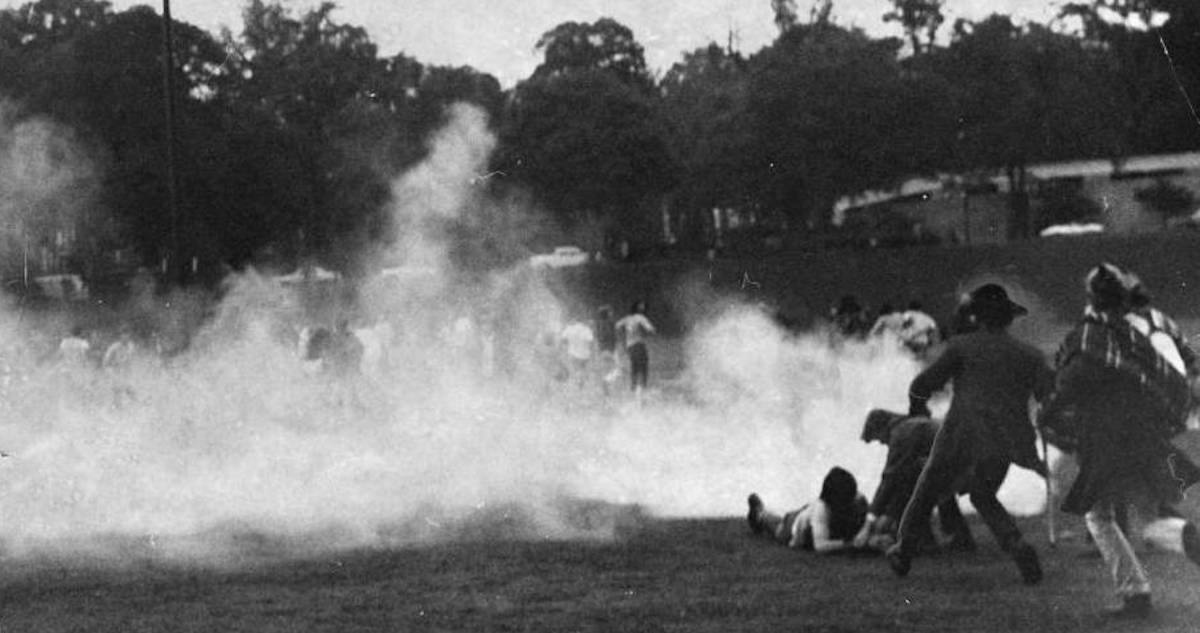
As the music, which had stopped during the struggle, resumed, Price and several other policemen moved back into the crowd and quickly found, and again apprehended, Nikas. This time, they also arrested Bill Fibben, a staff photographer for the Bird. But several hundred audience members immediately surrounded the cars containing Nikas and Fibben, shouting “This is our park!” and “get the pigs out of our park!” In response, police called for reinforcements and tear gas canisters. The concert’s promoter attempted to persuade police to let him restore calm but before he could do so, an officer lobbed a tear gas canister into the crowd and what had been merely an angry confrontation between the police and the concertgoers turned into a riot.30
TEAR GAS UNLEASHED ON HIPPIES ATTENDING A FOLK CONCERT IN PIEDMONT PARK, ATLANTA, GEORGIA, SEPTEMBER 22, 1969. PHOTO BY NOEL DAVIS. AJCP211-032A, ATLANTA JOURNAL-CONSTITUTION PHOTOGRAPHIC ARCHIVES. SPECIAL COLLECTIONS AND ARCHIVES, GEORGIA STATE UNIVERSITY LIBRARY. COPYRIGHT ATLANTA JOURNAL-CONSTITUTION. COURTESY GEORGIA STATE UNIVERSITY.
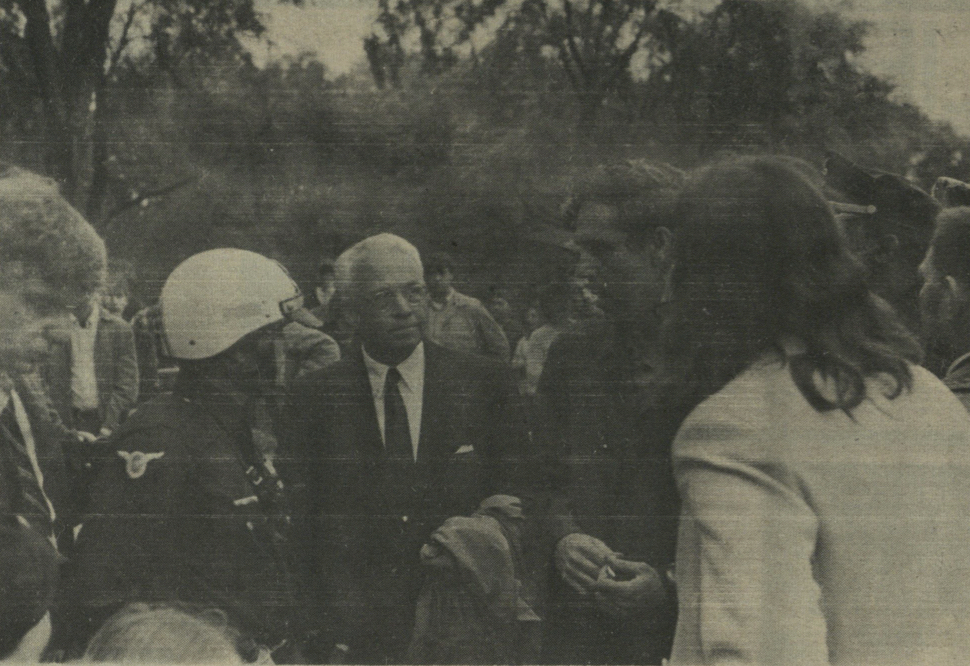
As the protestors around the patrol car began to scatter, several paddy wagons and almost the entire evening watch of the Atlanta police force approached the park. For the next thirty minutes a running battle of sorts took place. The police, who had taken up a position not far from the park pavilion, fired tear gas canisters into the crowd while several officers repeatedly charged into the rioters. The crowd responded by throwing some of the tear gas canisters back, along with rocks, cans and glass bottles, quickly dispersing after each volley only to retake its position after the clouds of tear gas dissipated.31 Ultimately, the confrontation ended only after American Civil Liberties Union lawyer Al Horn arrived at the park and talked with Police Superintendent Oscar Jordan.32 Following this conversation, the crowd calmed down and several police officers left the park. As attempts were being made to restart the music, Police Chief Herbert Jenkins and Mayor Ivan Allen finally arrived, too late to make any meaningful contribution although the mayor did spend some time speaking with concertgoers.33
RESPONSES TO THE RIOT
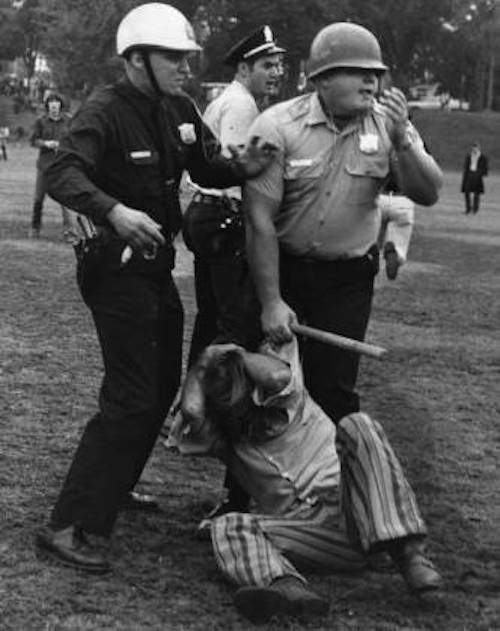
While the Piedmont Park riot resulted in few injuries and only twelve arrests,34 it provoked a variety of responses from the Strip community, civil rights leaders, local politicians, and city officials. The statements issued by these groups reveal the complicated nature of Atlanta politics in the late 1960s as well as divisions within the city’s hip community. Moreover, the cooperation between the hip and civil rights communities in response to the riot revealed how disaffected groups in Atlanta could cross racial lines when they found common cause.
POLICEMEN DRAGGING A YOUNG HIPPIE THROUGH THE GRASS, PIEDMONT PARK, ATLANTA, GEORGIA, SEPTEMBER 22, 1969. PHOTO BY NOEL DAVIS. AJCP211-032B, ATLANTA JOURNAL-CONSTITUTION PHOTOGRAPHIC ARCHIVES. SPECIAL COLLECTIONS AND ARCHIVES, GEORGIA STATE UNIVERSITY LIBRARY. COPYRIGHT ATLANTA JOURNAL-CONSTITUTION. COURTESY GEORGIA STATE UNIVERSITY.
With the mayoral election just weeks away, several of the candidates weighed in on the riot. City alderman Everett Millican, who had recently proposed a park curfew, favored drastic action, promising that, if elected, he would “run the hippies out of town.”35 Echoing statements he had made the previous spring, he labeled the city’s countercultural district “a disgrace,” filled with “hippies, homosexual, sex deviates and drug pushers.”36 While admitting that Piedmont Park had deteriorated before the hippies claimed it as their own, he still argued that “it’s gone down a lot more since.”37 Alderman and mayoral candidate Rodney Cook took a less aggressive position, stating that law-abiding citizens should not fear being “hit over the head” by police but that those who broke the law should be punished to the fullest extent possible. Instead of running the hippies out of town, Cook believed that hiring more policemen, raising salaries, providing them with better training, and creating neighborhood patrols would solve the problem.38
HIPPIES TALK TO MAYOR IVAN ALLEN JR. AFTER THE RIOT. FROM: GREAT SPECKLED BIRD 2, NO. 29 (SEPTEMBER 29, 1969), 22. GREAT SPECKLED BIRD COLLECTION. SPECIAL COLLECTIONS AND ARCHIVES, GEORGIA STATE UNIVERSITY LIBRARY. COURTESY GEORGIA STATE UNIVERSITY.
Meanwhile, in stark contrast to the interpretation of the riot offered by members of the political establishment, Great Speckled Bird writer Greg Gregory analyzed the riot from a countercultural perspective, arguing for the park’s importance to the development of a new American society and declaring that,39
Sunday’s resistance was not ‘revolutionary antics,’ the work of ‘agitators.’ Sunday was a defense of the kind of life we have chosen to live. This life includes music; it includes dope; but more significantly; and of revolutionary impact, is our self-perception as a people acting in unity.
He continued:40
A park cannot be liberated by permit, cannot be ‘free’ just because freaks come together to dig some fine music . . . Sunday was about what comes down when . . . we transgress the constricted lifestyle that is acceptable to and in this rotten society.
But Gregory also had harsh words for members in the hip community who criticized those who had fought back against the police. Arguing that this criticism attacked the very unity the riot had created, Gregory suggested that “to fall back on a love-and-peace stance which quickly becomes a hate-the-bottle throwers posture is to fragment the solidarity that saw politicos and culture freaks standing side by side.”41 While praising the importance of gentleness to their cultural revolution, he nonetheless argued that cruelty, not gentleness, needed to be the appropriate response when “tribal celebrations” came under attack. As he saw it, solidarity required that musicians, “trippers,” and rock throwers stand together or the new culture they hoped to create would die. Likewise, Jim Gwin asserted that “we must defend our vision as it emerges in concrete form. The communal/music experience in Piedmont Park is that vision.”42
The politicos of the Great Speckled Bird also responded quickly to the riot. Staff members at the Bird office began immediately collecting the statements of approximately one hundred people present in the park during the confrontation, which would be added to the police harassment suit the Bird had filed recently in federal court.43 During a press conference held at the newspaper’s office the day after the riot, the hip community presented three demands: that all charges against those arrested on Sunday be dropped, that all plainclothesmen and other policemen be banned from the park and, finally, to “let us have our music.”44
The riot also generated support from the city’s civil rights community. On Monday, the Atlanta Ad Hoc Committee on Law Enforcement and the Community, which had come together the previous April to investigate police brutality and included members of the Urban League, the National Association for the Advancement of Colored People, and the Metropolitan Atlanta Summit Leadership Conference, presented four recommendations to Mayor Ivan Allen. The committee called for an end to harassment, suspensions of policemen accused of brutality, improved jail conditions, and the establishment of grievance procedures. The group also noted that the Atlanta police “showed the same brutal force as Chicago” in their efforts to disperse the park crowd, a reference to the previous year’s street riots during the Democratic National Convention.45 While Allen declined to comment on these recommendations, he stated that the city would undertake a “full investigation of police brutality charges” stemming from the riot, and announced that the two officers noted most prominently for their actions in the park, C. R. Price and D. L. Dingee, had been transferred to duty in south Fulton County. Both the mayor and Jenkins stated this might help the situation since the problem had been caused only by a small number of “bad apples” within the police force.46
The committee clearly saw common cause between black Atlantans and the Strip community when it came to law enforcement issues. In its statement to Allen, it claimed that “the city has evaded responsibility and accountability for abuse of its citizens. Brutality occurs not only at the jail, it happens at the time of arrests . . . and we know that the police rioted in Piedmont Park yesterday.”47 Likewise, Southern Christian Leadership Conference (SCLC) leader Hosea Williams articulated the connection between oppressed African Americans and hip community members. When speaking to the crowd at Piedmont Park after the riot, he told them that,48
this is the same thing that has been happening to black people for a long time – and partly for the same reason: because they don’t want to conform to the ways of this sick, racist society. The reason they’re brutalizing you is simple: you want to live your own life, your own way.
THE GREAT SPECKLED BIRD 2, NO. 29 (SEPTEMBER 29, 1969), 3. GREAT SPECKLED BIRD COLLECTION. SPECIAL COLLECTIONS AND ARCHIVES, GEORGIA STATE UNIVERSITY LIBRARY. COURTESY GEORGIA STATE UNIVERSITY.
The Strip and civil rights communities further strengthened their bonds in the wake of the riot by planning a march to police headquarters at a meeting that included representatives from the Bird and the SCLC alongside numerous hippies and street people, ministers from several local churches, local countercultural shopkeepers, and political radicals. In addition to the three demands formulated immediately after the riot, the group agreed to publicly support the call from civil rights groups for the termination of Police Chief Herbert Jenkins and the demand that African Americans control their own communities. Attendees also demanded the firing of seven police officers involved in the riot, including Price and Dingee, as well as eight other officers that the African American community wanted dismissed.
On Saturday, September 27, a procession of approximately 600 marchers – which would ultimately grow to 1,000 participants – left Piedmont Park headed downtown along the city’s main thoroughfare. Holding banners with the phrases “Fire Jenkins” and “No Armed Police or Narks in Park,” the group included several African American ministers and civil rights leaders, such as the Reverend Douglas Slappey of the African Methodist Episcopal Church, and Hosea Williams. Once they reached police headquarters the marchers handed over their demands to Superintendent Jordan and the crowd listened to several speeches, before turning around and heading back to the park.49
YOUNG PEOPLE MARCH IN PROTEST AGAINST POLICE TACTICS AFTER A “GREAT SPECKLED BIRD” SPONSORED CONCERT, ATLANTA, GEORGIA, SEPTEMBER 27, 1969. V003-690927-A08, TOM COFFIN PHOTOGRAPHS. SPECIAL COLLECTIONS AND ARCHIVES, GEORGIA STATE UNIVERSITY LIBRARY. COURTESY GEORGIA STATE UNIVERSITY.
WHERE DID ALL THE HIPPIES GO?
The riot and the series of confrontations that led up to it would ultimately garner national attention via an October 10 story in Time magazine, entitled “The Great Hippie Hunt,” in which it was suggested that, 50
police and state solicitor general’s agents, with the tacit approval of the city administration and Atlanta’s business community, have waged war against these so-called undesirables, treating them as the greatest threat to the city since General Sherman.
This coverage and the brief flurry of activity following the riot in Piedmont Park ultimately did little to change conditions for the better, either in the Strip or at the park. Indeed, while the Strip had drawn most of the city leaders’ attention up to that point, in the years after the riot, they would increasingly object to the presence of the hip community in Piedmont Park as well, which many Atlantans had given up using after the hip community had adopted it as its own in 1969. Moreover, due to increased police harassment and the passage of a new city loitering ordinance in 1970,51 large numbers of people who had formerly called the Strip home had moved several blocks east to Piedmont Park. Reports in local papers claimed that at least several hundred people now called the park home and in August 1971 the Bird reported: “the Strip is practically deserted and the park is being used more.”52 But the introduction of hard drugs, the growing presence of criminal elements – including violent bikers – and a serious problem regarding teenage runaways changed the nature of the community and provoked a set of responses from the new Mayor Sam Massell that would ultimately end the hips’ occupation of the park and spell the end of Atlanta’s hip community.
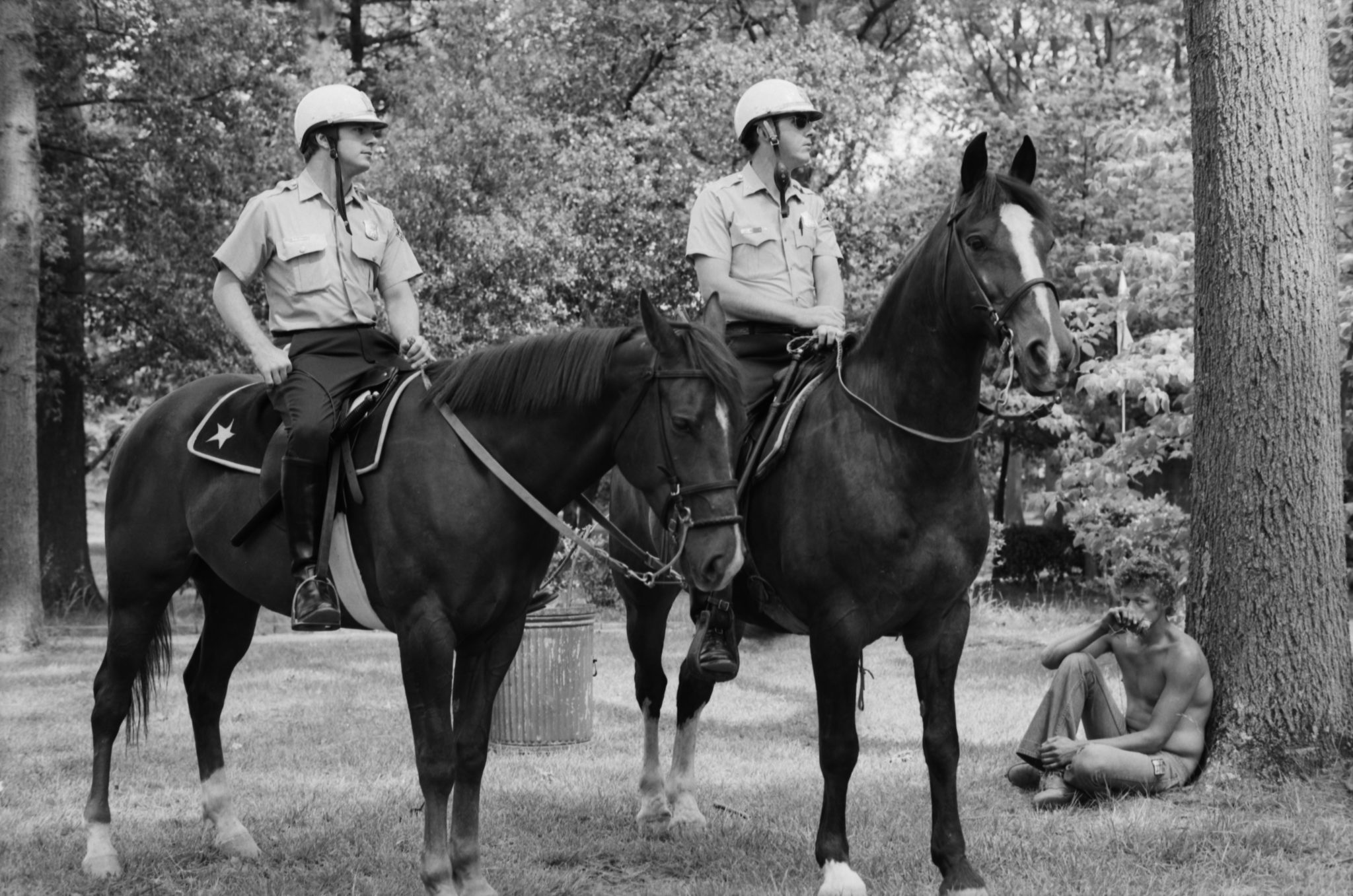
After a series of shootings in the summer and fall of 1971, Mayor Massell announced that a “special police detail, a mobile precinct, and a mounted patrol” would soon be on duty in Piedmont Park because, as he described it, “the park is a big place but not big enough to house punks with knives, guns, and needles.”53 These additional policeman soon began patrolling Piedmont Park aggressively and the crackdown had its intended effect – within days, hips had largely abandoned the park. New regulations which were soon adopted also made it harder to organize the kind of events that the hip community had held in Piedmont Park over the past several years, such as rock concerts, political rallies, and antiwar demonstrations.54 Denied the ability to organize events, hips still attempted to congregate informally in the park. Not surprisingly, the police worked diligently to make them unwelcome by selectively enforcing park ordinance 22-38, which made it “unlawful for any person, in any park, to, stand, walk, or ride on the grass,” and by asking for identification from members of any group of six or more hips. As the Bird put it, a “police state” now existed in the park.55
MOUNTED PATROL IN PIEDMONT PARK. BOYD LEWIS COLLECTION AT KENAN RESEARCH CENTER AT THE ATLANTA HISTORY CENTER. COURTESY ATLANTA HISTORY CENTER.
Pushed out of Piedmont Park and the Strip, the hip community saw its demise approaching quickly over the horizon. As its members relocated to other neighborhoods, left town, or moved on to new pursuits and passions, mainstream society’s adoption of many countercultural elements in the first years of the 1970s diminished the need for separate spaces where people could freely practice alternate lifestyles. Smoking marijuana, growing long hair, or just generally letting your freak flag fly no longer seemed so threatening, as witnessed by the newfound presence of “shaggy-haired young business executives in downtown Atlanta.”56 As the hippies disappeared, the developers moved in. Over the next several decades, the coffeehouses, clubs, and crash pads of the Strip were plowed under, replaced by gleaming high-rise office buildings. Piedmont Park, however, remained largely unchanged and stands today as one of the few remaining physical spaces connected to Atlanta’s hip community. This seems appropriate, given the importance of the park to the city’s hippies and political radicals. Although the riot that occurred in September 1969 is perhaps the best remembered event of Atlanta’s freak past, in truth it was one among many that briefly helped turn Piedmont Park into a park for the people.
ATLANTA MAYOR SAM MASSELL INPSECTS AT THE PROPOSED LAYOUT OF COLONY SQUARE, 1971. PHOTO BY ROBERT CONNELL. AJCP103-015A, ATLANTA JOURNAL-CONSTITUTION PHOTOGRAPHIC ARCHIVES. SPECIAL COLLECTIONS AND ARCHIVES, GEORGIA STATE UNIVERSITY LIBRARY. COPYRIGHT ATLANTA JOURNAL-CONSTITUTION. COURTESY GEORGIA STATE UNIVERSITY.
This work is licensed under a Creative Commons Attribution-NonCommercial-NoDerivatives 4.0 International License. Attribution must provide author name, article title, Atlanta Studies, date of publication, and a link to this page. Note that this license applies only to the text of the article, not to media used here by permission.
Interesting article. I recently went to the Schiele/Klimt exhibition at the Royal Academy in London.
The passage of time tends to either confirm the supposed transgressions of historical figures, or absolve them thereof. But Egon Schiele, whose centenary is being celebrated at museums across the world, presents a particular lens throughwhich to think about the line between art and exploitation.
Egon Schiele first began hosting teenage girls at his studio in Neulengbach, Austria, around 1910. About thirty miles from Vienna, he had a small painting studio with a garden out back. Boys and girls, often from poorer socioeconomic backgrounds, would come spend time there with him and his model-slash-lover Walburga Neuzil, whom he called Wally. Schiele was only twenty at the time. Wally was seventeen. The age of consent in Austria was fourteen (as it is today), and their relationship wasn’t much of a scandal. What was a scandal was Schiele’s painting the children and teenagers who came by his studio and, as would be…
The plotless beauty of his writing, and its fearless look at the emptiness of his own life, put ‘the Scottish Beat’ on a par with Kafka and Camus.
My scow is tied up in Flushing, NY, alongside the landing stage
of the Mac Asphalt and Construction Corporation. It is now just after
five in the afternoon. Today at this time it is still afternoon, and the
sun, striking the cinderblocks of the main building of the works has
turned them pink. The motor cranes and the decks of the other scows tied
up round about are deserted.
Half an hour ago I gave myself a fix.
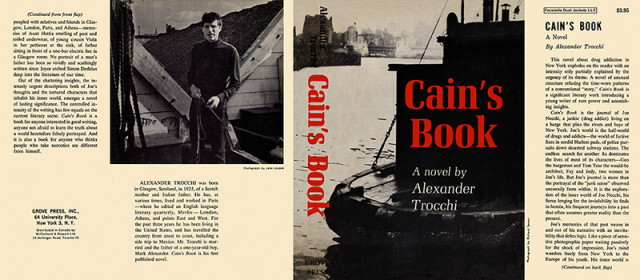
So begins Cain’s Book, Alexander Trocchi‘s
incredible novel of existential dread. Young Adam, its predecessor, is
better known, but the latter is the “Scottish Beat’s” classic.
Asked to name the best existential literature, most of us would probably say Albert Camus, Jean-Paul Sartre or Franz Kafka. But Cain’s Book actually takes the reader one step further into the philosophical world of existential angst than any of them. It positively drowns us in a word of unremitting absurdity and meaninglessness.
A roman à clef, Cain’s Book details the life of one Joe Nechhi, a
Glaswegian heroin addict living and working on a scow in New York’s
Hudson harbor. It is a book almost entirely devoid of plot: Nechhi
occasionally details trips into the city to score heroin, recollects his
childhood in Glasgow, or talks of his attempts to write a book. What is
incredible about the book is its unrelenting bleakness, and the sheer
poetic quality of Trocchi’s writing.
Heroin for Trocchi, as Remainder author Tom McCarthy noted in a lecture on Cain’s Book recently, “is a moveable void: taking that void around the city with him, in him, he ensures that he inhabits negative space constantly. This is his poetic project and it’s also the way his whole perception system works at its most basic level (the two are the same).”
In real life, Trocchi seemed very glad to cut himself off from his
peers, saying that his only concerns as a writer were “sodomy and
lesbianism”, that those were the only interesting subjects in the
previous 20 years of Scottish writing and that “I have written it all.”
Sadly, Cain’s Book was his last. As the 60s gave way to the 70s, Trocchi’s addiction to heroin took its toll and his talent lay pretty much squandered. The stories of his wild and tragic life are infamous and extensively documented in many of the leading “swinging 60s” biographies (Marianne Faithfull’s account of doing drugs with Trocchi is one of the best). Despite his addictions, and his sad death at the age of 59, Trocchi left us some of the bleakest, most beautiful writing to come out of the 60s.
In Cain’s Book the writing is all – the words ebb and flow like the
inky blackness of the Hudson River. Trocchi’s descriptive powers are
mesmerising: one barely even notices the lack of narrative drive until
after the book has been put down.
His other books includes some interesting pseudonymous pornography for the Olympia Press. (Titles like Helen and Desire, Sappho of Lesbos and White Thighs deliver their smut with a Sadean political edge.) Young Adam, of course, was turned into a successful film starring Ewan McGregor, and helped to raise the author’s public perception a little. But it’s Cain’s book that best fulfils Trocchi’s hopes for “the invisible insurrection of a thousand minds”.









 Kenny Wilson's Blog