Okay, I’m on a train again this time on the way to Madrid. This is the first of my proper trips using the interail pass and it went quite smoothly. The only problem I had was getting out of my hotel. There was no-one in the reception at 8.30 and the whole place was like Fort Knox. It was as hard to get out of as it was to get in what with three different gates to open with three different keys. I was going to leave the money with a note but then realised I couldn’t get out without the key so I couldn’t do that. Nightmare! Eventually, I banged on a door next to the reception and a bleary eyed man staggered out who couldn’t speak a word of English. He tried to overcharge me but eventually I paid the right amount. I tried to explain about the door situation which you couldn’t open without the key but I’m not sure he understood me. He seemed to think I could just push the door open. So going down four floors I tried to follow his instructions and of course it didn’t work just like I thought it wouldn’t. Fortunately, someone with a key came by and let me out so I didn’t have to go back up the four flights of stairs. When it comes to hotels you probably get what you pay for, and I didn’t pay very much!
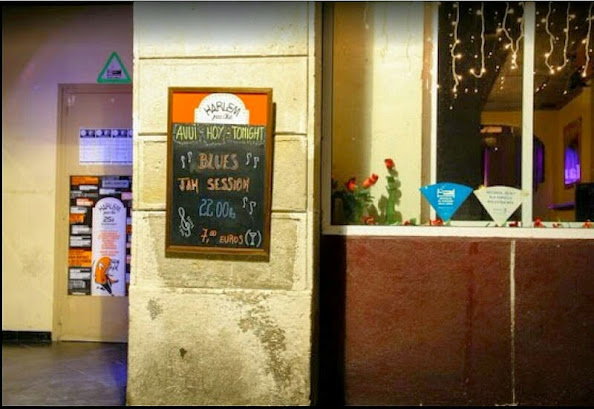
Blues Jam Night at the Harlem Jazz Club, Barcelona. Fantastic night every Tuesday!
Barcelona is great. I stayed two nights instead of one. Last night I went to a really good live music venue called the Harlem Jazz Club. It was blues jam night. The band were brilliant and I bought one of their CDs. I also did two numbers with them on piano and voice. I must have done okay because if they don’t like you you only get to do one number. It wasn’t really like a jam that I usually go to but the place was full and it was a really good night of music. The standard of the musicians was awesome.
Chino and the Big Beat. Brilliant band!!
During the day I got a travel pass and went round looking at the sights. The old city and Gothic Quarter are lovely but there is a lot of Barcelona that is quite boring and unremarkable. I love the Ramblas though and I went to possibly the best market ever. It’s amazing because in the past I must have visited this area more than five times but it was like I was seeing it for the first time. I never even knew there was a big market there. I suppose it’s the difference between travelling with others and travelling alone. Going solo can be lonely at times but at least you get to do and see what you want. It’s possible to be more spontaneous .They had fruit from everywhere in the world and it was lovely and fresh. I definitely had more than my five a day yesterday.
Fantastic market off the Ramblas, Barcelona
I’ve just stopped at Zaragoza. Will be in Madrid in about an hour.
Well,I’m feeling a pretty strange. I’m writing this on a train heading for Montpellier where I have a bit of a wait before I get a train to Barcelona. A month ago it seemed like a good idea and I’m sure it will eventually be one (idea that is). It’s good to do something different! I flew from Gatwick to Nice yesterday and everything seemed fine. Monarch Airlines were a bit odd and their baggage policy is even worse than Ryanair but they eventually let me on to the plane after queuing for about an hour.
When I got to Nice Airport everything was good and there was even a bus waiting to take me to the centre of town. I thought it would take me all the way to the railway station where I had booked a hotel, the Elvira, but it stopped way before then. Panic!! It was also pouring with rain and cold. This wasn’t supposed to happen! This is supposed to be the sunny Riviera!! I asked the driver in atrocious French how to get to the station and I managed to understand that I needed to get the tram. Somehow I stumbled upon the tramlines and walked along until I found a stop. Fortunately, my bus ticket was okay for the tram and I eventually arrived at the station at about nine o’clock. Another half an hour of getting wet and lost I was standing outside the hotel with the door locked and no-one at the reception. At this point a certain feeling of misery and panic crept in. Eventually, I was let in and finally got into my room with the sound of rain dripping on my tiny balcony through an open window. A dim, single light dangled from the centre of the ceiling. I slept badly and was afraid I would miss my train the following day. I set two alarms but didn’t need either of them.
Hotel Elvira, Nice where I spent my first night!
After a strange night of weird dreams and feelings of disorientation I had a nice couple of hours looking round Nice and am now on the train writing this, still feeling strange but adjusting to the little adventure I have set upon. The weather’s better now as well. Another eight hours and I will be in Barcelona. Can’t wait!!
I have recently got into making videos of the photos of some of my trips accompanied by music that has been important to me over the years. This includes tracks by the likes of the Velvet Underground, Country Joe and the Fish and Bix Beiderbecke. Quite a variety really. It is amazing how the music changes the way I look at the photos, and they seem to take on a different meaning. It’s quite an eye opener really.
The first one is of Essex and Suffolk when I went on a tour playing with my old friends, folk group Bodger’s Mate. It is accompanied by “I’m Coming Virginia”, one of my favourite tracks by Bix Beiderbecke from 1927. I’m amazed how well the music stands up. It could almost be contemporary. The guitar playing by Eddie Lang is incredibly subtle, considering it is the main rhythm part.
The next one is of the Old Town of Marbella with “Grace” by Country Joe and the Fish. “Electric Music for the Mind and Body” was one of my favourite albums when I was young, along with the even better “I Feel Like I’m Fixin’ to Die”. I first went to Marbella in 1971 and didn’t go back there until last year. It was virtually unrecognisable until I found the Old Town, which was actually the only bit that existed when I went there before, and it was just the same and the memories came flooding back.
The last one is of my photos of New York when I visited there in 2012. This was the first time I had ever been to America and I had a brilliant time. I went to all the places I had heard of when I first started playing the guitar and it felt like I had gone home. I think New York is the only place I have been where people seem to know what I’m talking about. Fantastic! Greenwich Village may have changed but it resonated with meaning for me. This is accompanied by “Sister Ray” by the Velvet Underground who were one of my favourite bands in 1968. It’s worth watching this just to hear “Sister Ray” all the way through although it is very long.
The WordPress.com stats helper monkeys prepared a 2014 annual report for this blog.
Here’s an excerpt:
The concert hall at the Sydney Opera House holds 2,700 people. This blog was viewed about 8,400 times in 2014. If it were a concert at Sydney Opera House, it would take about 3 sold-out performances for that many people to see it.
This is copied from an article about Mods in Leicester in the mid 1960s printed in the Leicester Mercury in2010. It is the only thing that comes up if you Google some of the Coffee Bars and Clubs in Leicester around at that time. The internet Information Revolution seems to start in the 1990s and knowledge about earlier times appears to be getting lost, or just isn’t there!! The article actually presents a pretty accurate picture of some of the things that happened then and the places that people went to. It complements my post about My Life in Music. The Irish was one of the main fashion shops but it was actually in Silver Arcade which was off Silver Street. It subsequently moved to the corner of Silver Street and High Street and is still there now, I believe, but it’s not the fashionable place it once was. The article also talks about the Antelope pub. I must have missed this totally because, although I remember the pub, I never went into it. I thought it was an “old man’s pub”. The main pubs we went to were the Fish and Quart on Churchgate and the Churchill on Silver Street which is now The Lamplighters. The Churchill became the trendy place to be from 1968 onwards.
Marlon Brando in “The Wild One”
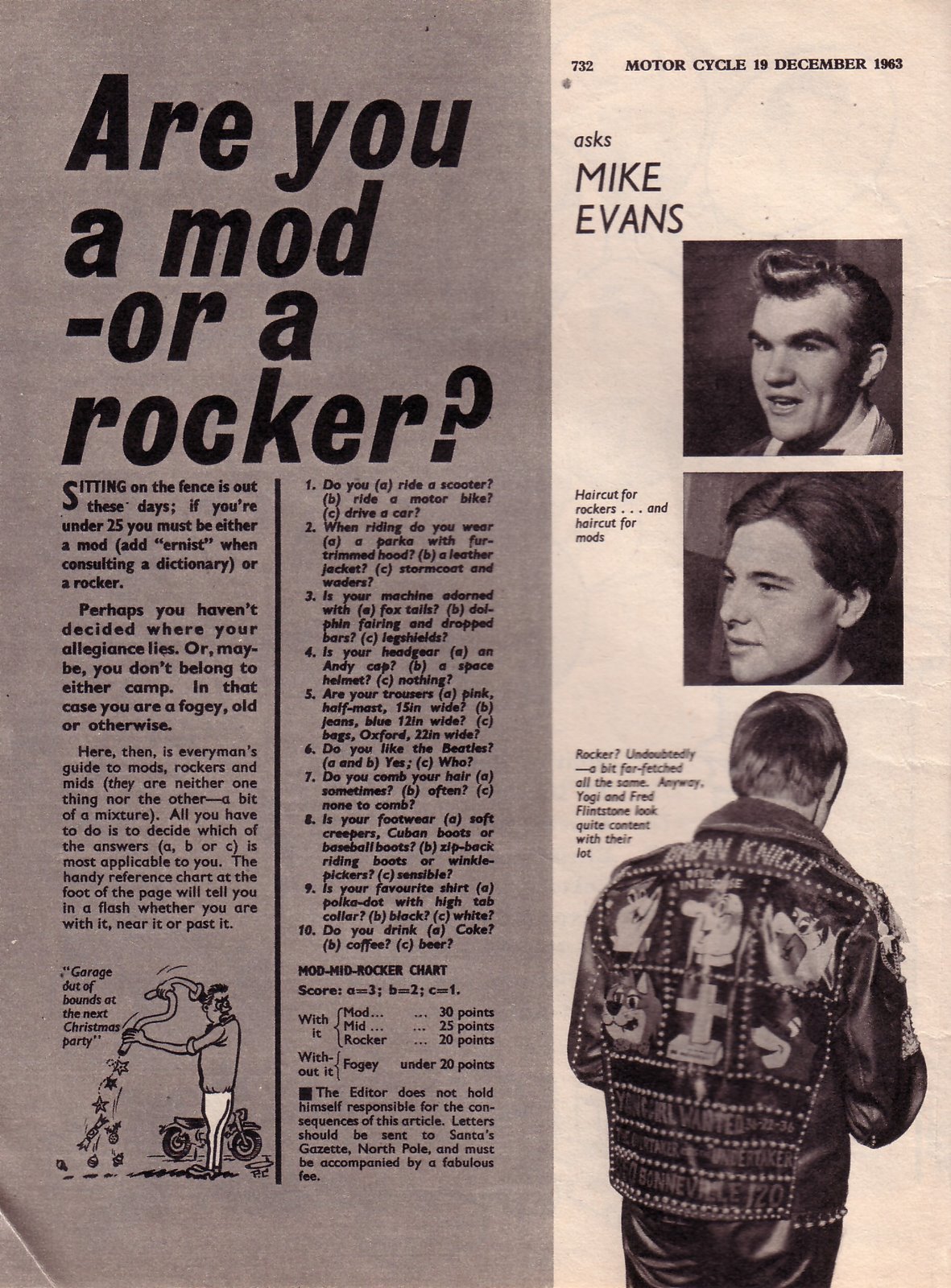
The interesting thing about the rivalry of the Mods and the Rockers was that it was invented by the media. If you look at the headlines they scream out about the Wild Ones! Actually, this is a reference to the Marlon Brando film “The Wild One” which was banned in Britain and not many people had seen it. Brando was the role model for the Rockers though, with his leather gear, macho swagger and surly attitude, to say nothing of the slurred drawl. “Hey, Johnny whadaya rebelling against?”“Whadaya got?” Elvis Presley copied him too in his earliest and greatest incarnation, circa 1956. Originally, however, there was no conflict. In fact, Mods became Rockers and vice versa. It all changed in the reporting of events at Brighton in 1964 and the rest is history! I do remember an occasion at Avenue Road Youth Club which was a Rocker stronghold. I’d been told to give a message by a group of Mods to Dave Buswell, leader of the local Rockers and as mean a looking guy as you could wish to meet. He was terrifying! The Mods were on Victoria Park ready for a battle. At that point all hell broke loose as they rushed out for the affray. Personally, I decided to go home and have a night in, watching telly! It was one battle I had no desire to fight and I didn’t even really know if I was a Mod or Rocker supporter then! I kind of liked them both!
I did eventually side with the Mods because, actually, the music was a lot better and the coffee bars and clubs were much more exciting! And although the girls weren’t any better looking, they were far less ferocious!
Sensational coverage of what was essentially a non-event of bored teenagers with nowhere to go! This is what created the Mods and Rockers clash!!
Juke Boxes were a massively important way of listening to new music.
“Turn left at the Clock Tower, head towards High Street, pass Cheapside, veer off by the amusement arcade and you’re there – right in the heart of Leicester’s pill-popping, sharp-dressing, scooter-revving, hedonistic counterculture”, writes Mark Charlton.
Or at least you would be if this was still the swinging 60s. If London had Carnaby Street at the heart of its Mod scene, Leicester had Silver Street. With their tailor-made suits, parkas and scooters, the Mods had a huge impact on the streets of mid-60s Leicester. They’d ride into town on their Vespas and Lambrettas to hit the coffee bars and hear the latest jukebox sounds from bands such as The Who, The Kinks and The Small Faces.
Rows and rows of scooters would be parked up in city centre streets, particularly outside bars such as Cadena, in Belvoir Street, and Kenco Coffee House, in Granby Street. But Silver Street was the real magnet for the Mods. That’s where Irish Clothing store was. That’s where Il Rondo was. That’s where you went to be seen. That’s where their real-life version of Quadrophenia played out.
John Barratt, 60, who grew up in Humberstone, was one of Leicester’s original Mods.
“Silver Street was our Carnaby Street,” he remembers. “I don’t know why but it was just a big happening for us there. I guess it had a lot to do with Irish Clothing and the Il Rondo, and there was also a pub called the Antelope. I think it just drew us to the area as there were places we could meet.”
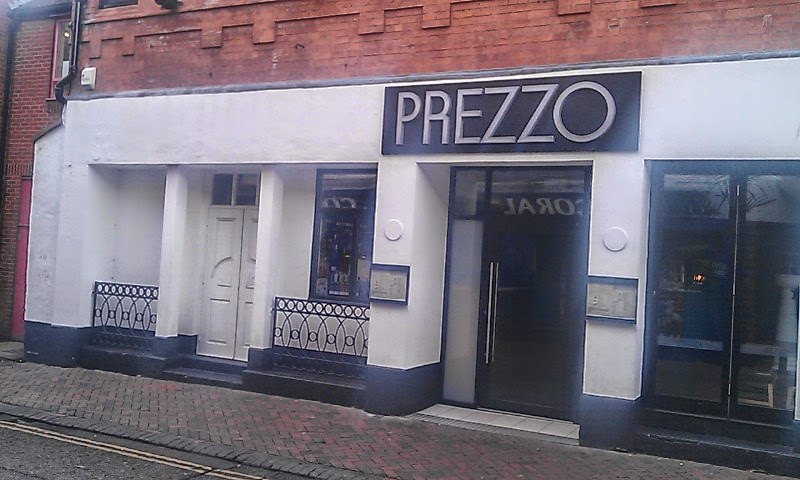
The site of the Il Rondo on Silver Street. Now a restaurant. The original entrance was where the white doors are now.
Leicester was buzzing with these hip, rebellious kids who wanted to make their mark on the world by dressing smartly and listening to the hottest new sounds. It was their way of getting noticed and making a point to their elders. John says: “In the 50s and early 60s, young people were almost penned in, everything was dictated to them. When Mod came along, it was our way of saying ‘we are human beings’. We were trying to put over our feelings that we weren’t going to put up with being told what to do.”
The Mod scene, with its slick fashion and fascination with black American soul music, had spread north from London, fed by newspapers reporting on violent clashes between Mods and Rockers in Brighton and Margate in 1964, and by broadcasts on Radio Caroline. Young people in Leicester were quick to pick up on the idea.
John says: “The first Mods were in Leicester by 1964. It was sweeping the country at that time. I was still at school and started getting into the music and the fashions. I knew I wanted to be a Mod. When I turned 16 I bought my scooter. At that time, I had a good job in engineering. I needed it. Being a Mod was expensive. You had to keep up with all the latest fashions, for a start. Then you had to run your scooter, keeping it taxed and on the road before buying all the accessories to make it look as good as possible. Then there was the music. You had to keep up with all the new music coming out, plus the wild life that went with it and on top of all that you had to try to keep a girl on your arm. I earned good money in engineering, but I didn’t save a penny.”
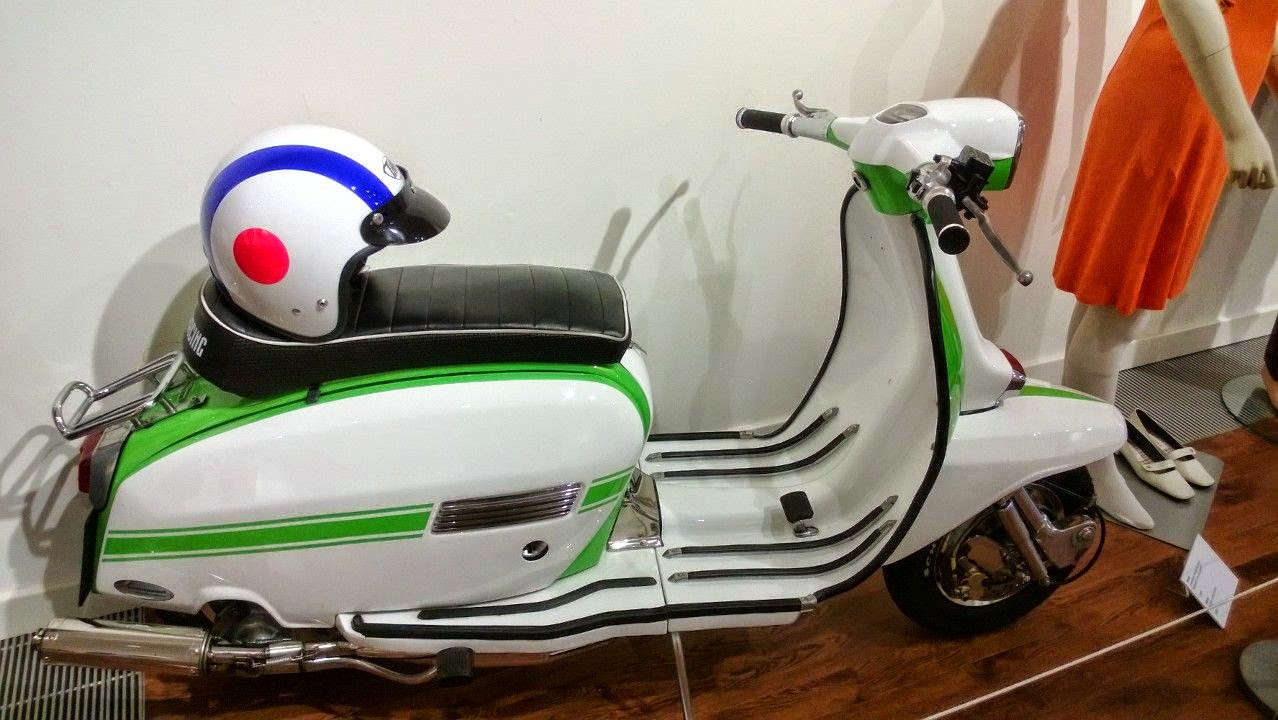
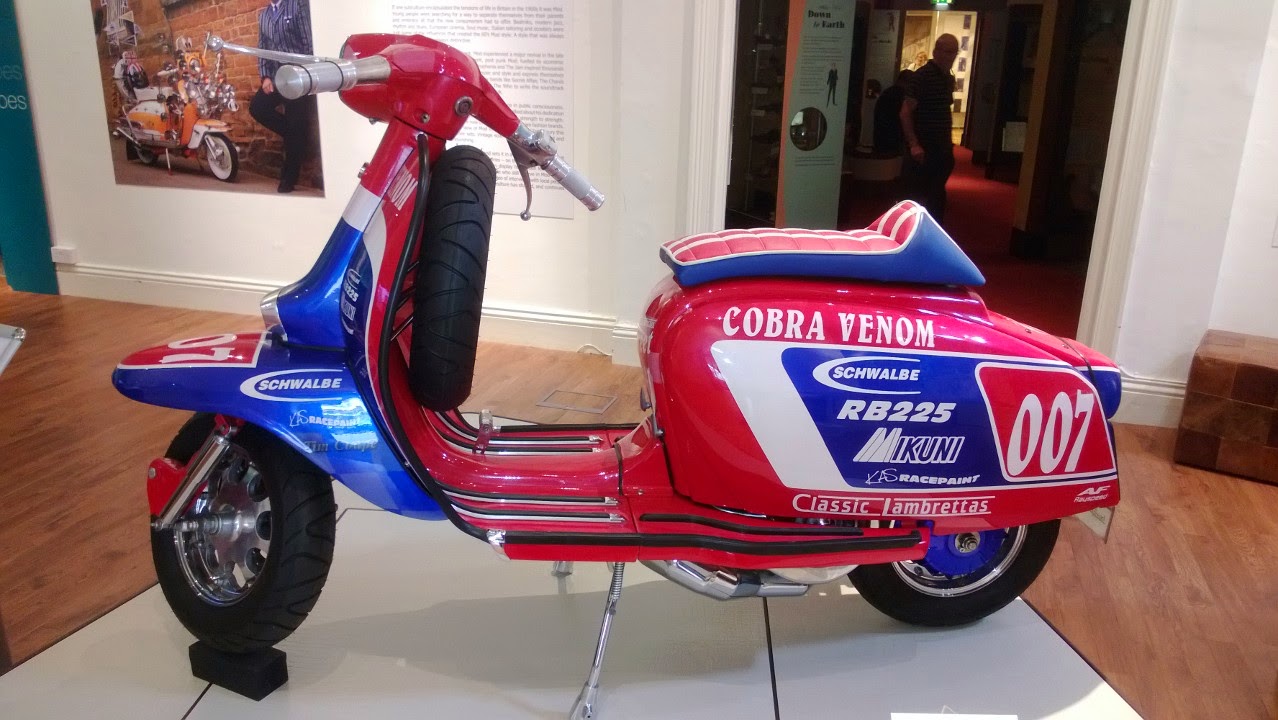
A Mod Lambretta scooter not yet customised! This is a picture I took recently at a Mod exhibition in Northampton.
Another young Mod was Chris Busby, from the West End of Leicester. He recalls choosing to be a Mod when he was still at school.
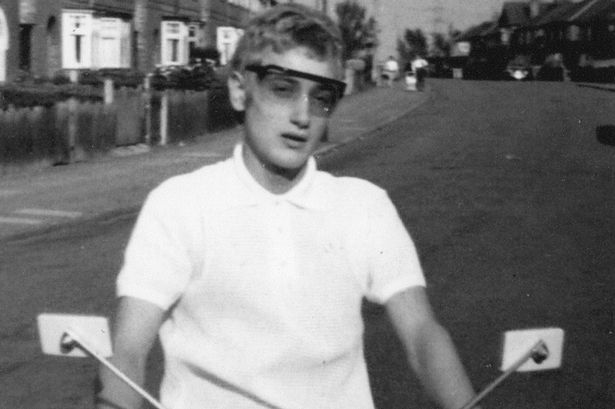
Chris Busby in the 1960s
“I was 14 in 1964 and we thought ‘should we be Mods or rockers?’. I looked at the rockers, they were greasers and horrible. I looked at the Mods, they were so clean looking and smart with their scooters. I wanted to be like that.”
Chris remembers Leicester was a great place to be at that time.
“There was so much going on,” he says. “The music was fantastic, there were some great places to go and lots of house parties.”
Chris was part of a Leicester Mod band called CERT X. Other notable Mod acts from the city’s scene were The Cissy and Legay.
John saw them perform at several gigs in the 60s. He says: “CERT X was a really good local band, really good. The highlight of the band’s career was supporting Cream at Nottingham University.
The music scene was vibrant at that time. Chris remembers: “A place called the Night Owl opened, in Newarke Street, in 1966, which put on all-nighters. I think (soul singer) Geno Washington recorded an album there. Bands like Amen Corner also appeared there. There were a lot of people taking drugs like blues and dexys, and I think that is why it got shut down quite quickly. The Green Bowler, in Churchgate, was popular too.”
Leicester in the mid 60s was already something of a cultural melting pot. Lots of young black kids were mixing with white lads at nightclubs and gigs.
Chris says: “It was a good time. We were friends with a lot of the black lads, there was never any trouble between us – we all respected one another. The only time we ever had aggro was with the rockers.”
The Mods’ cats-v-dogs relationship with the rockers is well documented. Seaside skirmishes at Brighton and Margate and made national news but there was plenty of trouble in Leicester, too.
John says: “The rockers used to hang out down at the Roman Cafe, in Humberstone Road. It was part of the life of a Mod to have problems with the rockers, or Hell’s Angels. They were so different from us. We would roll up at the Roman Cafe on our scooters just so we could have a scrap. They would come looking for us, too.”
Rockers! Mind you, these look a bit too old to be genuine Rockers.
Chris remembers one incident: “We were at the Casino Ballroom at the top of London Road. A popular boxer, Alex Barrow, was there, a black guy, with two of his friends. Two rockers walked in, and one of the lads with Alex said ‘you hit my mate’ and knocked one of them flying. Within 30 minutes, hundreds of rockers were flying down London Road on their motorbikes heading for the club.”
There was an unwritten hierarchy within the Mods. If you were particularly cool, you were a ‘face’. If you could not keep up with the pace of the scene, you were seen as a ‘ticket’.
Chris says: “The older lads, who were about two or three years older, were working and could afford better clothing. We looked up to them, they were the faces to us. There wasn’t a rank as such, but we were subconsciously aware the differences were there. We knew the older ones to nod at, there was never any problem between us.”
John says: “There was a lad called Tony Weston. He was king of the Mods to us. He was the organiser, our leader, always coming up with ideas and things todo. We all looked up to him because of the way he dressed and his scooter.” John had a Vespa 125cc GL scooter. “Registration 461 BBC,” he says.
“I’ll never forget it. It had all the gear – spotlamps, a big aerial at the back, a slimline windscreen and so many mirrors it was a wonder it moved, it was so weighed down. I had so many spotlamps that if I turned on the lights without the engine running it would flatten the battery.” But keeping your scooter up to scratch was a big part of it. It cost a bloody fortune. The main place for buying scooters at that time was a place called Readers,in Aylestone. We all went there. Scooters were appealing at the time because you could do hundreds of miles on a tank of petrol. A group of us went to Yarmouth. It took us the best part of six hours to get there. It was a steady run and we only used a tank-and-a-half of petrol there and back.”
Chris had a Lambretta li 150 with green and white stripped side panels and fur on the seats. “It cost me £30 in 1966 and wasn’t anything special compared to some of the scooters around but it was special to me,” he says. “It would be worth about £2,000 if I still had it.”
Another Lambretta. Poster of a Vespa in the background!
Chris also did his fair share of going to Mod events at coastal resorts, even taking a job in Skegness. But there was plenty going on in Leicester. Wednesday at Il Rondo, in Silver Street, was Mod night, on Sunday, Mod music was played at The Palais de Danse, in Humberstone Gate, and the Casino Ballroom, in London Road, held regular live events. Music was the lifeblood of the scene. All-night dances, or parties were often fuelled by the use of amphetamine-based drugs. Some were known as blues, or purple hearts.
John says: “People were taking them because, if you didn’t there was no way you would last the amount of time you were awake for.”
“The main thing was the music,” says Chris. “It was so new and fresh.”
John says: “There were certain songs that were important to us, for example the Sir Douglas Quintet’s She’s About a Mover and Louie Louie, by the Kingsmen.”
The fashion and hair styles still have a huge influence today. Chris has been a barber for 36 years and now has a shop, in Northampton Street. But when he needed a Mod cut back in the 60s, there was only one place to go.
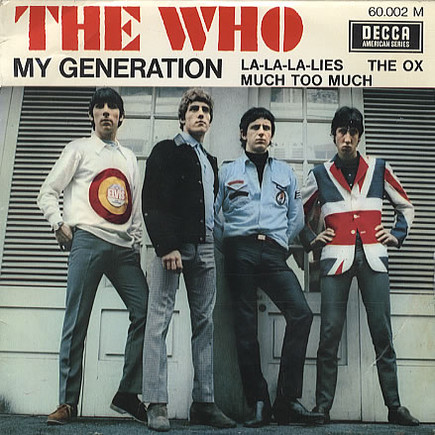
The Who in the mid 60s. My Generation, one of the best records of all time!!
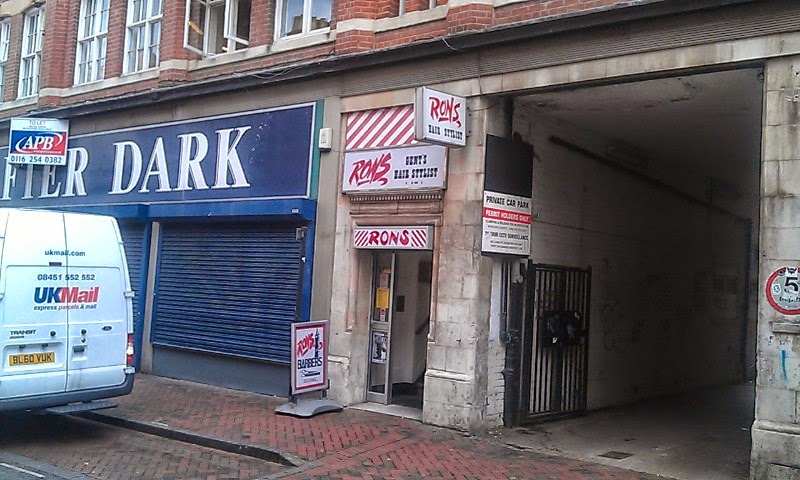
“Everybody went to Ron’s, in Church Gate. It is still there. At the time, there was a look that was something close to how Paul Weller wears his hair now. Another was how Roger Daltry (singer in The Who) wore his, with a parting, although some people just wanted a close-cut, clean look. Mods felt the way they looked set them apart from the rest. Attention to detail was vital. Clothes would be made-to-measure and tight fitting. Shirts and suits would be sent to the tailor for more buttons to be added or taken away, depending on the mood. We’d have bigger vents put in or more buttons put on our shirts, just to make them different. We were always trying to stay one step ahead,” says Chris.
Ron’s Hair Stylists on Churchgate, still going today!!
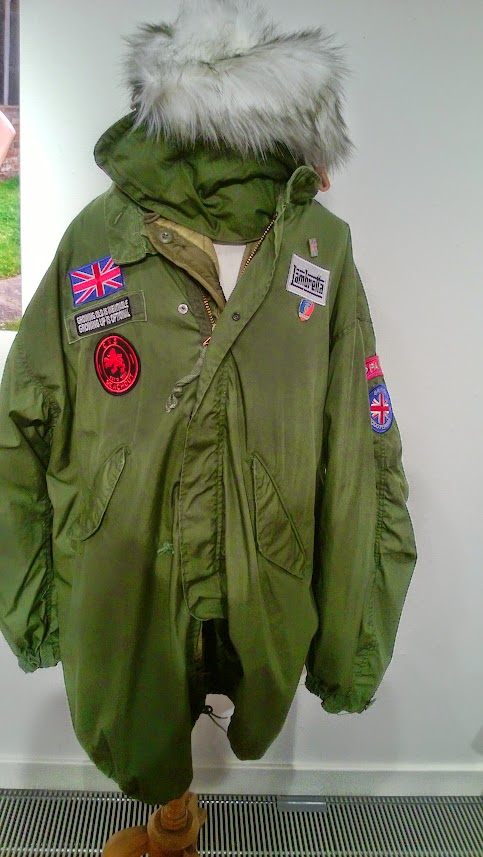
Having such smart clothes proved a problem motoring around town on a scooter. A US Army fishtail parka was ideal for keeping clean on the move.
John says: “I had a parka and a mohair suit – well, several. We were always buying clothes, trying to have something new and to stay ahead of everyone else.”
Mod parka. A photo I took at the same exhibition in Northampton.
Chris says: “I never really got into the suit thing. Lots of people did though. On a Saturday, there was Jackson’s the Tailors, in Gallowtree Gate, and Burton’s, in Church Gate, which would have queues outside all day from the moment they opened, with people collecting clothes they had ordered, or being measured up for something. Jackson’s was seen as a cut above the others because the staff would offer advice to the customers. Personally, I preferred wearing Levi Jeans, desert boots and a Ben Sherman shirt rather than a suit. I wanted to feel comfortable. Also jumpers with targets on, or shirts similar to those Roger Daltry was wearing at the time. I bought an overcoat from Irish for £22. That was four weeks wages to me. I have still got it.”
By 1967, the Mod scene was changing. Some were moving away from the slick looks and sounds and moving into psychedelic music.
“They were what we called the ‘flower children’, says John. “They were getting in to what became the hippy thing. I guess bands like The Who and Small Faces had become more psychedelic, particularly the Small Faces with their album Ogden’s Nut Gone Flake. I moved on to other things but I have never stopped feeling that I am a Mod. Even now, I’m still a Mod. I love the Mods.”
Some stuck to their cause of being a Mod and others became interested in the skinhead scene, which was emerging in the late 60s.
Chris, a married dad of three, remembers: “I was working in Skegness in 1969 and I could still see running battles between Mods and rockers. I went on to become interested in other things, but years later I was thinking about the look and how much I enjoyed wearing the clothes, so I went back to it.
“So now I wear a Ben Sherman, Levi jeans and desert boots. I love it, and the music, of course.”
In 1979, The Who brought out the movie Quadrophenia. It told the story of the Mods, their clashes with rockers, the girls, the drugs, the parties. The film was to coincide with and widen the impact of a Mod revival, which had started in London a few months earlier.
Chris said it was very true to life.
“It’s pretty close,” he says. “Particularly a scene in Brighton as Jimmy (Phil Daniels) walks along the seafront with all the other Mods. Somebody asks him what the best thing about being a Mod is. He says something like ‘being here, amongst all this’. And it was spot on. That buzz, the buzz of being part of it at that time, that is exactly how being a Mod felt.”(Mark Charlton Leicester Mercury 2010)
The press invented the clash between Mods and Rockers and then everyone believed it! It was propaganda on the scale of Goebbels!
Here are some videos of Steve Cartwright and my involvement with the N.U.T. strike in Leicester. The p.a. system stopped working but we managed to get by!
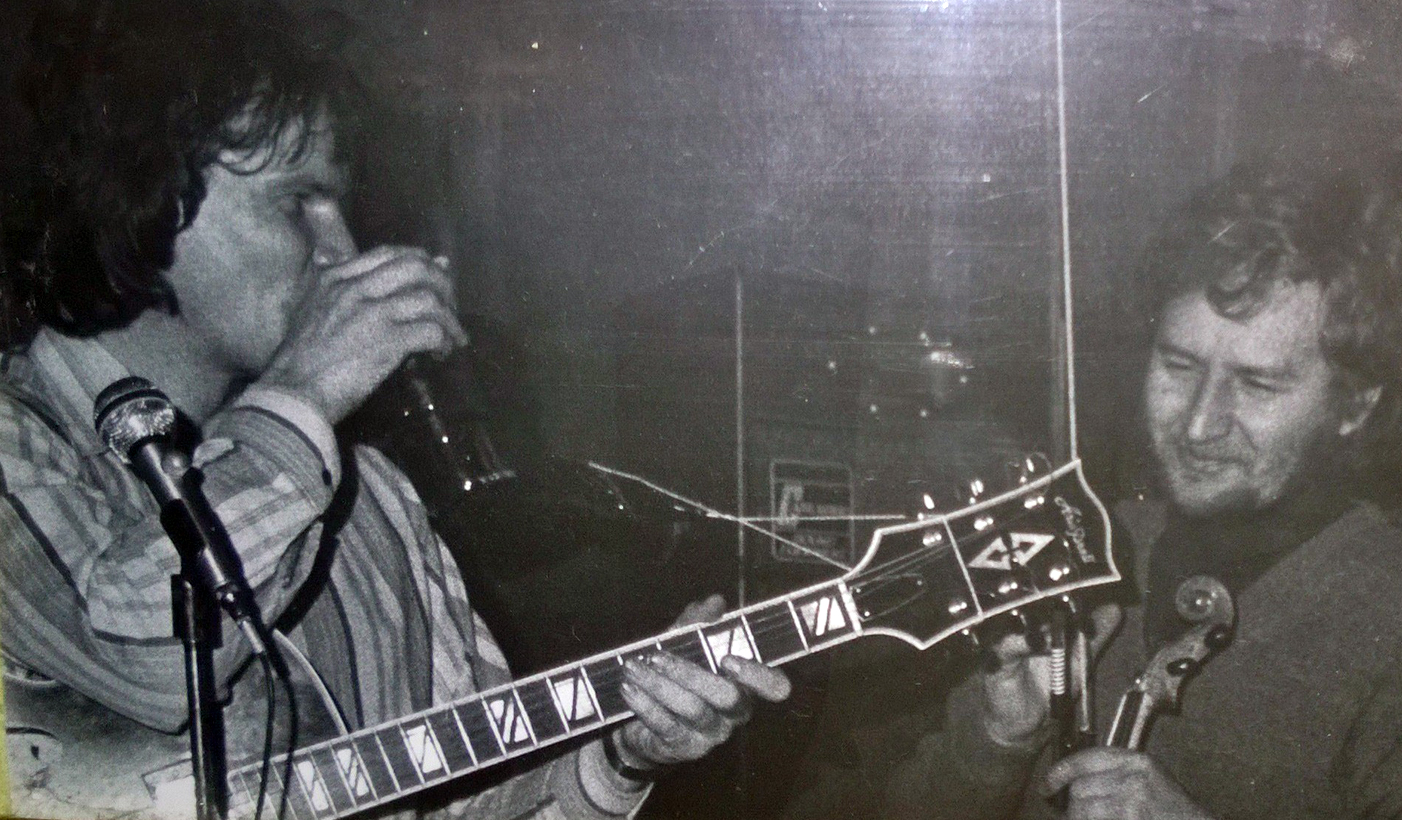
Rick Grech with Geoff Overon in the late 1970s. “to ruminate and reminis (sic) is allright (sic) once in a while. file this under Rock to Geoff. Rick Grech”. Actually, this is perhaps the first time I’ve seen him play bass in this period. He mostly played guitar and violin. The cryptic comment is probably referring to the fact that although he is playing bass he feels he has moved on from that. He no longer wants to be seen as a “bass player”.
I realized as I started this memoir that I don’t really know how to either spell or pronounce Rick’s name. Until recently I thought it was Ric and that Grech was pronounced with a hard “K” sound. I’m not sure now. On most of his recordings, and his own signature on a photograph I have, it is spelled Rick and many people I have spoken to who knew him assure me that Grech should be pronounced with a “CH” sound. I also thought he was of Polish origin but many biographies online say he was Ukrainian. Not a great start really as I am now totally confused and can hardly put myself forward as an expert! Mind you, it fits the person I knew for many years who was both interesting and sociable but was also a bit of an enigma who rarely gave a straight answer to any personal question.
What I do know is that I met him late 1975 and subsequently did gigs, wrote songs and recorded demos with him until the early eighties when we went our separate ways. When you look at biographies of Rick they all tend to agree that his career ended in 1977. Bizarrely, many say he became a carpet salesman. I don’t know where that came from but it was the sort of thing he would say as a joke. He had a cynical and sometimes surreal sense of humour. He actually saw himself as a musician and played in various combinations until his untimely death in 1990. The period I knew and worked with him was between 1975 and 1982 and we did many gigs together mainly around the Midlands area in the U.K.
In 1975 I was living on the St. Matthews Estate which was an area of social housing near the centre of Leicester. It was a time of economic upheaval with hyper-inflation and widespread industrial unrest. The then prime minister, Ted Heath, announced a three day week at the height of a miner’s strike that eventually brought down the government and returned Harold Wilson and a Labour government to power. On top of that there were many terrorist acts being committed by the IRA and other extremist groups with particularly horrendous bombings in Birmingham and Guildford. It was a time of great unrest and social change. The hope of the 60s had dissolved into the pessimism and paranoia of the 70s.
However, personally untouched by the economic downturn (living “on the dole” was alright as long as you didn’t have expensive habits), I continued to pursue and develop my career as a singer/songwriter. There weren’t many gigs in the centre of Leicester at that time so I and some of my musical friends started a club in the top room of a pub called the Town Arms on Pocklington’s Walk. We met every week and played songs and generally had a good time. Everyone at that time was making a big effort and many of the songs were excellent. Regulars at the time included Geoff Overon, Mick Pini, Dave Plimmer, Gwyn Jones, Annie Williamson and many others, some of whom I’ve forgotten the names of. None of us were making much money at the time but that didn’t really matter. We were more interested in writing and performing good songs.
The Town Arms, Leicester where our club used to meet every week in the upstairs room.
One night, out of the blue, Rick Grech turned up with his violin. He commenced to play along with people and then borrowed a guitar and sang some of his own songs. He obviously enjoyed himself and started to come every week. At the time he had just finished working with Gram Parsons and had even made two records with the original Crickets! One week he brought a cardboard box full of records to the club. It was by a “super-group” called KGB featuring Rick on bass. He proceeded to give everyone a free copy of this! This is when I first encountered Rick’s evasiveness. I said shouldn’t he be in America promoting this record but he told me nothing and didn’t want to discuss it! It was at this time that rumours started circulating that he had been expelled from America and could not return. I don’t know any facts about this but I know he never returned when I knew him in the 70s.
At the beginning Rick was a bit of an anachronism with his Rock Star status and red Ferrari which he crashed and abandoned shortly after I met him. But he was a nice guy who was soon part of the scene and we started working with him in various ways. At the time my maisonette (like a third story house on top of another house!) was a centre for continual jam sessions. I had a reel to reel tape recorder set up (a bit like the Basement Tapes) and recorded many sessions that involved Rick and lots of others. Unfortunately, the tapes I used were the cheapest available and oxidized over time and are virtually unplayable now. Rick was buzzing with ideas and writing some great songs and playing some fine fiddle. He was still involved in recording as a session musician with people like Rod Stewart and was still managed by impresario Robert Stigwood who released a compilation album of him in 1973. He had also promoted the talents of guitarist Albert Lee and had involved him in records with the Crickets and “Doctor to the Stars” turned country singer, Hank Wangford. It seems like Rick was everywhere, doing everything, he couldn’t fail, but cracks were beginning to show. Hank Wangford says this of his time with Gram Parsons and Rick:
“I spent four months in Canada, and came back and resolved to make a country album with Rick Grech for Robert Stigwood, I called Rick up one day and said, ‘You know who should co-produce this? Gram Parsons.’ He said, ‘I know Gram well’, and called him up. And Gram came over. “This was 1972. I did a demo with Rick on bass, Mike Kellie from Spooky Tooth on drums, Mike Storey on piano, and Pete Townshend on lead guitar. Glyn Johns was the engineer. I could have been forgiven for thinking I’d made it. But the whole thing fell apart. Gram came over, we spent a couple of days at Rick’s house going over the songs, but it fell apart because of heroin. Rick and Gram just got really stoned, and I didn’t take heroin. I hated it. Rick was so wrecked, he couldn’t get his recording machine to work. For hours and hours, he and Gram would get higher and higher, and nothing happened. Nothing was put on tape. Actually, that time, he brought with him George and Tammy’s new duets album We Go Together. And that was Gram’s role model for him and Emmylou.” (http://www.gramparsonsproject.com/hank/)
Hank Wangford with Syd Barrett and Roger Waters of Pink Floyd, Formentera 1967! If Daniel O’Donnell is the brightly scrubbed face of British country music then Hank Wangford is its guilty conscience, its dark and troubled grubby soul.This messianic derailment onto the path of country music came from befriending and playing with Gram Parsons, ex-Byrds and Flying Burrito Brothers, in the seventies. This was at a time when Hank – as Dr Sam Hutt – was a rock ‘n roll doctor. Many of his patients were from the world of rock music and the hippie alternative world. The Grateful Dead, the Who and the Rolling Stones were some of his clients.
There’s a horrible prescience to this because years later I was with Rick when he was incapable of working his tape machine because he was so wasted! He became a victim of serious drug and alcohol abuse that eventually sent him to an early grave!
In 1976 Rick decided to form a band to showcase his songs. It was based on the kind of music Gram Parsons had been producing on his two solo albums “GP” and “Grievous Angel” both of which contained songs written by Rick although he didn’t play on them. He did have a producer credit on “GP” though. He teamed up with a local Irish/Country band called the Lentones at the time but who changed their name to Rhinestone in 1976.
They did gigs at Irish clubs and were breaking into the Country & Western club scene that was becoming very popular at the time. They were a very good band who won a national Country Music competition and played at the Wembley Stadium at a big festival with Rick on fiddle. To get the “Gram” sound he invited singer Claire Hamill to join him. She was a fairly well-known singer/songwriter at the time from the North East (I’d seen her play when I was a student in Darlington) and had recorded four solo albums at that time. She was favourably compared to Joni Mitchell. Praise indeed!!
In 1976 we had moved operations from The Town Arms to a place called Watson’s Restaurant on Belvoir Street, Leicester. This was originally intended as a kind of club for well-to-do business types but it was short on customers. We turned it into a live music venue and it did very well for over a year until the owners went bankrupt. It was here that Rick and Claire refined their songs and harmonies and they sounded very good. It was time to go on the road. A band was formed and a tour was set up. Robert Stigwood was still the manager and was setting up recording etc.
The site of Watsons Restaurant as it looks now on Belvoir Street, Leicester. The live music was on the first floor.
What happened then can only be called a disaster. I went to one of the gigs at the Nottingham Boat House (a well known venue at the time) and Rick was not on his best form. Captain Video (an up and coming country rock band) did the support but the main problem was that most of the audience were not expecting Country music. They were there to hear Rick play bass and do a Rock set. He didn’t touch the bass and played no Rock, no Blind Faith, no Traffic, no Family. I believe this was the reaction that met most of the gigs on this tour! Although Gram Parsons had convinced us that Country was hip there were a lot of people who hadn’t got the message. A shame, because actually it was potentially very good. The harmonies and songs were excellent and the musicians were good if a little unrehearsed. They should have toured the Country Music Clubs who would have loved it! To make matters worse I believe Claire and Rick ran up enormous expenses at London’s Claridges Hotel and charged them to Robert Stigwood who then immediately dropped Rick from his management. Well, that was the story at the time and I’m sure that’s what Rick told me!
It was towards the end of 1976 that I started doing gigs with Rick. By this time his drug and drink addiction was spiralling out of control and he was getting short of money. A Gibson Dove that had belonged to Gram Parsons began to be pawned regularly and the royalties from his recordings had begun to dry up. For the next four years I did many gigs with Rick as a duo and also in a band. At one point we were doing over four gigs a week! One of the most memorable regular gigs we did was at the Crows Nest on King Richards Road, Leicester every Tuesday night.
Rick Grech and me at the old Crows Nest, King Richards Road, Leicester 1978
This was always well attended and Rick often produced some great work on the fiddle. It lasted for several years. We also did many club gigs as a band and recorded some demos in the early eighties that showed some promise. From 1982 I didn’t have a lot to do with Rick but I know he continued playing. He’d sit in on jam sessions and continued to write songs and record them on his TEAC four track tape recorder. The mid eighties were a difficult time for him but interest in his old recordings was increasing. Many of the recordings he had been a part of had become classics and were selling well in the new CD format. I heard that he went to New York at one point, thinking of forming a band but I don’t think anything came of it. His early death was a great loss and he continues to be missed. He was a warm, funny guy who could be difficult at times but had a big and generous heart.
Here are two demos I made with Rick in 1981. We had a band called Blue Mountain with Stu Wilson on bass and Chris Drayton on drums. Rick on violin and vocals, both my songs:
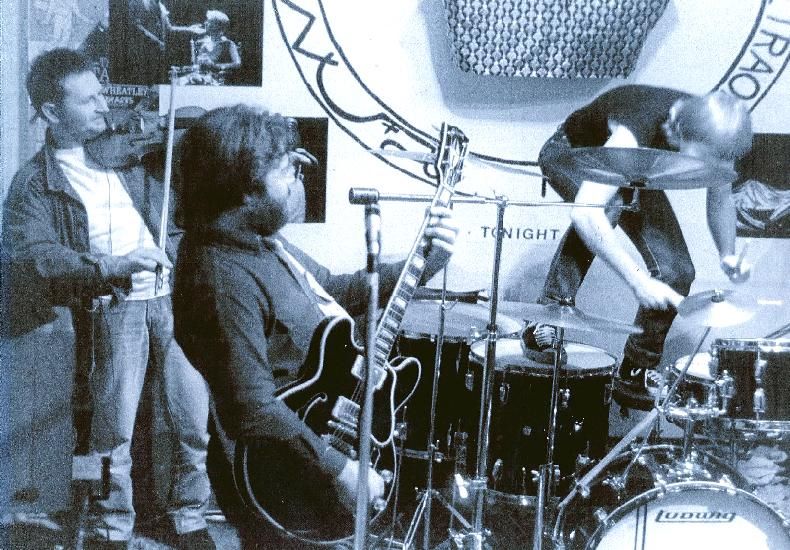
Rick Grech jamming with Geoff Overon and Graeme Malen at the Phoenix Theatre Leicester c.1985
Here is a great concert video of Rick Grech with Blind Faith in Hyde Park 1969. They sound really good!! Rick is on great form!!










 Kenny Wilson's Blog