Original illustration from the book of Cosette. Notice the huge broom held by the tiny girl. This image has been used extensively to promote the musical and the film.
It had to be done. I had two free tickets for Showcase Cinema De Luxe, Leicester last Sunday. Haven’t seen the Hobbit yet or Jack Reacher but I decided to opt for Les Mis. The reason for this isn’t because I’m a big fan of the musical. I’ve never seen it! I’ve been intending to see it for the past thirty years but never made it! I’m going to make a special effort now though. No, the reason is that it is my favourite book of all time. Written by Victor Hugo in the 19th Century it is a literary tour de force, one of the best books ever written.
It is incredibly long, over 1500 pages in English and covers a multitude of things. You find out about the Paris sewer system, the language (argot) of the Parisian underclass, discussion about Napoleon and the monarchy and many other things. The main story though is that of Jean Valjean and his progress from criminal and convict to prosperity as a business man and factory owner and eventually as a benefactor and saviour of Cosette, daughter of a woman who works in his factory, Fantine, who falls on hard times and dies. While all this is happening Jean Valjean is pursued by police inspector Javert who becomes convinced that the mayor is in fact the same man as Valjean who had broken his parole years before and needed to be arrested and put back in gaol. The reason for breaking his parole is missing from the film and is quite an important omission. After getting away with stealing the Bishop’s silver he steals a small amount from a young, poor boy. He becomes totally disgusted with himself and tries to find the boy to give it back but can’t find him. The boy reports it to the police and that is how he broke his parole. This is why Valjean feels that Javert is justified in pursuing him!
The story is quite melodramatic although brilliantly told and is similar to the kind of themes used by Thomas Hardy and Balzac. The characters are very well drawn and serve to bring out the moral ambiguities of the story. Javert is possibly the most interesting character. Although he appears to be remote and cruel and obsessive, his motives are born out of total honesty and respect for the law. Jean Valjean actually respects this about him even though his aim is to bring him down.
Later on the narrative becomes about the love story between Cosette and young middle class revolutionary Marius who is rescued by Valjean from the barricades of the 1832 rebellion against the restored monarchy. This is NOT the French Revolution as many people think but an event that might have been forgotten were it not for it’s inclusion in the book of Les Miserables. It was a storm in a tea cup. At the end of the story both Javert and Valjean, in very different ways, experience a kind of redemption and the world is left a better place. Apparently, Hugo based the two characters on the same person and this is a reason why they are so intrinsically linked. They are two sides of the same man.
In many ways the film is very good and it has really affected audiences emotionally. It is impossible to make a film of the book without seriously compromising the story in many ways but the basic meaning of it remains. I would say the second half is much better than the first although there are some strong episodes in the first like the opening galley scene and Fantine’s rendition of I Dreamed a Dream. I found this very powerful even though the song has become devalued and over familiarised by the Subo and X Factor effect (or was it the other one. Can’t remember!). Anne Hathaway’s performance as Fantine is astonishing! Despite winning Golden Globes recently I think Russel Crowe and Hugh Jackman are miscast. I think Crowe would have been better as Valjean and Jackman as Javert. An earlier French version had Gerard Depardieu as Valjean and John Malkovich as Javert. This is a superb version and worth seeing if you can get hold of it. Somehow I ended up with a DVD of it that had been given away free with the Daily Express and I have never knowingly bought the Daily Express so I don’t know where I got it from! It is a condensed version of a TV series and gets very close to the original story with some brilliant performances.
Seeing the recent film has renewed my interest in seeing the live theatre production. Film rarely captures the atmosphere and excitement of a live show but, with the live singing on set which is a first, this film is moving in the right direction. Although flawed I think this film is well worth seeing.
In the past few weeks I have been reading widely about the 1960s Counterculture both here and in America. This interest was inspired by two things. Writing an account of My Life in Music, which included my experience of the Counterculture in Leicester, and visiting an exhibition of sculptures by Francis Upritchard at Nottingham Contemporary and seeing James Riley’s talk about the perceived end of the Counterculture into “bad craziness” in the early 1970s.
My original piece was just based on memory with no reference to any other sources but I was struck by how close my experience was to the sequence of events described by James Riley. I was also intrigued by Francis Upritchard’s description of hippies in New Zealand when she says that “all the things that hippies hoped would happen, or felt might happen, didn’t.” In one sense her exhibition is about the failure of the 1960s and 70s counter-culture that is still celebrated at festivals – and its gaudy, individualistic “alternative” aftermath.
At this point it might be worthwhile to describe what I think the Counterculture is (or was). The Counterculture appeared in the 1960s both in the UK and America and became influential throughout the Western World and also in Eastern Europe. It’s protaganists were mainly young but there were significant influences from older artists and intellectuals. It’s not really clear why or how it came about but it epitomised what became known as the Generation Gap. This could be described as the difference between people who became adults before World War 2 and those who were adults after it.
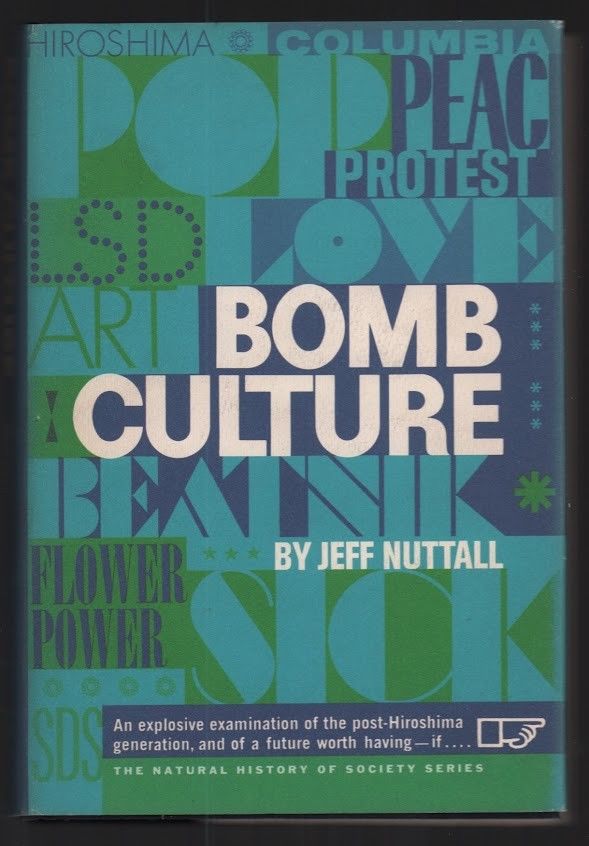
Jeff Nuttall in his seminal book Bomb Culture(1968) thinks that alternative attitudes in the UK grew out of the shadow and fear of the H Bomb. As the Cold War developed there was a constant reminder with the proliferation of nuclear weapons that the World could end any minute. This lead to massive demonstrations in the UK organised by CND (The Aldermaston Marches). Although these were attended by many thousands of people it became clear by the early sixties that the government had no intention of disarming or stopping the arms race. This lead to disillusionment and a feeling of alienation. Many young people began to reject the growing Affluent Societyand started creating their own culture much to the bewilderment of the older generation who, as Prime Minister Harold Macmillan said at the time, had “never had it so good”. A youth subculture emerged called The Beatniks by the press. They grew their hair, played trad jazz and folk music, frequented coffee bars and hitchhiked around the country, influenced by American beat writers like Jack Kerouac. In the UK this is where the Counterculture had it’s roots. Here is an unintentionally hilarious TV report about Beatniks in Cornwall in 1960:
Of note in this film is the playing and singing of Whiz Jones. You may think he is influenced by Bob Dylan but you’d be wrong. It was two years before Dylan’s first album was released, he hadn’t even arrived in New York by then. The guitar and singing style was undoubtedly learnt from American folk singer Ramblin’ Jack Elliot who was in England at the time and influenced a whole generation of British guitarists including Donovan (he was also a big influence on Bob Dylan!).
The roots of the American Counterculture are slightly different. Although there was the same fear of nuclear annihilation especially with the Cuban Missile Crisisof 1962 when the Soviet Union based nuclear missiles in Cuba within easy reach of the USA. Another factor was the Civil Rights Movement that was working to end racial segregation in the South and also the Vietnam War especially when conscription was accelerated from 1964. Out of this milieu a counterculture was created that eventually became what are known asHippies. This movement had a profound effect both in America and the rest of the World during the 1960s and it’s legacy has continued until now as I hope to demonstrate.
The UK and American countercultures influenced each other. Initially, the British counterculture imitated the Americans especially in the areas of poetry and the creation of Underground newspapers and magazines. As time progressed the British started influencing the Americans especially in the areas of art, fashion and music. The Beatles became the most popular and influential group in the World and embraced many countercultural ideas like drugs, mysticism and experimentalism. Paul McCartney was closely linked to the English Underground and was a main financier of the International Times, an important countercultural paper that had a wide distribution. Pink Floydemerged out of the British Underground with their take on psychedelic rock and, again, eventually became one of the most popular groups in the World.
The name Underground started to be increasingly used for the Counterculture although, really, this was a misnomer. The main players and self styled leaders were media savvy and natural experts in self promotion. (This was especially true of American Yippies Abbie Hoffman and Jerry Rubin. They achieved international fame at the Chicago Conspiracy Trial where the American justice system managed to appear both brutal and ridiculous. In a rare display of humour a member of the conventional left described their antics as Groucho Marxism!) It never really became underground until the 1970s when the mainstream media and press began to lose interest in it.
The Underground did not have a coherent political agenda. Although there was much talk of Revolution it was not clear what this really meant. This was true both in Britain and America. It definitely did not mean the same thing as what the old left referred to . The Communist states were seen as no better than the Capitalist ones and probably worse. Even Cuba, apart from the love for Che Guevara (who in the spirit of rock n roll died young and left a good looking corpse. He became the poster boy of the Revolution with his long hair and revolutionary beret!) was treated with suspicion. There was no strict ideology but general beliefs in the use of drugs (particularly marijuana and LSD), rejection of alcohol, free love, anti-war, anti-materialism, anti-consumerism, individualism, creativity, opposition to alienating work, rejection of television and advertising, caring for and living with the natural environment etc. The list could get very long and forms a general philosophy which is hard to formally categorise. The Revolution consisted of all these things. Slogans appeared that would have done justice to the best copywriters of Madison Avenue like “make love not war”, “turn on, tune in, drop out” and “do your own thing”.
So, why did the Revolution fail and where did it go wrong? Conventional wisdom would say that three events in 1969 caused a massive shift in attitudes. The infamous Charles Manson murders, The Woodstock Festival and the killing of a member of the audience by Hell’s Angels at Altamont Free Festival. The death of 60s idealism and the lost innocence of rock n roll is the theme of Don McLean’s song American Pie.
Charles Manson and his Family inverted the ideas of a hippy commune and went on a killing spree based on a psychotic interpretation of the Beatles White Album.
Woodstock is widely seen as the epitome and apotheosis of the Love Generation but can also be seen as the start of a megalithic, bloated and commercial music industry involving large scale festivals and stadium gigs. In order to attract popular acts large amounts of money were paid. Jimi Hendrix is reputed to have received $50,000, an incredible amount at the time equivalent to more than half a million now. Joan Baez virtually destroyed her credibility by accepting $10,000 even though she was using much of her own money to support radical causes. The festival made a colossal loss although that was recouped by subsequent sales of the film rights and DVD. A very interesting book about the making of this festival is Barefoot in Babylon by Robert Stephen Fitz. Rather than the music being an expression of the Counterculture a new commercial aristocracy was formed. The divorce between the music and the Counterculture was perhaps most symbolically shown when Pete Townshend of the Who knocked Abbie Hoffman off thestage with his guitar when Hoffman invaded the stage and tried to make an impromptu speech. It affected both people for years afterwards and effectively ended Hoffman’s political career. The clown prince of politics had been made to appear ridiculous and ineffective! Pete Townshend showed he wasn’t too enamoured with peace and love as this audio clip shows.
To deflect criticism of the cost of tickets on their 1969 tour of America the Rolling Stones gave a free concert at Altamont Speedway in California. This remarkably badly organised festival has become immortalised in the film Gimme Shelter (No, the Revolution wasn’t televised but it was often caught on film, which provided a good source of income from “Free” Festivals. The Stones had already done this with the Hyde Park Free Festival). The general air of chaos and violence is palpable with at least three deaths and a murder.
However, I don’t subscribe to conventional wisdom. Nor do I think that the Counterculture ended in 1969. As James Riley has said these events could just be coincidence and don’t signify anything. Personally, I think that after 1972 the Counterculture actually did go Underground. It was no longer really visible and it also became separated from the Music Industry which had become a large and profitable globalised industry. The press and media also lost interest until it gained notoriety again in the 1980s as the Peace Convoyand the New Age Travellers. This culminated in the savagery and brutality of mainstream culture under Thatcherism at the Battle of the Beanfield. This is an Observer article about this event twenty years later:
“* Tony Thompson, crime correspondent * The Observer, Sunday 12 June 2005
It looked just like a carnival – at first. The weather was sunny and music played as the 140 vehicles set off towards Stonehenge. The 600 or so Travellers were on their way to attend the annual free festival on squatted land beside the ancient stones.
A few hours later the convoy had been ambushed by more than 1,300 police officers; dozens of Travellers were injured, all but a handful were arrested, and every one of their vehicles was destroyed.
This month marks the 20th anniversary of what has become known as the Battle of the Beanfield. Despite four months’ planning, the police operation to stop the convoy was a shambles. Faulty police intelligence suggested the Travellers were armed with chainsaws, hammers, petrol bombs and even firearms. All this information was false.
Plans to stop the convoy near the A303 collapsed when a convoy outrider spotted the roadblock and directed the travellers down a side road, where they encountered a second roadblock. After a first wave of violent assaults by the police, in which windscreens were smashed and the occupants dragged out screaming, most of the vehicles broke into a neighbouring field, derailing the police plan further.
For the next four hours there was a standoff, while Assistant Chief Constable Lionel Grundy, the officer in charge, insisted all Travellers had to be arrested.
The final assault began at 7pm, by which time all the officers had changed into riot gear. Pregnant women were clubbed with truncheons, as were those holding babies. The journalist Nick Davies, then working for The Observer, saw the violence. ‘They were like flies around rotten meat,’ he wrote, ‘and there was no question of trying to make a lawful arrest. They crawled all over, truncheons flailing, hitting anybody they could reach. It was extremely violent and very sickening.’
When some of those remaining tried to get away, driving their vehicles through the beanfield, the police threw anything they could lay their hands on – fire extinguishers, stones, shields and truncheons – at them in order to bring them to a halt. The empty vehicles were then systematically smashed to pieces and several were set on fire. Seven healthy dogs belonging to the Travellers were put down by officers from the RSPCA. In total, 537 people were arrested – the most arrests to take place on any single day since the Second World War.
All those arrested were charged with obstruction of the police and the highway, but most of the charges were dismissed in the courts. The Travellers’ unexpected saviour was the Earl of Cardigan, whose family owned the forest where the convoy had stayed the night before. Cardigan had tagged along out of interest, and his descriptions of the violence prevented what might otherwise have become a major miscarriage of justice.
Cardigan recalled that in many cases ‘the smashing up of the vehicles and the instructions to ‘Get Out! Get Out! Get Out!’ and hand over your keys were given simultaneously and therefore there was no chance to understand what was being shouted at you, and to comply before your vehicle started disintegrating around you with your windscreen broken in and your side panels beaten by truncheons and so on.’
It remains a mystery why the police felt compelled to use such violence. With evidence that radio logs of conversations between officers on the day have been altered, the full story may never be known.
‘The Battle of the Beanfield remains a black day for British justice and civil liberties,’ says Andy Worthington, whose book on the event is published this week. ‘From the anti-Traveller legislation of the 1986 Public Order Act and the 1994 Criminal Justice Act to the current hysteria surrounding Gypsy and traveller settlements, the repercussions are still being felt.‘”
The 1986 Public Order Act caused many New Age Travellers to leave England to more tolerant places like Spain and New Zealand. Interestingly, the hippies that Francis Upritchard came across may have been refugees from this time.
Margaret Thatcher was an enigma. Behind the authoritarian Iron Lady facade she wasn’t even really a Tory. She is considered to be the first of what are called conviction politicians. She appeared motivated by a mission and set of beliefs. Tony Blair and David Cameron have also used this approach and in some ways are seen as her successors. Thatcher’s beliefs had more to do with 19th Century Economic Liberalism than traditional Tory concerns. Her mission was to restore the British nation to it’s former glory and roll back the tide of National Debt, Trade Unions holding the country to ransom and encourage Free Trade and Private Enterprise. She famously hated the sixties and virtually saw that period as the main cause of the country’s woes with it’s strong Trade Unions, Nationalised industries and Social Liberal values.
Margaret Thatcher was ruthlessly effective and she chose her battles well. By defeating the Miner’s Strike and legislating against the Closed Shopshe seriously reduced the power of the Trade Unions. At the same time she closed down most of the old heavy industries like steel, ship building and coal mines. By deregulating the banks, Privatising Nationalised businesses like energy and telecommunications and giving council house tenants the Right to Buy she effectively created a new capitalist society which boomed on the back of investments, services and rising house prices. It seemed to work so well that with the fall of the Berlin Wall in 1989and the end of the Cold War political economist Francis Fukuyama declared “What we may be witnessing is not just the end of the Cold War, or the passing of a particular period of postwar history, but the end of history as such…. That is, the end point of mankind’s ideological evolution and the universalization of Western liberal democracy as the final form of human government.” Mind you, considering events that happened in 2008, this was probably a bit premature!
But, I would still contend that the ideas of the 60s Counterculture permeated this period. As I have already said, Hippie ideals were resurrected with the Peace Convoy which was attracting many people to it, especially the legion of unemployed created by Thatcher’s early policies. But the ideas had also influenced the mainstream. The new bankers and brokers of the “Greed is Good” years were not the conservative bowler hatted bores of yesteryear but cocaine sniffing, champagne swilling hedonists who roared round London in new Porsches. They were into conspicuous consumption and, dare I say, a rock n roll life style. Also, the type of entrepreneurs that Thatcher was trying to encourage already existed in businesses started in the 60s. Although not British, clothing store chain The Gap, started as a “head shop” in San Francisco. Global business Time Out started when Tony Elliot took over the listings page from International Times because no one else could be bothered to do it! It became an immensely profitable business. Perhaps the most well known business with counterculture roots was Richard Branson with his Virgin brand. This started off as a mail order record company in the late 60s. All of these businesses brought a more relaxed, casual style and in the case of Branson a kind of celebrity status that would never have happened in the past. Basically, countercultural ideas had been assimilated by the mainstream.
However, the real Underground continued both in the Peace Convoy, the Greenham Common Women’s Peace Camp and more recently with the Occupy Movement which has become a global phenomenon. I will say more about this later!
In 1964 Herbert Marcuse published a book called One Dimensional Man in which he describes the advanced capitalist countries of the developed world as Totalitarian. This controversial statement was met with both bewilderment and ridicule. The world was at the height of the Cold War and the countries of the West saw themselves as a bulwark of freedom against the Communist dictatorships of the East, especially the Soviet Union. At the same time America was fighting an unwinnable war in Vietnam, again on the principle of freedom and democracy. America and the West were presenting themselves as the opposite to the oppressive totalitarian Eastern regimes. Of course, at the same time, the Communist regimes were declaring themselves as liberators and freedom fighters from oppressive Capitalism. In many people’s minds these were, in fact, two sides of the same coin and the only real losers were ordinary people! This is what Marcuse says about it:
“Does not the threat of an atomic catastrophe which could wipe out the human race also serve to protect the very forces which perpetuate this danger? The efforts to prevent such a catastrophe overshadow the search for its potential causes in contemporary industrial society. These causes remain unidentified, unexposed, unattacked by the public because they recede before the all too obvious threat from without–to the West from the East, to the East from the West. Equally obvious is the need for being prepared, for living on the brink, for facing the challenge. We submit to the peaceful production of the means of destruction, to the perfection of waste, to being educated for a defense which deforms the defenders and that which they defend.
If we attempt to relate the causes of the danger to the war in which society is organized and organizes its members, we are immediately confronted with the fact that advanced industrial society becomes richer, bigger, and better as it perpetuates the danger. The defense structure makes life easier for a greater number of people and extends man’s mastery of nature. Under these circumstances, our mass media have little difficulty in selling particular interests as those of all sensible men. The political needs of society become individual needs and aspirations, their satisfaction promotes business and the commonweal, and the whole appeals to be the very embodiment of Reason.
And yet this society is irrational as a whole. Its productivity is destructive of the free development of human needs and faculties, its peace maintained by the constant threat of war, its growth dependent on the repression of the real possibilities for pacifying the struggle for existence–individual, national, and international. This repression, so different from that which characterized the preceding, less developed stages of our society, operates today not from a position of natural and technical immaturity but rather from a position of strength. The capabilities (intellectual and material) of contemporary society are immeasurably greater than ever before-which means that the scope of society’s domination over the individual is immeasurably greater than ever before. Our society distinguishes itself by conquering the centrifugal social forces with Technology rather than Terror, on the dual basis of an overwhelming efficiency and an increasing standard of living.” (Marcuse: One Dimensional Man)
Since the fall of the Soviet Union and the assimilation of China into Global Capitalism a new enemy has been found in Islam and The War Against Terror. Of course, none of the Islamic nations can militarily compete with America so other ways of expanding the war machine have become necessary. Instead of defence (although this term is still used as a description) it becomes necessary to invade countries that “support terrorism”(which in a typical piece of Orwellian newspeak is usually called intervention in the same way that the killing of innocent civilians in the course of these interventions is called collateral damage). In fact, engaging this new enemy has been more productive in the mobilization for war because the weapons actually get used and therefore need to be replaced. It also means new and more effective weapons are researched and developed e.g. drones.
Marcuse considers advanced capitalism as totalitarian because of the way it uses technology and employs rationalism and science to support something that is, in fact, irrational. This creates an idea of common sense that is hard to refute i.e. why should anyone criticise the system when it is creating a high standard of living?
” By virtue of the way it has organized its technological base, contemporary industrial society tends to be totalitarian. For “totalitarian” is not only a terroristic political coordination of society, but also a non-terroristic economic-technical coordination which operates through the manipulation of needs by vested interests. It thus precludes the emergence of an effective opposition against the whole. Not only a specific form of government or party rule makes for totalitarianism, but also a specific system of production and distribution which may well be compatible with a “pluralism” of parties, newspapers, “countervailing powers,” etc” (Marcuse ibid)
“Indeed, in the most highly developed areas of contemporary society, the transplantation of social into individual needs is so effective that the difference between them seems to be purely theoretical. Can one really distinguish between the mass media as instruments of information and entertainment, and as agents of manipulation and indoctrination? Between the automobile as nuisance and as convenience? Between the horrors and the comforts of functional architecture? Between the work for national defense and the work for corporate gain? Between the private pleasure and the commercial and political utility involved in increasing the birth rate?
We are again confronted with one of the most vexing aspects of advanced industrial civilization: the rational character of its irrationality. Its productivity and efficiency, its capacity to increase and spread comforts, to turn waste into need, and destruction into construction, the extent to which this civilization transforms the object world into an extension of man’s mind and body makes the very notion of alienation questionable. The people recognize themselves in their commodities; they find their soul in their automobile, hi-fi set, split-level home, kitchen equipment. The very mechanism which ties the individual to his society has changed, and social control is anchored in the new needs which it has produced.
The prevailing forms of social control are technological in a new sense. To be sure, the technical structure and efficacy of the productive and destructive apparatus has been a major instrumentality for subjecting the population to the established social division of labor throughout the modern period. Moreover, such integration has always been accompanied by more obvious forms of compulsion: loss of livelihood, the administration of justice, the police, the armed forces. It still is. But in the contemporary period, the technological controls appear to be the very embodiment of Reason for the benefit of all social groups and interests- to such an extent that all contradiction seems irrational and all counteraction impossible.”(Marcuse ibid)
This is what Marcuse refers to as the One Dimensional Society which is perpetuated by One Dimensional Thinking and promoted by the use of advertising and mass media.
Richard Dawkins is a well known media figure who seems to have made it his mission to prove that God doesn’t exist. In many ways in my opinion he is the ultimate representation of the One Dimensional Man. You may wonder why this bothers me. Well, behind what seems like a radical stance I think his views are deeply conservative. He wants society and people to be organised in purely rational and scientific ways and he seems to want to prove to people who have a religious faith that they are wrong. Apart from the arrogance of this, many of his proofs are flawed and are not rational at all. For a start, as the Logical Positivists have pointed out, debating whether God exists or not is pointless. Unless you have a clear definition of what God is you can’t possibly prove he doesn’t exist. As far as I can see there are virtually no religious organisations that give a clear definition of God. For example, the Catholic Church describes God as a “great mystery beyond all understanding”. How can you possibly prove that this doesn’t exist?
You’d think he was on safer ground when he argues against the literal truth of the Bible but even here it becomes fairly problematic. It’s also noticeable that he doesn’t engage in debate with the leaders of other religions like Muslims or Buddhists. Why’s that?
Does literal truth matter? Many Christians believe that the New Testament replaces the Old and see the stories as parables and an insight into the background of the figure of Christ and Christian belief. Jesus says “love your neighbour as yourself” and this replaces the laws of the Old Testament. Alright, there are people who do believe in the literal truth of the Bible but how much real influence do these people have, and is it a problem for society as a whole? My one agreement with Dawkins is that there shouldn’t be Faith schools promoting dogma. He also wants all people to make their own choices about what they believe which I think is a laudable suggestion. But it’s naive to think that people growing up in families with a cohesive cultural background will not be influenced by the prevailing values of that culture. Even his rational and scientific society would influence it’s young with it’s own values. At best, people can only reject the values they have been indoctrinated with.
In a debate with Chief Rabbi Jonathan Sacks Richard Dawkins acknowledges that in terms of danger to humanity and used in the wrong hands, science and technology are the most destructive forces available. Although, without doubt, religious conflict and zealotry have created real problems on Earth, the technological wars of the 20th Century (and now) have created the most destruction. In the main these have been perpetrated by secular governments (like the Nazis) who have been antagonistic to religion. On the other hand, religious groups like the Quakers have actively opposed war and were a major element in the formation of CND. It doesn’t follow that a secular society is necessarily a good one. An influence on Nazi racial policy was a distortion of the writings of Charles Darwin who, as we know, is a big hero to Dawkins. This resulted in the genocide of six million Jews and countless others. Don’t get me wrong, I don’t blame Darwin for the Nazis but it shows how any text can be misused and misinterpreted, even scientific ones.
I agree with Jonathan Sacks that Religion isn’t necessarily in competition with Science. Religious belief can bring comfort to people in times of distress. It can also give them hope. It has been a source of inspiration for great works of art and acts of great unselfishness. It doesn’t need to be narrow minded or dogmatic. Most peoples beliefs are personal and don’t fit in with any religious dogma anyway. In fact, attendance of official religious services in the West have declined to the point that some of them are no longer viable, organised religion has been forced into a defensive position. The real problem, as far as I’m concerned, is the growth and misuse of science and technology and, apart from some brave attempts, the lack of alternatives to the prevailing capitalist system. And it is this system that is propped up with the dogma of Rationalism and Science!
Oppenheimer next to an H Bomb test. Is science and technology the real danger to the World?
The news item that interested me most in the past week is about the vandalising of a Mark Rothko canvas in the Tate gallery. The kind of outcry that this caused was quite interesting. An article by Jonathon Jones in The Guardian described it as virtually a sacrilegious act even though it’s not a religious painting. He displays a sense of awe and wonder that puts all Great Artists on a pinnacle and compares their work to some kind of deep spiritual experience. Other articles in the same paper either give a history of the grand tradition of vandalising art or described works of art that might be improved by vandalism!
The vandalised Rothko. He writes “a potential piece of Yellowism”. But how will it become an actual piece of Yellowism? Will this improve the value of the painting as Umanets has suggested?
Included in his article Jonathon Jones expresses outrage concerning the vandalism of Michelangelo’s Pieta with a hammer. I dare say many people share this outrage and agree with the many comments on Twitter that would condemn these perpetrators to torture, death or worse. However, there as been a long history of vandalising Great works of art. I am writing this in Florence, Italy and found out before this recent act that Michelangelo’s iconic sculpture David was vandalised with a hammer shortly after it was erected. It seems that hammers, knives and machetes are the most favoured weapons of destruction for vandalising art but shotguns and sulphuric acid have also been used. The statue symbolised Florence’s republican resistance to the autocracy of the Medicis (David versus Goliath) and was seen as a legitimate target by the supporters of the aristocracy! But perhaps the biggest collective act of vandalism occured during the English Civil War when a massive amount of art work and buildings were destroyed by the Puritans. Henry VIII was quite a major perpetrator as well when he dissolved the monasteries in search of loot!
Showing the damage done to Michelangelo’s Pieta with a hammer.
Vladimir Umanets was an unknown Pole until last week. Now he has achieved celebrity by tagging Rothko’s “Black on Maroon” at the Tate Modern. He compares himself to Marcel Duchamp who signed a urinal and presented it for exhibition in 1917 thus creating perhaps the first piece of conceptual art. He also likens himself to Damian Hurst who has signed his name to work he has not done. Umanets has said he is part of a new art movement (consisting of him and one other) called Yellowism. He expresses an appreciation of Rothko’s work who he sees as a seminal Yellowist. Now, is this guy crazy or is he making a valid point?
Duchamp famously produced a post card featuring the Mona Lisa on which he drew a moustache and goatee beard. No doubt, he would have preferred to have defaced the real picture but was either unable to or too scared of the consequences. Either way it was a controversial act that blew a giant raspberry at the art establishment and became iconic in it’s own right and later, in a parody of the conventions of classical art, was copied by Salvador Dali albeit with a different moustache. Dali had his own style in vandalism. When presented with a picture by Andy Warhol, apparently he threw it on the floor and pissed on it. Warhol remained calm and detached throughout. Perhaps he couldn’t decide whether it was a compliment or an insult!
Duchamp’s great masterpiece!!
I think Umanets was quite brave in what he did. Witnesses say he sat quietly for a long time and then wrote on the painting with a black pen. He knew he would be caught and was ready with his explanation. Unfortunately, he either hasn’t said (or it hasn’t been reported) what Yellowism actually is. This would make it more meaningful like the anti-war protest perpetrated on Picasso’s Guernica. Defacing Great works of art will always get you attention and will guarantee you a place in history (although maybe for all the wrong reasons)!
“Lies all Lies” written on Picasso’s Guernica. This is a strange protest considering the painting is already anti -war. Why didn’t he pick a painting that glorified war of which there are many?
Another remarkable case of vandalism was when suffragette Mary Richardson attacked Rokeby’s Venus with a meat cleaver. This actually became a picture in itself. She was drawing attention to the hunger strike of Mrs. Pankhurst that was happening at the time. Considering the subject matter of the painting it could also been seen as an act of proto-feminism.
Mary Richardson being apprehended at the National Gallery, London after attacking Rokesby’s Venus with a meat cleaver.
Personally, my favourite piece of art vandalism is when two Chinese students stripped to the waist and had a pillow fight on Tracy Emin’s Bed. Although, in this case, a more effective piece of vandalism would be if someone sneaked in and tidied it up and washed the sheets. Now that would be hilarious!
Decided to go to Sheffield today and give a running commentary of while I am here. Just got off the train and am now in the town centre sitting in a Caffe Nero. You probably realise by now that my life centres around Caffe Neros and Wetherspoons. One sells expensive coffee and the other sells cheap beer. They both use the same free WiFi provider though and I can use the same login details. God, this is even beginning to bore me! Sorry!
Caffe Nero. Town Hall in the background. It looks a bit like a fairy tale castle. Incredibly grandiose!
Sheffield is amazing. This is the first time I’ve looked around the city although I’ve been here times in the past doing gigs. Same thing happened in Derby. I felt like I knew the places but I don’t at all. Well, at least I’m making up for it now.
Graves Gallery
One of the reasons for coming here was to visit Graves Art Gallery where there is an exhibition of Andy Warhol self portraits. I’ve been interested in Warhol since the heady days of the 60s. Initially it was because of his association with the Velvet Underground and the hedonistic partying of the Factory. This became the stuff of legends and was attractive to an impressionable teenager like me. We tried to create our own version of The Factory in Leicester. At that time Warhol was the pre-eminent underground film maker and many of his films were shown in Leicester at our self created Arts Lab. I was impressed by their extreme nature and humour. I then became interested in his art but saw it mainly as iconoclastic and nihilistic which suited my state of mind at the time. I’ve since seen many of his paintings in galleries and realise he was a great stylist who had much to say. Even his car crash pictures have a strange kind of beauty about them and I never realised how big they were! It is clear he loved baiting the art establishment and he also loved critics and intellectuals who found a meaning in his work he never thought was there. His real achievement was to create profundity out of the ordinary, something I respect and have always tried to emulate. The mundane can be interesting with the right mental attitude. In fact, I believe everything is interesting! By making a Brillo box and Campbell’s soup cans ART he exposed the shallow commercialism of all art. They are ordinary objects in a supermarket but display them in a gallery and they become ART. There is no difference between a Warhol on the art market and a Van Gogh or a Da Vinci. Van Gogh may have been a tortured genius attempting to communicate with the world but his work is now seen as a high value commodity. Da Vinci was a product of the patronage of the Medicis of Florence. Their works are just expensive and rare products that the rich invest in, more valuable than gold! Essentially, they are all the same. Even the Abstract Expressionists played the same game. They may not have liked it but they were just part of the system. Warhol knew exactly what it was about: MONEY. When he moved from advertising to being an ARTIST he really saw no difference in the two areas apart from the fact that ART could be far more lucrative to the artist and give him fame and celebrity. That’s why the art establishment hated him so much. He exposed it’s commercial core. Some of his comments like “everyone in the future will be famous for 15 minutes” ,”art is what you can get away with” and “I’m a deeply superficial person” show a real insight into the workings of the art and culture industries. Notice the emphasis on “deeply“. He wasn’t totally superficial he was deeply superficial. The ultimate post-modernist statement!
Andy Warhol poster
Well, true to form I came on the day when the Graves Gallery was closed. I seem to make a habit of this. So, I didn’t see the self portraits of Andy Warhol but I did see the public library that it is part of. Very impressive as is the square that it belongs to. I went to the Millenium Gallery nearby that has several exhibitions in it. The John Ruskin gallery is nice but didn’t really rock my boat.
Paul Morrison poster
The exhibition of Paul Morrison was far more impressive. He is a local Sheffield artist who has achieved some fame and renown around the world. I really liked his work. He creates weird landscapes that seem strangely normal until you look closer and realise the anomalies. His video art is also interesting with changing views of water and aquarian growth. He is truly post-modern borrowing from nearly everything. I particularly liked his Bridget Riley inspired op-art piece which unfortunately did not translate into my photograph. Sheffield, I WILL be back!
Am sorting out the details for my trip. Feeling kind of nervous and excited. Not sure what is going to happen or even if I’m going to get there, but I’m sure I will! Have practiced being a lone visitor in Berlin and it was weird but worthwhile. It’s not just about going somewhere far away to see what’s there but also about finding things out about myself which you can only do when you’re far from your comfort zone.
Why New York? Well, it’s the home I never knew apart from blasts of beat poetry, jazz and the folk scene. It was the sounds of the Velvet Underground in my suburban home in Leicester. It was the skyscrapers and Superman. It was the abstract expressionists and the weird goings on in the Andy Warhol factory. It was the complete fantasy. It was Positively 4th Street, where I am staying just round the corner in the Jane Hotel. It’s the Statue of Liberty and countless black and white movies from the 50s. In short, it was a dream of an alternative reality that I had always been part of but had never been to. I am going to pursue a dream. Is this wise? No, but I am driven to it like a moth to a flame.

 was treated with suspicion. There was no strict ideology but general beliefs in the use of drugs (particularly marijuana and LSD), rejection of alcohol, free love, anti-war, anti-materialism, anti-consumerism, individualism, creativity, opposition to alienating work, rejection of television and advertising, caring for and living with the natural environment etc. The list could get very long and forms a general philosophy which is hard to formally categorise. The Revolution consisted of all these things. Slogans appeared that would have done justice to the best copywriters of Madison Avenue like “make love not war”, “turn on, tune in, drop out” and “do your own thing”.


