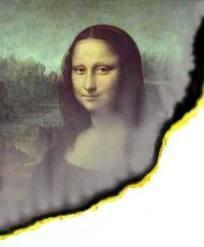
Situationist International December 1967: The Revolution of Modern Art and the Modern Art of Revolution

The Revolution of Modern Art and the Modern Art of Revolution

Timothy Clark, Christopher Gray, Donald Nicholson-Smith & Charles Radcliffe & others 

(unpublished text,1967) 
The Crisis of Modern Art: Dada and Surrealism
‘NEVER BEFORE,’ wrote Artaud, ‘has there been so much talk about civilisation and culture as today, when it is life itself that is disappearing. And there is a strange parallel between the general collapse of life, which underlies every specific symptom of demoralisation, and this obsession with a culture which is designed to domineer over life.’ Modern Art is at a dead end. To be blind to this fact implies a complete ignorance of the most radical theses of the European avant-garde during the revolutionary upheavals of 1910-1925: that art must cease to be a specialised and imaginary transformation of the world and become the real transformation of lived experience itself. Ignorance of this attempt to recreate the nature of creativity itself, and above all its vicissitudes in Dada and Surrealism, has made the whole development of modern art incoherent, chaotic and incomprehensible.

With the Industrial Revolution, there began a change in the whole definition of art – slowly, often unconscioulsy, it changed from a celebration of society and its ideologies to a project of total subversion. From being the focus and guarantee of myth, “great” art became an explosion at the centre of the mythic constellation. Out of mythic time and space it produced a radical historical consciousness which released and reassembled the real contradictions of bourgeois “civilisation.”

Even the antique became subversive – in 50 years, art escaped from the certainties of Augustan values and created its own revolutionary myth of a primitive society. For David and Ledoux, the imperative was to capture the forms of life and self-consciousness which had produced the culture of the ancient world; to recreate rather than to imitate. The 19th century was only to give that proposal a more demoniac and Dionysian gloss.

The project of art – for Blake, for Nietzsche – became the transvaluation of all values and the destruction of all that prevents it. Art became negation: in Goya, in Beethoven, or in Gericault, one can see the change from celebrant to subversive within the space of a lifetime. But a change in the definition of art demanded a change in its forms and the 19th century was marked by an accelerating and desperate attempt at improvising new forms of artistic attack. Courbet began by touting his pictures round the countryside in a marquee and ended in the Commune by superintending the destruction of the Vendome column (the century’s most radical artistic art, which its author immediately disowned).

After the Commune, artists suffered a collective loss of nerve. Mythic time was reborn out of the womb of historical continuity, but it was the mythic time of an isolated and finally obliterated individuality. In the novel, Tolstoy or Conrad struggled to retain a sense of nothingness; irony teetered over into despair; time stopped and insanity took over.

For the Symbolists, the evasion of history became a principle; they gave up the struggle for new revolutionary forms in favor of a purely mythic cult of the isolated artistic gesture. If it was impossible to paint the proletariat, it was equally impossible to paint anything else. So art had to be about nothing; life must exist for art’s sake; the ugly and intolerable truth, said Mallarme with complete disdain, is the “popular form of beauty.” The Symbolists lived on in a realm of an infinitely elegant but stifling tautology. In Mallarme himself, the inescapable subject of poetry is the death of being and the birth of abstract consciousness: a consciousness at once multiform, perfect, magnificently anti-dialectical and radically impotent.

In the end, for all its fury (and Symbolists and Anarchists worked side-by-side in the 1890s) revolutionary art was caught in contradictions. It could not or would not break free of the forms of bourgeois culture as a whole. Its content and method could become transformations of the world, but, while art remained imprisoned within the social spectacle, its transformations remained imaginary. Rather than enter into direct social conflict with the reality it criticized, it transferred the whole problem into an abstract and inoffensive sphere where it functioned objectively as a force consolidating all it wanted to destroy. Revolt against reality became the evasion of reality. Marx’s original critique of the genesis of religious myth and ideology applies word-for-word to the rebellion of bourgeois art: it too “is at the same time the expression of real distress and the protest against real distress. It is the sigh of the oppresses creature, the heart of a heartless world, just as it is the spirit of a spiritless situation. It is the opium of the people” [Marx, Contribution to the critique of Hegel‘s “Philosophy of Right”].

The separation and hostility between the “world” of art and the “world” of everyday life finally exploded in Dada. “Life and art are One,” proclaimed Tzara; “the modern artist does not paint, he creates directly.” But this upsurge of real, direct creativity had its own contradictions. All the real creative possibilities of the time were dependent on the free use of its real productive forces, on the free use of its technology, from which the Dadaists, like everyone else, were excluded. Only the possibility of total revolution could have liberated Dada. Without it, Dada was condemned to vandalism and, ultimately, to nihilism – unable to get past the stage of denouncing an alienated culture and the self-sacrificial forms of expression which it imposed on its artists and their audience alike. It painted pictures on the Mona Lisa, instead of raising the Louvre. Dada flared up and burnt out as an art sabotaging art in the name of reality and reality in the name of art. A tour de force of nihilistic gaiety. The variety, exuberance and audacity of the ludic creativity it liberated, vital enough to transmute the most banal object or event into something vivid and unforeseen, only discovered its real orientation in the revolutionary turmoil of Germany at the end of the First World War. In Berlin, where its expression was most coherent, Dada offered a brief glimpse of a new praxis beyond both art and politics: the revolution of everyday life.

Surrealism was initially an attempt to forge a positive movement out of the devastation left in the wake of Dada. The original Surrealist group understood clearly enough, at least during its heyday, that social repression is coherent and is repeated on every level of experience and that the essential meaning of revolution could only be the liberation and immediate gratification of everyone’s repressed will to live “” the liberation of a subjectivity seething with revolt and spontaneous creativity, with sovereign re-inventions of the world in terms of subjective desire, whose existence Freud had revealed to them (but whose repression and sublimation Freud, as a specialist accepting the permanence of bourgeois society as a whole, could only believe to be irrevocable). They saw quite rightly that the most vital role a revolutionary avant-garde could play was to create a coherent group experimenting with a new lifestyle, drawing on new techniques, which were simultaneously self-expressive and socially disruptive, of extending the perimeters of lived experience. Art was a series of free experiments in the construction of a new libertarian order.

But their gradual lapse into traditional forms of expression – the self-same forms whose pretensions to immortality the Dadaists had already sent up, mercilessly, once and for all – proved to be their downfall: their acceptance of a fundamentally reformist position and their integration within the spectacle. They tried to introduce the subjective dimension of revolution into the communist movement at the very moment when its Stalinist hierarchy had been perfected. They tried to use conventional artistic forms at the very moment when the disintegration of the spectacle, for which they themselves were partly responsible, had turned the most scandalous gestures of spectacular revolt into eminently marketable commodities. As all the real revolutionary possibilities of the period were wiped out, suffocated by bureaucratic reformism or murdered by the firing squad, the Surrealist attempt to supersede art and politics in a completely new type of revolutionary self-expression steadily degenerated into a travesty of its original elements: the mostly celestial art and the most abject communism.

 The Transformation of Poverty and the Transformation of the Revolutionary Project
FROM THEN till now . . . nothing. For nearly half a century, art has repeated itself, each repetition feebler, more inane than the last. Only today, with the first signs of a more highly evolved revolt within a more highly developed capitalism, can the radical project of modern art be taken up again and taken up more coherently. It is not enough for art to seek its realisation in practice; practice must also seek its art. The bourgeois artists, rebelling against the mediocrity of mere survival, which was all their class could guarantee, were always tragically at cross-purposes with the traditional revolutionary movement. While the artists – from Keats to the Marx Brothers – were trying to invent the richest possible experience of an absent life the working class – at least on the level of their official theory and organisation – were struggling for the very survival the artists rejected. Only now, with the Welfare State, with the gradual accession of the whole proletariat to hitherto ‘bourgeois’ standards of comfort and leisure, can the two movements converge and lose their traditional animosity. As, in mechanical succession, the problems of material survival are solved and as life, in an equally mechanical succession, becomes more and more disgusting, all revolt becomes essentially a revolt against the quality of experience. One knows very few people dying of hunger. But everyone one knows is dying of boredom.

By now it has become painfully evident to everyone – apart from a gaga radical left – that it is not one or another isolated aspect of contemporary civilisation that is horrifying, but our own lives as a whole, as they are lived on an everyday level. The utter debacle of the left today lies in its failure to notice, let alone understand, the transformation of poverty which is the basic characteristic of life in the highly industrialised countries. Poverty is still conceived in terms of the 19th century proletariat – its brutal struggle to survive in the teeth of exposure, starvation and disease – rather than in terms of the inability to live, the lethargy, the boredom, the isolation, the anguish and the sense of complete meaninglessness which are eating like a cancer through its 20th century counterpart. The left blithely accepts all the mystifications of spectacular consumption. They cannot see that consumption is no more than the corollary of modern production – functioning as both its economic stabilisation and its ideological justification – and that the one sector is just as alienated as the other. They cannot see that all the pseudo variety of leisure masks a single experience: the reduction of everyone to the role of passive and isolated spectators, forced to surrender their own individual desires and to accept a purely fictitious and mass-produced surrogate. Within this perspective, the left has become no more than the avant-garde of the permanent reformism to which neo-capitalism is condemned. Revolution, on the contrary, demands a total change, and today this can only mean to supersede the present system of work and leisure en bloc.

The revolutionary project, as dreamed among the dark satanic mills of consumer society, can only be the creation of a new lease of life as a whole and the subordination of the productive forces to this end. Life must become the game desire plays with itself. But the rediscovery and the realisation of human desires is impossible without a critique of the phantastic form in which these desires have always found the illusory realisation which allowed their real repression to continue. Today this means that ‘art’ – phantasy erected into a systematic culture – has become Public Enemy Number One. It also means that the traditional philistinism of the left is no longer just an incidental embarrassment. It has become deadly. From now on, the possibility of a new revolutionary critique of society depends on the possibility of a sex revolutionary critique of culture and vice versa. There is no question of subordinating art to politics or politics to art. The question is of superseding both of them insofar as they are separated forms.

No project, however phantastic, can any longer be dismissed as ‘Utopian’. The power of industrial productivity has grown immeasurably faster than any of the 19th century revolutionaries foresaw. The speed at which automation is being developed and applied heralds the possibility of the complete abolition of forced labor – the absolute pre-condition of real human emancipation – and, at the same time, the creation of a new, purely ludic type of free activity, whose achievement demands a critique of the alienation of ‘free’ creativity in the work of art. Art must be short-circuited. The whole accumulated power of the productive forces must be put directly at the service of man’s imagination and will to live. At the service of the countless dreams, desires and half-formed projects which are our common obsession and our essence, and which we all mutely surrender in exchange for one or another worthless substitute. Our wildest fantasies are the richest elements of our reality. They must be given real, not abstract powers. Dynamite, feudal castles, jungles, liquor, helicopters, laboratories . . . everything and more must pass into their service. “The world has long haboured the dream of something. Today if it merely becomes conscious of it, it can possess it really.” (Marx, Letter to Ruge, September 1843)

  The Realisation of Art and the Permanent Revolution of Everyday Life
“The goal of the Situationists is immediate participation in a varied and passionate life, through moments which are both transient and consciously controlled. The value of these moments can only lie in their real effect. The Situationists see cultural activity, from the point of view of the totality, as a method of experimental construction of everyday life, which can be developed indefinitely with the extension of leisure and the disappearance of the division of labour (and, first and foremost, the artistic division of labour). Art can stop being an interpretation of sensations and become an immediate creation of more highly evolved sensations. The problem is how to produce ourselves, and not the things which enslave us.” (‘Theses on Cultural Revolution’, Internationale Situationniste No. 1, 1958)

IT IS NOT enough to burn the museums. They must also be sacked. Past creativity must be freed from the forms into which it has been ossified and brought back to life. Everything of value in art has always cried aloud to be made real and to be lived. This ‘subversion’ of traditional art is, obviously, merely part of the whole art of subversion we must master (cf. Ten Days That Shook the University). Creativity, since Dada, has not been a matter of producing anything more but of learning to use what has already been produced.

Contemporary research into the factors ‘conditioning’ human life poses implicitly the question of man’s integral determination of his own nature. If the results of this research are brought together and synthesized under the aegis of the cyberneticians, then man will be condemned to a New Ice Age. A recent ‘Commission on the Year 2000’ is already gleefully discussing the possibilities of ‘programmed dreams and human liberation for medical purposes.’ (Newsweek, 16/10/67). If, on the contrary, these ‘means of conditioning’ are seized by the revolutionary masses, then creativity will have found its real tools: the possibilities of everyone freely shaping their own experience will become literally demiurgic. From now on, Utopia is not only an eminently practical project, it is a vitally necessary one.

The construction of situations is the creation of real time and space, and the widest integrated field before it lies in the form of the city. The city expresses, concretely, the prevailing organisation of everyday life. The nightmare of the contemporary megalopolis – space and time engineered to isolate, exhaust and abstract us – has driven the lesson home to everybody, and its very pitilessness has begun to engender a new utopian consciousness. “If man is formed by circumstances, then these circumstances must be formed by man.” (Marx, The Holy Family). If all the factors conditioning us are co-ordinated and unified by the structure of the city, then the question of mastering our own experience becomes one of mastering the conditioning inherent in the city and revolutionising its use. This is the context within which man can begin, experimentally, to create the circumstances that create him: to create his own immediate experience. These “fields of lived experience” will supersede the antagonism between town and country which has dominated human life up to now. They will be environments which transform individual and group experience, and are themselves transformed as a result; they will be cities whose structure affords, concretely, the means of access to every possible experience, and, simultaneously, every possible experience of these means of access. Dynamically inter-related and evolving wholes. Game-cities. In this context, Fourier’s dictum that “the equilibrium of the passions depends upon the constant confrontation of opposites” should be understood as an architectural principle. (The subversion of past culture as a whole finds its focus in the cities. So many neglected themes “” the labyrinth, for example “” remain to be explored.) What does Utopia mean today? To create the real time and space within which all our desires can be realised and all of our reality desired. To create the total work of art.

Unitary urbanism is a critique, not a doctrine, of cities. It is the living critique of cities by their inhabitants: the permanent qualitative transformation, made by everyone, of social space and time. Thus, rather than say that Utopia is the total work of art, it would be more accurate to say that Utopia is the richest and most complex domain serving total creativity. This also means that any specific propositions we can make today are of purely critical value. On an immediate practical level, experimentation with a new positive distribution of space and time cannot be dissociated from the general problems of organisation and tactics confronting us. Clearly a whole urban guerilla will have to be invented. We must learn to subvert existing cities, to grasp all the possible and the least expected uses of time and space they contain. Conditioning must be thrown in reverse. It can only be out of these experiments, out of the whole development of the revolutionary movement, that a real revolutionary urbanism can grow. On a rudimentary level, the blazing ghettoes of the USA already convey something of the primitive splendor, hazardousness and poetry of the environments demanded by the new proletariat. Detroit in flames was a purely Utopian affirmation. A city burnt to make a negro holiday . . . shadows of most terrible, yet great and glorious things to come. . . .

 The Work of Art: A Spectacular Commodity
UNFORTUNATELY, it is not only the avant-garde of revolutionary art and politics which has a different conception of the role to be played by artistic creativity. “The problem is to get the artist onto the workshop floor among other research workers, rather than outside industry producing sculptures,” remarks the Committee of the Art Placement Group, which is sponsored by, amongst others, the Tate Gallery, the Institute of Directors, and the Institute of Contemporary Arts (Evening Standard, 1/2/67). In fact, industrialisation of ‘art’ is already a fait accompli. The irreversible expansion of the modern economy has been forcing it to accord an increasingly important position for a long time now. Already the substance of the tertiary sector of the economy – the one expanding the most rapidly – is almost exclusively ‘cultural.’ Alienated society, by revealing its perfect compatibility with the work of art and its growing dependence upon it, has betrayed the alienation of art in the harshest and least flattering light possible. Art, like the rest of the spectacle, is no more than the organisation of everyday life in a form where its true nature can at most be dismissed and turned into the appearance of its opposite: where exclusion can be made to seem participation, where one-way transmission can be made to seem communication, where loss of reality can be made to seem realisation.

Most of the crap passed off as culture today is no more than dismembered fragments – reproduced mechanically without the slightest concern for their original significance – of the debris left by the collapse of every world culture. This rubbish can be marketed simply as historico-aesthetic bric-a-brac or, alternatively, various past styles and attitudes can be amalgamated, up-dated and plastered indiscriminately over an increasingly wide range of products as haphazard and auto-destructive fashions. But the importance of art in the spectacle today cannot be reduced to the mere fact that it offers a relatively unexploited accumulation of commodities. Marshall McLuhan remarks: “Our technology is, also, ahead of its time, if we reckon by the ability to recognise it for what it is. To prevent undue wreckage in society, the artist tends now to move from the ivory tower to the control tower of society. Just as higher education is no longer a frill or a luxury, but a stark need for production in the shaping and structure created by electric technology.” And Galbraith, even more clearly, speaks about the great need “to subordinate economic to aesthetic goals.” (Guardian, 22/2/67).

Art has a specific role to play in the spectacle. Production, once it is no longer answering any real needs at all, can only justify itself in purely aesthetic terms. The work of art – the completely gratuitous product with a purely formal coherence – provides the strongest ideology of pure contemplation possible today. As such it is the model commodity. A life which has no sense apart from contemplation of its own suspension in a void finds its expression in the gadget: a permanently superannuated product whose only interest lies in its abstract technico-aesthetic ingenuity and whose only use lies in the status it confers on those consuming its latest remake. Production as a whole will become increasingly ‘artistic’ insofar as it loses any other raison d’etre.

Rated slightly above the run-of-the-mill consumers of traditional culture is a sort of mass avant-garde of consumers who wouldn’t miss a single episode of the latest ‘revolt’ churned out by the spectacle: the latest solemn 80 minute flick of 360 variegated bare arses, the latest manual of how to freak out without tears, the latest napalm-twisted monsters air-expressed to the local Theatre of Fact. One builds up resistance to the spectacle, and, like any other drug, its continued effectiveness demands increasingly suicidal doses. Today, with everyone all but dead from boredom, the spectacle is essentially a spectacle of revolt. Its function is quite simply to distract attention from the only real revolt: revolt against the spectacle. And, apart from this one point, the more extreme the scandal the better. Any revolt within the spectacular forms, however sincere subjectively – from The Who to Marat/Sade – is absorbed and made to function in exactly the opposite perspective to the one that was intended. A baffled ‘protest vote’ becomes more and more overtly nihilistic. Censorship. Hash. Vietnam. The same old careerism in the same old rackets. Today the standard way of maintaining conformity is by means of illusory revolts against it. The final form taken by the Provos – Saturday night riots protected by the police, put in quarantine, functioning as Europe’s premier avant-garde tourist attraction – illustrates very clearly how resilient the spectacle can be.

Beyond this, there are a number of recent cultural movements which are billed as a coherent development from the bases of modern art – as a contemporary avant-garde – and which are in fact no more than the falsification of the high points of modern art and their integration. Two forms seem to be particularly representative: reformism and nihilism.

 The Phoney Avant-Garde
ATTEMPTS TO reform the artistic spectacle, to make it more coherent and, inseparably, to resurrect the illusion of participation in it, are ten a penny. For a time, separated forms – sound, light, jazz, dance, painting, film, poetry, politics, theatre sculpture, architecture, etc – have been brought together, in various juxtapositions, in the mixed and multi-media shows. In kinetic art we are promised the apotheosis of the process. A current Russian group declares: “We propose to exploit all possibilities, all aesthetic and technical means, all physical and chemical phenomena, even all kinds of art as our methods of artistic expression.” (Form, No. 4). The specialist always dreams of ‘broadening his field.’ Likewise the obsessive attempts to make the ‘audience’ ‘participate.’ No one cares to point out that these two concepts are blatantly contradictory, that every artistic form, like every other prevailing social form, is explicitly designed to prohibit even the intervention, let alone the control, of the vast majority of people. Endless examples could be cited. Last winter saw “Vietnamese Free Elections” billed as an experiment in creating “total involvement” in the Vietnamese situation through a fusion of political and dramatic form, etc. “Actors are not wanted,” it was stated. “This is a new exercise in audience participation” that came with the ticket. “If you want to speak, hold up your hand. When you are recognised by the chairman, you must give your real name and the fictional occupation entered on your background sheet. . . . during the course of the meeting, you are operating as a fictional character and not as a spokesman for your personally held beliefs.” (emphasis in original). The Happening is the general matrix of participation art – and the Happening is where it becomes obvious that nothing ever happens. Everyone has lost themselves as totally as they have lost everyone else. Without the drugs, it could be explosive.

Cop art, cop artists. The whole lot moves towards a fusion of forms in a total environmental spectacle complete with various forms of prefabricated and controlled participation. It is just an integral part of the all-encompassing reforming of modern capitalism. Behind it looms the whole weight of a society trying to obscure the increasingly transparent exclusion and repression it imposes on everyone, to restore some semblance of colour, variety and meaning to leisure and work, to “organise participation in something in which it is impossible to participate.” As such, these artists should be treated the same way as police-state psychiatrists, cyberneticians, and contemporary architects. Small wonder their avant-garde cultural ‘events’ are so heavily policed.

Anything art can do, life can do better. A journalist describes the sense of complete reality of driving a static racing car in an ambiance consisting solely of a colour film, which responded to every touch of the steering and acceleration as though he were really speeding round a race track. Even the sensations of a 120 mph smash could be simulated (Daily Express, 18/1/66). Expo ’67, the Holy City of science fiction, boasts a three-million-buck ‘Gyrotron’ designed “to lift its passengers into a facsimile of outer space and then dunk them in a fiery volcano. . . . We orbit up an invisible track. Glowing around us are spinning planets, comets, galaxies . . . man-made satellites, Telstars, moon rockets . . . vooming in our cars are electronic undulations, deep beeps and astral snores.” Finally, the ‘participants’ are plunged down a “red incinerator, surrounded by simulated lava, steam and demonic shrieks” (Life, 15/5/67). Reinforced by the sort of conditioning made possible by the discoveries of the kinetic artists, such techniques could ensure an unprecedented measure of control. Sutavision, an abstract form of colour TV, already mass-marketed, offers to provide “wonderful relaxation possibilities” giving “a wide series of phantasies” and functioning as “part of a normal home or business office.” “Radiant colours moving in an almost hypnotic rhythm across the screen . . . wherein one can see any number of intriguing spectacles.” Box three, a further refinement of TV, can manipulate basic mood changes through the rhythms and the frequency of the light patterns employed (Observer Magazine, 23/10/66). Still more sinister is the combination of total kinetic environments and a stiff dose of acid. “We try to vaporise the mind,” says a psychedelic artist, “by bombing the senses…” The Us Company [a commune of painters, poets, film-makers, teachers and weavers that lived and worked together in an abandoned church in Garneville, New York, USA] artists call their congenial wrap-around a “be-in” because the spectator is to exist in the show, rather than look at it. The audience becomes disorientated from their normal time sense and preoccupations. . . . The spectator feels he is being transported to mystical heights.” And this “is invading not only museums and colleges, but cultural festivals, discotheques, movie houses and fashion shows” (Life, 3/10/66). To date, Leary is the only person to have attempted to pull all this together. Having reduced everyone to a state of hyper-impressionable plasticity, he incorporated a backwoods myth of the modern-scientific-truth-underlying-all-world-religions, a cretin’s catechism broadcast persuasively at the same time as it was expressed by the integral manipulation of sense data. Leary’s personal vulgarity should not blind anyone to the possibilities implicit in this. A crass manipulation of subjective experience accepted ecstatically as a mystical revelation.

“All this art is finished. . . . Squares on the wall. Shapes on the floor. Emptiness. Empty rooms” (Warhol to a reporter from Vogue). Nihilism is the second most widespread form of contemporary ‘avant-garde’ culture; the morass stretches from playwrights like Ionesco and film-makers like Antonioni, through novelists like Robbe-Grillet and Burroughs, to the paintings and sculpture of the pop, destructive and auto-destructive artists. All re-enact a Dadaist revulsion from contemporary life “” but their revolt, such as it is, is purely passive., theatrical and aesthetic, shorn of any of the passionate fury, horror or desperation which would lead to a really destructive praxis. Neo-Dada, whatever its formal similarities to Dada, is re-animated by a spirit diametrically opposed to that of the original Dadaist groups. “The only truly disgusting things,” said Picabia, “are Art and Anti-Art. Wherever Art rears its head, life disappears.” Neo-Dada, far from being a terrified outcry at the almost complete disappearance of life, is, on the contrary, an attempt to confer a purely aesthetic value on its absence and on the schizophrenic incoherence of its surrogates. It invites us to contemplate the wreckage, ruin and confusion surrounding us, and not to take up arms in the gaiety of the world’s subversion, pillage and total overthrow. Their culture of the absurd reveals only the absurdity of their culture.

Purely contemplative nihilism is no more the special province of artists than is modern reformism. In fact, neo-Dada lags way behind the misadventures of the commodity-economy itself – every aspect of life today could pass as its own parody. The Naked Lunch pales before any of the mass media. Its real significance is quite different. For pop art is not only, as Black Mask remarks, the apotheosis of capitalist reality: it is the last ditch attempt to shore up the decomposition of the spectacle. Decay has reached the point where it must be made attractive in its own right. If nothing has any value, then nothing must become valuable. The bluff may be desperate but no one dares to call it, here or anywhere else. And so Marvel comics become as venerable as Pope. The function of neo-Dada is to provide an aesthetic and ideological alibi for the coming period, to which modern commerce is condemned, of increasingly pointless and self-destructive products: the consumption/anti-consumption of the life/anti-life. Galbraith’s subordination of economic to aesthetic goals is perfectly summed up in the Mystic Box. “Throw switch ‘on.’ Box rumbles and quivers. Lid slowly rises, a hand emerges and pushes switch off. Hand disappears as lid slams shut. Does absolutely nothing but switch off!” The nihilism of modern art is merely an introduction to the art of modern nihilism.

 The Intelligentsia Split in Two
THESE TWO movements – the attempt to reform the spectacle and the attempt to arrest its crisis as purely contemplative nihilism – are distinct but in no way contradictory manoeuvres. In both cases, the function of the artist is merely to give aesthetic consecration to what has already taken place. His job is purely ideological. The role played today by the work of art has dissociated everything in art which awoke real creativity and revolt from everything which imposed passivity and conformism. Its revolutionary and its alienated elements have sprung apart and become the living denial of one another. Art as commodity has become the arch-enemy of all real creativity. The resolution of the ambiguity of culture is also the resolution of the ambiguity of the intelligentsia. The present cultural set-up is potentially split into two bitterly opposed factions. The majority of the intelligentsia has, quite crudely, sold out. At the same time, its truly dissident and imaginative elements have refused all collaboration, all productivity, within the forms tolerated by social power and are tending more and more to become indistinguishable from the rest of the new lumpenproletariat in their open contempt and derision for the ‘values’ of consumer society. While the way of life of the servile intelligentsia is the living denial of anything remotely resembling either creativity or intelligence, the rebel intelligentsia is becoming caught up in the reality of disaffection and revolt, refusing to work and inevitably faced, point blank, with a radical reappraisal of the relationship between creativity and everyday life. Frequenting the lumpen, they will learn to use other weapons than their imagination. One of our first moves must be to envenom the latent hostility between these two factions. It shouldn’t be too difficult. The demoralisation of the servile intelligentsia is already proverbial. The contradictions between fake glamour and the reality of their mental celebrity are too flagrant to pass unperceived, even by those who are, indisputably, the most stupid people in contemporary society.

 Revolt, the Spectacle and the Game
THE REAL creativity of the times is at the antipodes of anything officially acknowledged to be ‘art.’ Art has become an integral part of contemporary society and a ‘new’ art can only exist as a supersession of contemporary society as a whole. It can only exist as the creation of new forms of activity. As such, it [‘new’ art] has formed an integral part of every eruption of real revolt over the last decade. All have expressed the same furious and baffled will to live, to live every possible experience to the full – which, in the context of a society which suppresses life in all its forms, can only mean to construct experience and to construct it against the given order. To create immediate experience as purely hedonistic and experimental enjoyment of itself can be expressed by only one social form – the game – and it is the desire to play that all real revolt has asserted against the uniform passivity of this society of survival and the spectacle. The game is the spontaneous way everyday life enriches and develops itself; the game is the conscious form of the supersession of spectacular art and politics. It is participation, communication and self-realisation resurrected in their adequate form. It is the means and the end of total revolution.

The reduction of all lived experience to the production and consumption of commodities is the hidden system by which all revolt is engendered, and the tide rising in all the highly industrialised countries can only throw itself more and more violently against the commodity-form. Moreover, this confirmation can only become increasingly embittered as the integration effected by power is revealed as more and more clearly to be the re-conversion of revolt into a spectacular commodity (q.v., the transparence of the conforming non-conformity dished up for modern youth). Life is revealed as a war between the commodity and the ludic. As a pitiless game. And there are only two ways to subordinate the commodity to the desire to play: either by destroying it, or by subverting it.

 The Real Avant-Garde: The Game-Revolt of Delinquency, Petty Crime and the New Lumpen
THE JUVENILE delinquents – not the pop artists – are the true inheritors of Dada. Instinctively grasping their exclusion from the whole of social life, they have denounced its products, ridiculed, degraded and destroyed them. A smashed telephone, a burnt car, a terrorised cripple are the living denial of the ‘values’ in the name of which life is eliminated. Delinquent violence is a spontaneous overthrow of the abstract and contemplative role imposed on everyone, but the delinquents’ inability to grasp any possibility of really changing things once and for all forces them, like the Dadaists, to remain purely nihilistic. They can neither understand nor find a coherent form for the direct participation in the reality they have discovered, for the intoxication and sense of purpose they feel, for the revolutionary values they embody. The Stockholm riots, the Hell’s Angels, the riots of Mods and Rockers “” all are the assertion of the desire to play in a situation where it is totally impossible. All reveal quite clearly the relationship between pure destructivity and the desire to play: the destruction of the game can only be avenged by destruction. Destructivity is the only passionate use to which one can put everything that remains irremediably separated. It is the only game the nihilist can play; the bloodbath of the 120 Days of Sodom proletarianised along with the rest.

The vast escalation of petty crime “” spontaneous, everyday crime on a mass level – marks a qualitatively new stage in contemporary class conflict: the turning point between pure destruction of the commodity and the stage of its subversion. Shoplifting, for example, beyond being a grass-roots refusal of hierarchically organised distribution, is also a spontaneous rebuttal of the use of both product and productive force. The sociologists and floorwalkers concerned – neither group being noted for a particularly ludic attitude towards life – have failed to spot either that people enjoy the act of stealing, or, through an even darker piece of dialectical foul-play, that people are beginning to steal because they enjoy it. Theft is, in fact, a summary overthrow of the whole structure of the spectacle; it is the subordination of the inanimate object, from whose free use we are withheld, to the living sensations it can awake when played with imaginatively within a specific situation. And the modesty of something as small as shoplifting is deceptive. A teenage girl interviewed recently remarked: “I often get this fancy that the world stands still for an hour and I go into a shop and get rigged” (Evening Standard, 16/8/66). Alive, in embryo, is our whole concept of subversion: the bestowal of a whole new use value on this useless world and against this useless world, subordinated to the sovereign pleasure of subjective creativity.

The formation of the new lumpen prefigures several features of an all-encompassing subversion. On the one hand, the lumpen is the sphere of complete social breakdown of apathy, negativity and nihilism – but, at the same time, in so far as it defines itself by its refusal to work and its attempt to use its clandestine leisure in the invention of new types of free activity, [the lumpen] is fumbling, however clumsily, with the quick of the revolutionary supersession now possible. As such it could quickly become social dynamite. It only needs to realise the possibility of everyday life being transformed, objectively, for its last illusions to lose their power, e.g., the futile attempt to revitalize immediate experience subjectively, by heightening its perception with drugs, etc. The Provo movement in 1966 was the first groping attempt of this new, and still partly heterogeneous, social force to organise itself into a mass movement aimed at the qualitative transformation of everyday life. At its highest moment, [the Provo movement]’s upsurge of disruptive self-expression superseded both traditional art and traditional politics. It collapsed not through any essential irrelevance of the social forces it represented, but through their complete lack of any real political consciousness: through their blindness to their own hierarchical organisation and through their failure to grasp the full extent of the crisis of contemporary society and the staggering libertarian possibilities it conceals.

Initially, the new lumpen will probably be our most important theatre of operations. We must enter it as a power against it and precipitate its crisis. Ultimately, this can only mean to start a real movement between the lumpen and the rest of the proletariat: their conjunction will define the revolution. In terms of the lumpen itself, the first thing to do is to dissociate the rank-and-file from the incredible crock of shit raised up, like a monstrance, by their leaders and ideologists. The false intelligentsia – from the CIA-subsidised torpor of the latest New Left, to the sanctimonious little tits of International Times – are a New Establishment whose tenure depends on the success with which they can confront the most way-out point of social and intellectual revolt. The parody they stage can only arouse a growing radicalism and fury on the part of those they claim to represent. The Los Angeles Free Press, distilling their experience of revolt in an article aptly entitled To Survive in the Streets, could in all seriousness conclude: “Summing up: Dress warm, keep clean and healthy, eat a balanced diet, live indoors and avoid crime. Living in the streets can be fun if you conscientiously study the rules of the game.” (Reprinted in The East Village Other, 15/6/67). Hippie racketeers should certainly steer clear of public places, come the day. The poesie faite par tous has been known to be somewhat trigger-happy in the past.

 Revolution as a Game
THE NEW revolutionary movement can be no more than the organisation of popular revolt into its most coherent, its richest form. And there is no organisation to date which would not completely betray it. All previous political critiques of the repressive hierarchy engendered by the past revolutionary argument – that of Solidarity, for example – have completely missed the point: they were not focused on precisely what it was that this hierarchy repressed and perverted in the form of passive militancy. In the context of the radical ‘ethics’ still bogged down in singularly distasteful forms of sub-Christian masochism, the ludic aspects of the revolution cannot be over-emphasised. Revolution is essentially a game and one plays it for the pleasure involved. Its dynamic is a subjective fury to live, not altruism. It is totally opposed to any form of self-sacrificial subordination of oneself to a cause – to Progress, to the Proletariat, to Other People. Any such attitude is diametrically opposed to the revolutionary appreciation of reality: it is no more than an ideological extension of religion for the use by the ‘revolutionary’ leaderships in justifying their own power and in repressing every sign of popular creativity.

The game is the destruction of the sacred – whether it be the sanctity of Jesus or the santity of the electric mixer and the Wonderloaf. Tragedy, said Lukacs, is a game played in the sight of godlessness. The true form of godlessness will be the final achievement of revolution – the end of the illusory and all its forms, the beginning of real life and its direct self-consciousness.

The revolutionary movement must be a game as much as the society it prefigures. Ends and means cannot be disassociated. We are concerned first and foremost with the construction of our own lives. Today, this can only mean the total destruction of power. Thus the crucial revolutionary problem is the creation of a praxis in which self-expression and social disruption are one and the same thing: of creating a style of self-realisation which can only spell the destruction of everything which blocks total realisation. From another point of view, this is the problem of creating the coherent social form of what is initially and remains essentially an individual and subjective revolt. Only Marx’s original project, the creation of the total man, of an individual reappropriating the entire experience of the species, can supersede the individual vs. Society dualism by which hierarchical power holds itself together while it holds us apart. If it fails in this, then the new revolutionary movement will merely build an even more labyrinthine illusory community; or, alternatively, it will shatter into an isolated and ultimately self-destructive search for kicks. If it succeeds, then it will permeate society as a game that everyone can play. There is nothing left today that can withstand a coherent opposition once it has established itself as such. Life and revolution will be invented together or not at all.

All the creativity of the time will grow from this movement and it is in this perspective that our own experiments will be made and should be understood. The end of this process will not merely be the long overdue end of this mad, disintegrating civilisation. It will be the end of pre-history itself. Man stands on the verge of the greatest breakthrough ever made in the human appropriation of nature. Man is the world of man and a new civilisation can only be based on man’s free and experimental creation of his own world and his own creation. This creation will no longer accept any internal division or separation. Life will be the creation of life itself. The total man will be confronted only with his ever-increasing appropriation of nature, of his own nature, finally elaborated, in all of its beauty and terror, as our ‘worthy opponent’ in a ludic conflict where everything is possible.

Found in a Trunk: The Lost Avant-Garde Movement that came Decades before Dada

BY CECILE PAUL OCTOBER 8, 2021

If modern art has taught us anything, it is that anything can be considered art. Picasso’s and Braque’s curious peeling newspaper collages of the 1910s spring to mind as the opening act for the ‘Modern Art’ movement. It was at this point in time, in the early 20th century where ‘real’ art – the academic 19th century kind, with all its airs and graces and establishment-imposed ‘rules’ – and this new lighter, less formal and somewhat random approach, parted ways. Modern Art as we perceive it was arguably launched by the quirky and wonderfully chaotic Dada movement that took root in central Europe around 1910 and flowered in New York in the early 1920s, causing a somewhat profound ruffling of the feathers of the status quo. And whilst we now see Dada as revolutionary, it was uncanny to discover that Dada had a look-a-like predecessor – not a direct ancestor, mind you, more like a forgotten uncle. ‘Les Incohérents’ was a short-lived French art movement that originated from Montmartre in Paris in the 1880s. Unconcerned with the intellectual, political or spiritual facets of the arts (which Dada would address a mere 20 years later), they did, however, attempt to question through satire and ridicule, what exactly ‘art’ was, who it was intended for and why on earth it had to be so darn square.

Paris in the 1880s was the capital of a flourishing world empire, serious and secure. Perhaps it could afford some cultural introspection and self-analysis, if only for its own entertainment? If beauty is in the eye of the beholder, then the Incoherents movement had a point: why restrict the arts, visual, music or dance world to the same old tedious and traditional offerings? Why not open it up to fun, new rules and new media?

Photo card – FECAMP – Cavalcade de Fécamp -Cabanon des Incohérents

As a small group of self-publicists, Les Incohérents were fed up with the stale and rather dull version of the-then established Arts world and wanted to entice the public with an alternative and more joyful view on art and life.

Playful, ingenious, ridiculous and entertaining, the Incoherent’s message was delivered through social amusement of the public, not unlike today’s social media content. This was to be an art for all, not just for a chosen few intellectuals. There’s indeed nothing new under the sun: from the graffitied walls of Pompeii to the current explosion of self-indulgent imagery on the likes of Facebook and Instagram, it’s human nature to tease and tinker with mainstream messages and offer an alternative opinion.

Mona Lisa fumant la pipe by Sapeck (AKA Eugène Bataille)

The Mona Lisa of the movement is quite literally, the Mona Lisa herself, enjoying her long clay pipe. Mona Lisa fumant la pipe created by the artist Sapeck (AKA Eugène Bataille) in 1883, is perhaps Les Incohérents’ most iconic identity piece. The crude application of the pipe and its smoke rings, shatters the reverence of the historic image, and let’s face it, Sapeck’s subject is clearly far more relaxed than Leonardo’s. No longer part of an exclusive private collection or purely the intellectual property of the elite, street art was now there for all to enjoy. Technological developments in printing and photography allowed ease of artistic appropriation of established iconic images and masterpieces. Contributors of the Incoherents movement continued to manipulate and distort all aspects of the Arts, from dance to opera, from poster art to photography in an attempt to provoke and rewrite the rules as to what ‘art’ was and who it was for.

The founder and leader of the movement was Jules Lévy, a Parisian writer, publisher and founder of a wine-loving literary club out of Montmartre during the Belle Epoque called Les Hydropathes, which had fizzled out in 1880. Working in newspapers of the day and familiar with volume printing and understanding the public’s appetite for news, in an anti-establishment move, Levy had decided to throw a public ‘exhibition of drawings by people who could not draw’. Billed as a charity event, the contributors could present works in a public forum. This was the first ‘Incohérent’ art exhibition, held on July 13th 1882 on the Champs Elysées. Appropriately, in true Incohérents style, the Champs Elysées show was extravagantly lit by candlelight due to a gas outage. A profusion of works were shown; drawings of all types, paintings littered with alternative and radical subject matter, miscellaneous sculpture and objects in all mediums and forms. These consisted of nonsensical, irrational and bizarre imagery, all engineered to question, provoke, engage and get a laugh from the public.

The success of the Champs Elysées event prompted Lévy to run a second show from his own tiny attic apartment in October 1882 which attracted some 2,000 people including Édouard Manet, Auguste Renoir, Camille Pissarro, and Richard Wagner. Imagine the art world’s most famous artists and critics crowded together to see over 150 works in a chambre de bonne (Paris’ matchbox apartments reserved for domestic workers). A stark contrast to the pomp and elitism of the prestigious art ‘Salon’ and its official circuits, it was nothing short of a parody. One academic called the radical counter-salon “an attack on art”.

The sober scene of a typical Paris art salon at the Champs Elysées in 1881

The public was actively invited to engage with this new art through the mocking and mannering of old icons. To say they were intrigued and amused is an understatement. They were gagging for more. Masked balls and cabarets were advertised across the city as the vehicle for delivering their message, attracting the public to a variety of venues and experiences where a jumble of different media, random objects, miscellaneous artefacts, scratchings, pastings and other weird and wonderful objects would be exhibited. A sort of arts ‘rave’ of the day.

Les Incohérents, whether it was a ball or a happening or an exhibition, became a ‘must do and see’ event in the Parisian cultural calendar.  October 1883 saw the first official exhibition of Incoherent art at the Galerie Vivienne in the heart of Paris. This show and all their future events would be run for charity, with the guidelines ‘All works are allowed, the serious works and obscene excepted’. The show was an Aladdin’s Cave of absurdities, parodies and pictorial puns and was furnished with a formal catalogue of the works, giving us some idea today of just how bizarre the content was. A whopping 20,000-plus enthusiasts visited the exhibition that October.

The next year, the Incohérents were again at Galerie Vivienne with yet more artful amusements. This time the catalogue, now effectively their manifesto, was lavishly illustrated with engravings of the peculiar works. The invitation card showed a ghostly broom-wielding dancer chasing blackbirds, perhaps an allegory for ‘out with the old and in with the new!’ The newspapers relished the event and as for the public, nothing could gratify their insatiable appetite for ‘incohérent art’.

La femme sans visage de Marc Sonal, Cruelle énigme, Catalogue des arts incohérents, 1884

Les Incohérents gave the Parisian public and celebrities of the day a chaotic and absurd serving of the visual arts, a barrage of eclectic offerings and experiences. Whilst never shocking nor challenging, the events were joyfully anticipated and was very much ‘a thing’ to attend and be seen attending in the Paris of the 1880s. But by the end of the decade, the success of the movement was catching up with Lévy. Accused of commercially exploiting both his artistic contributors and his public, the press began to describe him as a new form of the establishment, ‘the official unofficial Incoherent’. To add insult to injury, other enterprises in Paris started to cash-in on the branding, badging new cafes and titling magazines with the movement’s name and likeness

In order to distance himself from his accusers, Lévy organised a masked funeral ball at the Folies-Bergère nightspot to mark the end of the movement. In 1891, Levy tried to relaunch the movement with a new magazine, ‘Folies-Bergère’, but this also struggled to capture public attention. One last exhibition in 1893 was described this time by a critical press as ‘all that is outdated, outmoded. Inconsistency joined decadence, decay and other jokes with or without handles in the bag of old-fashioned chiffes’. Lévy plodded on until 1896, still trying to be the good Svengali and showman but his movement had flowered and wilted, and its audience had moved on for titillating entertainment elsewhere. Les Incohérents would be momentarily ressurected stateside in 1919 when Marcel Duchamp appropriated the Mona Lisa image, but this time, in place of Sabeck’s pipe, she now sported a moustache.

So little of the movement’s works is thought to have survived, that when the Musée d’Orsay devoted a retrospective to the Incoherent Arts in 1992, it was only able to exhibit archival documents and press clippings. Thousands of works produced by hundreds of artists during the movement’s zenith had all disappeared. Even by the 1930s, surrealists like André Breton, who often spoke about the Incoherents, had never seen their works.

With few traces of its existence, the movement was practically a lost legend; but more than a century later, unexpectedly in early 2021, seventeen important works attributed to the Incoherent Arts exhibitions were discovered in an old trunk. Unearthed amongst the storage of a private home near Paris, the large trunk full of a “jumble of documents, drawings, objects wrapped in rags,” included one work which has since been identified as the first monochrome in the history of art.

Discovered in the trunk
Discovered in the trunk: “La tortue et les deux canards, d’après Lafontaine (Molière)”/ Exposition des Arts Incohérents, 1884
Discovered in the trunk: signed GIEFFE (Jules Foloppe)

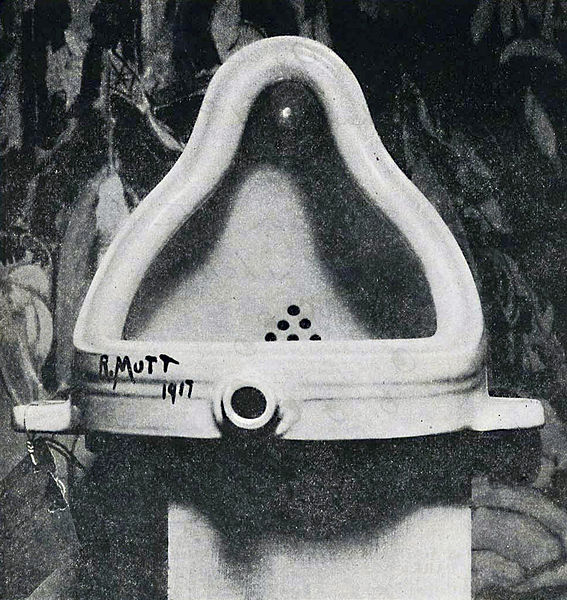
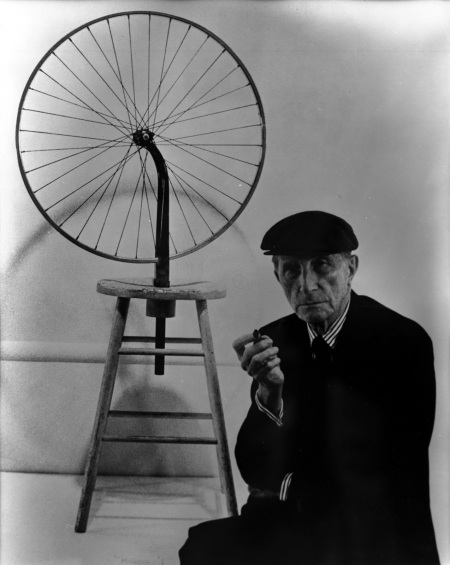
Another important find amongst the trunk’s contents was a piece of green cab curtain suspended from a wooden cylinder created by Alphonse Allais, given a title that roughly translates to “Pimps still in the prime of life and their stomachs in the grass drink absinthe“. To the untrained eye, it might look like just an old swatch of antique fabric, but the piece actually predates the Dada movement’s “readymade” philosophy, a term coined by Marcel Duchamp to describe works of art he made from manufactured objects, such as his famous Bottle Rack (1915), the iconic porcelain urinal he titled Fountain (1917) and Bicycle Wheel (1913).

Discovered in the trunk: 1897 Green cab curtain by Alphonse Allais, “Des souteneurs, encore dans la force de l’âge et le ventre dans l’herbe, boivent de l’absinthe” © Galerie Johann Naldi

Unaware of the mysterious trunk’s value or significance, the homeowners were unable to identify its original owner – perhaps a co-organiser of Les Incohérents, one of the movement’s artists, or an early collector? Dealer and art expert, Johann Naldi, is still searching for answers while planning to present his findings to the public at the end of 2021, when the collection is also expected to go up for sale as a single lot. The Musée d’Orsay is rumoured to be a likely buyer.

And yet for such a historic find, bringing this collection to the world’s stage could be far more problematic that some would probably hope having just uncovered a missing link in the history of modern art. The problem being; the collection’s centrepiece, a canvas entirely painted in black, now identified as art history’s first monochrome, entitled “Combat de Nègres dans la Nuit“, which translates to “Negroes Fighting in a Cellar at Night”.

Combat de Nègres pendant la nuit (as seen from the back) © Galerie Johann Naldi

The provocative “joke” painting by the poet Paul Bilhaud, exhibited at the very first ‘Incohérent’ art exhibition in 1882 on the Champs Elysées, was thought to be lost forever. And now here it is, having resurfaced nearly 140 years later, facing a very different 21st century audience in the wake of a global racial reckoning.

Perhaps tellingly, the international press has been uncharacteristically slow to pick up a story about the rediscovery of an entire art movement hidden inside a trunk. Mainstream newspaper Le Monde however, has followed the story among other French art world publications, describing Paul Bilhaud’s historic monochrome as the collection’s most significant attraction. Meanwhile, the French Ministry of Culture has declared the collective discovery a “national treasure”. Disappointingly, we found that the French media coverage thus far has notably and consistently avoided any acknowledgement of the inevitable outcry that would likely ensue were a racist artwork disguised as humour to find its way into a public museum today and be celebrated as a national treasure.

The rediscovered works were briefly exhibited at a small gallery in Paris in Feburary 2021 © Le Figaro

As a conceptual piece, it is decades ahead of its time, which is where experts no doubt find the majority of the work’s merit. But is it worth elevating as the movement’s pièce de résistance or better used to reopen the conversation about what we consider art? It’s possible these issues are being raised behind the scenes before the collection is presented on a larger international stage.

In many ways, the Incoherents did create flickers of the avant-garde before the avant-garde. The movement momentarily released the public perception of the arts from the confines of its establishment, but it was Dada that actually managed to break the mould of previous centuries’ art traditions. Where the Dadaist created art for the mind, Les Incohérents was perhaps more of an amuse-bouche; a teaser of things to come. Now it’s our turn again to decide what to celebrate as art for public consumption.

The Long Walk of the Situationist International | Greil Marcus (The Village Voice)

“The situationists were bent on discovering the absolute ability to criticize anyone, anywhere — without re­straint, without the pull of alliances, and without self-satisfaction. And they were bent on turning that criticism into event.”

by GREIL MARCUS

Originally published May 1, 1982

How Extreme Was It

— 1 —

I first became intrigued with the Situ­ationist International in 1979, when I strug­gled through “Le Bruit et la Fureur,” one of the anonymous lead articles in the first issue of the journal Internationale Situationniste. The writer reviewed the exploits of artistic rebels in the postwar West as if such matters had real political consequences, and then said this: “The rotten egg smell exuded by the idea of God envelops the mystical cretins of the American ‘Beat Generation,’ and is not even entirely absent from the declarations of the Angry Young Men… They have simply come to change their opinions about a few social conventions without even noticing the whole change of terrain of all cultural activ­ity so evident in every avant-garde tendency of this century. The Angry Young Men are in fact particularly reactionary in their attribution of a privileged, redemptive value to the practice of literature: they are defending a mystification that was denounced in Europe around 1920 and whose survival today is of greater counterrevolutionary significance than that of the British Crown.”

Mystical cretins… finally, I thought (for­getting the date of the publication before me), someone has cut through the suburban cul-de-sac that passed for cultural rebellion in the 1950s. But this wasn’t “finally” — it was 1958, in a sober, carefully printed magazine (oddly illustrated with captionless photos of women in bathing suits), in an article that concluded: “If we are not surrealists it is because we don’t want to be bored… Decrepit surrealism, raging and ill-informed youth, well-off adolescent rebels lacking perspective but far from lacking a cause — boredom is what they all have in common. The situationists will execute the judgment contemporary leisure is pronouncing against itself.”

Strange stuff — almost mystifying for an American — but there was a power in the prose that was even more seductive than the hard-nosed dismissal of the Beat generation. This was the situationist style — what one commentator called “a rather irritating form of hermetic terrorism,” a judgment situ­ationist Raoul Vaneigem would quote with approval. Over the next decade it never really changed, but only became more seductive and more hard-nosed, because it discovered more seductive and hard-nosed opponents. Beginning with the notion that modern life was boring and therefore wrong, the situationists sought out every manifestation of alienation and domination and every man­ifestation of the opposition produced by al­ienation and domination. They turned out original analyses of the former (whether it was the Kennedy-era fallout shelter program in “The Geopolitics of Hibernation” — what a title! — or the Chinese cultural revolution in “The Explosion Point of Ideology in China”) and mercilessly criticized the timidity and limits of the latter. In every case they tried to link specifics to a totality — why was the world struggling to turn itself inside out, and how could it be made to do so? What were the real sources of revolution in postwar society, and how were they different from any that had come before?

The Situationist International Antho­logy contains pre-SI documents, 250 pages of material from the situationist journal, May 1968 documents, two filmscripts, and far more, stretching from 1953, four years before the Situationist International was formed, to 1971, a year before its formal dissolution. It is exhilarating to read this book — to confront a group that was determined to make enemies, burn bridges, deny itself the rewards of cele­brity, to find and maintain its own voice in a world where, it seemed, all other voices of cultural or political resistance were either cravenly compromised or so lacking in consciousness they did not even recognize their compromises.

— 2 —

The attack on the Beat Generation and the Angry Young Men — in 1958, it is worth remembering, considered in the English-­speaking world the very summa of “anti­-Establishment” negation — was an opening round in a struggle the situationists thought was already going on, and a move toward a situation they meant to construct. “Our ideas are in everyone’s mind,” they would say more than once over the next 10 years. They meant that their ideas for a different world were in everyone’s mind as desires, but not yet as ideas. Their project was to expose the empti­ness of everyday life in the modern world and to make the link between desire and idea real. They meant to make that link so real it would be acted upon by almost everyone, since in the modern world, in the affluent capitalist West and the bureaucratic state-capitalist East, the split between desire and idea was part of almost everyone’s life.

Throughout the next decade, the situationists argued that the alienation which in the 19th century was rooted in production had, in the 20th century, become rooted in consumption. Consumption had come to de­fine happiness and to suppress all other pos­sibilities of freedom and selfhood. Lenin had written that under communism everyone would become an employee of the state; that was no less capitalism than the Western ver­sion, in which everyone was first and fore­most a member of an economy based in com­modities. The cutting edge of the present-day contradiction — that place where the way of life almost everyone took for granted grated most harshly against what life promised and what it delivered — was as much leisure as work. This meant the concepts behind “cul­ture” were as much at stake as the ideas behind industry.

Culture, the situationists thought, was “the Northwest Passage” to a superseding of the dominant society. This was where they started; this was the significance of their attack on the Beat generation. It was a means to a far more powerful attack on the nature of modern society itself: on the division of labor, the fragmentation of work and thought, the manner in which the material success of mod­ern life had leaped over all questions of the quality of life, in which “the struggle against poverty… [had] overshot its ultimate goal, the liberation of man from material cares,” and produced a world in which, “faced with the alternative of love or a garbage disposal unit, young people of all countries have chosen the garbage disposal unit.”

I have presented a bare outline of the situationist perspective, but perhaps more important for a reader in 1982 is the use the situationists made of that perspective. Un­like many with whom they shared certain notions — Norman Mailer, the Marxist soci­ologist Henri Lefebvre, the gauchiste review Socialisme ou Barbarie — the situationists were bent on discovering the absolute ability to criticize anyone, anywhere — without re­straint, without the pull of alliances, and without self-satisfaction. And they were bent on turning that criticism into events.

— 3 — 

The situationists thought of themselves as avant-garde revolutionaries, linked as clearly to dada as to Marx. One could trace them back to Saint-Just — the 22-year-old who ar­rived in Paris in 1789 with a blasphemous epic poem, Organt (an account of the raping of nuns and of endless sexual adventures), and became the coldest, most romantic, most brilliant, most tragic administrator of the Terror. Prosecutor of Louis XVI, he gave his head to the same guillotine a year later.

More directly, situationist thinking began in Paris in the early 1950s, when Guy Debord and a few other members of the Lettrist International — a group, known mostly to itself, which had split off from the Lettrists, a tiny, postwar neodada movement of anti-­art intellectuals and students — devoted themselves to dérives: to drifting through the city for days, weeks, even months at a time, looking for what they called the city’s psychogeography. They meant to find signs of what lettrist Ivan Chtcheglov called “forgot­ten desires” — images of play, eccentricity, secret rebellion, creativity, and negation. That led them into the Paris catacombs, where they sometimes spent the night. They looked for images of refusal, or for images society had itself refused, hidden, sup­pressed, or “recuperated” — images of refusal, nihilism, or freedom that society had taken back into itself, co-opted or rehabilitated, isolated or discredited. Rooted in similar but intellectually (and physically!) far more lim­ited surrealist expeditions of the 1920s, the dérives were a search, Guy Debord would write many years later, for the “supersession of art.” They were an attempt to fashion a new version of daily life — a new version of how people organized their wishes, pains, fears, hopes, ambitions, limits, social rela­tionships, and identities, a process that ordi­narily took place without consciousness.

The few members of the grandiosely named Lettrist International wanted to re­shape daily life according to the desires dis­covered and affirmed by modern art. Dada, at the Cabaret Voltaire “a laboratory for the rehabilitation of everyday life” in which art as art was denounced and scattered, “wanted to suppress art without realizing it,” Debord wrote in 1967, in his book The Society of the Spectacle. “Surrealism wanted to realize art without suppressing it.” In other words, dada wanted to kill off the claim that art was superior to life and leave art for dead. Sur­realism wanted to turn the impulses that led one to create art into a recreation of life, but it also wanted to maintain the production of art works. Thus surrealism ended up as just another debilitated, gallery-bound art move­ment, a fate dada avoided at the price of being almost completely ignored. The Let­trist International thought art had to be both suppressed as separate, special activity, and turned into life. That was the meaning of supersession, and that was the meaning of a group giving itself up to the pull of the city. It was also the meaning of the LI’s attack on art as art. Debord produced a film without images; with the Danish painter Asger Jorn, he created a book “ ‘composed entirely of prefabricated elements,’ in which the writing on each page runs in all directions and the reciprocal relations of the phrases are in­variably uncompleted.” Not only was the book impossible to “read,” it featured a sand­paper jacket, so that when placed in a book­shelf it would eat other books.

In 1952, at the Ritz, the LI broke up a Charlie Chaplin press conference, part of the huge publicity campaign for Limelight. “We believe that the most urgent expression of freedom is the destruction of idols, especially when they present themselves in the name of freedom,” they explained. “The provocative tone of our leaflet was an attack against a unanimous, servile enthusiasm.” (Pro­vocative was perhaps not the word. “No More Flat Feet,” the leaflet Debord and others scattered in the Ritz, read: “Because you [Chaplin] identified yourself with the weak and the oppressed, to attack you was to strike the weak and the oppressed, but in the shadow of your rattan cane some could al­ready discern the policeman’s night­stick…”) The lettrist radicals practiced graffiti on the walls of Paris (one of their favorite mottoes, “Never work!,” would show up 15 years later during May 1968, and 13 years after that in Bow Wow Wow’s “W.O.R.K.,” written by Malcolm McLaren). They painted slogans on their ties, shoes, and pants, hoping to walk the streets as living examples of détournement — the diversion of an element of culture or everyday life (in this case, simply clothes) to a new and displacing purpose. The band “lived on the margins of the economy. It tended toward a role of pure consumption” — not of commodities, but “of time.”

From On the Passage of a Few Persons Through a Rather Brief Period of Time, Debord’s 1959 film on the group:

Voice 1: That which was directly lived reappears frozen in the distance, fit into the tastes and illusions of an era carried away with it.

Voice 2: The appearance of events we have not made, that others have made against us, obliges us from now on to be aware of the passage of time, its results, the trans­formation of our own desires into events. What differentiates the past from the present is precisely its out-of-reach objectivity; there is no more should-be; being is so consumed that it has ceased to exist. The details are already lost in the dust of time. Who was afraid of life, afraid of the night, afraid of being taken, afraid of being kept?

Voice 3: That which should be abolished continues, and we continue to wear away with it. Once again the fatigue of so many nights passed in the same way. It is a walk that has lasted a long time.

Voice 1: Really hard to drink more.

This was the search for that Northwest Passage, that unmarked alleyway from the world as it appeared to the world as it had never been, but which the art of the 20th century had promised it could be: a promise shaped in countless images of freedom to experiment with life and of freedom from the banality and tyranny of bourgeois order and bureaucratic rule. Debord and the others tried to practice, he said, “a systematic ques­tioning of all the diversions and works of a society, a total critique of its idea of happiness.” “Our movement was not a literary school, a revitalization of expression, a mod­ernism,” a Lettrist International publication stated in 1955, after some years of the pure consumption of time, various manifestos, numerous jail sentences for drug possession and drunk driving, suicide attempts, and all­-night arguments. “We have the advantage of no longer expecting anything from known activities, known individuals, and known in­stitutions.”

They tried to practice a radical decondi­tioning: to demystify their environment and the expectations they had brought to it, to escape the possibility that they would them­selves recuperate their own gestures of re­fusal. The formation of the Situationist In­ternational — at first, in 1957, including 15 or 20 painters, writers, and architects from Eng­land, France, Algeria, Denmark, Holland, It­aly, and Germany — was based on the recog­nition that such a project, no matter bow poorly defined or mysterious, was either a revolutionary project or it was nothing. It was a recognition that the experiments of the dérives, the attempts to discover lost intima­tions of real life behind the perfectly com­posed face of modern society, had to be trans­formed into a general contestation of that society, or else dissolve in bohemian solipsism.

— 4 —

Born in Paris in 1931, Guy Debord was from beginning to end at the center of the Situationist International, and the editor of its journal. The Society of the Spectacle, the concise and remarkably cant-free (or cant­-destroying, for that seems to be its effect) book of theory he published after 10 years of situationist activity, begins with these lines: “In societies where modern conditions of pro­duction prevail, all of life presents itself as an immense accumulation of spectacles. Every­thing that was lived has moved away into a representation.” Determined to destroy the claims of 20th-century social organization, Debord was echoing the first sentence of Capital: “The wealth of societies in which the capitalist mode of production prevails ap­pears as an ‘immense collection of com­modities.’ ” To complain, as French Marxist critics did, that Debord misses Marx’s quali­fication, “appears as,” is to miss Debord’s own apparent qualification, “presents itself as” — and to miss the point of situationist writing altogether. Debord’s qualification turned out not to be a qualification at all, but rather the basis of a theory in which a society organized as appearance can be disrupted on the field of appearance.

Debord argued that the commodity — now transmuted into “spectacle,” or seemingly natural, autonomous images communicated as the facts of life — had taken over the social function once fulfilled by religion and myth, and that appearances were now inseparable from the essential processes of alienation and domination in modern society. In 1651, the cover of Thomas Hobbes’s Leviathan presented the manifestation of a nascent bour­geois domination: a picture of a gigantic sov­ereign being, whose body — the body politic­ — was made up of countless faceless citizens. This was presented as an entirely positive image, as a utopia. In 1967, International Situationniste #11 printed an almost identical image, “Portrait of Alienation”: countless Chinese performing a card trick which pro­duced the gigantic face of Mao Zedong.

If society is organized around consump­tion, one participates in social life as a con­sumer; the spectacle produces spectators, and thus protects itself from questioning. It induces passivity rather than action, con­templation rather than thinking, and a deg­radation of life into materialism. It is no matter that in advanced societies, material survival is not at issue (except for those who are kept poor in order to represent poverty and reassure the rest of the population that they should be satisfied). The “standard of survival,” like its twin, the “standard of boredom,” is raised but the nature of the standard does not change. Desires are de­graded or displaced into needs and maintained as needs. A project precisely the op­posite of that of modern art, from Lautréa­mont and Rimbaud to dada and surrealism, is fulfilled.

The spectacle is not merely advertising, or propaganda, or television. It is a world. The spectacle as we experience it, but fail to perceive it, “is not a collection of images, but a social relationship between people, mediated by images.” In 1928 in One-Way Street, writing about German inflation, Walter Benjamin anticipated the argument: “The free­dom of conversation is being lost. If it was earlier a matter of course to take interest in one’s partner, this is now replaced by inquiry into the price of his shoes or his umbrella. Irresistibly intruding upon any convivial ex­change is the theme of the conditions of life, of money. What this theme involves is not so much the concerns and sorrows of individu­als, in which they might be able to help one another, as the overall picture. It is as if one were trapped in a theater and had to follow the events on the stage whether one wanted to or not, had to make them again and again, willingly or unwillingly, the subject of one’s thought and speech.” Raoul Vaneigem de­fined the terrain of values such a situation produced: “Rozanov’s definition of nihilism is the best: ‘The show is over. The audience get up to leave their seats. Time to collect their coats and go home. They turn around… No more coats and no more home.’ ” “The spectator feels at home nowhere,” Debord wrote, “because the spectacle is everywhere.”

The spectacle is “the diplomatic represen­tation of hierarchic society to itself, where all other expression is banned” — which is to say where all other expression makes no sense, appears as babble (this may be the ironic, protesting meaning of dada phonetic poems, in which words were reduced to sounds, and of lettrist poetry, in which sounds were re­duced to letters). The spectacle says “nothing more than ‘that which appears is good, that which is good appears.’ ” (In a crisis, or when the “standard of survival” falls, as in our own day, hierarchic society retreats, but main­tains its hegemony, the closing of questions. The spectacle “no longer promises any­thing,” Debord wrote in 1979, in a new pref­ace to the fourth Italian edition of his book. “It simply says, ‘It is so.’ ”) The spectacle organizes ordinary life (consider the following in terms of making love): “The alienation of the spectator to the profit of the con­templated object is expressed in the following way: the more he contemplates the less he lives; the more he accepts recognizing himself in the dominant images of need, the less he understands his own existence and his own desires. The externality of the spectacle in relation to the active man appears in the fact that his own gestures are no longer his but those of another who represents them to him.”

Debord summed it up this way: “The first phase of the domination of the economy over social life brought into the definition of all human realization the obvious degradation of being into having. The present phase of total occupation of social life by the accumulated results of the economy” — by spectacle­ — “leads to a generalized sliding of having into appearing.” We are twice removed from where we want to be, the situationists argued — yet each day still seems like a natu­ral fact.

 — 5 —

This was the situationists’ account of what they, and everyone else, were up against. It was an argument from Marx’s 1844 Economic and Philosophical Manuscripts, an argument that the “spectacle-commodity society,” within which one could make only meaningless choices and against which one could seemingly not intervene, had suc­ceeded in producing fundamental contradic­tions between what people accepted and what, in ways they could not understand, they wanted.

This was the precise opposite of social science, developed at precisely the time when the ideology of the end of ideology was con­quering the universities of the West. It was an argument about consciousness and false consciousness, not as the primary cause of domination but as its primary battleground.

If capitalism had shifted the terms of its organization from production to consump­tion, and its means of control from economic misery to false consciousness, then the task of would-be revolutionaries was to bring about a recognition of the life already lived by almost everyone. Foreclosing the construc­tion of one’s own life, advanced capitalism had made almost everyone a member of a new proletariat, and thus a potential revolutionary. Here again, the discovery of the source of revolution in what “modern art [had] sought and promise” served as the axis of the argument. Modern art, one could read in Internationale Situationniste #8, in January of 1963, had “made a clean sweep of all the values and rules of everyday behav­ior,” of unquestioned order and the “unani­mous, servile enthusiasm” Debord and his friends had thrown up at Chaplin; but that clean sweep had been isolated in museums. Modern revolutionary impulses had been separated from the world, but “just as in the nineteenth century revolutionary theory arose out of philosophy” — out of Marx’s dic­tum that philosophy, having interpreted the world, must set about changing it — now one had to look to the demands of art.

At the time of the Paris Commune in 1871, workers discussed matters that had previously been the exclusive province of philosophers — suggesting the possibility that philosophy could be realized in daily life. In the 20th century, with “survival” conquered as fact but maintained as ideology, the same logic meant that just as artists constructed a version of life in words, paint, or stone, men and women could themselves begin to con­struct their own lives out of desire. This desire, in scattered and barely noticed ways, was shaping the 20th century, or the super­seding of it (“Ours is the best effort so far toward getting out of the twentieth century,” an anonymous situationist wrote in 1963, in one of the most striking lines in the 12 issues of Internationale Situationniste). It was the desire more hidden, more overwhelmed and confused by spectacle, than any other. It had shaped the lettrist adventures. It was the Northwest Passage. If the spectacle was “both the result and the project of the exist­ing mode of production,” then the construc­tion of life as artists constructed art — in terms of what one made of friendship, love, sex, work, play, and suffering — was under­stood by the situationists as both the result and the project of revolution.

— 6 —

To pursue this revolution, it was neces­sary to take all the partial and isolated inci­dents of resistance and refusal of things as they were, and then link them. It was neces­sary to discover and speak the language of these incidents, to do for signs of life what the Lettrist International had tried to do for the city’s signs of “forgotten desires.” This de­manded a theory of exemplary acts. Society was organized as appearance, and could be contested on the field of appearance; what mattered was the puncturing of ap­pearance — speech and action against the spectacle that was, suddenly, not babble, but understood. The situationist project, in this sense, was a quest for a new language of action. That quest resulted in the urgent, daring tone of even the lengthiest, most sol­emn essays in Internationale Situationniste — the sense of minds engaged, quickened be­yond rhetoric, by emerging social contradic­tions — and it resulted in such outrages as a six-word analysis of a leading French soci­ologist. (“M. GEORGES LAPASSADE,” announced almost a full page of I.S. #9, “EST UN CON.”) It led as well to a style of absurdity and play, and to an affirmation that contestation was fun: a good way to live. The situationists delighted in the discovery that dialectics caused society to produce not just contradictions but also endless self parodies. Their journal was filled with them — my favorite is a reproduction of an ad for the Peace o’ Mind Fallout Shelter Com­pany. And the comics that illustrated I.S. led to détournement of the putative heroes of everyday life. Characters out of Steve Canyon and True Romance were given new balloons, and made to speak passionately of revolution, alienation, and the lie of culture — as if even the most unlikely people actually cared about such things. In the pages of I.S., a kiss suggested not marriage but fantasies of liberation: a sigh for the Paris Commune.

The theory of exemplary acts and the quest for a new language of action also brought the situationists’ pursuit of ex­tremism into play. I.S #10, March 1966, on the Watts riots: “…all those who went so far as to recognize the ‘apparent justifications’ of the rage of the Los Angeles blacks… all those ‘theorists’ and ‘spokesmen’ of interna­tional Left, or rather of its nothingness, deplored the irresponsibility, the disorder, the looting (especially the fact that arms and alcohol were the first targets for plunder)… But who has defended the rioters of Los Angeles in the terms they deserve? We will.” The article continued: “The looting of the Watts district was the most direct realization of the distorted principle, ‘To each according to his false needs’… [but] real desires begin to be expressed in festival, in the potlatch of destruction… For the first time it is not poverty but material abundance which must be dominated [and of course it was the rela­tive “affluence” of the Watts rioters, at least as compared to black Americans in Harlem, that so mystified the observers of this first outbreak of violent black rage]… Comfort will never be comfortable enough for those who seek what is not on the market.”

“The task of being more extremist than the SI falls to the SI itself,” the situationists said; that was the basis of the group’s con­tinuation. The situationists looked for ex­emplary acts which might reveal to spec­tators that that was all they were. They cited, celebrated, and analyzed incidents which dramatized the contradictions of modern so­ciety, and contained suggestions of what forms a real contestation of that society might take. Such acts included the Watts riots; the resistance of students and workers to the Chinese cultural revolution (a struggle, the situationists wrote, of “the official owners of the ideology against the majority of the owners of the apparatus of the economy and the state”); the burning of the Koran in the streets of Baghdad in 1959; the exposure of a site meant to house part of the British government in the event of nuclear war; the “kidnapping” of art works by Caracas stu­dents, who used them to demand the release of political prisoners; the Free Speech Move­ment in Berkeley in 1964; the situationist-­inspired disruption of classes taught by French cyberneticians in 1966 at Strasbourg, and by sociologists at Nanterre in 1967 and 1968; and the subversion of Berlin actor Wolfgang Neuss, who in 1963 “perpetrated a most suggestive act of sabotage… by placing a notice in the paper Der Abend giving away the identity of the killer in a television serial that had been keeping the masses in suspense for weeks.”

Some of these actions led nowhere; some, like the assaults on the cyberneticians and sociologists, led to May 1968, where the idea of general contestation on the plane of ap­pearances was realized.

The situationist idea was to prevent the recuperation of such incidents by making theory out of them. Once the speech of the spectacle no longer held a monopoly, it would be heard as babble — as mystification ex­posed. Those who took part in wildcat strikes or practiced cultural sabotage, the situationists argued, acted out of boredom, rage, disgust — out of an inchoate but inescapable perception that they were not free and, worse, could not form a real image of free­dom. Yet there were tentative images of free­dom being shaped, which, if made into theory, could allow people to understand and maintain their own actions. Out of this, a real image of freedom would appear, and it would dominate: the state and society would begin to dissolve. Resistance to that dissolution would be stillborn, because workers, soldiers, and bureaucrats would act on new possi­bilities of freedom no less than anyone else­ — they would join in a general wildcat strike that would end only when society was reconstructed on new terms. When the theory matched the pieces of practice from which the theory was derived, the world would change.

— 7 — 

The situationist program — as opposed to the situationist project, the situationist practice — came down to Lautréamont and work­ers’ councils. On one side, the avant-garde saint of negation, who had written that poetry “must be made by all”; on the other, the self-starting, self-managing organs of di­rect democracy that had appeared in almost every revolutionary moment of the 20th cen­tury, bypassing the state and allowing for complete participation (the soviets of Petro­grad in 1905 and 1917, the German Räte of 1919, the anarchist collectives of Barcelona in 1936, the Hungarian councils of 1956). Be­tween those poles, the situationists thought, one would find the liberation of everyday life, the part of experience that was omitted from the history books.

These were the situationist touchstones — and, oddly, they were left unexamined. The situationists’ use of workers’ councils re­minds me of those moments in D.W. Grif­fith’s Abraham Lincoln when, stumped by how to get out of a scene, he simply had Walter Huston gaze heavenward and utter the magic words, “The Union!” It is true that the direct democracy of workers’ councils — ­where anyone was allowed to speak, where representation was kept to a minimum and delegates were recallable at any moment — was anathema both to the Bolsheviks and to the Right. It may also have been only the crisis of a revolutionary situation that pro­duced the energy necessary to sustain council politics. The situationists wrote that no one had tried to find out how people had actually lived during those brief moments when revo­lutionary contestation had found its form — a form that would shape the new society — but they did not try either. They spoke endlessly about “everyday life,” but ignored work that examined it both politically and in its smallest details (James Agee’s Let Us Now Praise Famous Men, Foucault’s Madness and Civilization, the books of the Annale school, Walter Benjamin’s One-Way Street and A Berlin Chronicle, the writing of Larissa Reissner, a Pravda correspondent who covered Weimar Germany), and pro­duced nothing to match it.

But if Lautréamont, workers’ councils, and everyday life were more signposts than true elements of a theory, they worked as signposts. The very distance of such images from the world as it was conventionally un­derstood helped expose what that the world con­cealed. What appeared between the signposts of Lautréamont and workers’ councils was the possibility of critique.

Pursued without compromise or self-censorship, that critique liberated the situ­ationists from the reassurances of ideology as surely as the experiments of the Lettrist In­ternational had liberated its members from the seductions of the bourgeois art world. It opened up a space of freedom, and was a necessary preface to the new language of action the situationists were after. A single example will do: the situationist analysis of Vietnam, published in I.S. #11 in March 1967 — almost frightening in its prescience, and perhaps even more frightening in its clarity.

“It is obviously impossible to seek, at the moment, a revolutionary solution to the Vietnam war,” said the anonymous writer. “It is first of all necessary to put an end to the American aggression in order to allow the real social struggle in Vietnam to develop in a natural way; that is to say, to allow the Vietnamese workers and peasants to re­discover their enemies at home; the bureau­cracy of the North and all the propertied and ruling strata of the South. The withdrawal of the Americans will mean that the Stalinist bureaucracy will immediately seize control of the whole country: this is the unavoidable conclusion. Because the invaders cannot in­definitely sustain their aggression; ever since Talleyrand it has been a commonplace that one can do anything with a bayonet except sit on it. The point, therefore, is not to give unconditional (or even conditional) support to the Vietcong, but to struggle consistently and without any concessions against Ameri­can imperialism… The Vietnam war is rooted in America and it is from there that it must be rooted out.” This was a long way from the situationists’ rejection of the Beat generation, but the road had been a straight one.

If the situationists were fooled, it was only by themselves; they were not fooled by the world. They understood, as no one else of their time did, why major events — May 1968, the Free Speech Movement, or, for that mat­ter, Malcolm McLaren’s experiment with what Simon Frith has called the politiciza­tion of consumption — arise out of what are, seemingly, the most trivial provocations and the most banal repressions. They understood why the smallest incidents can lead, with astonishing speed, to a reopening of all ques­tions. Specific, localized explanations tied to economic crises and political contexts never work, because the reason such events de­veloped as they did was what the situationists said it was: people were bored, they were not free, they did not know how to say so. Given the chance, they would say so. People could not form a real image of freedom, and they would seize any opportunity that made the construction of such an image possible.
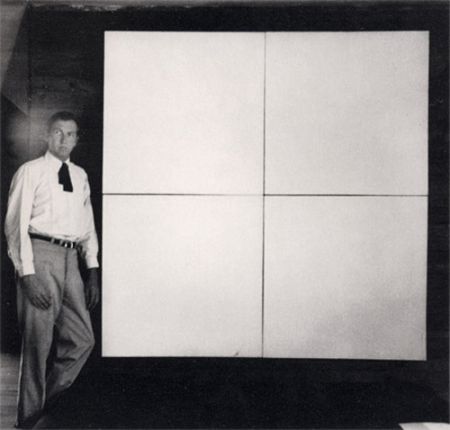
— 8 — 

Leaving the 20th Century, edited and translated by former British situationist Christopher Gray, published only in the UK and long out of print, was until Ken Knabb’s book the best representation of situationist writing in English, and it was not good. Translations were messy and inaccurate, the selection of articles erratic and confusing, the commentary often mushy.

With the exception of a good edition of The Society of the Spectacle put out by Black & Red of Detroit in 1977, other situ­ationist work in English was far worse. A few pieces — “The Decline and Fall of the Specta­cle-Commodity Society” (on Watts), “On the Poverty of Student Life” (the SI’s most fa­mous publication, which caused a scandal in France in 1966 and prefigured the May 1968 revolt), “The Beginning of an Era” (on May 1968) — appeared as smudgy, sometimes gruesomely typeset and translated pamphlets. Most were put out by the short­-lived British or American sections of the SI, or by small situationist-inspired groups in New York or Berkeley.

The situationist journal, and the situ­ationist books as they were originally pub­lished in Paris, could not have been more different. Wonderfully illustrated with photos, comics, reproductions of advertise­ments, drawings, and maps, Internationale Situationniste had an elegant, straight­forward design: flat, cool, and direct. It made a simple point: what we have written is meant seriously and should be read seriously.

The Situationist International Anthology does not present the complete text of the situationist journal, and it has no illustrations. But the translations are clear and readable — sometimes too literal, sometimes inspired. Entirely self-published, the anthology is a better job of book-making than most of the books published today by com­mercial houses. There are virtually no typos; it is well indexed, briefly but usefully an­notated, and the design, binding, and print­ing are all first class.

In other words, Knabb has, unlike most other publishers of situationist material in English, taken the material seriously, and allowed it to speak with something like its original authority. One can follow the devel­opment of a group of writers which devoted itself to living up to one of its original prescriptions: “The task of an avant-garde is to keep abreast of reality.”

The situationist journal was never copyrighted. Rather, it bore this legend: “All the texts published in International Situationniste may be freely reproduced, trans­lated, or adapted, even without indication of origin.” Knabb’s book carries an equivalent notation.

— 9 — 

The role of the Situationist International, its members wrote, was not to act as any sort of vanguard party. The situationists “had to know how to wait,” and to be ready to disap­pear in a common festival of revolt. Their job was not to “build” the SI, as the job of a Trotskyist or Bolshevik militant is to build his or her organization, trimming all thoughts and all pronouncements to that goal, careful not to offend anyone who might be seduced or recruited. Their job was to think and speak as clearly as possible — not to get people to listen to speeches, they said, but to get people to think for themselves.

Rather than expanding their group, the situationists worked to make it smaller, ex­pelling careerist, backsliding, or art-as-poli­tics (as opposed to politics-as-art) members almost from the day the group was formed. By the time of the May 1968 revolt, the Situationist International was composed mostly of Parisians hardly more numerous­ — perhaps less numerous — than those who walked the streets as the Lettrist Interna­tional. Behind them they had 11 numbers of their journal, more than a decade of fitting theory to fragments of practice, and the scan­dals of Strasbourg and Nanterre, both of which gained them a far wider audience than they had ever had before. And so, in May, they made a difference. They defined the mood and the spirit of the event: almost all of the most memorable graffiti from that explosion came, as inspiration or simply quota­tion, from situationist books and essays. “Those who talk about revolution and class struggle, without understanding what is subversive about love and positive in the refusal of constraints,” ran one apparently spontaneous slogan, in fact a quote from Raoul Vaneigem, “such people have corpses in their mouths.”

At the liberated Sorbonne and later in their own Council for Maintaining the Oc­cupations, the situationists struggled against reformism, working to define the most radi­cal possibilities of the May revolt — “[This] is now a revolutionary movement,” read their “Address to All Workers” of May 30, 1968, “a movement which lacks nothing but the con­sciousness of what it has already done in order to triumph” — which meant, in the end, that the situationists would leave behind the most radical definition of the failure of that revolt. It was an event the situationists had constructed, in the pages of their journal, long before it took place. One can look back to January 1963 and read in I.S. #8: “We will only organize the detonation.

— 10 — 

What to make of this strange mix of post-surrealist ideas about art, Marxian concepts of alienation, an attempt to recover a forgot­ten revolutionary tradition, millenarianism, and plain refusal of the world combined with a desire to smash it? Nothing, perhaps. The Situationist International cannot even be justified by piggy-backing it onto official his­tory, onto May 1968, not because that revolt failed, but because it disappeared. If 300 books on May 1968 were published within a year of the event, as I.S. #12 trumpeted, how many were published in the years to follow? If the situationist idea of general contestation was realized in May 1968, the idea also re­alized its limits. The theory of the exemplary act — and May was one great, complex, momentarily controlling exemplary act —­ may have gone as far as such a theory or such an act can go.

What one can make of the material in the Situationist International Anthology is perhaps this: out of the goals and the perspectives the situationists defined for themselves came a critique so strong it forces one to try to understand its sources and its shape, no matter how much of it one might see through. In an attack on the Situationist International published in 1978, Jean Barrot wrote that it had wound up “being used as literature.” This is undoubtedly true, and it is as well a rather bizarre dismissal of the way in which people might use literature. “An author who teaches a writer nothing,” Walter Benjamin wrote in “The Author as Pro­ducer,” “teaches nobody anything. The de­termining factor is the exemplary character of a production that enables it, first, to lead other producers to this production, and secondly to present them with an improved apparatus for their use. And this apparatus is better to the degree that it leads consumers to production, in short that it is capable of making co-workers out of readers or spectators.” The fact is that the writing in the Situationist International Anthology makes almost all present-day political and aesthetic thinking seem cowardly, self-protecting, careerist, and satisfied. The book is a means to the recovery of ambition. ❖

This article from the Village Voice Archive was posted on March 18, 2020


The Bride and the Bachelors: an exhibition at The Barbican, London March 2013

Until recently I knew about Marcel Duchamp but not very much. I knew he was an iconoclast who presented a porcelain urinal as a work of art but I had no idea of his profound influence on others like John Cage and Merce Cunningham. Visiting this exhibition at the Barbican changed all that. It is apparent how important Duchamp’s ideas were. In fact, it has filled in quite a few gaps for me.

It is perhaps not suprising to have not seen many of his works in the past. It seems that most of them are in Philadelphia and there aren’t really that many of them. Also, many of his art works were conceptual and the original pieces were lost. It was the idea that was important. This was especially true of his readymades. The famous urinal piece Fountain was presented for exhibition  to the Society of Independent Artists exhibit in 1917. “Artworks in the Independent Artists shows were not selected by jury, and all pieces submitted were displayed. However, the show committee insisted that Fountain was not art, and rejected it from the show. This caused an uproar amongst the Dadaists, and led Duchamp to resign from the board of the Independent Artists.”(Wikipedia)

Duchamp Fountain

Duchamp Fountain. This is the only known photograph of the original urinal that was lost. Signed by R.Mutt! It was turning it on it’s side and signing it that made it art!

This was the point at which Duchamp rejected retinal (roughly, things you can see) art and developed ideas of “art at the service of the mind.” In fact, he is probably the first conceptual artist. He liked the idea of being an artist but was not so convinced by art.He was a big influence on the Dadaists of the early 20s who rejected mainstream art.

Dada was born out of negative reaction to the horrors of World War I. This international movement was begun by a group of artists and poets associated with the Cabaret Voltaire in Zurich. Dada rejected reason and logic, prizing nonsense, irrationality and intuition. The origin of the name Dada is unclear; some believe that it is a nonsensical word. Others maintain that it originates from the Romanian artistsTristan Tzara and Marcel Janco‘s frequent use of the words da, da, meaning yes, yes in the Romanian language. Another theory says that the name “Dada” came during a meeting of the group when a paper knife stuck into a French-German dictionary happened to point to ‘dada’, a French word for ‘hobbyhorse’.(Dona Budd “The Language of Art Knowledge”)

I don't belive in art I believe in artists.

This exhibition deals with Duchamp’s ideas but also looks at his influence on other artists particularly John Cage, Merce Cunningham, Robert Rauschenberg and Jasper Johns. As I found earlier on this year he was also a big influence on Richard Hamilton who created his own picture of Nude Descending a Staircase which you can see in a previous post. The Nude by Duchamp was painted at a time when he was influenced by both Cubism and Futurism and he tries to convey movement in the picture which I think he succeeds in. The Hamilton picture on the other hand seems very static. Was that intentional?

1035442

Hamilton’s version of Duchamp

John Cage is someone I know a lot more about. Like Duchamp and other members of the American avant garde in the 1940s and 50s he was often seen as a dilettante, a kind of fool but after the publication of his book Silence in the early 1960s opinion of him radically changed and he is now seen as one of the most important composers of the 20th Century. Yes, he is the composer of the infamous 4’33” that so many have heard of but so few have actually heard. It consists of silence in three parts. Of course, he used it to prove there was no such thing as silence. He was influenced by Duchamp but his readymades were found sounds. He put forward the theory that all sound is and can be music. He also introduced chance into his compositions by using the I Ching (a Chinese divination book of wisdom) and other methods. Artist Robert Rauschenberg created paintings that were pure white to show that visual events still happened with shadows, blemishes etc. Choreographer Merce Cunningham created dances in collaboration with Cage and Rauschenberg that used similar chance methods. All of this happened because of the ideas and influence of Duchamp. His position in history is assured.

John Cage score for Strings 20

John Cage score for Strings 20 created by dropping ink stained pieces of string on to a page.

White Painting by Robert Rauschenberg

White Painting by Robert Rauschenberg

The exhibition was fascinating and definitely worth visiting. There is music playing and the recorded sounds of dancers (and sometimes real dancers).  There is a strange kind of peacefulness in the air, probably helped by the fact the gallery wasn’t that full when I was there! It raises and in some ways answers the question “what is art for?”. On the other hand the pieces are still displayed in a pristine white gallery and they are still worth millions of dollars to collectors. It’s ironic that 50 years after Duchamp questioned Art and announced the readymade that Andy Warhol could take a Brillo box or a soup can and call it art and it now sells for tens of thousands of dollars. Either someone didn’t get the joke or they never really understood what was being said in the first place. And in the post modern world of Damian Hirst and Tracey Emin there is no longer even any irony in it.

Duchamp with his bicycle wheel mounted on a stool.

Duchamp with his bicycle wheel mounted on a stool. Apparently this was never exhibited. He liked having it in his studio and spin the wheel round!

Jasper Johns Figure 8

Jasper Johns Figure 8. Creating art from the mundane!

‘Yellowism’ Explained!

I found this blog when looking for images of Duchamp and decided to copy and post it here. It links to my ‘Vandalising Rothko’ piece and at the time I had no idea what Yellowism was! I found it very interesting so I reposted it in full. It is clear that Vladimir Umanets was very influenced by Duchamp. I want to make it clear that I do not necessarily agree with what’s written here, I’m not sure I can even understand it! However, I believe that Umanets was motivated by a strong force and the question “What Is Art For?” is still a valid pursuit. He showed courage and commitment to do what he did but I’m not convinced by his philosophy at this stage.

Here’s an interesting post from Interdome about the treatment of Umanets i.e. giving him a two year prison sentence for defacing the Rothko:

As a case study, let’s look at Ai’s Dropping a Han Dynasty Urn.

On the surface level, the photo set appears to mock artistic fetishism: Ai looks like he could not possibly give a fuck as he lets the valuable artifact shatter on the ground. There’s a sublime disregard in the pictures; it’s art against art like Kruger’s sentences are ads against ads. But as an artist, Ai can’t destroy art, he can only make more. From one urn, he gets three pictures. If I went into the Hirshhorn, grabbed one of the photos off the wall, and let it fall to ground like I didn’t give a fuck, I would be arrested and taken to jail. It’s only freedom of expression if you break something you own, otherwise it’s vandalism.

One true vandal learned this lesson (or taught it) very publicly when Vladimir Umanets was sentenced to two years in prison for writing “a potential work of yellowism” on a Mark Rothko painting in London’s Tate Modern. Yellowism is the idea that if anything can become art regardless of its use value, then we could imagine a third category of stuff past art, in light of which the art/non-art distinction dissolves. Both are equally potential works of yellowism, just like a soup can and a urinal are equally art objects. Umanets writing “a potential work of yellowism” on a Rothko is the same as Duchamp Sharpie-ing “a potential work of art” on a toilet while he takes a piss. Except Umanets isn’t an artist. We know he’s not an artist because he’s in jail in England, and England, Ai would remind us, has freedom of expression.

Umanets wasn’t looking for freedom of expression, but freedom from expression, out from under the artistic injunction to replace what you destroy. He wanted to break without buying, but that’s not in liberalism’s deal. And no one cries for a vandal.

Because Umanets is a vandal and not an artist, there won’t be any complaints from the U.S. State Department. Because this is England and not Russia, there won’t be a Human Rights Watch report, as there was for the band Pussy Riot when they were arrested for trespassing. Even anti-capitalist arts writers called for his head on a platter.

Anonymous asked: FUCK OFF PLEASE

x

29 Mar 2013 / 0 notes

►► The Authors of the Death
by Marcin Lodyga

When looking from art perspective, one can say that yellowism is a dead territory where the richness of meanings and interpretations is reduced to one – to yellow. But one needs to remember that yellowists don’t announce the death of art. Art is and will be alive forever. They rather say that yellowism is dead, inert, homogeneous mass without creativity. Authors of the manifesto and definition of yellowism are the authors of the death – yellowists are the authors of a single interpretation. This death is positioned outside of art, like mirror.

Roland Barthes in “The Death of the Author” says: “To give a text an Author” and assign a single, corresponding interpretation to it “is to impose a limit on that text.” Barthes argues against the method of reading that relies on aspects of the author’s identity — their political views, historical context, religion, ethnicity, psychology, or other biographical or personal attributes — to distill meaning from the author’s work. Yellowists want to impose a limit on the text, on art, and on ordinary reality too, but not by giving a “text” an author. Paraphrasing Barthes I say: To give a “text” a YELLOW and assign a single, corresponding interpretation to it is to impose a limit on the text. Barthes demands the death of the author (author disappears) because the author’s identity limits the text, the reading. In yellowism case author also disappears and yellow – the necessary “limitation” appears instead of the author.

Inside yellowism the artistic kingdom of meanings and interpretations is erased together with the author. It doesn’t matter WHO made a piece of yellowism because all pieces were, are and will be about yellow only. Yellowism is permanent, boring, inert, homogeneous flat, ‘dead’ mass. Always was and always will be. Like in the forest where all the trees (meanings) ‘look’ the same – wherever you go you are in the same place anyway. A thousand kilometers left, two meters right or backwards – you are always in the same place. In yellowism the nature of the authors has “the identity of the indistinguishable forest”.

Barthes conclusion: “the birth of the reader must be ransomed by the death of the Author.” Yellowism conclusion: the death of meanings and the death of the author must be ransomed by the birth of single meaning – yellow.

image

image

image

Marcin Lodyga
“Sounds from the chamber”
piece of yellowism
for public audition in yellowistic chambers only
CD / audio recording of a walk through Miroslaw Balka exhibition Gravity made in the gallery space
executed in 2013

Anonymous asked: please can you explain the relevance of all the tits and bums on this site to yellowism. Is yellowism tits and bums? is that the context everything is reduced to?

x

5 Mar 2013 / 1 note

image

Anonymous asked: At least Marinetti was funny..

x

4 Mar 2013 / 1 note

image

►► Luncheon on the grass
(on the grass: Arthur Danto, Roy Turner, Joseph Kosuth, Marcin Lodyga)

What makes the difference between a Brillo box and a work of art consisting of a Brillo box is a certain theory of art. It is the theory that takes it up into the world of art, and keeps it from collapsing into the real object which it is. – Arthur Danto. But to expose the irrelevance of this idea when attributed to the tradition, we have only to ask what “real object”, “Le déjeuner sur l’herbe” by Manet collapses into when the implicit theory which supported it is refuted. – ask another thinker Roy Turner (Philosophy Now magazine)

Marcin Lodyga starts: If “Le déjeuner sur l’herbe” by Manet was placed in the context of yellowism, inside a yellowistic chamber, then it would stop to be a work of art and it would become a piece of yellowism – a pure expression of yellow color in the form of Manet painting. Inside yellowism the painting by Manet is not a work of art. We have only to ask what piece of yellowism “Le déjeuner sur l’herbe” by Manet collapses into when the implicit context of yellowism which supported it is refuted. The answer: it collapses into a work of art, it becomes a work of art again, it gains its previous status.

Painting is a kind of art. If you make paintings you are already accepting (not questioning ) the nature of art. One is then accepting the nature of art to be the European tradition of a painting-sculpture dichotomy. – nervously said Joseph Kosuth (“Art After Philosophy”). Dear Joseph – Marcin replies – in the context of yellowism – which is NOT a kind of total, huge conceptual art work, as you would consider it probably, painting is not a work of art. You said: “Art is the definition of art”, I say: yellowism is the definition of yellowism.

text by Marcin Lodyga
27/02/13

The Flaneur art blog- Should Umanets really be jailed for 2 years for defacing a Rothko? #yellowism –

flaneurphotos:

New Post has been published onhttp://flaneur.me.uk/12/should-umanets-really-be-jailed-for-2-years-for-defacing-a-rothko-yellowism/

Should Umanets really be jailed for 2 years for defacing a Rothko? #yellowism

image

26 Feb 2013 / Reblogged from flaneurphotos with 5 notes / yellowism

Interdome: As a case study, let’s look at Ai’s Dropping a Han Dynasty Urn. On the…

interdome:

As a case study, let’s look at Ai’s Dropping a Han Dynasty Urn.

On the surface level, the photo set appears to mock artistic fetishism: Ai looks like he could not possibly give a fuck as he lets the valuable artifact shatter on the ground. There’s a sublime disregard in the pictures;…

26 Feb 2013 / Reblogged from interdome with 4 notes / yellowism


fixedgearbikesyeah asked: NO ONE CARES

x

9 Feb 2013 / 1 note

justiceismine asked: Yellowism is neither art, nor anti-art but a cause. Some might ask if Yellowism is needed or say it’s pathetic/stupid but I say it deserves it’s place as did Jackson Pollock for example, which he did not get at his time.

x

6 Feb 2013 / 3 notes

spacecowboysparklefingers asked: No one is going to drink your yellow kool-aid. Your totalitarian snake oil ideology has been ineffectual and irrelevant since De Stijl/Neoplasticism tried it. There is no dialogue here, you won’t even respond to this with anything more than an “X”. Please don’t write on anymore Rothko’s (or any other pieces of art for that matter), they are not yours to write on, and some people really enjoy them. No one wants you here yellowism, go home.

x

6 Feb 2013 / 1 note

image

image

Marcin Lodyga
“You can start painting again, in yellowism”
yellowistic draft
signed and dated on the front
poster printed for the occasion of Duchamp season in Barbican, London
150 x 100 cm
executed in 2013

image

►► Rome outside of art
by Marcin Lodyga

Yellowism is not dadaism or neo-dadaism. If you think that yellowism is dadaism then actually you are a dadaist, because you try to devalue yellowism and make it meaningless. Dadaists were nihilists and they “promoted” nonsense. The fact that in yellowism everything means yellow leads to the wrong conclusion that everything means nothing and therefore yellowism is perceived as nihilism /dadaism. This is the big misunderstanding. The real consequence of yellowism existence is the philosophy of ONE and the vision of many different isms (existing outside of art) which can be reduced to (one) yellow-ism anyway. Although yellowism clones exist under different names – they are yellowism. In the future: many one-perspective “worlds”. Not only one “world” full of perspectives (meanings), many various subjective interpretations – like in postmodernism, especially postmodern art, but also many separate “worlds” (greenism, blueism, chairism) with one perspective each, concentrated on one meaning only. Yellowism, divided into many isms, will be positioned away from the forever developing, “organic” realm of art.

The total flattening announced by yellowists is more humanitarian than dadaism because it doesn’t leave people with nothing – inside the desert of meanings where you can watch only the wrecks and corpses of culture. Yellowists save one meaning (yellow) for everything and also they let you live in the “yellowistic totalitarian illusion of many”- you can exist in autonomous groups called greenism, blueism, chairism or skyism etc. but you will be a yellowist anyway. All roads lead to Rome. The universal Rome – the absolute truth will be always outside of art.

Dadaists are nihilists, they do not offer anything, they don’t show a new perspective, new possibilities, they replace everything with nothing. » Dada (…) wants nothing, absolutely nothing, and what it does is to make the public say ” We understand nothing, nothing, nothing “. “The Dadaists are nothing, nothing, nothing and they will surely succeed in nothing, nothing, nothing.” « 391, No. 12, Paris, March 1920 Francis Picabia who knows nothing, nothing, nothing.

Nihilists say that without absolute, universal, and transcendent values, there can be no real values at all. Friedrich Nietzsche, however, argues that the lack of such absolute values does not imply the absence of any values at all. Nietzsche “permits” the values of many different and even mutually exclusive perspectives. This is called “perspectivism” – all ideations take place from particular perspectives. This means that there are many possible conceptual schemes, or perspectives in which judgment of truth or value can be made. This leads (me) to postmodernism. Postmodernism is the consequence of Nietzsche’s perspectivism but is nihilistic. The proliferation of alternative perspectives, beliefs and values makes that postmodern society is foundationless.

This what we see in the galleries is the result of postmodernism or post-post modernism, or postpostpostmodernism, whatever. Many perspectives, many points of view, not one grand and universal but many interpretations closed inside the circle called “art”. In the future artists will resign from art, will abandon this circle. Art full of many perspectives will still exist but will be surrounded by – isms. Some artists will never leave the territory of art but there will be yellowists, greenists, chairists looking at them from outside – located in one perspective circles.

All the other isms are actually yellow-ism because, they have the same architecture, logic. Finally they can be reduced to yellowism, flattened to yellow-ism. However, people will need this totalitarian illusion of many isms, they will construct their own contexts, for example greenism,redism, chairism or godism, and they will be happy inside the isms but all the new one-meaning worlds can be always considered as yellowism.

Yellowism doesn’t replace (like dadaism) all the values with nothing, yellowism gives one sense instead of nonsense. Yellowism presents the vision of many autonomous territories around multiperspective art. Yellowism saves the ONE – whatever it is: blue, green, chair and offers the new grand philosophy of ONE.

Marcin Lodyga
18.01.2013
London

mysar: yellow posterby rasym aka. mysar

mysar:

yellow posterby rasym aka. mysar

19 Jan 2013 / Reblogged from mysar with 3 notes

image

image

Marcin Lodyga, Khadija Davies
Portrait of Members of Art & Language with Caps, in the Style of Jackson Pollock
yellowistic draft
signed and dated 18/01/13 on the front
magazine cover, pink ink
22.4 x 28.6 cm
Executed in 2013

The authors of manifesto and definition of yellowism Marcin Łodyga and Vladimir Umanets at The British Museum in London (January 2012).
© Sylwester Kolton.

►► Discipline and punish.The birth of the black hole

Yellowists see the whole domain of reality and the whole domain of art as gigantic readymades which can be transported into the context of yellowism. Yellowism is a specific prison, a ghetto in which you are free from freedom, in which the freedom of interpretation doesn’t exist. Every content placed in this territory defines yellow color. It requires a noetic discipline. You have to respect the internal yellowism law. Yellowism is a bit like a black hole – most of the information about the matter that went into forming the black hole is lost. In the end yellowism only remembers the total mass, charge, and angular momentum. The physical form of objects and beings transported from art and reality is preserved, but all the forms carry only one, always and forever the same, identical message. You can observe that something is moving inside, you can watch pieces of yellowism free from the past and future; there is a movement but there is actually no time.

Yellowists don’t punish art, they don’t take a revenge on art or reality. Manifesto of yellowism is not a death sentence for art. Yellowists don’t destroy and don’t create. Yellowism is not vandalism and it’s not a form of creation. There is no postmodern, Derrida’s deconstruction, any destruction or creative construction inside yellowism. There is something else: flatstruction. Everything is flattened to yellow, all interpretations are ironed to one flat surface, to one meaning. The total flattening (flatstruction) is a state of permanent homogeneity. Yellowists don’t create and they don’t destroy, they make everything flat therefore, inside yellowism, deconstruction, creativity, vandalism, surrealism or fascism or anything else is flattened to one, to the expression of yellow.

Artists push the boundaries of art and are imprisoned in their seeming freedom. Yellowists are free outside of art. They resigned from art, they overstepped the boundary and the fact that everything can be about yellow gives them the almost cosmic freedom.

text by Marcin Lodyga

►► A dead animal

Today you can overstep the border, you can be a bit like Alice through the looking glass, you don’t have to, together with other artists, push the boundaries of art further anymore, now it’s time to cross it and discover the another, still unknown for many, space called yellowism. Of course, you can stay where you are and run your artistic life in harmony with the motion of postmodernism. Yellowists don’t announce the end of art; they say in manifesto: art is a forever developing whole. They don’t promote a slogan: “art is dead”, they rather say that yellowism is dead and always was dead and always will be dead. Therefore they don’t want to replace art with yellowism. They just introduce a new autonomous territory, specific environment which is parallel to the context of art. They give you a vision of time in culture when the resignation from art will be a trend. Yellowists show you the possibility of alternative existence in which the fact that you abandon art is considered as the most creative decision. It doesn’t matter what the condition of art will be after twenty or hundred years – yellowism will be still the same. Any changes and any progress around yellowism are and will be, metaphorically speaking, like a tank of formaldehyde for a dead animal.

text by Marcin Lodyga

Richard Hamilton Late Works at the National Gallery

I had a lovely time visiting London this week. Like New York it is a place that makes me feel good just by being there, walking around! This time I went to The National Gallery to see the Richard Hamilton exhibition before it closed.

ecard-RH-with-text-revised2

Richard Hamilton is one of the first artists to describe what he was doing as Pop Art a long time before Andy Warhol started using the term. His iconic picture from  1957 is called “Just what is it that makes today’s homes so different, so appealing?

Just what is it that makes todays homes so different so appealing

Just what is it that makes today’s homes so different, so appealing? Notice the word Pop on the lollipop.

Here is his potential manifesto for Pop Art written in January 1957:

“16th January 1957

Dear Peter and Alison,

I have been thinking about our conversation of the other evening and thought that it might be a good idea to get something on paper, as much to sort it out for myself as to put a point of view to you.

There have been a number of manifestations in the post-war years in London which I would select as important and which have a bearing on what I take to be an objective:

Parallel of Life and Art
(investigation into an imagery of general value)

Man, Machine and Motion
(investigation into a particular technological imagery)
Reyner Banham’s research on automobile styling
Ad image research (Paolozzi, Smithson, McHale)
Independent Group discussion on Pop Art – Fine Art relationship
House of the Future
(conversion of Pop Art attitudes in industrial design to scale of domestic architecture)

This is Tomorrow
Group 2 presentation of Pop Art and perception material attempted impersonal treatment. Group 6 presentation of human needs in terms of a strong personal idiom.

Looking at this list is is clear that the Pop Art/Technology background emerges as the important feature.

The disadvantage (as well as the great virtue) of the TIT show was its incoherence and obscurity of language.

My view is that another show should be as highly disciplined and unified in conception as this one was chaotic. Is it possible that the participants could relinquish their existing personal solutions and try to bring about some new formal conception complying with a strict, mutually agreed programme?

Suppose we were to start with the objective of providing a unique solution to the specific requirement of a domestic environment e.g. some kind of shelter, some kind of equipment, some kind of art. This solution could then be formulated and rated on the basis of compliance with a table of characteristics of Pop Art.

Pop Art is:
Popular (designed for a mass audience)
Transient (short-term solution)
Expendable (easily-forgotten)
Low cost
Mass produced
Young (aimed at youth)
Witty
Sexy
Gimmicky
Glamorous
Big Business

This is just a beginning. Perhaps the first part of our task is the analysis of Pop Art and the production of a table. I find I am not yet sure about the “sincerity” of Pop Art. It is not a characteristic of all but it is of some – at least, a pseudo-sincerity is. Maybe we have to subdivide Pop Art into its various categories and decide into which category each of the subdivisions of our project fits. What do you think?

Yours,

(The letter was unanswered but I used the suggestion made in it as the theoretical basis for a painting called Hommage á Chrylsler Corp., the first product of a slowly contrived programme. R.H.)”(Collected Words 1953-1982)

The exhibition for the Late Works was in preparation before Hamilton died on 13th September 2011. It seems odd to have such contemporary images in the conservative National Gallery but it is based on his studies of works that are in there. There is a particular interest in Renaissance perspective. There are also allusions to work by his hero Marcel Duchamp.

I found the exhibition very interesting although I know some others were disappointed. I am most impressed that right into old age Hamilton was still experimenting and using computers and Photoshop to create his images. I was particularly impressed by the culmination of the exhibition Le chef-d’oeuvre inconnu in which three great painters contemplate a reclining nude. This is very evocative and emotional.

3420

Le chef-d’oeuvre inconnu

Richard Hamilton_Venus

Le chef-d’oeuvre inconnu

An evocation of Marcel Duchamp

An evocation of Marcel Duchamp

An annunciation

An annunciation

The Passage of the Angel to the Virgin, 2007

The Passage of the Angel to the Virgin, 2007

Yes, I am very impressed by these pictures and would recommend this exhibition if it moves somewhere else although I think it was particularly curated for the National Gallery with it’s many references to pictures in it’s collection and the building itself.