Tom Rapp, ’60s Folk Experimentalist And Civil Rights Attorney, Dead At 70 | BPR

I found this link on the Middle Earth Facebook group. Tom Rapp was part of a great late 60s band called Pearls Before Swine. They were one of my favourites. He was a really great songwriter and a big influence on me. He wrote a song called Rocket Man which inspired Elton John to write his version, which obviously became a big hit. Tom’s was better in my opinion, though.

Tom Rapp, a civil rights attorney and musician best known for his late-’60s and early-’70s recordings under the name Pearls Before Swine, has died while in hospice care at his home in Melbourne, Fla., his publicist confirmed to NPR Music. He was 70 years old.

Like many of his generation, Rapp was inspired by Elvis and The Everly Brothers. But it was hearing Bob Dylan‘s “Blowin’ in the Wind” in the early ’60s that finally galvanized him to begin writing music in earnest. (A possibly apocryphal tale goes that Rapp and Dylan actually competed as children in the same talent contest, with Dylan placing fifth, Rapp second.)

Pearls Before Swine’s first record, One Nation Underground, released in 1967, wore that influence plainly on its sleeve — not so much the fraught Hieronymous Bosch extract that adorned its cover, but in the Xeroxing of Dylan’s vocal delivery (with the addition of Rapp’s notable and endearing speech impediment) heard on the song “Playmate.” While Rapp may have been emulating on the mic there, the rest of the music on “Playmate” is woven with forward-thinking threads of psychedelia and garage rock. Further on, Rapp steps into his own, even presaging punk’s approach to institutional fealty (don’t) in the lyrics of “Drop Out!” and an avant-garde approach to a cursing word, spelled out in Morse code, on “(Oh Dear) Miss Morse.”

The album would go on to sell “about 250,000,” Rapp told NPR Music’s Bob Boilen last fall during a conversation centered on its 50th anniversary reissue. Despite the impressive sales, Rapp and his bandmates received next to no money from them. Bernard Stollman, who ran the label ESP-Disk’ that released One Nation Underground and its follow-up, told them that “the CIA and the Mafia were putting [the records] out themselves,” and so the sales weren’t ending with money in the pocket of ESP-Disk’ and, by extension, Pearls Before Swine. (Or many of the label’s other artists, the story goes.)

Rapp would go on to release eight more well-regarded records — Balaclava, the follow-up to One Nation Underground, perhaps highest among them — before utterly disappearing from music in 1974, not long after opening a concert for Patti Smith.

Infused with the spirit of the counterculture, but not willing to take his own advice and “drop out,” Rapp headed to college and, from there, law school, graduating from the University of Pennsylvania Law School in 1984. Rapp was a civil rights attorney in Philadelphia until 2001, after which he returned again to Florida. His practice emphasized reining in corporations and local governments.

As much as his music, Rapp’s work as a lawyer and his attitude towards his rediscovery in the popular imagination were illustrative of his spirit. Nearly 17 years ago, Rapp’s career was profiled for Weekend Edition by Peter Clowney. Rapp was bemused at the bloom of his late-in-life celebrity, treating it with a humbled, arm’s-length detachment, the attitude of someone who had long since filled his life.

Describing that rediscovery, which began around 1992 while he was in Philadelphia, Rapp said: “They call me a psychedelic godfather and they have these articles about how I’m a legend. The way that works is, you do some albums in the ’60s that are OK, you go away for 30 years, and you don’t die — then you’re a legend.”

During that piece, Rapp shared his “lessons from the ’60s.” They began with a dark half-joke: “One of the lessons of the ’60s was that assassination works.” He continued: “Love is real. Justice is real. Countries have no morals; you have to kick them to get them to do the right thing. Honesty is possible and necessary. And everything is not for sale.”

Source: Tom Rapp, ’60s Folk Experimentalist And Civil Rights Attorney, Dead At 70 | BPR

With the Weathermen: The Personal Journal of a Revolutionary Woman – Susan Stern (1975) | 1960s: Days of Rage

“Drugs. Sex. Revolutionary violence. From its first pages, Susan Stern’s memoir With the Weathermen provides a candid, first-hand look at the radical politics and the social and cultura…

Source: With the Weathermen: The Personal Journal of a Revolutionary Woman – Susan Stern (1975) | 1960s: Days of Rage

The Society of the Spectacle – Guy Debord (1967)

1960s: Days of Rage's avatar1960s: Days of Rage


The Society of the Spectacle (French: La société du spectacle) is a 1967 work of philosophy and Marxist critical theory by Guy Debord, in which the author develops and presents the concept of the Spectacle. The book is considered an important text for the Situationist movement. Debord published a follow-up book Comments on the Society of the Spectacle in 1988. The work is a series of 221 short theses. They contain approximately a paragraph each. Debord traces the development of a modern society in which authentic social life has been replaced with its representation: ‘All that once was directly lived has become mere representation.’ Debord argues that the history of social life can be understood as ‘the decline of being into having, and having into merely appearing.’ This condition, according to Debord, is the ‘historical moment at which the commodity completes its colonization

View original post 260 more words

Living the Bohemian Student Dream in 1960s Paris

studentsinparis

I love to find a good Paris photo story that I haven’t seen before, and this one that I found buried in Life magazine’s archives is a quite a treat. Veteran photographer for the magazine Loomis Dean followed a group of young students in 1961, getting an intimate peek into their lives as they pursued the bohemian dream in mid-century Paris.

And you know what? It doesn’t seem like much has changed. Clicking through, I noticed the routines didn’t seem so different from the Paris I’ve come to know today. Whether you start out in a tiny attic room or student dorms, throw yourself into the café culture or lose yourself in art museums, Paris is more recogniseable than ever in this photo story from decades past…

Monday nights at the local…

parisbar

parisbar4

parisbar3


The mid-week hangovers…

hangover

Actual photo caption: “Student with a hangover”.

hangover1


To the Café! (and make it a double)…

pariscafe1

paricafe


Close living quarters (the dorm room years)…

dorms5

A college dormitory at number 57 Rue Lacépède in the 5th arrondissement (Latin Quarter).

dorms4

There is still a café under this building called La Contrescarpe (see it here on Google earth).

dormroom

records

A student looking through his music.

dorm2

parisdorm


 A Classroom in Paris

studentspark

Students studying in a park.

artstudents

Art students visiting a gallery.

artstudents2


Every hour is Apéro Hour!

parisbar2


Getting to know the locals…

parisbar5

(over Pastis-fuelled philosophical debates)

parisbar6


Beatnik shindigs in old wine cellars…

cellarparty

cellar1


Ending up at a house parties, having no idea who the apartment belongs to.

parisparty


Saturday nights in.

parisdinner

parisdinner3

parisdinner2


Inspiration-searching Sundays…

parisstreet

seinemusician

Strolling down the Seine…

parisstreet1

parisman

parisartist

Art students “picnicking” with their models…

nudes


Not forgetting Springtime loves…

parisinspiration

fallinginlove

fallinginlove1


And of course, too many damn cigarettes.

smokingcigarettes

cellarparty1

pariscafe2


All photos (c) LIFE

Interview with Dave Andrews of Radio Leicester about iconic music venue “Il Rondo”

This is an interview by Dave Andrews of Radio Leicester with me, Shaun Knapp, and Sue Barton about the iconic music venue Il Rondo that is now a store room for an Italian restaurant! It was amazing to see it and realise it was still there virtually unchanged but rather derelict.

The Il Rondo hosted some of the greats of popular music including The Rolling Stones, The Who, Howlin’ Wolf, Fleetwood Mac and a host of others!


Heaven and Hell Coffee Lounge in Soho, W1 |Eric Lindsay

This is a brilliant blog post about the Heaven and Hell Coffee Bar in Soho written by it’s founder Eric Lindsay (link at end). Sadly not with us anymore. Check it out!!
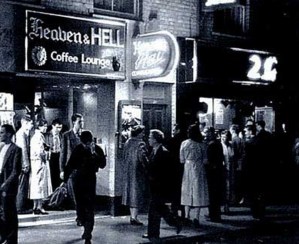
Ray Jackson and I opened Heaven and Hell in late 1955. I had the idea from when I had been working in Paris, where there was a type of cheap cabaret called  “Ciel at l’Enfer” “Heaven and Hell” in Pigalle. The name and the place intrigued me, so later when I was in Paris again with Ray, I took him along to see the place and he also thought it was tacky but great.

The name stayed in my memory for a later date.

Here are some old photographs that I have just come across to show you how much the original impressed me. “Ciel et l’Enfer” was an intriguing name.

heaven-and-hell-old-postcard

heaven-and-hell-old-postcard-2

We had already sold the Regency Coffee Bar in East Sheen, which we opened with £200, £100 each, sometime in 1953. The Regency look was in, so we bought chairs from an antique shop in Putney for 5/- each and the owner of the shop taught me how to give them the antique look. We bought cheap floor covering, Ray’s uncle hung the wallpaper and my mother made the tablecloths and curtains. I used the same red Regency striped material to upholster the chairs, it was all a bit make do and mend, but the final result looked great. The major expense was the Gaggia Coffee Machine, which we paid off for. So espresso coffee came to East Sheen!

We thought we would do business, well forget it! I thought we would be stuck there for the rest of our lives. East Sheen was half way on the bus route between Hammersmith and Richmond, and really one should never get off the bus. I was convinced it was a place that people just stopped off to die. There was literally no business. Although everybody who lived there had the airs and graces of society toffs, they had no cash flow to buy a cup of coffee. In fact they hadn’t got a pot to piss in! But they lived in East Sheen so they had a little status. (They thought!)

Fortunately both Ray and I continued working in Theatre and TV, and Ray in films because we needed something extra to survive.

We were ‘so busy’ at the Regency that one person could run the whole place – serve coffee, do the cooking, the lot. So Ray and I worked alternate days. When I was on duty I would take an order and call out to the kitchen and then rush round talking to myself (the invisible chef). At least it was a good way to pass the time and it gave the customers the idea that we had staff.  I thought I was going to be stuck there forever.  We earned £10 a week each. My bus fares cost me £5, so you can see I was really in pocket! Finally we managed to sell the place to a guy who had retired from Claridges Hotel with a pension who wanted something easy to do in his retirement years. Well I could have told him that he wouldn’t be rushed off his feet here, but I didn’t and we sold the Regency for the princely sum of £1000, which was a profit, and we both breathed a sigh of relief!

We then started searching around for empty premises in Soho because I certainly wasn’t going out of town again. It had to be a shop and basement so that Heaven could be on the ground floor and Hell downstairs. We finally came across a little shop with a basement at 57 Old Compton Street. The ground floor had a small jewelry shop sharing the premises called of all things “Going Gay”.  Do you think it was an omen? The gentleman who owned the freehold was called Harry Shanson, and he owned all the freeholds of 55, 57 and 59 Old Compton Street W.1.

Shaws the estate agents who were handling  the property arranged for Ray and myself to see Mr. Shanson in his office in the City. Well, somehow it must have been our lucky day, because we talked to him and told him we were actors and what we wanted to do with the premises and the name we were going to call the coffee bar and the whole theme. He was interested in everything we had to say. Finally the question of rent came up and Ray and I nearly fell of the chairs when he told us what he wanted. It was far too much for us to afford. We got up to leave and explained that we just couldn’t afford to pay that sort of rent. He asked us how much we could afford. I told him half of what he was asking, to which he replied, “O.K.” With that, we both nearly passed out. Ray and I left his office floating on air.

We started work at 57 Old Compton Street. From the St. Martins School of Art we found a designer to make the plaster casts for the lights in Heaven and also Hell. Beforehand, Ray and I decided that Heaven should have an ethereal theme with sun flowers for lights with cherub faces. The staircase leading to Hell was a giant Devil’s mouth, which you walked down into. Hell was totally black with red flames climbing up the walls.

Out of the walls for lights we had these arms holding lighted Devil masks. The emergency exit, which we had to have, was a ladder in the middle of the room closed on 3 sides with a red curtain on which was a full length painting of the Devil with horns, tail and pitch fork. It was all very atmospheric and the customers adored it. On the street wall we had a light box with a colour transparency of Heaven and below it Hell. From the moment we opened, the place was full, at lunchtimes and evenings. I used to have to stand on the door letting customers in as a seat became vacant whilst they were queuing out in the street. Not many people wanted to stay in Heaven, they all wanted to go to Hell. No pun intended. As you may gather, business was fabulous, especially when the Soho Fair was on.

heaven-and-hell-soho-fair

heaven-and-hell-coffee-lounge-1-print

Over the years Harry Shanson and his wife became firm friends. He was one of the kindest people in the world. One day when we had been running quite a few years, Harry’s son, who was a bit of a monster when he was young, came in and said to me, “My daddy owns this place! It’s ours.” So I politely said to him “Fuck off!”

There was never a dull moment in Old Compton Street. The 2 I’s was next door. The customers would go from coffee bar to coffee bar. The 2 I’s used to have their windows smashed in regularly. We fortunately were left alone. Everyone seemed to making money and at 9 pence a coffee it was some hard going.

Two prostitutes in 1950s Soho

Prostitutes were on every street corner. The flat above Heaven and Hell was occupied by Suzy, an elegant French lady of the night who really would have been more at home in Mayfair, but I suppose she wanted a quick turn over! She wore the stair carpet out all the time. Next door at No. 57, Jackie, another French beauty, much younger than Suzy, could turn 100 customers a day. My mother, who used to come up to town regularly, used to sit in the window in Heaven and keep score. She was so intrigued by it all.

Well, the time came when Ray and I decided that we would like to get a flat together, so I spoke to Harry Shanson. The lovely  Suzy got her marching orders and Ray and I moved into Flat 1, 57 Old Compton Street at a rent that he asked us what we would like to pay, so that also was very reasonable. It was a known fact that he could always get at least double from the tarts. I did think she might send the ‘heavies’ in after being thrown out and when she found out that we had taken the flat, but no, she was always pleased to see me and talk when I saw her on her new beat at the corner of Greek St. and Old Compton St. Working ‘flats’ were not that difficult for the ‘girls’ to come by.

Suzy had kept the place spotless, after all she had he own French maid who was on duty full time during the working hours. The bedroom looked as though it had seen plenty of action. But after we had redecorated the whole place even Suzy wouldn’t have recognized it as her own little bordello.

We never had live music in Heaven and Hell, just two jukeboxes one in Heaven and one in Hell, with the same records in each. It was easier than all the hassle with live music because the customers never left. With us, they stayed about an hour and left, rather than sitting there all night. Also it was much more profitable as we would get loads of double plays from the 2 machines.

So the money rolled in and we were ready to roll out onto our next venture which was:

“THE CASINO de PARIS STRIPTEASE THEATRE CLUB”

P.S. If any of you ‘older readers’  happen to come across a picture of yourselves taken inside “Heaven and Hell,” I would be very happy to include it into my blog.

Source: Heaven and Hell Coffee Lounge in Soho, W.I. | ericlindsay 

Be Here Now – Ram Dass (1971)

1960s: Days of Rage's avatar1960s: Days of Rage


“I watched the movie many, many times, but when it came to reading Be Here Now, it was so over my head. I loved the artistic presentation and illustrations, but every time I tried to read it, I had no idea what it was talking about. So it sat on a shelf alongside all my other books, and every once in a while I’d catch the title out of the corner of my eye and feel guilty for never reading it. In case you haven’t read it, Be Here Now is a pretty ‘far out’ book. Written in the early 70’s, it begins with some background about Dass himself: how he was a professor at Harvard, and his work at the forefront of the 60’s LSD research and experimentation movement. Dass says things that might alienate or scare off a person who didn’t live through the Sixties, or who…

View original post 286 more words

Coney Island of the Mind – Lawrence Ferlinghetti (1958)

1960s: Days of Rage's avatar1960s: Days of Rage


“This year marks the 50th anniversary of the publication of Coney Island of the Mind, Lawrence Ferlinghetti’s landmark second volume of poetry. In commemoration, New Directions has recently released a new hardback edition of the book, complete with a CD of the author reading the bulk of its poems, as well as selections from Pictures of the Gone World, his first collection of verse. Such an elaborate republication is highly appropriate–for time has revealed Coney Island of the Mind to be not only a book of great cultural importance, but also a major classic of modern poetry. As a social phenomenon Coney Island of the Mind is truly remarkable. With roughly a million copies in print, few poetry collections come anywhere close to matching its readership. Raw sales, though, only tell part of the story. Along with Jack Kerouac’s On the Road and Allen Ginsberg’s Howl

View original post 150 more words