Atlanta Studies | Parks are for the People: The Piedmont Park Riot and the Politics of Late 1960s Atlanta

By Christopher Huff

In the summer of 1967, Atlanta Journal reporter Michael Palmer went undercover as a hippie. Hoping to provide his readers with some insight into a movement that had recently made its way into the national consciousness, Palmer put on a “white, ruffled shirt, and old vest, levies [sic] frayed at the cuffs” and stealthily entered the city’s small but noticeable hippie community. In a series of articles that followed this experience, Palmer discussed with a mixture of dismissal and despair what he encountered during his five weeks of undercover research – from watching people take drugs in a “crash pad” to participating in a “love-in” at Piedmont Park. While Palmer ultimately provided little real insight into the countercultural mindset, he did make his readers very aware that something new and different was happening in Midtown Atlanta.1

During the late 1960s and early 1970s the section of the city that straddled Peachtree Street for several blocks, running from roughly Seventeenth Street down to Tenth Street, served as Atlanta’s own version of San Francisco’s famed Haight-Ashbury district. This part of Midtown had acquired several names over the years2 – Tight Squeeze, the 10th Street Business District and the 14th Street Area – but became popularly known as “the Strip” during its countercultural heyday.3 The area had already developed a reputation as a bohemian destination by the early 1960s – one reporter described it as “Atlanta’s own Greenwich Village” – due to its proximity to the Atlanta College of Art and the Atlanta Memorial Arts Center, as well as its abundance of affordable housing for young adults moving to the city.4 By the middle of the decade a small community of hippies found a spiritual home with the opening of the Catacombs coffeehouse on Fourteenth Street. The area’s “hip” population – which included not only “real” hippies but also political radicals, members of motorcycle gangs, left-leaning religious leaders, artists, teenage runaways, drug dealers, sympathetic lawyers, social workers, business owners, and teenage “plastic hippies,” who visited the Strip on the weekends but then returned to their suburban homes on Sunday evenings – grew significantly in 1967 as the counterculture gained national recognition and thousands of curious teenagers and young adults made their way to hippie neighborhoods across the nation during the Summer of Love.

POLICE PERFORMING A NIGHTTIME ANTI-DRUG RAID AGAINST HIPPIES, ATLANTA, GEORGIA, AUGUST 4, 1969. V003-600001-A24, TOM COFFIN PHOTOGRAPHS. SPECIAL COLLECTIONS AND ARCHIVES, GEORGIA STATE UNIVERSITY LIBRARY. COURTESY GEORGIA STATE UNIVERSITY.
Several factors, however, thwarted attempts by Strip residents to create a thriving and safe hip community in Atlanta.5 Business owners disliked them, local “straight” residents complained repeatedly to city officials about their presence, and the police engaged in an ongoing campaign of harassment that included arresting hippies for minor infractions. In July, 1968, a group of local business owners attended a meeting of the city’s Aldermanic Police Committee to complain how the hippie presence harmed the value of their businesses and made it “unsafe for residents to walk down the street.” That same month, Police Chief Herbert Jenkins launched a crackdown on the area’s hippie population.6While the city’s recently founded underground newspaper, the Great Speckled Bird, regularly reported on the ill-treatment the hip community suffered at the hands of business owners and the police, the straight press routinely ignored or downplayed these issues.7
INSPECTING THE DAMAGE: “ATLANTIS RISING BOMBING,” ATLANTA, GEORGIA, SEPTEMBER 11, 1969. V003-690911-A28, TOM COFFIN PHOTOGRAPHS. SPECIAL COLLECTIONS AND ARCHIVES, GEORGIA STATE UNIVERSITY LIBRARY. COURTESY GEORGIA STATE UNIVERSITY.
These issues worsened considerably during the first six months of 1969. The Great Speckled Bird speculated that a recent wave of suspicious fires in the area was an attempt to scare away hippies.8 In addition, the number of sexual assaults against hip women in the Strip increased, as did the number of physical confrontations between Strip residents and straight locals, some of which included the exchange of gunfire.9 In August, a near riot erupted in the Strip when hippies and political radicals clashed with local police and agents from the Georgia Bureau of Investigation during yet another in a series of drug raids in the neighborhood.10 Then, in early September, a firebomb destroyed Atlantis Rising, a combination artist collective and recreation center that served Strip residents and acted as a meeting space for radical political groups.11 Finally, this pattern of confrontation and violence culminated on September 21 when attendees and police clashed during a free concert in Piedmont Park.
The events leading up to and following the Piedmont Park riot illustrate the changing nature of social and political life in Atlanta during the late 1960s. Far from an isolated incident, the riot, and the response to it, reflected the growing frustration of Strip residents as they faced continual police harassment and acts of anonymous violence while trying to create a functional alternative district built on the concepts of cooperation and community. Moreover, the riot revealed connections and shared concerns between white youth and the African American community at a time of significant change in the local political landscape. While the Piedmont Park riot is a lesser known event of civil disobedience in the history of Atlanta, re-examining the riot reveals how far the political and cultural radicalism of the 1960s had made its way into the nation’s most conservative areas, as well as how the presence of a community of radical white youth impacted local political scene, which is usually portrayed by historians of the era as a struggle between conservative whites and African Americans for control of the city during a time of significant demographic change.

OUR PARK

By the late 1960s, Piedmont Park, located just a few blocks east of the Strip, offered a safe haven away from the hassles of life on Peachtree. At a time when hippies were routinely arrested for simply walking down the street, the existence of a place where they could gather freely ensured that the park became integral to community-building efforts by local counterculture and New Left leaders. The Atlanta antiwar movement often chose the park as a gathering point for marches into downtown or as a location for post-march rallies.12 And in July 1968, approximately 800 people gathered around the park’s pavilion for the city’s first “Be-In,” an event copied from the more famous San Francisco Human Be-In held the previous summer.13 The hip community’s use of Piedmont Park increased significantly during the first nine months of 1969. In March, the Great Speckled Bird celebrated its first anniversary with a party in the park. The city’s political activists even took time to enjoy the park’s athletic facilities by forming a “Revolutionary Softball League” that spring.14 And the series of free Sunday concerts which had occurred occasionally during the spring and early summer of 1969 became more regular occurrences following the 1969 Atlanta International Pop Festival. The festival, held over the Fourth of July holiday weekend at an automobile racetrack in Hampton, Georgia, featured Janis Joplin, Joe Cocker, Credence Clearwater Revival, Grand Funk Railroad, and Led Zeppelin.15 Held the day after the festival ended, a free concert in Piedmont Park featured many of the bands that had played at Hampton, including, Delaney and Bonnie, Spirit, the Allman Brothers, and the Grateful Dead.16
While the park served as key place to experience countercultural entertainment, the recent wave of harassment and violence in the Strip also led many hippies and New Leftists alike to see their use of the park in more overtly political terms; it had become an important battleground in their quest for meaningful social change.17 This shared cause between the counterculture and New Left was not unique to Atlanta in the late 1960s. While the middle years of the decade witnessed the rise of two movements that could be identified as uniquely separate, each with its own goals and philosophies, by 1969 the boundaries between the New Left and counterculture had become blurry. The New Left recast itself into an expansive social movement aimed at the creation of a new American culture as it sought more than just political change, while the counterculture rethought its earlier utopianism and now sought to practice its core beliefs within, rather than separate from, American society.18
VIETNAM WAR PROTEST. METRO ATLANTA CHAMBER OF COMMERCE COLLECTION AT KENAN RESEARCH CENTER AT ATLANTA HISTORY CENTER. COURTESY ATLANTA HISTORY CENTER.
HIPPIE DRUM CIRCLE IN PIEDMONT PARK, ATLANTA, GEORGIA, CIRCA 1969. TOM COFFIN PHOTOGRAPHS. SPECIAL COLLECTIONS AND ARCHIVES, GEORGIA STATE UNIVERSITY LIBRARY. COURTESY GEORGIA STATE UNIVERSITY.
Echoing countercultural writers around the nation, the Bird had repeatedly expounded on the importance of rock music as a catalyst for social change and on Piedmont Park’s new role as a site for this melding of culture and politics.19 In a piece entitled “Our Park,” “Richard” explained the importance not only of rock music to the creation of a new society, but of a place to experience such music in a revolutionary way, noting that:20
if we are a revolutionary culture then we must . . . refuse festivals and radio and recordings . . . musicians will play, will fill our parks, because they must play, and we will listen because we must and there will be no one in between.
By the summer of 1969, the importance of Piedmont Park to the growth of Atlanta’s hip community led many Strip residents to consider the park, at least on certain days, as their own. Piedmont Park became a place to listen to some good music, get a free meal, commune with likeminded individuals, discuss radical politics, and explore new ways of living together. Or as “Richard” concluded,21
you will come to the park to make it your park and you will listen to music and know that it is your music and it will be freedom.
Following the dramatic firebombing of Atlantis Rising in late August, the park also became a place of spiritual rejuvenation for the Strip community. On the Sunday following the attack, a benefit concert for the store was held in the park that featured several prominent local and regional bands, including the Allman Brothers. As Miller Francis, the community’s preeminent cultural chronicler, noted in an article for The Great Speckled Bird the concert was more than simply a musical event or a rally for Atlantis Rising. For Francis, the park acted not simply as a public recreational space, but as a key focal point for the political struggle to build a viable alternative community.22 Accordingly, as he noted:23
PEOPLE EATING AT A FREE CONCERT SPONSORED BY THE “GREAT SPECKLED BIRD” AT PIEDMONT PARK, ATLANTA, GEORGIA, SEPTEMBER 21, 1969. TOM COFFIN PHOTOGRAPHS. SPECIAL COLLECTIONS AND ARCHIVES, GEORGIA STATE UNIVERSITY LIBRARY. COURTESY GEORGIA STATE UNIVERSITY.
The vibes in Piedmont Park on all the Saturdays and Sundays flow out of our fight to replace the power behind the firebomb . . . that gutted Atlantis Rising, and our attempt to design a politics to effect that replacement.
Francis noted the intense sense of positive feelings that the crowd in “our park” generated, as well as the wide array of the city’s population which was in attendance in addition to the usual hippie contingent, including “straight, crewcut, turned-on, tribal, black, working class, mothers and children.”24 However, it would be this very attachment to the park that laid the foundation for the riot that occurred only a week later.
Throughout the nation, public spaces played an important role in bringing politics and culture together. Parks took on particular meaning in the late 1960s, serving as a central site for the expression of a spatial politics that helped reveal the growing intersection of the counterculture and the New Left. Perhaps most famously, in May 1969, violence erupted in Berkeley over an undeveloped piece of land owned by the University of California. Claiming the space as their own, over two hundred hippies, college students, and community activists had turned the former parking lot into a park, which they called “People’s Park.” Then, on May 15, police cleared the park and encircled it with cyclone fencing, a provocation which the local hip community responded to by rioting with the ensuing street battle ending that evening only after twenty policemen had been injured and twenty protestors had been shot, one fatally.25 While the events in Berkeley are well-remembered, the events at Piedmont Park a few months later exemplify that the willingness to defend contested space was not restricted to cities famous for their radical communities.

“GET THE PIGS OUT OF OUR PARK!”

The September 21, 1969, free concert in Piedmont Park boasted an impressive lineup. While the Allman Brothers would not play that Sunday, the show presented some of the best local rock acts, including Radar, the Booger Band, and headliner The Hampton Grease Band. This list of performers, as well as the success of the concert the previous Sunday, and a prominently placed announcement in the Great Speckled Bird, ensured a sizable attendance. And despite a chilly rain, by late afternoon between 1,000 and 1,500 people had arrived in the park.
ONE OF THE BANDS PERFORMING AT A “GREAT SPECKLED BIRD” CONCERT IN PIEDMONT PARK, ATLANTA, GEORGIA, SEPTEMBER 21, 1969. V003-600001-C27, TOM COFFIN PHOTOGRAPHS. SPECIAL COLLECTIONS AND ARCHIVES, GEORGIA STATE UNIVERSITY LIBRARY. COURTESY GEORGIA STATE UNIVERSITY.
Several staff members from the Great Speckled Bird circulated through the crowd, collecting affidavits regarding police harassment, which they planned to include as part of the paper’s recently-filed lawsuit against the police department.26 Earlier that month the hip community became involved in a local debate over police brutality. During a speech at the West Hunter Street Baptist Church on September 12, DeWitt Smith, an African American patrolman, publicly accused several white officers of beating three black prisoners without provocation. Notably, during his comments, he also mentioned the mistreatment local hippies routinely endured, stating:27
if your hair is long and you’re wearing bell-bottoms you are in for it. Girls are jerked and pulled into line by their hair . . . and they {officers} seem to delight in grabbing a man by the seat of his pants and lifting him up until the pressure in his groin becomes unbearable.
During the following week, a coalition of local civil rights groups and the Great Speckled Bird filed separate lawsuits against the Atlanta police department, which illustrated an emergent, if problematic, alliance of the New Left, the counterculture, and the local civil rights movement in late 1960s Atlanta.28
But in addition to the Bird staffers, several undercover policemen also moved through the crowd in the park that day. And just as the band Brickwall started its set, word began to circulate that undercover narcotics agents from the Atlanta police were in the audience and looking to make arrests. Concert attendee George Nikas soon found himself in custody after following Detective C. R. Price through the crowd, warning other concertgoers that Price was a policeman. As the young man was led away a crowd gathered around the two and began chanting “show us your badge!” and “let him go!” In the ensuing confrontation, Price ended up pulling his service weapon and brandishing it at the crowd, providing enough of a distraction for Nikas to escape and disappear back into the audience.29
“GREAT SPECKLED BIRD” PHOTOGRAPHER BILL FIBBEN BEING ARRESTED DURING A BOTCHED POLICE OPERATION DURING A CONCERT IN PIEDMONT PARK, ATLANTA, GEORGIA, SEPTEMBER 21, 1969. V003-600001-C35, TOM COFFIN PHOTOGRAPHS. SPECIAL COLLECTIONS AND ARCHIVES, GEORGIA STATE UNIVERSITY LIBRARY. COURTESY GEORGIA STATE UNIVERSITY.
As the music, which had stopped during the struggle, resumed, Price and several other policemen moved back into the crowd and quickly found, and again apprehended, Nikas. This time, they also arrested Bill Fibben, a staff photographer for the Bird. But several hundred audience members immediately surrounded the cars containing Nikas and Fibben, shouting “This is our park!” and “get the pigs out of our park!” In response, police called for reinforcements and tear gas canisters. The concert’s promoter attempted to persuade police to let him restore calm but before he could do so, an officer lobbed a tear gas canister into the crowd and what had been merely an angry confrontation between the police and the concertgoers turned into a riot.30
TEAR GAS UNLEASHED ON HIPPIES ATTENDING A FOLK CONCERT IN PIEDMONT PARK, ATLANTA, GEORGIA, SEPTEMBER 22, 1969. PHOTO BY NOEL DAVIS. AJCP211-032A, ATLANTA JOURNAL-CONSTITUTION PHOTOGRAPHIC ARCHIVES. SPECIAL COLLECTIONS AND ARCHIVES, GEORGIA STATE UNIVERSITY LIBRARY. COPYRIGHT ATLANTA JOURNAL-CONSTITUTION. COURTESY GEORGIA STATE UNIVERSITY.
As the protestors around the patrol car began to scatter, several paddy wagons and almost the entire evening watch of the Atlanta police force approached the park. For the next thirty minutes a running battle of sorts took place. The police, who had taken up a position not far from the park pavilion, fired tear gas canisters into the crowd while several officers repeatedly charged into the rioters. The crowd responded by throwing some of the tear gas canisters back, along with rocks, cans and glass bottles, quickly dispersing after each volley only to retake its position after the clouds of tear gas dissipated.31 Ultimately, the confrontation ended only after American Civil Liberties Union lawyer Al Horn arrived at the park and talked with Police Superintendent Oscar Jordan.32 Following this conversation, the crowd calmed down and several police officers left the park. As attempts were being made to restart the music, Police Chief Herbert Jenkins and Mayor Ivan Allen finally arrived, too late to make any meaningful contribution although the mayor did spend some time speaking with concertgoers.33

RESPONSES TO THE RIOT

While the Piedmont Park riot resulted in few injuries and only twelve arrests,34 it provoked a variety of responses from the Strip community, civil rights leaders, local politicians, and city officials. The statements issued by these groups reveal the complicated nature of Atlanta politics in the late 1960s as well as divisions within the city’s hip community. Moreover, the cooperation between the hip and civil rights communities in response to the riot revealed how disaffected groups in Atlanta could cross racial lines when they found common cause.
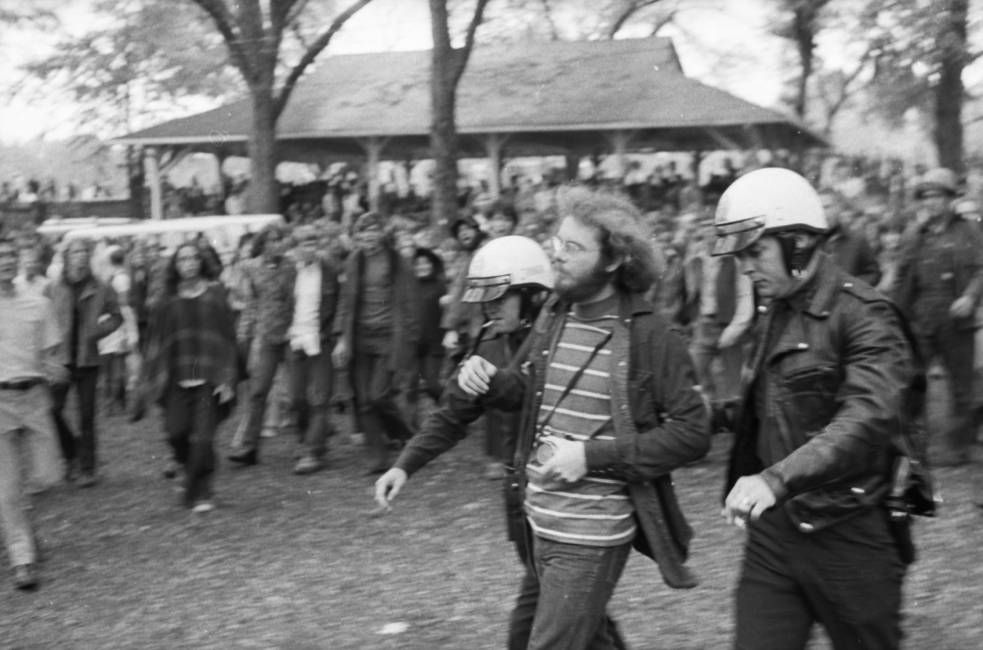
POLICEMEN DRAGGING A YOUNG HIPPIE THROUGH THE GRASS, PIEDMONT PARK, ATLANTA, GEORGIA, SEPTEMBER 22, 1969. PHOTO BY NOEL DAVIS. AJCP211-032B, ATLANTA JOURNAL-CONSTITUTION PHOTOGRAPHIC ARCHIVES. SPECIAL COLLECTIONS AND ARCHIVES, GEORGIA STATE UNIVERSITY LIBRARY. COPYRIGHT ATLANTA JOURNAL-CONSTITUTION. COURTESY GEORGIA STATE UNIVERSITY.
With the mayoral election just weeks away, several of the candidates weighed in on the riot. City alderman Everett Millican, who had recently proposed a park curfew, favored drastic action, promising that, if elected, he would “run the hippies out of town.”35 Echoing statements he had made the previous spring, he labeled the city’s countercultural district “a disgrace,” filled with “hippies, homosexual, sex deviates and drug pushers.”36 While admitting that Piedmont Park had deteriorated before the hippies claimed it as their own, he still argued that “it’s gone down a lot more since.”37 Alderman and mayoral candidate Rodney Cook took a less aggressive position, stating that law-abiding citizens should not fear being “hit over the head” by police but that those who broke the law should be punished to the fullest extent possible. Instead of running the hippies out of town, Cook believed that hiring more policemen, raising salaries, providing them with better training, and creating neighborhood patrols would solve the problem.38
HIPPIES TALK TO MAYOR IVAN ALLEN JR. AFTER THE RIOT. FROM: GREAT SPECKLED BIRD 2, NO. 29 (SEPTEMBER 29, 1969), 22. GREAT SPECKLED BIRD COLLECTION. SPECIAL COLLECTIONS AND ARCHIVES, GEORGIA STATE UNIVERSITY LIBRARY. COURTESY GEORGIA STATE UNIVERSITY.
Meanwhile, in stark contrast to the interpretation of the riot offered by members of the political establishment, Great Speckled Bird writer Greg Gregory analyzed the riot from a countercultural perspective, arguing for the park’s importance to the development of a new American society and declaring that,39
Sunday’s resistance was not ‘revolutionary antics,’ the work of ‘agitators.’ Sunday was a defense of the kind of life we have chosen to live. This life includes music; it includes dope; but more significantly; and of revolutionary impact, is our self-perception as a people acting in unity.
He continued:40
A park cannot be liberated by permit, cannot be ‘free’ just because freaks come together to dig some fine music . . . Sunday was about what comes down when . . . we transgress the constricted lifestyle that is acceptable to and in this rotten society.
But Gregory also had harsh words for members in the hip community who criticized those who had fought back against the police. Arguing that this criticism attacked the very unity the riot had created, Gregory suggested that “to fall back on a love-and-peace stance which quickly becomes a hate-the-bottle throwers posture is to fragment the solidarity that saw politicos and culture freaks standing side by side.”41 While praising the importance of gentleness to their cultural revolution, he nonetheless argued that cruelty, not gentleness, needed to be the appropriate response when “tribal celebrations” came under attack. As he saw it, solidarity required that musicians, “trippers,” and rock throwers stand together or the new culture they hoped to create would die. Likewise, Jim Gwin asserted that “we must defend our vision as it emerges in concrete form. The communal/music experience in Piedmont Park is that vision.”42
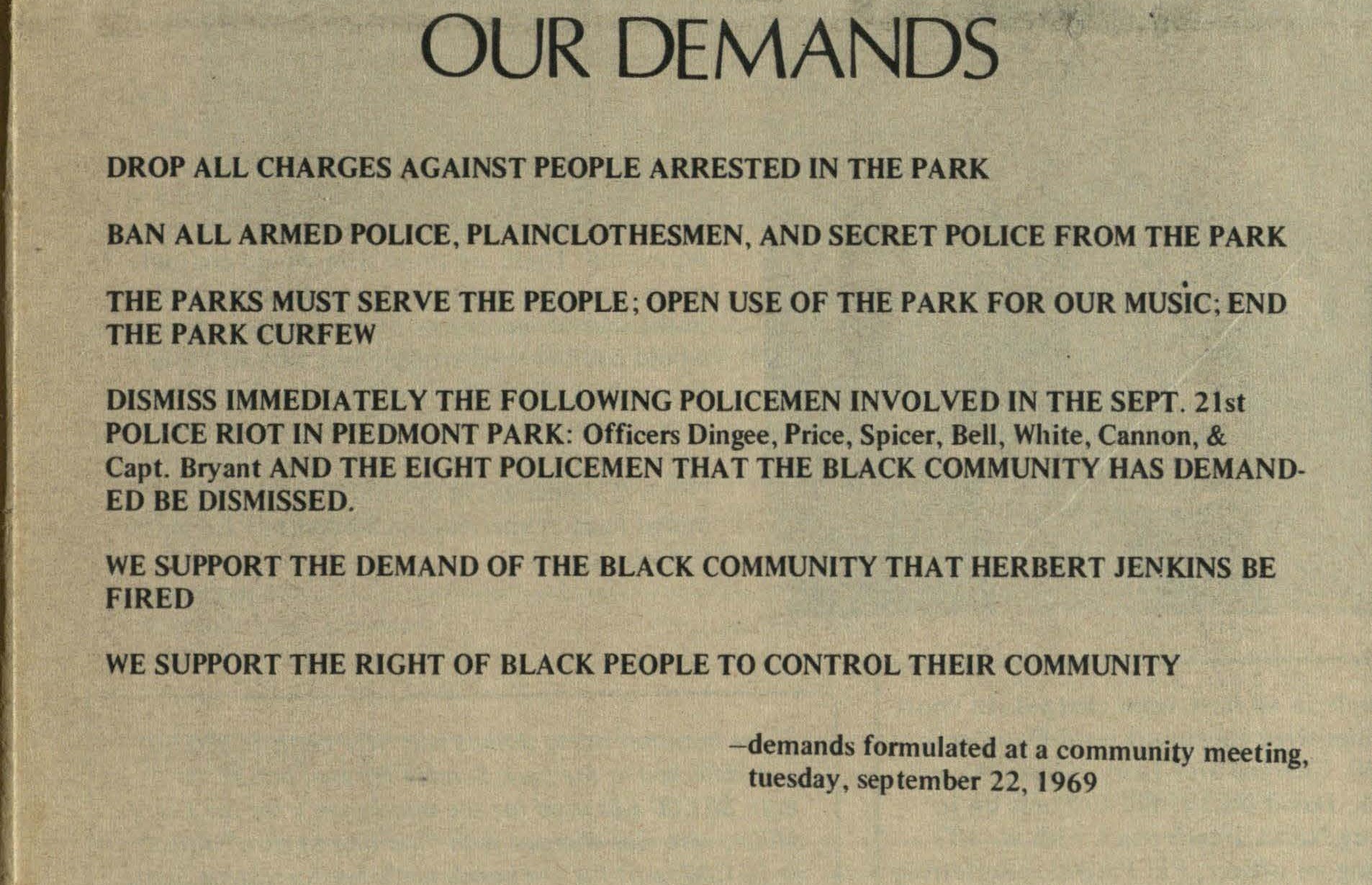
The politicos of the Great Speckled Bird also responded quickly to the riot. Staff members at the Bird office began immediately collecting the statements of approximately one hundred people present in the park during the confrontation, which would be added to the police harassment suit the Bird had filed recently in federal court.43 During a press conference held at the newspaper’s office the day after the riot, the hip community presented three demands: that all charges against those arrested on Sunday be dropped, that all plainclothesmen and other policemen be banned from the park and, finally, to “let us have our music.”44
The riot also generated support from the city’s civil rights community. On Monday, the Atlanta Ad Hoc Committee on Law Enforcement and the Community, which had come together the previous April to investigate police brutality and included members of the Urban League, the National Association for the Advancement of Colored People, and the Metropolitan Atlanta Summit Leadership Conference, presented four recommendations to Mayor Ivan Allen. The committee called for an end to harassment, suspensions of policemen accused of brutality, improved jail conditions, and the establishment of grievance procedures. The group also noted that the Atlanta police “showed the same brutal force as Chicago” in their efforts to disperse the park crowd, a reference to the previous year’s street riots during the Democratic National Convention.45 While Allen declined to comment on these recommendations, he stated that the city would undertake a “full investigation of police brutality charges” stemming from the riot, and announced that the two officers noted most prominently for their actions in the park, C. R. Price and D. L. Dingee, had been transferred to duty in south Fulton County. Both the mayor and Jenkins stated this might help the situation since the problem had been caused only by a small number of “bad apples” within the police force.46
The committee clearly saw common cause between black Atlantans and the Strip community when it came to law enforcement issues. In its statement to Allen, it claimed that “the city has evaded responsibility and accountability for abuse of its citizens. Brutality occurs not only at the jail, it happens at the time of arrests . . . and we know that the police rioted in Piedmont Park yesterday.”47 Likewise, Southern Christian Leadership Conference (SCLC) leader Hosea Williams articulated the connection between oppressed African Americans and hip community members. When speaking to the crowd at Piedmont Park after the riot, he told them that,48
this is the same thing that has been happening to black people for a long time – and partly for the same reason: because they don’t want to conform to the ways of this sick, racist society. The reason they’re brutalizing you is simple: you want to live your own life, your own way.
THE GREAT SPECKLED BIRD 2, NO. 29 (SEPTEMBER 29, 1969), 3. GREAT SPECKLED BIRD COLLECTION. SPECIAL COLLECTIONS AND ARCHIVES, GEORGIA STATE UNIVERSITY LIBRARY. COURTESY GEORGIA STATE UNIVERSITY.
The Strip and civil rights communities further strengthened their bonds in the wake of the riot by planning a march to police headquarters at a meeting that included representatives from the Bird and the SCLC alongside numerous hippies and street people, ministers from several local churches, local countercultural shopkeepers, and political radicals. In addition to the three demands formulated immediately after the riot, the group agreed to publicly support the call from civil rights groups for the termination of Police Chief Herbert Jenkins and the demand that African Americans control their own communities. Attendees also demanded the firing of seven police officers involved in the riot, including Price and Dingee, as well as eight other officers that the African American community wanted dismissed.
On Saturday, September 27, a procession of approximately 600 marchers – which would ultimately grow to 1,000 participants – left Piedmont Park headed downtown along the city’s main thoroughfare. Holding banners with the phrases “Fire Jenkins” and “No Armed Police or Narks in Park,” the group included several African American ministers and civil rights leaders, such as the Reverend Douglas Slappey of the African Methodist Episcopal Church, and Hosea Williams. Once they reached police headquarters the marchers handed over their demands to Superintendent Jordan and the crowd listened to several speeches, before turning around and heading back to the park.49
YOUNG PEOPLE MARCH IN PROTEST AGAINST POLICE TACTICS AFTER A “GREAT SPECKLED BIRD” SPONSORED CONCERT, ATLANTA, GEORGIA, SEPTEMBER 27, 1969. V003-690927-A08, TOM COFFIN PHOTOGRAPHS. SPECIAL COLLECTIONS AND ARCHIVES, GEORGIA STATE UNIVERSITY LIBRARY. COURTESY GEORGIA STATE UNIVERSITY.

WHERE DID ALL THE HIPPIES GO?

The riot and the series of confrontations that led up to it would ultimately garner national attention via an October 10 story in Time magazine, entitled “The Great Hippie Hunt,” in which it was suggested that, 50
police and state solicitor general’s agents, with the tacit approval of the city administration and Atlanta’s business community, have waged war against these so-called undesirables, treating them as the greatest threat to the city since General Sherman.
This coverage and the brief flurry of activity following the riot in Piedmont Park ultimately did little to change conditions for the better, either in the Strip or at the park. Indeed, while the Strip had drawn most of the city leaders’ attention up to that point, in the years after the riot, they would increasingly object to the presence of the hip community in Piedmont Park as well, which many Atlantans had given up using after the hip community had adopted it as its own in 1969. Moreover, due to increased police harassment and the passage of a new city loitering ordinance in 1970,51 large numbers of people who had formerly called the Strip home had moved several blocks east to Piedmont Park. Reports in local papers claimed that at least several hundred people now called the park home and in August 1971 the Bird reported: “the Strip is practically deserted and the park is being used more.”52 But the introduction of hard drugs, the growing presence of criminal elements – including violent bikers – and a serious problem regarding teenage runaways changed the nature of the community and provoked a set of responses from the new Mayor Sam Massell that would ultimately end the hips’ occupation of the park and spell the end of Atlanta’s hip community.
After a series of shootings in the summer and fall of 1971, Mayor Massell announced that a “special police detail, a mobile precinct, and a mounted patrol” would soon be on duty in Piedmont Park because, as he described it, “the park is a big place but not big enough to house punks with knives, guns, and needles.”53 These additional policeman soon began patrolling Piedmont Park aggressively and the crackdown had its intended effect – within days, hips had largely abandoned the park. New regulations which were soon adopted also made it harder to organize the kind of events that the hip community had held in Piedmont Park over the past several years, such as rock concerts, political rallies, and antiwar demonstrations.54 Denied the ability to organize events, hips still attempted to congregate informally in the park. Not surprisingly, the police worked diligently to make them unwelcome by selectively enforcing park ordinance 22-38, which made it “unlawful for any person, in any park, to, stand, walk, or ride on the grass,” and by asking for identification from members of any group of six or more hips. As the Bird put it, a “police state” now existed in the park.55
MOUNTED PATROL IN PIEDMONT PARK. BOYD LEWIS COLLECTION AT KENAN RESEARCH CENTER AT THE ATLANTA HISTORY CENTER. COURTESY ATLANTA HISTORY CENTER.
Pushed out of Piedmont Park and the Strip, the hip community saw its demise approaching quickly over the horizon. As its members relocated to other neighborhoods, left town, or moved on to new pursuits and passions, mainstream society’s adoption of many countercultural elements in the first years of the 1970s diminished the need for separate spaces where people could freely practice alternate lifestyles. Smoking marijuana, growing long hair, or just generally letting your freak flag fly no longer seemed so threatening, as witnessed by the newfound presence of “shaggy-haired young business executives in downtown Atlanta.”56 As the hippies disappeared, the developers moved in. Over the next several decades, the coffeehouses, clubs, and crash pads of the Strip were plowed under, replaced by gleaming high-rise office buildings. Piedmont Park, however, remained largely unchanged and stands today as one of the few remaining physical spaces connected to Atlanta’s hip community. This seems appropriate, given the importance of the park to the city’s hippies and political radicals. Although the riot that occurred in September 1969 is perhaps the best remembered event of Atlanta’s freak past, in truth it was one among many that briefly helped turn Piedmont Park into a park for the people.
ATLANTA MAYOR SAM MASSELL INPSECTS AT THE PROPOSED LAYOUT OF COLONY SQUARE, 1971. PHOTO BY ROBERT CONNELL. AJCP103-015A, ATLANTA JOURNAL-CONSTITUTION PHOTOGRAPHIC ARCHIVES. SPECIAL COLLECTIONS AND ARCHIVES, GEORGIA STATE UNIVERSITY LIBRARY. COPYRIGHT ATLANTA JOURNAL-CONSTITUTION. COURTESY GEORGIA STATE UNIVERSITY.
This work is licensed under a Creative Commons Attribution-NonCommercial-NoDerivatives 4.0 International License. Attribution must provide author name, article title, Atlanta Studies, date of publication, and a link to this page. Note that this license applies only to the text of the article, not to media used here by permission.

Source: Atlanta Studies | Parks are for the People: The Piedmont Park Riot and the Politics of Late 1960s Atlanta

The junky genius of Alexander Trocchi | Tony O’Neill | The Guardian

The plotless beauty of his writing, and its fearless look at the emptiness of his own life, put ‘the Scottish Beat’ on a par with Kafka and Camus.

My scow is tied up in Flushing, NY, alongside the landing stage of the Mac Asphalt and Construction Corporation. It is now just after five in the afternoon. Today at this time it is still afternoon, and the sun, striking the cinderblocks of the main building of the works has turned them pink. The motor cranes and the decks of the other scows tied up round about are deserted.

Half an hour ago I gave myself a fix.

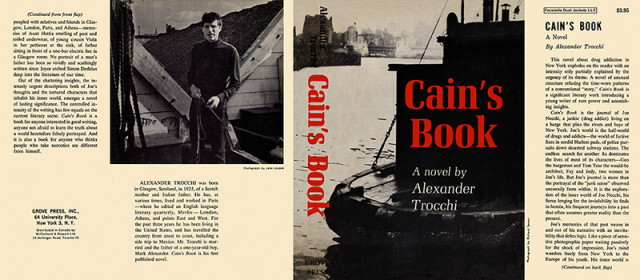
So begins Cain’s Book, Alexander Trocchi‘s incredible novel of existential dread. Young Adam, its predecessor, is better known, but the latter is the “Scottish Beat’s” classic.

Asked to name the best existential literature, most of us would probably say Albert Camus, Jean-Paul Sartre or Franz Kafka. But Cain’s Book actually takes the reader one step further into the philosophical world of existential angst than any of them. It positively drowns us in a word of unremitting absurdity and meaninglessness.

A roman à clef, Cain’s Book details the life of one Joe Nechhi, a Glaswegian heroin addict living and working on a scow in New York’s Hudson harbor. It is a book almost entirely devoid of plot: Nechhi occasionally details trips into the city to score heroin, recollects his childhood in Glasgow, or talks of his attempts to write a book. What is incredible about the book is its unrelenting bleakness, and the sheer poetic quality of Trocchi’s writing.

Heroin for Trocchi, as Remainder author Tom McCarthy noted in a lecture on Cain’s Book recently, “is a moveable void: taking that void around the city with him, in him, he ensures that he inhabits negative space constantly. This is his poetic project and it’s also the way his whole perception system works at its most basic level (the two are the same).”

In real life, Trocchi seemed very glad to cut himself off from his peers, saying that his only concerns as a writer were “sodomy and lesbianism”, that those were the only interesting subjects in the previous 20 years of Scottish writing and that “I have written it all.”

Sadly, Cain’s Book was his last. As the 60s gave way to the 70s, Trocchi’s addiction to heroin took its toll and his talent lay pretty much squandered. The stories of his wild and tragic life are infamous and extensively documented in many of the leading “swinging 60s” biographies (Marianne Faithfull’s account of doing drugs with Trocchi is one of the best). Despite his addictions, and his sad death at the age of 59, Trocchi left us some of the bleakest, most beautiful writing to come out of the 60s.

In Cain’s Book the writing is all – the words ebb and flow like the inky blackness of the Hudson River. Trocchi’s descriptive powers are mesmerising: one barely even notices the lack of narrative drive until after the book has been put down.

His other books includes some interesting pseudonymous pornography for the Olympia Press. (Titles like Helen and Desire, Sappho of Lesbos and White Thighs deliver their smut with a Sadean political edge.) Young Adam, of course, was turned into a successful film starring Ewan McGregor, and helped to raise the author’s public perception a little. But it’s Cain’s book that best fulfils Trocchi’s hopes for “the invisible insurrection of a thousand minds”.

Alexander Trocchi

Guy Debord predicted our distracted society | John Harris


Blurring appearance and reality … Keanu Reeves and Hugo Weaving in The Matrix. Photograph: Rex Features

“In societies where modern conditions of production prevail, all life presents as an immense accumulation of spectacles. Everything that was directly lived has moved away into a representation.”

With echoes of the most rapier-like prose written by Marx and Engels (eg “The history of all hitherto existing society is the history of class struggles”), so begins Guy Debord’s The Society of the Spectacle, the treatise on the modern human condition he published in 1967. It quickly came to be seen as the set text of the Parisian événements of the following year, and has long since bled into the culture via no end of people, from the Sex Pistols to the Canadian troublemakers who call themselves Adbusters.

Its title alone is now used as shorthand for the image-saturated, comprehensively mediated way of life that defines all supposedly advanced cultures: relative to what Debord meant by it, the term usually ends up sounding banal, but the frequency with which it’s used still speaks volumes about the power of his insights. Put another way, there are not many copyright-free monographs associated with arcane leftist sects that predicted where western societies would end up at 40 years’ distance, but this one did exactly that.

The Society of the Spectacle maps out some aspects of the 21st century directly: not least, so-called celebrity culture and its portrayal of lives whose freedom and dazzle suggest almost the opposite of life as most of us actually live it. Try this: “As specialists of apparent life, stars serve as superficial objects that people can identify with in order to compensate for the fragmented productive specialisations that they actually live.” The book’s take on the driving-out of meaning from politics is also pretty much beyond question, as are its warnings about “purely spectacular rebellion” and the fact that at some unspecified point in the recent(ish) past, “dissatisfaction itself became a commodity” (so throw away that Che Guevara T-shirt, and quick).

But there are also very modern phenomena that fit its view of the world: when Debord writes about how “behind the masks of total choice, different forms of the same alienation confront each other”, I now think of social media, and the white noise of most online life. All told, the book is full of sentences that describe something simple, but profound: the way that just about everything that we consume – and, if we’re not careful, most of what we do – embodies a mixture of distraction and reinforcement that serves to reproduce the mode of society and economy that has taken the idea of the spectacle to an almost surreal extreme. Not that Debord ever used the word, but his ideas were essentially pointing to the basis of what we now know as neoliberalism.

Some brief history. Debord was the de facto leader of the Situationist International, a tiny and ever-changing intellectual cell who drew on all kinds of influences, but whose essential worldview combined two elements: an understanding of alienation traceable to the young Marx, and an emphasis on what left politics has never much liked: the kind of desire-driven irrationality celebrated by both the dadaists and surrealists. The ideas in The Society of the Spectacle drew on obvious antecedents – Hegel, Marx, Engels, the Hungarian Marxist George Lukacs – and also pointed to what was soon to come: not least, postmodernism, and the “hyperreality” diagnosed by Jean Baudrillard.

To sum up the book’s substance in a couple of sentences is a nonsense, but here goes: essentially, Debord argues that having recast the idea of “being into having”, what he calls “the present phase of total occupation of social life by the accumulated results of the economy” has led to “a generalised sliding from having into appearing, from which all actual ‘having’ must draw its immediate prestige and its ultimate function.”

Like most of The Society of the Spectacle, you have to read such words slowly, but they hit the spot: he is talking about alienation, the commodification of almost every aspect of life and the profound social sea-change whereby any notion of the authentic becomes almost impossible. Whether their writers knew anything about Debord is probably doubtful, but as unlikely it may sound, one way of opening your mind to the idea of the spectacle is maybe to re-watch two hugely successful movies about exactly the blurring of appearance and reality that he described: The Matrix and The Truman Show.

It’s also an idea to read The Revolution of Everyday Life by Debord’s one-time accomplice Raoul Vaneigem, which works as a companion piece to The Society of the Spectacle. Vaneigem writes more in a more human register than Debord, and is a more straightforward propagandist:

“Inauthenticity is a right of man … Take a 35-year-old man. Each morning he takes his car, drives to the office, pushes papers, has lunch in town, plays pool, pushes more papers, leaves work, has a couple of drinks, goes home, greets his wife, kisses his children, eats his steak in front of the TV, goes to bed, makes love, and falls asleep. Who reduces a man’s life to this pathetic sequence of cliches? A journalist? A cop? A market researcher? A socialist-realist author? Not at all. He does it himself, breaking his day down into a series of poses chosen more or less unconsciously from the range of dominant stereotypes.”

The words point up something very important: that the spectacle is much more than something at which we passively gaze, and it increasingly defines our perception of life itself, and the way we relate to others. As the book puts it: “The spectacle is not a collection of images, but a social relation among people, mediated by images.”

How we confront the spectacle is a subject for another piece: in essence, the Situationists’ contention was that its colonisation of life was not quite complete, and resistance has to begin with finding islands of the authentic, and building on them (though as what some people call late capitalism has developed, such opportunities have inevitably shrunk, a fact captured in the bleak tone of Debord’s 1989 text Comments on the Society of Spectacle, published five years before he killed himself). In truth, the spectacular dominion Debord described is too all-encompassing to suggest any obvious means of overturning it: it’s very easy to succumb to the idea that the spectacle just is, and to suggest any way out of it is absurd (which, in a very reductive sense, was Baudrillard’s basic contention).

What is incontestable, though, is how well the book, and Debord’s ideas, describe the way we live now. The images that stare from magazine racks prove his point. The almost comic contrast between modern economic circumstances and what miraculously arrives to disguise them – the Queen’s Jubilee, the Olympics – confirms almost everything the book contains. My battered copy features a much-reproduced photograph from post-war America: an entranced cinema audience, all wearing 3D glasses. But when I read it now, I always picture the archetypal modern crowd: squeezed up against each other, but all looking intently at the blinking screens they hold in their hands, while their thumbs punch out an imitation of life that surely proves Debord’s point ten thousand times over.

Guy Debord’s The Society of the Spectacle | Will Self 

Guy Debord

“What other text from the 60s so accurately describes the shit we’re in?’ – Will Self on Debord’s The Society of the Spectacle. Photograph: Situationist International

Will Self takes a walk through the banlieues of Paris and is astonished by the prescience of Debord’s 1967 masterpiece, which so accurately describes ‘the shit we’re in’

A small green tent was pitched on the small daisy-spotted patch of greenish grass. It looked tidily enough done; suitable perhaps for a summer rock festival. But this was just outside the Saint-Gratien RER station, north of the rundown riverine port of Gennevilliers, on the outer whorl of the Parisian fingerprint; and the tent – which had the limp-wristed bough of an evergreen touching its flysheet in benediction – was quite clearly being lived in.

The mental picture the non-Parisian has of the city’s banlieues is framed by the fictive: gangster movies such as La Haine, or TV cop shows such as Spiral that do battle with similar Danish, Swedish, British and, of course, American vehicles, in a race to see which can sandblast its respective society with the greatest quantity of grit. But within this framing, content and dimensionality are provided by recent history, and in particular by the widespread rioting of 2005 that thrust these under-imagined locales on to TV screens worldwide. Not since the événements of 1968 had Parisian street fighting commanded such attention, but whereas the soixante-huitardscould be characterised as the vanguard of a stillborn revolution, the young second-, third- and probably fourth-generation immigrants who chucked molotov cocktails at the flics and the CRS during the émeutes neither donned, nor were measured up for, any such ideological camouflage.

Instead, the violent eruption of the Parisian banlieues was anatomised by reference to a body politic sickening with pathological metaphors. Implicitly, explicitly … ineluctably, the rioters were the Muslim Other, which, having been almost accidentally ingurgitated as part of the colonialist couscous, was now playing havoc with Gallic digestion. The French state had found itself – willingly or not – as a fellow-traveller on the neocons’ coach trip to the rapturous intersection of medieval chiliasm and Fukuyama’s neoliberal end-point.

Walking from the RER station towards the Seine, I passed not through what the fictive might lead you to expect, but rather low and hummocky hills, the swoop of a B-class road, outcroppings of commerce, small apartment blocks, car parks, duff public sculpture, off-cuts of quasi-open space – over it all an ambiguous miasma of street furniture and signage: this was France, certainly, but a France at once decoupled from any sense of pays, and divorced from the least suggestion of the urbane. In a comparable district of London – picture, if you are able to, Ruislip or Hounslow, Abbey Wood or Enfield – there would be myriad subliminally registered cues, all of which would combine to force on the spectator the unavoidability of her metropolitan condition. In London, the interwar spread of municipal socialism through the arteries of the tube system was accompanied by the soft-modernism of the suburban stations and Harry Beck’s matching diagram, which completes their connectivity. In London, the map really is the territory, because the territory really is the map. Not here.

The vexed relationship between the map and the territory suffuses The Society of the Spectacle, Guy Debord’s 1967 masterpiece, which argues that not only authentic social relations, but even the bricks and mortar that frame them, and the tarmac that connects one to another, have all been replaced with their representation; a 1:1 scale model. Moreover, for Debord, as a sequel to the paralysis of “historical development”, the contrast between town and country has become submerged in a sclerotic suburbia. He is at pains to point out that this annulling is no cod-utopian “supersession” but rather an “erosion … visible in the eclectic mélange of … decayed elements”.

From the beige depths of a heavily shuttered house beside a hillock from which I could spy the Eiffel Tower, a deep, dark voice spoke: “Qu’est-ce que vous cherchez?” I suppose, had I been the ghost of Jane Jacobs I would have experienced this as reassurance: the eyes, even if unseen themselves, remained on the street. But, instead, I muttered pacifications: “Nothing … just having a look … about”, then walked on down and around the hill through a scree of crushed fag packets, centrifugally impelled aluminium trim and the petrified tears shed by long dead cars. Dragon’s teeth were sewn across the scabrous roadway – I queased between them and found myself within 100 metres of the riverbank. The A15 soared overhead: two pilotisplanted this side of the river, the next pair on the far bank, its two carriageways separated by curved air. Up there was the city, conceived of however you so pleased. Down here, however, was this un-place, an inter-zone, under-imagined and thus free to be itself. Sprays of cherry blossom mimicked by tangles of wire and a shaggy pelt of weedy grass. Two small brown kids sat beside an oblong concrete depression filled with dank water, one had her hair tied in pigtails. They were playing with tin cans, cups and a bucket. Beyond them, right on the river’s edge was their Paris: a bidonville of shacks built from bits of scavenged packing cases, plastic tarpaulin, car tyres and all sorts of other stuff.

Many of its most sympathetic readers experience The Society of the Spectacleas a concerted howl of disgust. I cannot agree – for me it is the Spectacle that, far from being the creation of some malevolent or false god, emerges instead as the hero of the piece, inasmuch as any hero can be conceived of as the unconscious product of insensate historical processes. The Spectacle, Debord writes, “is the heart of the unrealism of the real society”. We are all jammed up against the plate glass of the Spectacle, our faces crushed as we “lèche-vitrine” in search of the same old commodified poison.

The entirely manmade nature of the world from which the individual subject experiences alienation is not, for Debord, a factual programme to be passively viewed on the TV screens of the global village, but a belief that is actively entered into. It is the genius of Debord to have characterised the totalising capability of late capitalism so early in its post-industrial manifestation. The Society of the Spectacle reads – if you will savour a cliche – as fresh as paint. Debord’s analysis of time itself as a series of epochs is dizzying: such “pseudo-festivals” as sporting events (the Olympics springs immediately to mind), act to convince the denizens of the Spectacle that they are still living in a cyclical and eternal go-round, while only the anointed few, the celebrities, are imbued with the attributes of money and power that signify the ability to make choices – to progress into a better future. “Being a star,” Debord writes, “means specialising in the seemingly lived.” Sound familiar, “Sir” Peter Bazalgette?

But it is most of all in its analysis of the ideology of the Spectacle that Debord’s text repays close reading. It is the Spectacle’s genius to have “turned need against life” and thus effected “the separation and estrangement between man and man”. Hence the Spectacle’s embrace of economics as the only form of instrumental – indeed “scientific” – knowledge worth possessing; hence ritual obeisance made before the gods who will confer growth, and hence the fact that more or less any contemporary western politician – from Hollande, to Merkel, to Cameron, to Obama, and back again – who had eyes to see, could find their own Caliban image raging back at them from the pages of The Society of the Spectacle.

At Argenteuil centre-ville, I found echoic pedestrian underpasses, faux-19th century streetlamps of twirled iron and postmodern apartment blocks built of scaled-up children’s construction toys. I walked on across the oxbow of Gennevilliers, still feeling that I was nowhere at all in particular – standing beside a grocery store or an office block, then crossing between parked cars. The bridge across the re-encountered Seine that led to Clichy was lined with cheerful window boxes, planted with a gaily patriotic tricolour of blooms pinker, pinker and pinkest. Where there are window boxes there must, of course, be a window – this one framed the mirrored cuboids of La Défenseto the west, structures that might have been designed expressly to conform to the Debordian paradigm.

And then, some way past the Porte de Clichy, I was quite suddenly – if at an indefinable point – in Paris, a city to this day that defines itself by the micro-associations of its smaller parts: the awning of an alimentation, a drain cover, the angle of a pissing dog’s leg, the furl of paper around a stick of bread, the white apron around a smoking waiter – quite as much as the high extravaganza of its grand boulevards and gold-leafed public buildings. Rereading The Society of the Spectacle, I was struck yet again not only by Debord’s astonishing prescience – for what other text from the late 1960s so accurately describes the shit we’re still in? – but also wondered how it was that his dérives across the Paris of the time could have so attuned him to the way in which the urban environment of the near future would become quite so decoupled from any element of the felt or experienced life. After all, Pariswas by no means the most Spectacular city of the late 1950s and early 60s; indeed, it’s still not on an equal footing to London. Unplanned London, which has just arrived at its square miles of parametrically designed junk space, its CCTV-overseen gated business cantonments and Chinese party cadre-owned luxury encampments, its logo skyscrapers and purpose-built “iconic” tourist destinations.

It occurs to me that Haussmann’s attempt to impose civic order and authority on the medieval jumble of mid-19th century Paris had not only paved the way for the Spectacle, but it had also afforded its – and his – enemies with the material to rip up for their barricades. There seems a nice congruence between the go-rounds of the Grands Boulevards and centrifugal/centripetal current of French theorising, whereby notions given form in the cafes of the Boulevard Saint-Germain and the classrooms of the Sorbonne and the Ecole Normale Supérieure swirl out in widening circles from the metropolis, only to then gurgle back in again, before eventually disappearing up the arses of their originators.

Seen like this, The Society of the Spectacle is at once the bastard progeny of the French Enlightenment – out of Diderot, by means of the Napoleonic Code – and a salutary reminder of how the pursuit of some millenarian ideological purity only ever results – if successful – in the rumbling of tumbrels; or, if a failure, in its wholesale co-option by its stated enemies. That we no longer hear quite so much about “the spectacle” as shorthand for any of the following: the ludic element of consumer society, the post-ideological character of western “democracy”, the web-cum-matrix woven by the internet, the glocal character of late capitalism, may be because Debord’s concept has now been so thoroughly appropriated – one might fairly say détourned – that there’s nothing left of it but its coldly numerical bones.

Had Debord not shot himself in 1994 in his rural fastness of Bellevue-la-Montagne, he probably would have turned his gun on the likes of Tony Wilson and Malcolm McLaren (and no doubt me as well); pop music impresarios whose much-trumpeted situationist influence – such as it was – consisted only in a series of pranks, that, while they may have given succour to the culturally anomic nonetheless only resulted in the profitable sale of records, posters and other memorabilia. I doubt, somehow, that either Wilson – chiefly known for managing Joy Division and the Happy Mondays, and setting up Factory Records – or McLaren, rather more famous for his role as the Sex Pistols’ svengali, can have subjected The Society of the Spectacle to a sustained critical reading. Had they done so, they would’ve realised that their antics were anathema to Debord; that the playful elements of situationist practice – the bowdlerising of cartoons, the daubing on walls of whacky slogans, the exaltation of drunkenness – were only ever to be sanctioned if constitutive of a genuine insurrection, such as the few short weeks of 68, and as precursors of that revolution of everyday life (to adapt the title of the competing situationist theoretical work, written by Debord’s greatest rival, Raoul Vaneigem), which was to follow the final and complete dissolution of the Spectacle.

The relative success of the Situationist International during les évènementsalso sowed the seeds for the détournement of The Society of the Spectacleitself. I say relative success because it can be doubted – and will always be disputed – the extent to which Debord and his loose confraternity of freelance bully-boys and wannabe revolutionists actually succeeded in either manning the barricades themselves, or screwing the courage of the mob to CRS’s sticking post. But the important thing was that the situationists were perceived as having been in the thick of things – as instigators and ideological choreographers of the distinctively ludic elements of this particular civil disorder. The sneering, de haut en bas reception of The Society of the Spectacle on its publication the year before in French, was followed the year after by its rhapsodic one when it appeared in translation. By then, of course, the game was effectively up – something Debord, a man obsessed by war games and strategising, undoubtedly grasped. The Society of the Spectacle so far as being an animator of events, had in a matter of months become simply another text to be subjected to scores, hundreds, thousands of exhaustive academic analyses. The best that could be said for the thing – from its author’s point of view – was that the royalties paid his wine bills, and helped to supplement a lifetime of unabashed – and indeed, self-righteous – sponging.

Of course, The Society of the Spectacle still animates serious protest to this day – or, rather, since to admit to having been one of the Invisible Committee that authored the highly Debordian The Coming Insurrection (2007) is to court arrest on those grounds alone, the very style of the earlier work remains inflammatory. As to its content, The Coming Insurrection has nothing much to add – how can it, when, as I say, never before has Debord’s work seemed quite as relevant as it does now, in the permanent present that he so accurately foretold? Open his book, read it, be amazed, pour yourself a glass of supermarket wine – as he would wish – and then forget all about it, which is what the Spectacle wants.

Watch “The Society of the Spectacle” by Guy Debord

This is the film made of Guy Debord’s book “The Society of the Spectacle” which is one of the main texts of the Situationist International.

“Fulfillment was already there”: Debord & ’68 | Situationist International

Andy Merrifield discusses the influence of Guy Debord and the Situationist International on the events of May ’68.

On the brink of working class and student insurgency came Guy Debord’s The Society of the Spectacle (1967), the radical book of the 1960s, perhaps the most radical radical book ever written. Its 221 strange theses give us stirring crescendos of literary power, compelling evocations of an epoch in which unity spelt division, essence appearance, truth falsity. A topsy-turvy world where everything and everybody partook in a perverse paradox. Debord mocked the reality of this non-reality, an absurd world in which ugliness signified beauty, stupidity intelligence, subjecting it to his own dialectical inversion, his own spirit of negation. This was theory that identified enemy minefields and plotted a Northwest Passage, getting daubed on the walls of Paris and other cities during May 1968: “POWER TO THE WORKERS’ COUNCILS,” “DOWN WITH THE SPECTACULAR COMMODITY ECONOMY,” “THE END OF THE UNIVERSITY.”

Its refrains were all over the modern high-rise environment at the University of Paris-Nanterre, a classic scene of urban isolation and separation, a “suburban Vietnam,” where a peripheral new town university coexisted with working-class slums and Arab and Portuguese shantytowns. The place was sterile, sexually and socially repressive, and totalitarian. This was the spirit of a society without any spirit. The same centralisation, hierarchy, and bureaucratic obsession persisting in the educational sector persisted in other aspects of the French state. Tough rules governed student dorms and freedom of movement; classes were overcrowded, resources stretched; professors were distant, student alienation rife. The right-wing Gaullist regime attempted to modernise the economy, in line with Common Market membership, and unemployment was growing.

At the University of Strasbourg, two years prior, a handful of Situationists had intervened; angry students of Henri Lefebvre and friends of Debord. They’d riled and denounce, tried to revolutionise students with an influential pamphlet called “On the Poverty of Student Life—Considered in its Economic, Political, Psychological, Sexual and especially Intellectual Aspects, with a Modest Proposal for its Remedy.” They’d infiltrated the National Union of French Students (UNEF), accused students at Strasbourg of pandering to a society dominated by the commodity and the spectacle. Student poverty was a poverty of ideas, a poverty of guts. Students were really “submissive children,” labour-power in the making, without class consciousness. They accepted the business and institutional roles for which the “university-factory” prepared them, never questioning the system of production that alienated all activity, products, people, and ideas. The Situationist’s text struck a chord; translated reprints extended its audience, notably to the U.S., Britain and Italy. In Strasbourg, the document caused a scandal; a coterie of students refused to be integrated. Critical awareness gathered steam over the next year and a bit, until, in late March of 1968, it blew a gasket at Nanterre.

On Friday, March 22nd, assorted Situationists, young communists, Trotskyists, anarchists, and Maoists invaded the university’s administration building, and began occupying it. The week before, the “Committee of the Enragés and the Situationist International” had been established. Its members put up posters and scribbled slogans on the walls of Nanterre and the Sorbonne in the Latin Quarter: “TAKE YOUR DESIRES FOR REALITY,” “NEVER WORK,” “BOREDOM IS COUNTER-REVOLUTIONARY,” “TRADE UNIONS ARE BROTHELS,” “PROFESSORS, YOU MAKE US GROW OLD,” “IF YOU RUN INTO A COP, SMASH HIS FACE IN.” In early May, “the March 22 Movement” met with UNEF at the Sorbonne. The authorities tried to break up the meeting; instead they only unleashed its latent power. The gendarmerie mobile poured into the Sorbonne’s courtyard and encircled its buildings. Several thousand students fought back, inside and outside, ripping up paving stones on the street. Skirmishes broke out elsewhere, spreading both sides of the Seine, flaring up at Châtelet and Les Halles. On May 6 and 7 a huge student demonstration took over the Boulevard Saint Michel and thoroughfares near rue Gay-Lussac; protesters overturned cars, set them ablaze, dispatched Molotov cocktails, and manned the barricades.

On May 13 there was a one-day general strike. With the French Communist Party (PCF) and general worker’s union (CGT) joining the action, “student-worker” solidarity suddenly looked possible. Situationists and students took over the Sorbonne. On one revered fresco they emblazoned the caption: “HUMANITY WILL ONLY BE HAPPY THE DAY THE LAST BUREAUCRAT IS HUNG BY THE GUTS OF THE LAST CAPITALIST.” Exams had been cancelled at the barricades; sociologists and psychologists became the new cops. Next day, in Nantes, workers at the Sud-Aviation plant occupied their factory and locked out the bosses. Meanwhile, Renault workers at Cléon in Seine-Maritime followed suit. Then the Nouvelles Messageries de la Presse Parisienne launched a wildcat action, halting newspaper distribution. Workers’ councils linked up with students’ councils, becoming comrades in arms. The working class, at last, declared its unequivocal support for the student movement when rank and filers at Renault-Billancourt took over France’s largest factory.

By May 20 strikes and occupations became contagious. Nationwide, around 10 million workers downed tools and froze assembly lines. France seemed on the precipice of revolution; a festival of people was glimpsed. Alienation was cast off, momentarily; freedom was real; capitalised time abandoned. Without trains, cars, Metro and work, leisure time was reclaimed, time lived. Students and workers seized the contingent situation, acted spontaneously, created new situations, realising something what no trade union or party could ever do, or wanted to do. And yet, as quickly as things erupted, they were almost as speedily repressed, by state and bourgeoisie, soon backed by the Communists and the CGT. The optimistic promise, the beach beneath the paving stones, had dissipated, for now. The music was over. There was no other side to break on through to.

The occupation of Paris was, and still is, seen throughout the world as an event of historical significance. Solidarity between workers and students had for a moment expressed itself; so too direct action militancy and student internationalism. From the LSE to Berkeley, from Columbia to Nantes, from the Sorbonne to Barcelona, dissatisfaction had spread like wildfire. At the same time, The Society of the Spectacle’s demands, as Debord would write (with Gianfranco Sanguinetti) in The Veritable Split in the Situationist International (1972), “were plastered in the factories of Milan as in the University of Coimra. Its principal theses, from California to Calabria, from Scotland to Spain, from Belfast to Leningrad, infiltrate clandestinely or are proclaimed in open struggles…The Situationist International imposed itself in a moment of universal history as the thought of the collapse of a world; a collapse which has now begun before our eyes.”

In old photos of the student occupations of the Sorbonne, Debord is visible in the thick of the action, lurking with intent. He was no student himself, nor was he particularly “youthful”: in May 1968, Debord, the freelance revolutionary, was thirty-six, older than a lot of junior professors, and almost twice the age of many student leaders (like Daniel Cohn-Bendit). He must have seemed like an old guy to many kids, somebody’s dad drinking in the student bar. Already his appearance had started to deteriorate. Surrounded by a large crowd of student activists, we can see him standing side on, without glasses, wearing a white jacket. His face is a lot puffier than a decade earlier; a boozer’s physiognomy was rapidly becoming apparent. By comparison with other ’68ers, who were mere political toddlers, he was a veteran provocateur.

Debord and other Situationists were genius agitators and organisers, and their presence was felt, practically and theoretically. The spirit of The Society of the Spectacle was there, even if some kids had never read nor fully understood it. On the other hand, Debord was frequently the most sectarian, invariably falling out with allies—especially falling out with allies, being most ruthless with old friends and former comrades. “Guy was a very tenacious person,” Jean-Michel Mension, a past oustee, remembered in his Situationist memoir The Tribe. “He was already very hard—very strict in the way he conceived of existence with this person or that.” There “were certainly jokers who became part of Guy’s group merely because they were friends of so and so, people who had no business there and who lasted only six months or a year before Guy found them really idiotic and kicked them out.”

Debord likewise dissed former pal Henri Lefebvre, the Nanterre Marxist professor, denouncing him as an “agent of recuperation.” He said the sexagenarian philosopher had stolen certain Situationist ideas. Debord reckoned Lefebvre’s take on the 1871 Paris Commune was almost entirely lifted from SI’s pamphlet, “Theses on the Commune” (1962). “This was a delicate subject,” Lefebvre recalled in a 1987 interview. “I was close to the Situationists…And then we had a quarrel that got worse and worse in conditions I don’t understand too well myself…I had this idea about the Commune as a festival, and I threw it into debate, after consulting an unpublished document about the Commune that is at the Feltrinelli Institute in Milan.”

Both Lefebvre and Debord believed the Commune some sort of historical antecedent of 1968. For seventy-three days, between March and May of 1871, when Prussian forces at war with France surrounded Paris, the city had become a liberated zone of people power. The barricades went up, even across Haussmann’s mighty boulevards, amid the carnivals and pranks. Freely elected workers, artists, and small business owners were suddenly at the helm. Their rally cries were territorial and urban; their practice was festive and spontaneous. The Communards, until the National Guard massacred 20,000 of them, launched a revolt in culture and everyday life, demanded freedom and self-determination, crushed Louis Napoleon’s authority as he’d once crushed their freedom, occupied the streets, shouted and sang for their “right to the city.”

For the first time, it looked like a working-class revolution wasn’t merely possible, but imminent. In “Theses on the Commune,” Debord said the Situationists believed that the “Commune was the biggest festival of the nineteenth-century” (Thesis #2). “Underlying the events of that spring of 1871,” he went on, “one can see the insurgents’ feeling that they had become the masters of their own history, not so much on the level of ‘governmental’ politics as on the level of their everyday life.” “The Commune,” Thesis #7 said, “represents the only realisation of a revolutionary urbanism to date.” It “succumbed less to the force of arms,” the next thesis explained, “than to the force of habit.” “Theoreticians who examine the history of this movement,” continued #11, importantly, “can easily prove that the Commune was objectively doomed to failure and could not have been fulfilled. They forget that for those who really lived it, the fulfillment was already there” (emphasis in original). “The audacity and inventiveness of the Commune,” #12 stated, “must obviously be measured not in relation to our time, but in terms of the prevailing political, intellectual and moral attitudes of its own time, in terms of the interdependence of all the prevailing banalities that it blasted to pieces.” “The social war of which the Commune was one moment,” declared the penultimate #13, “is still being fought today. In the task of ‘making conscious the unconscious tendencies of the Commune’ (Frederick Engels), the last word is still to be said.”

In the wake of May ’68, Debord released a film version of The Society of the Spectacle, dedicating it to wife Alice Becker-Ho, whose beautiful image, clad in flat cap, leaning on a wall with a cigarette drooping nonchalantly from her mouth, fills one frame. It evokes an Alice-cum-Brando’s Wild One pose: “Alice, whattya rebelling against?” “Whaddya got?” The film’s dialogue closely follows Debord’s original text, but the rapid-fire captions, disarming classical music, and exaggerated footage make it visually stunning. There are battle scenes and moody vistas of Paris, spliced between images of Lenin, Stalin, Mao and Castro, all giving speeches; Debord plainly disapproves. There are news clips from the ’68 Renault strike, with workers locked inside the factory by the unions; scenes from the Bourse alive with frenzied traders, participating in money mayhem; there’s a vision of the Tower of Babel amid pitched battles from Vietnam and Watts (Los Angeles), circa 1965; Paris’s streets are ablaze, and students can be seen fighting cops; there are burning barricades at night, the storming of the Winter Palace in 1917, street altercations in Italy in the 1960s, Italian police leaping from jeeps, truncheoning a crowd of young people; West German security forces patrol another street, while Soviet tanks push back German workers in Berlin in June 1953.

The Society of the Spectacle, the movie, sealed a magical era for Debord. “Whoever considers the life of the Situationists,” he contended a few years later, “finds there the history of the revolution. Nothing has been able to sour it.” It was how it’d been for the Communards, who really lived it, whose fulfillment was already there. Fulfillment was already there for Debord, too: he really did live it in ’68, and now the music was over. Nothing could sour it. Yet as the dust settled from 1968, emptiness prevailed in the ruins. Many soixante-huitards suddenly found themselves stuck between the rock and the hard place, between a degenerative past and an impossible future. For a moment, the dream of spontaneous freedom became real, in wide-awake time. An instant later, it disappeared in a puff of smoke.

Source: Verso

Kenny Wilson Talks about Bob Dylan at Secular Hall Leicester 5th October 7 p.m.

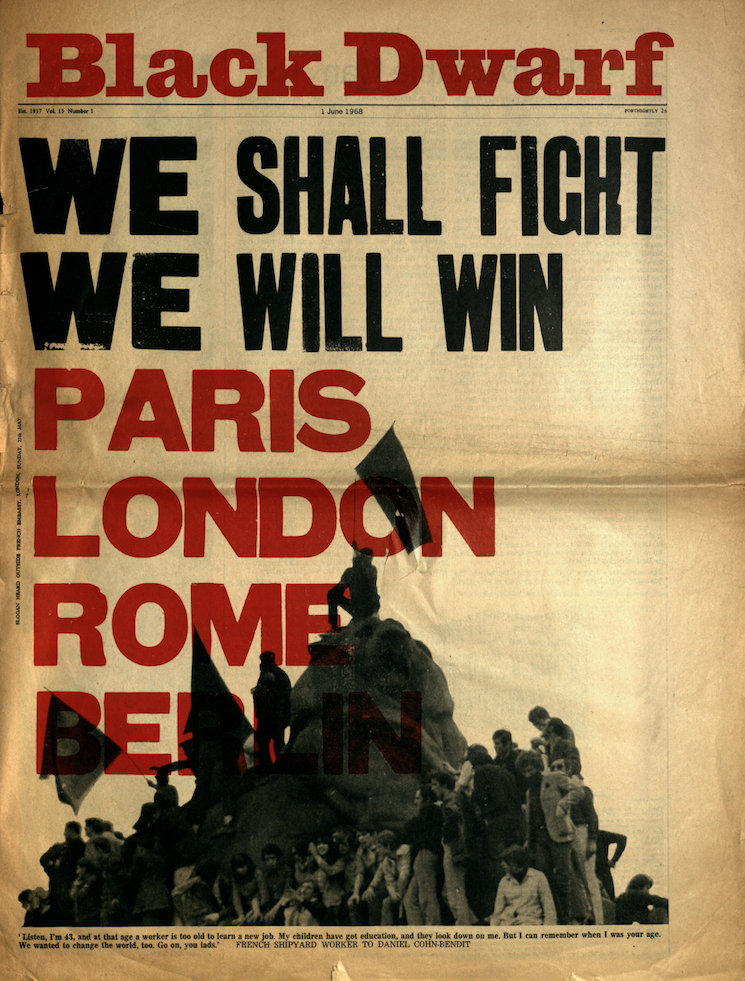
We Shall Fight, We Will Win: On The Black Dwarf and 1968 (Verso)

We Shall Fight, We Will Win: On The Black Dwarf and 1968

Screen_shot_2018-05-16_at_14.44.37-

The Black Dwarf  was announced with a free broadsheet on 1 May 1968 and published four weeks later. The inspiration was the struggle of the Vietnamese liberation movement against American imperialism that had taken over territories from the European colonial powers. The Tet offensive by the Vietnamese NLF (National Liberation Front) that year had witnessed an assault on most of the provincial capitals in occupied South Vietnam which culminated with a surprise assault on the US Embassy in Saigon (now Ho Chi Minh city), where the stars and stripes were lowered and the NLF flag hoisted. This symbolism, as well as real gains on the ground, marked the beginning of the end of the US war. The game was up. The tortures, use of chemical weapons, destruction of the ecology by defoliants carried on for another seven years. Imperial narcissism knows no boundaries. It was the Tet offensive that boosted the anti-war movements in the United States and across the world.

First issue of <i>The Black Dwarf</i> released as a free-sheet on May Day 1968

In Britain the Vietnam Solidarity Campaign grew rapidly. In October 1967, 10,000 marchers came close to entering the US embassy. In March 1968 contingents from the German SDS and the French JCR joined us as 30,000 people mobilised by the Vietnam Solidarity Campaign surrounded the US Embassy in London.  We had been baton-charged by mounted police (‘The Cossacks, the Cossacks’ was our cry as we edged forward thinking of Vietnam and Petrograd 1917). Mick Jagger, marching with us, angered by police brutalities, thought we should have answered force with force. Britain was hopeless. A few months later he wrote Streetfighting Man. Culture was intervening in politics.

‘Hey! think the time is right for a palace revolution, but where I live the game to play is compromise solution
Hey, said my name is called Disturbance; I’ll shout and scream, I’ll kill the King, I’ll rail at all his servants’

The BBC refused to play it. He scribbled a note ‘For you!’ and sent it to me with the song. We published the lyrics in The Black Dwarf, aligned with a text by Engels on street fighting. A debate on the new music and the new mood erupted briefly in the New Left Review with Richard Merton (Perry Anderson’s nom-de-plume) arguing that:

“… it is incorrect to say that the Stones are ‘not major innovators’. Perhaps a polarization Stones-Beatles such as Adorno constructed between Schoenberg and Stravinsky (evoked by Beckett) might actually be a fruitful exercise. Suffice it to say here that, for all their intelligence and refinement, the Beatles have never strayed much beyond the strict limits of romantic convention: central moments of their oeuvre are nostalgia and whimsy, both eminently consecrated traditions of middle-class England…By contrast, the Stones have refused the given orthodoxy of pop music; their work is a dark and veridical negation of it. It is an astonishing fact that there is virtually not one Jagger-Richards composition which is conventionally about a ‘happy’ or ‘unhappy’ personal relationship. Love, jealousy and lament—the substance of 85 per cent of traditional pop music—are missing. Sexual exploitation, mental disintegration and physical immersion are their substitutes.”

In Britain music, in France cinema, were the auguries of what was about to come.

VSC broke with the more traditional opposition to the war. It declared its solidarity with NLF and supported its victory. Whereas the old New Left had launched CND and developed a ‘third camp’ position, the VSC responded to the conjuncture. The NLF was created, led by the Vietnamese Communist Party. It was armed by the Soviet Union and China. At one point, Bertrand Russell, distinguished VSC sponsor, wrote an open letter to Leonid Brezhnev, then leader of the Soviet Union, demanding that the Soviet Air Force be dispatched to defend the Vietnamese.

This was the political context in which The Black Dwarf was launched. It was conceived as a political-cultural weekly. The idea came from Clive Goodwin, a radical literary agent who became the publisher. The first meeting to discuss the paper took place at his house on 79 Cromwell Road. The room was lit by Pauline Boty’s paintings. She had been married to Clive and died of leukaemia in 1963. Present were Clive, the poets Christopher Logue and Adrian Mitchell, the playwright David Mercer, Margaret Mattheson, BBC script editor Roger Smith, D.A.N. Jones (who we wanted to be editor) and myself. Behind the scenes were Kenneth Tynan (who offered to review the House of Commons, but didn’t), Ken Trodd and Tony Garnett. We all agreed it was a great idea. Christopher Logue was sent off to look at old radical journals in the British Museum. The following week he returned with the name: The Black Dwarf. It was a polemical paper edited by Thomas Wooler in 1817 and agitating viciously and satirically for electoral and parliamentary reform. The title was inspired by the stunted bodies and soot-stained faces of coal miners.

Communication was slow in those days and it wasn’t till late afternoon on 9 May 1968 that we got news that something serious might erupt in Paris. The Sorbonne had been occupied! Five thousand people were packing the amphitheatre. Action Committees of various sorts were sprouting like magic mushrooms. The isolation of the Nanterre March 22 Committee had been broken. Of its two principal inspirers, Daniel Bensaid died some years ago, steadfast as ever, while the other Daniel (I think his last name was Cohn-Bendit) died politically. His corpse, I’m reliably informed, is currently on guard duty at the Elysee cemetery. He now regards Macron as the true representative of ’68. We published Sartre’s remarks to the Sorbonne students in the amphitheatre:

“Something has emerged from you which surprised, which astonishes and which denies everything which has made our society what it is today. That is what I would call the extension of the field of possibility. Do not give up.”

The night of the barricades on 10 May set France on fire. Soon the whole country was involved and 10 million workers went on strike, occupying factories in Rouen, Nantes, Paris, Lyon, etc. It seemed as if the Paris Commune had been reborn. As the first issue was brought to us, I thought the cover chosen by D.A.N. Jones was too weak and watery. We needed to identify with the movement. On a scrappy piece of paper, I wrote: ‘We Shall Fight, We Will Win, Paris, London, Rome, Berlin’ and handed it to our designer, Robin Fior. Everyone except Jones agreed. We decided to pulp 20,000 copies of the first issue. Jones walked out and I was appointed editor.

In our May Day broadsheet in 1968 we had described the first Editor of the old paper thus:

“Tom Wooler was a clever and humorous man. He edited a great left-wing paper which closed down 140 years ago…He was a printer from Sheffield with an office in Fleet Street. When he was charged with writing seditious and libellous material (they said he had libelled King Richard II) he explained that he hadn’t written a word. He had simply set it up in print!”

He was acquitted but forced a change in the law. Henceforth printers became liable as well. Ironically our Black Dwarf was rejected by almost a hundred printers and we finally ended up taking the train to a printer in Bala, North Wales the only printshop prepared to do the job. It was the same with distributors. They rejected us en masse. Only the great Collets’ bookshop on Charing Cross Road in London and a few radical bookstores elsewhere in the country (all gone now) stocked the magazine. We were dependent on street sellers and Mick Shrapnell a VSC/hippy militant used to sell 500 copies on his own. The musical Hair , a huge West End hit, helped with the lead actress displaying the latest issue on stage in every performance. Our supporters in the painting fraternity: David Hockney, Ron Kitaj, Jim Dine, Felix Topolski didn’t have much dosh but donated paintings that we auctioned. Other donors would drop in with much needed cash. We managed to print 45 issues of the paper and were amongst the first to declare 1969 as the ‘Year of the Militant Woman?’ with Sheila Rowbotham’s stunning manifesto. I had told the designer David Wills that it should be designed like an old-fashioned manifesto. The unreconstructed pig tried to subvert the message by placing the manifesto on two gigantic breasts. Sheila rang in a state as she saw the proofs. I rushed over, had it changed and sacked Wills on the spot afterwards. These things happened.

Politics was getting polarised and a number of the staff and EB members split on my decision to publish three pages from dissident ANC guerrillas who had been tortured and denounced by their leaders simply for asking critical questions of overall strategy and tactics. I was convinced they were genuine. Supporters of the ANC leadership were horrified when the magazine appeared. Thabo Mbeki led a squad of supporters to buy up all our copies in Collets. We reprinted. But the vote had revealed a division between Trotskyists and the others and a split took place. Was it avoidable? Probably, but left politics was becoming more and more polarised after the French May and the Prague Spring. A group of us left and established The Red Mole, much more linked to the IMG [International Marxist Group]. Another problem was lack of funds. We were in trouble anyway but the split was regrettable. The non-Trotskyists set up Seven Days , a paper I liked very much which should have survived.

The Black Dwarf and Seven Days are now digitalised in full and made available by the Amiel-Melburn Trust archive, an extremely valuable resource.

Tariq Ali

17 May 2018