Atlanta Studies | Parks are for the People: The Piedmont Park Riot and the Politics of Late 1960s Atlanta

By Christopher Huff

In the summer of 1967, Atlanta Journal reporter Michael Palmer went undercover as a hippie. Hoping to provide his readers with some insight into a movement that had recently made its way into the national consciousness, Palmer put on a “white, ruffled shirt, and old vest, levies [sic] frayed at the cuffs” and stealthily entered the city’s small but noticeable hippie community. In a series of articles that followed this experience, Palmer discussed with a mixture of dismissal and despair what he encountered during his five weeks of undercover research – from watching people take drugs in a “crash pad” to participating in a “love-in” at Piedmont Park. While Palmer ultimately provided little real insight into the countercultural mindset, he did make his readers very aware that something new and different was happening in Midtown Atlanta.1

During the late 1960s and early 1970s the section of the city that straddled Peachtree Street for several blocks, running from roughly Seventeenth Street down to Tenth Street, served as Atlanta’s own version of San Francisco’s famed Haight-Ashbury district. This part of Midtown had acquired several names over the years2 – Tight Squeeze, the 10th Street Business District and the 14th Street Area – but became popularly known as “the Strip” during its countercultural heyday.3 The area had already developed a reputation as a bohemian destination by the early 1960s – one reporter described it as “Atlanta’s own Greenwich Village” – due to its proximity to the Atlanta College of Art and the Atlanta Memorial Arts Center, as well as its abundance of affordable housing for young adults moving to the city.4 By the middle of the decade a small community of hippies found a spiritual home with the opening of the Catacombs coffeehouse on Fourteenth Street. The area’s “hip” population – which included not only “real” hippies but also political radicals, members of motorcycle gangs, left-leaning religious leaders, artists, teenage runaways, drug dealers, sympathetic lawyers, social workers, business owners, and teenage “plastic hippies,” who visited the Strip on the weekends but then returned to their suburban homes on Sunday evenings – grew significantly in 1967 as the counterculture gained national recognition and thousands of curious teenagers and young adults made their way to hippie neighborhoods across the nation during the Summer of Love.

POLICE PERFORMING A NIGHTTIME ANTI-DRUG RAID AGAINST HIPPIES, ATLANTA, GEORGIA, AUGUST 4, 1969. V003-600001-A24, TOM COFFIN PHOTOGRAPHS. SPECIAL COLLECTIONS AND ARCHIVES, GEORGIA STATE UNIVERSITY LIBRARY. COURTESY GEORGIA STATE UNIVERSITY.
Several factors, however, thwarted attempts by Strip residents to create a thriving and safe hip community in Atlanta.5 Business owners disliked them, local “straight” residents complained repeatedly to city officials about their presence, and the police engaged in an ongoing campaign of harassment that included arresting hippies for minor infractions. In July, 1968, a group of local business owners attended a meeting of the city’s Aldermanic Police Committee to complain how the hippie presence harmed the value of their businesses and made it “unsafe for residents to walk down the street.” That same month, Police Chief Herbert Jenkins launched a crackdown on the area’s hippie population.6While the city’s recently founded underground newspaper, the Great Speckled Bird, regularly reported on the ill-treatment the hip community suffered at the hands of business owners and the police, the straight press routinely ignored or downplayed these issues.7
INSPECTING THE DAMAGE: “ATLANTIS RISING BOMBING,” ATLANTA, GEORGIA, SEPTEMBER 11, 1969. V003-690911-A28, TOM COFFIN PHOTOGRAPHS. SPECIAL COLLECTIONS AND ARCHIVES, GEORGIA STATE UNIVERSITY LIBRARY. COURTESY GEORGIA STATE UNIVERSITY.
These issues worsened considerably during the first six months of 1969. The Great Speckled Bird speculated that a recent wave of suspicious fires in the area was an attempt to scare away hippies.8 In addition, the number of sexual assaults against hip women in the Strip increased, as did the number of physical confrontations between Strip residents and straight locals, some of which included the exchange of gunfire.9 In August, a near riot erupted in the Strip when hippies and political radicals clashed with local police and agents from the Georgia Bureau of Investigation during yet another in a series of drug raids in the neighborhood.10 Then, in early September, a firebomb destroyed Atlantis Rising, a combination artist collective and recreation center that served Strip residents and acted as a meeting space for radical political groups.11 Finally, this pattern of confrontation and violence culminated on September 21 when attendees and police clashed during a free concert in Piedmont Park.
The events leading up to and following the Piedmont Park riot illustrate the changing nature of social and political life in Atlanta during the late 1960s. Far from an isolated incident, the riot, and the response to it, reflected the growing frustration of Strip residents as they faced continual police harassment and acts of anonymous violence while trying to create a functional alternative district built on the concepts of cooperation and community. Moreover, the riot revealed connections and shared concerns between white youth and the African American community at a time of significant change in the local political landscape. While the Piedmont Park riot is a lesser known event of civil disobedience in the history of Atlanta, re-examining the riot reveals how far the political and cultural radicalism of the 1960s had made its way into the nation’s most conservative areas, as well as how the presence of a community of radical white youth impacted local political scene, which is usually portrayed by historians of the era as a struggle between conservative whites and African Americans for control of the city during a time of significant demographic change.

OUR PARK

By the late 1960s, Piedmont Park, located just a few blocks east of the Strip, offered a safe haven away from the hassles of life on Peachtree. At a time when hippies were routinely arrested for simply walking down the street, the existence of a place where they could gather freely ensured that the park became integral to community-building efforts by local counterculture and New Left leaders. The Atlanta antiwar movement often chose the park as a gathering point for marches into downtown or as a location for post-march rallies.12 And in July 1968, approximately 800 people gathered around the park’s pavilion for the city’s first “Be-In,” an event copied from the more famous San Francisco Human Be-In held the previous summer.13 The hip community’s use of Piedmont Park increased significantly during the first nine months of 1969. In March, the Great Speckled Bird celebrated its first anniversary with a party in the park. The city’s political activists even took time to enjoy the park’s athletic facilities by forming a “Revolutionary Softball League” that spring.14 And the series of free Sunday concerts which had occurred occasionally during the spring and early summer of 1969 became more regular occurrences following the 1969 Atlanta International Pop Festival. The festival, held over the Fourth of July holiday weekend at an automobile racetrack in Hampton, Georgia, featured Janis Joplin, Joe Cocker, Credence Clearwater Revival, Grand Funk Railroad, and Led Zeppelin.15 Held the day after the festival ended, a free concert in Piedmont Park featured many of the bands that had played at Hampton, including, Delaney and Bonnie, Spirit, the Allman Brothers, and the Grateful Dead.16
While the park served as key place to experience countercultural entertainment, the recent wave of harassment and violence in the Strip also led many hippies and New Leftists alike to see their use of the park in more overtly political terms; it had become an important battleground in their quest for meaningful social change.17 This shared cause between the counterculture and New Left was not unique to Atlanta in the late 1960s. While the middle years of the decade witnessed the rise of two movements that could be identified as uniquely separate, each with its own goals and philosophies, by 1969 the boundaries between the New Left and counterculture had become blurry. The New Left recast itself into an expansive social movement aimed at the creation of a new American culture as it sought more than just political change, while the counterculture rethought its earlier utopianism and now sought to practice its core beliefs within, rather than separate from, American society.18
VIETNAM WAR PROTEST. METRO ATLANTA CHAMBER OF COMMERCE COLLECTION AT KENAN RESEARCH CENTER AT ATLANTA HISTORY CENTER. COURTESY ATLANTA HISTORY CENTER.
HIPPIE DRUM CIRCLE IN PIEDMONT PARK, ATLANTA, GEORGIA, CIRCA 1969. TOM COFFIN PHOTOGRAPHS. SPECIAL COLLECTIONS AND ARCHIVES, GEORGIA STATE UNIVERSITY LIBRARY. COURTESY GEORGIA STATE UNIVERSITY.
Echoing countercultural writers around the nation, the Bird had repeatedly expounded on the importance of rock music as a catalyst for social change and on Piedmont Park’s new role as a site for this melding of culture and politics.19 In a piece entitled “Our Park,” “Richard” explained the importance not only of rock music to the creation of a new society, but of a place to experience such music in a revolutionary way, noting that:20
if we are a revolutionary culture then we must . . . refuse festivals and radio and recordings . . . musicians will play, will fill our parks, because they must play, and we will listen because we must and there will be no one in between.
By the summer of 1969, the importance of Piedmont Park to the growth of Atlanta’s hip community led many Strip residents to consider the park, at least on certain days, as their own. Piedmont Park became a place to listen to some good music, get a free meal, commune with likeminded individuals, discuss radical politics, and explore new ways of living together. Or as “Richard” concluded,21
you will come to the park to make it your park and you will listen to music and know that it is your music and it will be freedom.
Following the dramatic firebombing of Atlantis Rising in late August, the park also became a place of spiritual rejuvenation for the Strip community. On the Sunday following the attack, a benefit concert for the store was held in the park that featured several prominent local and regional bands, including the Allman Brothers. As Miller Francis, the community’s preeminent cultural chronicler, noted in an article for The Great Speckled Bird the concert was more than simply a musical event or a rally for Atlantis Rising. For Francis, the park acted not simply as a public recreational space, but as a key focal point for the political struggle to build a viable alternative community.22 Accordingly, as he noted:23
PEOPLE EATING AT A FREE CONCERT SPONSORED BY THE “GREAT SPECKLED BIRD” AT PIEDMONT PARK, ATLANTA, GEORGIA, SEPTEMBER 21, 1969. TOM COFFIN PHOTOGRAPHS. SPECIAL COLLECTIONS AND ARCHIVES, GEORGIA STATE UNIVERSITY LIBRARY. COURTESY GEORGIA STATE UNIVERSITY.
The vibes in Piedmont Park on all the Saturdays and Sundays flow out of our fight to replace the power behind the firebomb . . . that gutted Atlantis Rising, and our attempt to design a politics to effect that replacement.
Francis noted the intense sense of positive feelings that the crowd in “our park” generated, as well as the wide array of the city’s population which was in attendance in addition to the usual hippie contingent, including “straight, crewcut, turned-on, tribal, black, working class, mothers and children.”24 However, it would be this very attachment to the park that laid the foundation for the riot that occurred only a week later.
Throughout the nation, public spaces played an important role in bringing politics and culture together. Parks took on particular meaning in the late 1960s, serving as a central site for the expression of a spatial politics that helped reveal the growing intersection of the counterculture and the New Left. Perhaps most famously, in May 1969, violence erupted in Berkeley over an undeveloped piece of land owned by the University of California. Claiming the space as their own, over two hundred hippies, college students, and community activists had turned the former parking lot into a park, which they called “People’s Park.” Then, on May 15, police cleared the park and encircled it with cyclone fencing, a provocation which the local hip community responded to by rioting with the ensuing street battle ending that evening only after twenty policemen had been injured and twenty protestors had been shot, one fatally.25 While the events in Berkeley are well-remembered, the events at Piedmont Park a few months later exemplify that the willingness to defend contested space was not restricted to cities famous for their radical communities.

“GET THE PIGS OUT OF OUR PARK!”

The September 21, 1969, free concert in Piedmont Park boasted an impressive lineup. While the Allman Brothers would not play that Sunday, the show presented some of the best local rock acts, including Radar, the Booger Band, and headliner The Hampton Grease Band. This list of performers, as well as the success of the concert the previous Sunday, and a prominently placed announcement in the Great Speckled Bird, ensured a sizable attendance. And despite a chilly rain, by late afternoon between 1,000 and 1,500 people had arrived in the park.
ONE OF THE BANDS PERFORMING AT A “GREAT SPECKLED BIRD” CONCERT IN PIEDMONT PARK, ATLANTA, GEORGIA, SEPTEMBER 21, 1969. V003-600001-C27, TOM COFFIN PHOTOGRAPHS. SPECIAL COLLECTIONS AND ARCHIVES, GEORGIA STATE UNIVERSITY LIBRARY. COURTESY GEORGIA STATE UNIVERSITY.
Several staff members from the Great Speckled Bird circulated through the crowd, collecting affidavits regarding police harassment, which they planned to include as part of the paper’s recently-filed lawsuit against the police department.26 Earlier that month the hip community became involved in a local debate over police brutality. During a speech at the West Hunter Street Baptist Church on September 12, DeWitt Smith, an African American patrolman, publicly accused several white officers of beating three black prisoners without provocation. Notably, during his comments, he also mentioned the mistreatment local hippies routinely endured, stating:27
if your hair is long and you’re wearing bell-bottoms you are in for it. Girls are jerked and pulled into line by their hair . . . and they {officers} seem to delight in grabbing a man by the seat of his pants and lifting him up until the pressure in his groin becomes unbearable.
During the following week, a coalition of local civil rights groups and the Great Speckled Bird filed separate lawsuits against the Atlanta police department, which illustrated an emergent, if problematic, alliance of the New Left, the counterculture, and the local civil rights movement in late 1960s Atlanta.28
But in addition to the Bird staffers, several undercover policemen also moved through the crowd in the park that day. And just as the band Brickwall started its set, word began to circulate that undercover narcotics agents from the Atlanta police were in the audience and looking to make arrests. Concert attendee George Nikas soon found himself in custody after following Detective C. R. Price through the crowd, warning other concertgoers that Price was a policeman. As the young man was led away a crowd gathered around the two and began chanting “show us your badge!” and “let him go!” In the ensuing confrontation, Price ended up pulling his service weapon and brandishing it at the crowd, providing enough of a distraction for Nikas to escape and disappear back into the audience.29
“GREAT SPECKLED BIRD” PHOTOGRAPHER BILL FIBBEN BEING ARRESTED DURING A BOTCHED POLICE OPERATION DURING A CONCERT IN PIEDMONT PARK, ATLANTA, GEORGIA, SEPTEMBER 21, 1969. V003-600001-C35, TOM COFFIN PHOTOGRAPHS. SPECIAL COLLECTIONS AND ARCHIVES, GEORGIA STATE UNIVERSITY LIBRARY. COURTESY GEORGIA STATE UNIVERSITY.
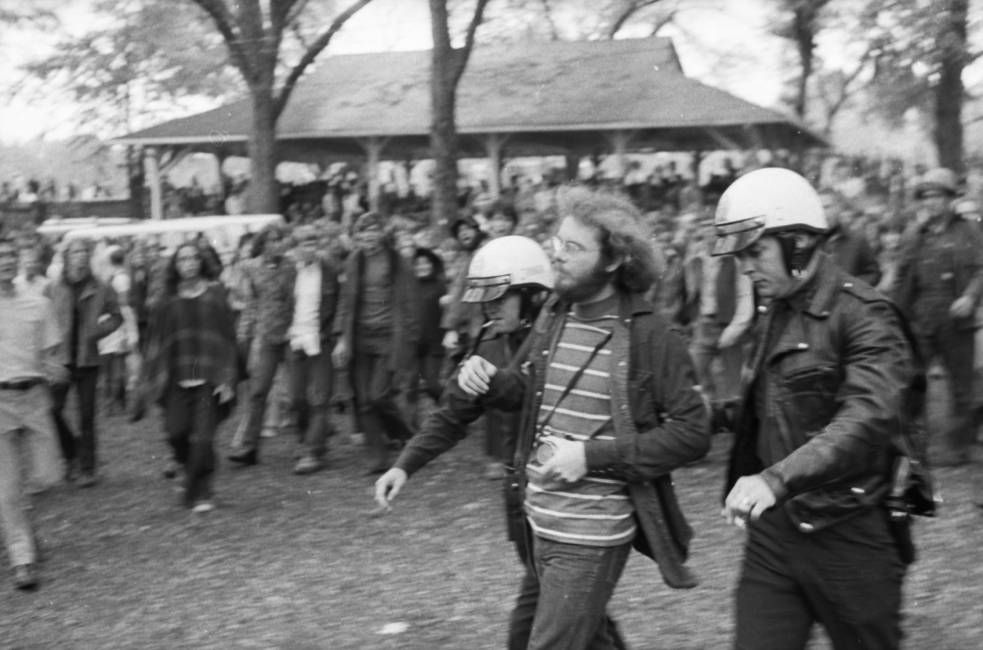
As the music, which had stopped during the struggle, resumed, Price and several other policemen moved back into the crowd and quickly found, and again apprehended, Nikas. This time, they also arrested Bill Fibben, a staff photographer for the Bird. But several hundred audience members immediately surrounded the cars containing Nikas and Fibben, shouting “This is our park!” and “get the pigs out of our park!” In response, police called for reinforcements and tear gas canisters. The concert’s promoter attempted to persuade police to let him restore calm but before he could do so, an officer lobbed a tear gas canister into the crowd and what had been merely an angry confrontation between the police and the concertgoers turned into a riot.30
TEAR GAS UNLEASHED ON HIPPIES ATTENDING A FOLK CONCERT IN PIEDMONT PARK, ATLANTA, GEORGIA, SEPTEMBER 22, 1969. PHOTO BY NOEL DAVIS. AJCP211-032A, ATLANTA JOURNAL-CONSTITUTION PHOTOGRAPHIC ARCHIVES. SPECIAL COLLECTIONS AND ARCHIVES, GEORGIA STATE UNIVERSITY LIBRARY. COPYRIGHT ATLANTA JOURNAL-CONSTITUTION. COURTESY GEORGIA STATE UNIVERSITY.
As the protestors around the patrol car began to scatter, several paddy wagons and almost the entire evening watch of the Atlanta police force approached the park. For the next thirty minutes a running battle of sorts took place. The police, who had taken up a position not far from the park pavilion, fired tear gas canisters into the crowd while several officers repeatedly charged into the rioters. The crowd responded by throwing some of the tear gas canisters back, along with rocks, cans and glass bottles, quickly dispersing after each volley only to retake its position after the clouds of tear gas dissipated.31 Ultimately, the confrontation ended only after American Civil Liberties Union lawyer Al Horn arrived at the park and talked with Police Superintendent Oscar Jordan.32 Following this conversation, the crowd calmed down and several police officers left the park. As attempts were being made to restart the music, Police Chief Herbert Jenkins and Mayor Ivan Allen finally arrived, too late to make any meaningful contribution although the mayor did spend some time speaking with concertgoers.33

RESPONSES TO THE RIOT

While the Piedmont Park riot resulted in few injuries and only twelve arrests,34 it provoked a variety of responses from the Strip community, civil rights leaders, local politicians, and city officials. The statements issued by these groups reveal the complicated nature of Atlanta politics in the late 1960s as well as divisions within the city’s hip community. Moreover, the cooperation between the hip and civil rights communities in response to the riot revealed how disaffected groups in Atlanta could cross racial lines when they found common cause.
POLICEMEN DRAGGING A YOUNG HIPPIE THROUGH THE GRASS, PIEDMONT PARK, ATLANTA, GEORGIA, SEPTEMBER 22, 1969. PHOTO BY NOEL DAVIS. AJCP211-032B, ATLANTA JOURNAL-CONSTITUTION PHOTOGRAPHIC ARCHIVES. SPECIAL COLLECTIONS AND ARCHIVES, GEORGIA STATE UNIVERSITY LIBRARY. COPYRIGHT ATLANTA JOURNAL-CONSTITUTION. COURTESY GEORGIA STATE UNIVERSITY.
With the mayoral election just weeks away, several of the candidates weighed in on the riot. City alderman Everett Millican, who had recently proposed a park curfew, favored drastic action, promising that, if elected, he would “run the hippies out of town.”35 Echoing statements he had made the previous spring, he labeled the city’s countercultural district “a disgrace,” filled with “hippies, homosexual, sex deviates and drug pushers.”36 While admitting that Piedmont Park had deteriorated before the hippies claimed it as their own, he still argued that “it’s gone down a lot more since.”37 Alderman and mayoral candidate Rodney Cook took a less aggressive position, stating that law-abiding citizens should not fear being “hit over the head” by police but that those who broke the law should be punished to the fullest extent possible. Instead of running the hippies out of town, Cook believed that hiring more policemen, raising salaries, providing them with better training, and creating neighborhood patrols would solve the problem.38
HIPPIES TALK TO MAYOR IVAN ALLEN JR. AFTER THE RIOT. FROM: GREAT SPECKLED BIRD 2, NO. 29 (SEPTEMBER 29, 1969), 22. GREAT SPECKLED BIRD COLLECTION. SPECIAL COLLECTIONS AND ARCHIVES, GEORGIA STATE UNIVERSITY LIBRARY. COURTESY GEORGIA STATE UNIVERSITY.
Meanwhile, in stark contrast to the interpretation of the riot offered by members of the political establishment, Great Speckled Bird writer Greg Gregory analyzed the riot from a countercultural perspective, arguing for the park’s importance to the development of a new American society and declaring that,39
Sunday’s resistance was not ‘revolutionary antics,’ the work of ‘agitators.’ Sunday was a defense of the kind of life we have chosen to live. This life includes music; it includes dope; but more significantly; and of revolutionary impact, is our self-perception as a people acting in unity.
He continued:40
A park cannot be liberated by permit, cannot be ‘free’ just because freaks come together to dig some fine music . . . Sunday was about what comes down when . . . we transgress the constricted lifestyle that is acceptable to and in this rotten society.
But Gregory also had harsh words for members in the hip community who criticized those who had fought back against the police. Arguing that this criticism attacked the very unity the riot had created, Gregory suggested that “to fall back on a love-and-peace stance which quickly becomes a hate-the-bottle throwers posture is to fragment the solidarity that saw politicos and culture freaks standing side by side.”41 While praising the importance of gentleness to their cultural revolution, he nonetheless argued that cruelty, not gentleness, needed to be the appropriate response when “tribal celebrations” came under attack. As he saw it, solidarity required that musicians, “trippers,” and rock throwers stand together or the new culture they hoped to create would die. Likewise, Jim Gwin asserted that “we must defend our vision as it emerges in concrete form. The communal/music experience in Piedmont Park is that vision.”42
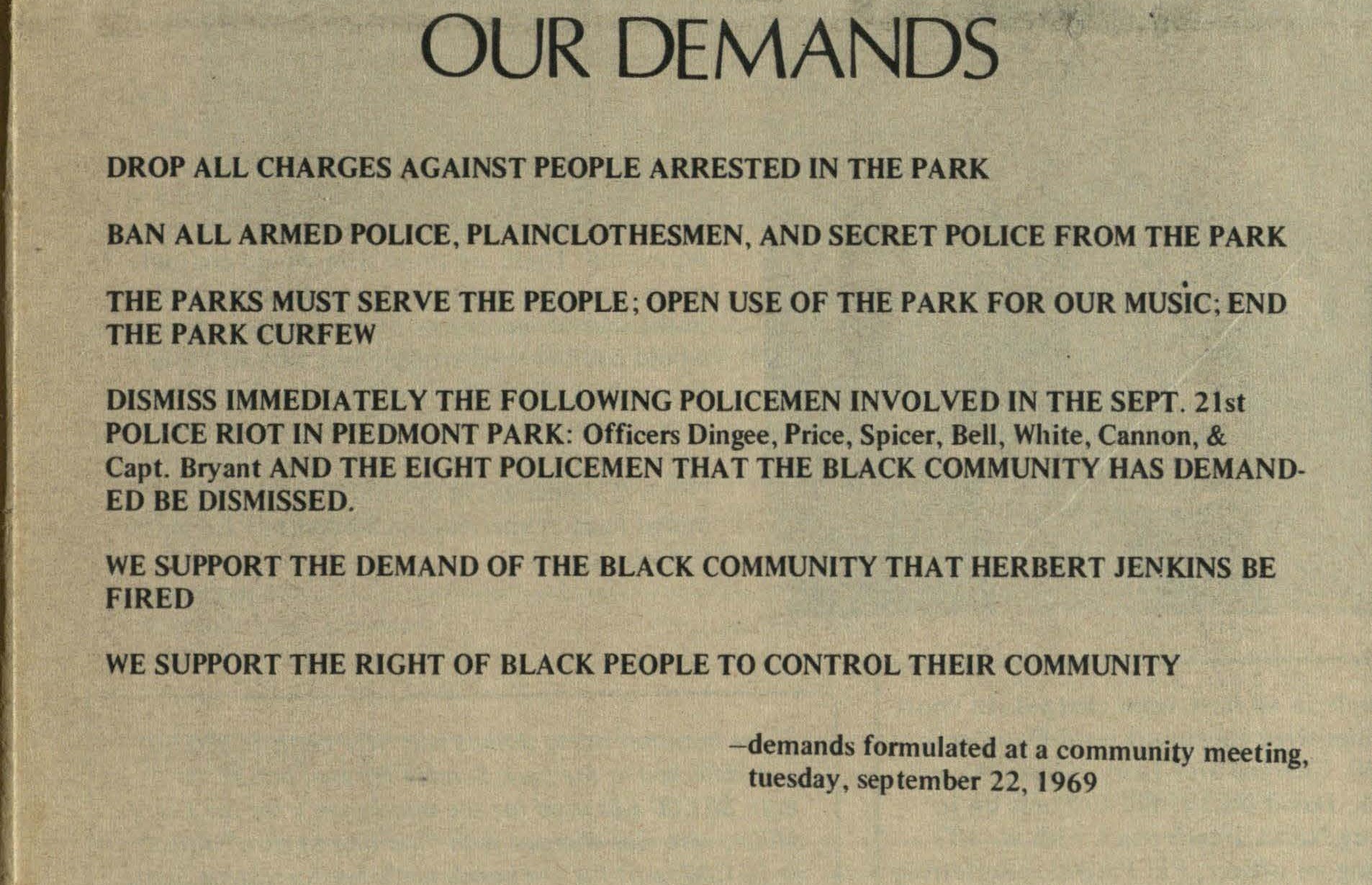
The politicos of the Great Speckled Bird also responded quickly to the riot. Staff members at the Bird office began immediately collecting the statements of approximately one hundred people present in the park during the confrontation, which would be added to the police harassment suit the Bird had filed recently in federal court.43 During a press conference held at the newspaper’s office the day after the riot, the hip community presented three demands: that all charges against those arrested on Sunday be dropped, that all plainclothesmen and other policemen be banned from the park and, finally, to “let us have our music.”44
The riot also generated support from the city’s civil rights community. On Monday, the Atlanta Ad Hoc Committee on Law Enforcement and the Community, which had come together the previous April to investigate police brutality and included members of the Urban League, the National Association for the Advancement of Colored People, and the Metropolitan Atlanta Summit Leadership Conference, presented four recommendations to Mayor Ivan Allen. The committee called for an end to harassment, suspensions of policemen accused of brutality, improved jail conditions, and the establishment of grievance procedures. The group also noted that the Atlanta police “showed the same brutal force as Chicago” in their efforts to disperse the park crowd, a reference to the previous year’s street riots during the Democratic National Convention.45 While Allen declined to comment on these recommendations, he stated that the city would undertake a “full investigation of police brutality charges” stemming from the riot, and announced that the two officers noted most prominently for their actions in the park, C. R. Price and D. L. Dingee, had been transferred to duty in south Fulton County. Both the mayor and Jenkins stated this might help the situation since the problem had been caused only by a small number of “bad apples” within the police force.46
The committee clearly saw common cause between black Atlantans and the Strip community when it came to law enforcement issues. In its statement to Allen, it claimed that “the city has evaded responsibility and accountability for abuse of its citizens. Brutality occurs not only at the jail, it happens at the time of arrests . . . and we know that the police rioted in Piedmont Park yesterday.”47 Likewise, Southern Christian Leadership Conference (SCLC) leader Hosea Williams articulated the connection between oppressed African Americans and hip community members. When speaking to the crowd at Piedmont Park after the riot, he told them that,48
this is the same thing that has been happening to black people for a long time – and partly for the same reason: because they don’t want to conform to the ways of this sick, racist society. The reason they’re brutalizing you is simple: you want to live your own life, your own way.
THE GREAT SPECKLED BIRD 2, NO. 29 (SEPTEMBER 29, 1969), 3. GREAT SPECKLED BIRD COLLECTION. SPECIAL COLLECTIONS AND ARCHIVES, GEORGIA STATE UNIVERSITY LIBRARY. COURTESY GEORGIA STATE UNIVERSITY.
The Strip and civil rights communities further strengthened their bonds in the wake of the riot by planning a march to police headquarters at a meeting that included representatives from the Bird and the SCLC alongside numerous hippies and street people, ministers from several local churches, local countercultural shopkeepers, and political radicals. In addition to the three demands formulated immediately after the riot, the group agreed to publicly support the call from civil rights groups for the termination of Police Chief Herbert Jenkins and the demand that African Americans control their own communities. Attendees also demanded the firing of seven police officers involved in the riot, including Price and Dingee, as well as eight other officers that the African American community wanted dismissed.
On Saturday, September 27, a procession of approximately 600 marchers – which would ultimately grow to 1,000 participants – left Piedmont Park headed downtown along the city’s main thoroughfare. Holding banners with the phrases “Fire Jenkins” and “No Armed Police or Narks in Park,” the group included several African American ministers and civil rights leaders, such as the Reverend Douglas Slappey of the African Methodist Episcopal Church, and Hosea Williams. Once they reached police headquarters the marchers handed over their demands to Superintendent Jordan and the crowd listened to several speeches, before turning around and heading back to the park.49
YOUNG PEOPLE MARCH IN PROTEST AGAINST POLICE TACTICS AFTER A “GREAT SPECKLED BIRD” SPONSORED CONCERT, ATLANTA, GEORGIA, SEPTEMBER 27, 1969. V003-690927-A08, TOM COFFIN PHOTOGRAPHS. SPECIAL COLLECTIONS AND ARCHIVES, GEORGIA STATE UNIVERSITY LIBRARY. COURTESY GEORGIA STATE UNIVERSITY.

WHERE DID ALL THE HIPPIES GO?

The riot and the series of confrontations that led up to it would ultimately garner national attention via an October 10 story in Time magazine, entitled “The Great Hippie Hunt,” in which it was suggested that, 50
police and state solicitor general’s agents, with the tacit approval of the city administration and Atlanta’s business community, have waged war against these so-called undesirables, treating them as the greatest threat to the city since General Sherman.
This coverage and the brief flurry of activity following the riot in Piedmont Park ultimately did little to change conditions for the better, either in the Strip or at the park. Indeed, while the Strip had drawn most of the city leaders’ attention up to that point, in the years after the riot, they would increasingly object to the presence of the hip community in Piedmont Park as well, which many Atlantans had given up using after the hip community had adopted it as its own in 1969. Moreover, due to increased police harassment and the passage of a new city loitering ordinance in 1970,51 large numbers of people who had formerly called the Strip home had moved several blocks east to Piedmont Park. Reports in local papers claimed that at least several hundred people now called the park home and in August 1971 the Bird reported: “the Strip is practically deserted and the park is being used more.”52 But the introduction of hard drugs, the growing presence of criminal elements – including violent bikers – and a serious problem regarding teenage runaways changed the nature of the community and provoked a set of responses from the new Mayor Sam Massell that would ultimately end the hips’ occupation of the park and spell the end of Atlanta’s hip community.
After a series of shootings in the summer and fall of 1971, Mayor Massell announced that a “special police detail, a mobile precinct, and a mounted patrol” would soon be on duty in Piedmont Park because, as he described it, “the park is a big place but not big enough to house punks with knives, guns, and needles.”53 These additional policeman soon began patrolling Piedmont Park aggressively and the crackdown had its intended effect – within days, hips had largely abandoned the park. New regulations which were soon adopted also made it harder to organize the kind of events that the hip community had held in Piedmont Park over the past several years, such as rock concerts, political rallies, and antiwar demonstrations.54 Denied the ability to organize events, hips still attempted to congregate informally in the park. Not surprisingly, the police worked diligently to make them unwelcome by selectively enforcing park ordinance 22-38, which made it “unlawful for any person, in any park, to, stand, walk, or ride on the grass,” and by asking for identification from members of any group of six or more hips. As the Bird put it, a “police state” now existed in the park.55
MOUNTED PATROL IN PIEDMONT PARK. BOYD LEWIS COLLECTION AT KENAN RESEARCH CENTER AT THE ATLANTA HISTORY CENTER. COURTESY ATLANTA HISTORY CENTER.
Pushed out of Piedmont Park and the Strip, the hip community saw its demise approaching quickly over the horizon. As its members relocated to other neighborhoods, left town, or moved on to new pursuits and passions, mainstream society’s adoption of many countercultural elements in the first years of the 1970s diminished the need for separate spaces where people could freely practice alternate lifestyles. Smoking marijuana, growing long hair, or just generally letting your freak flag fly no longer seemed so threatening, as witnessed by the newfound presence of “shaggy-haired young business executives in downtown Atlanta.”56 As the hippies disappeared, the developers moved in. Over the next several decades, the coffeehouses, clubs, and crash pads of the Strip were plowed under, replaced by gleaming high-rise office buildings. Piedmont Park, however, remained largely unchanged and stands today as one of the few remaining physical spaces connected to Atlanta’s hip community. This seems appropriate, given the importance of the park to the city’s hippies and political radicals. Although the riot that occurred in September 1969 is perhaps the best remembered event of Atlanta’s freak past, in truth it was one among many that briefly helped turn Piedmont Park into a park for the people.
ATLANTA MAYOR SAM MASSELL INPSECTS AT THE PROPOSED LAYOUT OF COLONY SQUARE, 1971. PHOTO BY ROBERT CONNELL. AJCP103-015A, ATLANTA JOURNAL-CONSTITUTION PHOTOGRAPHIC ARCHIVES. SPECIAL COLLECTIONS AND ARCHIVES, GEORGIA STATE UNIVERSITY LIBRARY. COPYRIGHT ATLANTA JOURNAL-CONSTITUTION. COURTESY GEORGIA STATE UNIVERSITY.
This work is licensed under a Creative Commons Attribution-NonCommercial-NoDerivatives 4.0 International License. Attribution must provide author name, article title, Atlanta Studies, date of publication, and a link to this page. Note that this license applies only to the text of the article, not to media used here by permission.

Source: Atlanta Studies | Parks are for the People: The Piedmont Park Riot and the Politics of Late 1960s Atlanta

The junky genius of Alexander Trocchi | Tony O’Neill | The Guardian

The plotless beauty of his writing, and its fearless look at the emptiness of his own life, put ‘the Scottish Beat’ on a par with Kafka and Camus.

My scow is tied up in Flushing, NY, alongside the landing stage of the Mac Asphalt and Construction Corporation. It is now just after five in the afternoon. Today at this time it is still afternoon, and the sun, striking the cinderblocks of the main building of the works has turned them pink. The motor cranes and the decks of the other scows tied up round about are deserted.

Half an hour ago I gave myself a fix.

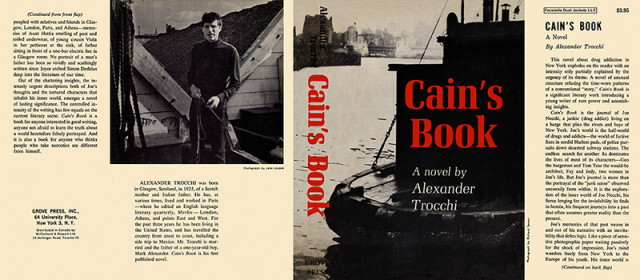
So begins Cain’s Book, Alexander Trocchi‘s incredible novel of existential dread. Young Adam, its predecessor, is better known, but the latter is the “Scottish Beat’s” classic.

Asked to name the best existential literature, most of us would probably say Albert Camus, Jean-Paul Sartre or Franz Kafka. But Cain’s Book actually takes the reader one step further into the philosophical world of existential angst than any of them. It positively drowns us in a word of unremitting absurdity and meaninglessness.

A roman à clef, Cain’s Book details the life of one Joe Nechhi, a Glaswegian heroin addict living and working on a scow in New York’s Hudson harbor. It is a book almost entirely devoid of plot: Nechhi occasionally details trips into the city to score heroin, recollects his childhood in Glasgow, or talks of his attempts to write a book. What is incredible about the book is its unrelenting bleakness, and the sheer poetic quality of Trocchi’s writing.

Heroin for Trocchi, as Remainder author Tom McCarthy noted in a lecture on Cain’s Book recently, “is a moveable void: taking that void around the city with him, in him, he ensures that he inhabits negative space constantly. This is his poetic project and it’s also the way his whole perception system works at its most basic level (the two are the same).”

In real life, Trocchi seemed very glad to cut himself off from his peers, saying that his only concerns as a writer were “sodomy and lesbianism”, that those were the only interesting subjects in the previous 20 years of Scottish writing and that “I have written it all.”

Sadly, Cain’s Book was his last. As the 60s gave way to the 70s, Trocchi’s addiction to heroin took its toll and his talent lay pretty much squandered. The stories of his wild and tragic life are infamous and extensively documented in many of the leading “swinging 60s” biographies (Marianne Faithfull’s account of doing drugs with Trocchi is one of the best). Despite his addictions, and his sad death at the age of 59, Trocchi left us some of the bleakest, most beautiful writing to come out of the 60s.

In Cain’s Book the writing is all – the words ebb and flow like the inky blackness of the Hudson River. Trocchi’s descriptive powers are mesmerising: one barely even notices the lack of narrative drive until after the book has been put down.

His other books includes some interesting pseudonymous pornography for the Olympia Press. (Titles like Helen and Desire, Sappho of Lesbos and White Thighs deliver their smut with a Sadean political edge.) Young Adam, of course, was turned into a successful film starring Ewan McGregor, and helped to raise the author’s public perception a little. But it’s Cain’s book that best fulfils Trocchi’s hopes for “the invisible insurrection of a thousand minds”.

Alexander Trocchi

The Hippies // By Hunter S. Thompson 

The Hippies – By Hunter S. Thompson

The best year to be a hippie was 1965, but then there was not much to write about, because not much was happening in public and most of what was happening in private was illegal. The real year of the hippie was 1966, despite the lack of publicity, which in 1967 gave way to a nationwide avalanche in Look, Life, Time, Newsweek, the Atlantic, the New York Times, the Saturday Evening Post, and even the Aspen Illustrated News, which did a special issue on hippies in August of 1967 and made a record sale of all but 6 copies of a 3,500-copy press run. But 1967 was not really a good year to be a hippie. It was a good year for salesmen and exhibitionists who called themselves hippies and gave colorful interviews for the benefit of the mass media, but serious hippies, with nothing to sell, found that they had little to gain and a lot to lose by becoming public figures. Many were harassed and arrested for no other reason than their sudden identification with a so-called cult of sex and drugs. The publicity rumble, which seemed like a joke at first, turned into a menacing landslide. So quite a few people who might have been called the original hippies in 1965 had dropped out of sight by the time hippies became a national fad in 1967.

Ten years earlier the Beat Generation went the same confusing route. From 1955 to about 1959 there were thousands of young people involved in a thriving bohemian subculture that was only an echo by the time the mass media picked it up in 1960. Jack Kerouac was the novelist of the Beat Generation in the same way that Ernest Hemingway was the novelist of the Lost Generation, and Kerouac’s classic “beat” novel, On the Road, was published in 1957. Yet by the time Kerouac began appearing on television shows to explain the “thrust” of his book, the characters it was based on had already drifted off into limbo, to await their reincarnation as hippies some five years later. (The purest example of this was Neal Cassidy [Cassady], who served as a model for Dean Moriarity in On the Road and also for McMurphy in Ken Kesey’s One Flew Over the Cuckoo’s Nest.) Publicity follows reality, but only up to the point where a new kind of reality, created by publicity, begins to emerge. So the hippie in 1967 was put in the strange position of being an anti-culture hero at the same time as he was also becoming a hot commercial property. His banner of alienation appeared to be planted in quicksand. The very society he was trying to drop out of began idealizing him. He was famous in a hazy kind of way that was not quite infamy but still colorfully ambivalent and vaguely disturbing.

Despite the mass media publicity, hippies still suffer or perhaps not from a lack of definition. The Random House Dictionary of the English Language was a best seller in 1966, the year of its publication, but it had no definition for “hippie.” The closest it came was a definition of “hippy”: “having big hips; a hippy girl.” Its definition of “hip” was closer to contemporary usage. “Hip” is a slang word, said Random House, meaning “familiar with the latest ideas, styles, developments, etc.; informed, sophisticated, knowledgeable [?].” That question mark is a sneaky but meaningful piece of editorial comment.

Everyone seems to agree that hippies have some kind of widespread appeal, but nobody can say exactly what they stand for. Not even the hippies seem to know, although some can be very articulate when it comes to details.

“I love the whole world,” said a 23-year-old girl in San Francisco’s Haight-Ashbury district, the hippies’ world capital. “I am the divine mother, part of Buddha, part of God, part of everything.

“I live from meal to meal. I have no money, no possessions. Money is beautiful only when it’s flowing; when it piles up, it’s a hang-up. We take care of each other. There’s always something to buy beans and rice for the group, and someone always sees that I get ‘grass’ [marijuana] or ‘acid’ [LSD]. I was in a mental hospital once because I tried to conform and play the game. But now I’m free and happy.” She was then asked whether she used drugs often. “Fairly,” she replied. “When I find myself becoming confused I drop out and take a dose of acid. It’s a short cut to reality; it throws you right into it. Everyone should take it, even children. Why shouldn’t they be enlightened early, instead of waiting till they’re old? Human beings need total freedom. That’s where God is at. We need to shed hypocrisy, dishonesty, and phoniness and go back to the purity of our childhood values.”

The next question was “Do you ever pray?” “Oh yes,” she said. “I pray in the morning sun. It nourishes me with its energy so I can spread my love and beauty and nourish others. I never pray for anything; I don’t need anything. Whatever turns me on is a sacrament: LSD, sex, my bells, my colors…. That’s the holy communion, you dig?” That’s about the most definitive comment anybody’s ever going to get from a practicing hippie. Unlike beatniks, many of whom were writing poems and novels with the idea of becoming second-wave Kerouacs or Allen Ginsbergs, the hippie opinion makers have cultivated among their followers a strong distrust of the written word. Journalists are mocked, and writers are called “type freaks.” Because of this stylized ignorance, few hippies are really articulate. They prefer to communicate by dancing, or touching, or extrasensory perception (ESP). They talk, among themselves, about “love waves” and “vibrations” (“vibes”) that come from other people. That leaves a lot of room for subjective interpretation, and therein lies the key to the hippies’ widespread appeal.

This is not to say that hippies are universally loved. From coast to coast, the forces of law and order have confronted the hippies with extreme distaste. Here are some representative comments from a Denver, Colo., police lieutenant. Denver, he said, was becoming a refuge for “long-haired, vagrant, antisocial, psychopathic, dangerous drug users, who refer to themselves as a ‘hippie subculture a group which rebels against society and is bound together by the use and abuse of dangerous drugs and narcotics.” They range in age, he continued, from 13 to the early 20’s, and they pay for their minimal needs by “mooching, begging, and borrowing from each other, their friends, parents, and complete strangers…. It is not uncommon to find as many as 20 hippies living together in one small apartment, in communal fashion, with their garbage and trash piled halfway to the ceiling in some cases.”

One of his co-workers, a Denver detective, explained that hippies are easy prey for arrests, since “it is easy to search and locate their drugs and marijuana because they don’t have any furniture to speak of, except for mattresses lying on the floor. They don’t believe in any form of productivity,” he said, “and in addition to a distaste for work, money, and material wealth, hippies believe in free love, legalized use of marijuana, burning draft cards, mutual love and help, a peaceful planet, and love for love’s sake. They object to war and believe that everything and everybody except the police are beautiful.”

Many so-called hippies shout “love” as a cynical password and use it as a smokescreen to obscure their own greed, hypocrisy, or mental deformities. Many hippies sell drugs, and although the vast majority of such dealers sell only enough to cover their own living expenses, a few net upward of $20,000 a year. A kilogram (2.2 pounds) of marijuana, for instance, costs about $35 in Mexico. Once across the border it sells (as a kilo) for anywhere from $150 to $200. Broken down into 34 ounces, it sells for $15 to $25 an ounce, or $510 to $850 a kilo. The price varies from city to city, campus to campus, and coast to coast. “Grass” is generally cheaper in California than it is in the East. The profit margin becomes mind-boggling regardless of the geography when a $35 Mexican kilogram is broken down into individual “joints,” or marijuana cigarettes, which sell on urban street corners for about a dollar each. The risk naturally increases with the profit potential. It’s one thing to pay for a trip to Mexico by bringing back three kilos and selling two in a circle of friends: The only risk there is the possibility of being searched and seized at the border. But a man who gets arrested for selling hundreds of “joints” to high school students on a St. Louis street corner can expect the worst when his case comes to court.

The British historian Arnold Toynbee, at the age of 78, toured San Francisco’s Haight-Ashbury district and wrote his impressions for the London Observer. “The leaders of the Establishment,” he said, “will be making the mistake of their lives if they discount and ignore the revolt of the hippies and many of the hippies’ non hippie contemporaries on the grounds that these are either disgraceful wastrels or traitors, or else just silly kids who are sowing their wild oats.”

Toynbee never really endorsed the hippies; he explained his affinity in the longer focus of history. If the human race is to survive, he said, the ethical, moral, and social habits of the world must change: The emphasis must switch from nationalism to mankind. And Toynbee saw in the hippies a hopeful resurgence of the basic humanitarian values that were beginning to seem to him and other long-range thinkers like a tragically lost cause in the war-poisoned atmosphere of the 1960’s. He was not quite sure what the hippies really stood for, but since they were against the same things he was against (war, violence, and dehumanized profiteering), he was naturally on their side, and vice versa.

There is a definite continuity between the beatniks of the 1950’s and the hippies of the 1960’s. Many hippies deny this, but as an active participant in both scenes, I’m sure it’s true. I was living in Greenwich Village in New York City when the beatniks came to fame during 1957 and 1958. I moved to San Francisco in 1959 and then to the Big Sur coast for 1960 and 1961. Then after two years in South America and one in Colorado, I was back in San Francisco, living in the Haight-Ashbury district, during 1964, 1965, and 1966. None of these moves was intentional in terms of time or place; they just seemed to happen. When I moved into the Haight-Ashbury, for instance, I’d never even heard that name. But I’d just been evicted from another place on three days’ notice, and the first cheap apartment I found was on Parnassus Street, a few blocks above Haight.

At that time the bars on what is now called “the street” were predominantly Negro. Nobody had ever heard the word “hippie,” and all the live music was Charlie Parker-type jazz. Several miles away, down by the bay in the relatively posh and expensive Marina district, a new and completely unpublicized nightclub called the Matrix was featuring an equally unpublicized band called the Jefferson Airplane. At about the same time, hippie author Ken Kesey (One Flew Over the Cuckoo’s Nest, 1962, and Sometimes a Great Notion, 1964) was conducting experiments in light, sound, and drugs at his home at La Honda, in the wooded hills about 50 miles south of San Francisco. As the result of a network of circumstance, casual friendships, and connections in the drug underworld, Kesey’s band of Merry Pranksters was soon playing host to the Jefferson Airplane and then to the Grateful Dead, another wildly electric band that would later become known on both coasts along with the Airplane as the original heroes of the San Francisco acid-rock sound. During 1965, Kesey’s group staged several much-publicized Acid Tests, which featured music by the Grateful Dead and free Kool-Aid spiked with LSD. The same people showed up at the Matrix, the Acid Tests, and Kesey’s home in La Honda. They wore strange, colorful clothes and lived in a world of wild lights and loud music. These were the original hippies.

It was also in 1965 that I began writing a book on the Hell’s Angels, a notorious gang of motorcycle outlaws who had plagued California for years, and the same kind of weird coincidence that jelled the whole hippie phenomenon also made the Hell’s Angels part of the scene. I was having a beer with Kesey one afternoon in a San Francisco tavern when I mentioned that I was on my way out to the headquarters of the Frisco Angels to drop off a Brazilian drum record that one of them wanted to borrow. Kesey said he might as well go along, and when he met the Angels he invited them down to a weekend party in La Honda. The Angels went and thereby met a lot of people who were living in the Haight-Ashbury for the same reason I was (cheap rent for good apartments). People who lived two or three blocks from each other would never realize it until they met at some pre-hippie party. But suddenly everybody was living in the Haight-Ashbury, and this accidental unity took on a style of its own. All that it lacked was a label, and the San Francisco Chronicle quickly came up with one. These people were “hippies,” said the Chronicle, and, lo, the phenomenon was launched. The Airplane and the Grateful Dead began advertising their sparsely attended dances with psychedelic posters, which were given away at first and then sold for $1 each, until finally the poster advertisements became so popular that some of the originals were selling in the best San Francisco art galleries for more than $2,000. By this time both the Jefferson Airplane and the Grateful Dead had gold-plated record contracts, and one of the Airplane’s best numbers, “White Rabbit,” was among the best-selling singles in the nation.

By that time, too, the Haight-Ashbury had become such a noisy mecca for freaks, drug peddlers, and curiosity seekers that it was no longer a good place to live. Haight Street was so crowded that municipal buses had to be rerouted because of the traffic jams.

At the same time, the “Hashbury” was becoming a magnet for a whole generation of young dropouts, all those who had canceled their reservations on the great assembly line: the high-rolling, soul-bending competition for status and security in the ever-fattening yet ever-narrowing American economy of the late 1960’s. As the rewards of status grew richer, the competition grew stiffer. A failing grade in math on a high school report card carried far more serious implications than simply a reduced allowance: It could alter a boy’s chances of getting into college and, on the next level, of getting the “right job.” As the economy demanded higher and higher skills, it produced more and more technological dropouts. The main difference between hippies and other dropouts was that most hippies were white and voluntarily poor. Their backgrounds were largely middle class; many had gone to college for a while before opting out for the “natural life”à an easy, unpressured existence on the fringe of the money economy. Their parents, they said, were walking proof of the fallacy of the American notion that says “work and suffer now; live and relax later.”

The hippies reversed that ethic. “Enjoy life now,” they said, “and worry about the future tomorrow.” Most take the question of survival for granted, but in 1967, as their enclaves in New York and San Francisco filled up with penniless pilgrims, it became obvious that there was simply not enough food and lodging.

A partial solution emerged in the form of a group called the Diggers, sometimes referred to as the “worker-priests” of the hippie movement. The Diggers are young and aggressively pragmatic; they set up free lodging centers, free soup kitchens, and free clothing distribution centers. They comb hippie neighborhoods, soliciting donations of everything from money to stale bread and camping equipment. In the Hashbury, Diggers’ signs are posted in local stores, asking for donations of hammers, saws, shovels, shoes, and anything else that vagrant hippies might use to make themselves at least partially self-supporting. The Hashbury Diggers were able, for a while, to serve free meals, however meager, each afternoon in Golden Gate Park, but the demand soon swamped the supply. More and more hungry hippies showed up to eat, and the Diggers were forced to roam far afield to get food.

The concept of mass sharing goes along with the American Indian tribal motif that is basic to the whole hippie movement. The cult of tribalism is regarded by many as the key to survival. Poet Gary Snyder, one of the hippie gurus, or spiritual guides, sees a “back to the land” movement as the answer to the food and lodging problem. He urges hippies to move out of the cities, form tribes, purchase land, and live communally in remote areas. By early 1967 there were already a half dozen functioning hippie settlements in California, Nevada, Colorado, and upstate New York. They were primitive shack-towns, with communal kitchens, half-alive fruit and vegetable gardens, and spectacularly uncertain futures. Back in the cities the vast majority of hippies were still living from day to day. On Haight Street those without gainful employment could easily pick up a few dollars a day by panhandling. The influx of nervous voyeurs and curiosity seekers was a handy money-tree for the legion of psychedelic beggars. Regular visitors to the Hashbury found it convenient to keep a supply of quarters in their pockets so that they wouldn’t have to haggle about change. The panhandlers were usually barefoot, always young, and never apologetic. They would share what they collected anyway, so it seemed entirely reasonable that strangers should share with them. Unlike the beatniks, few hippies are given to strong drink. Booze is superfluous in the drug culture, and food is regarded as a necessity to be acquired at the least possible expense. A “family” of hippies will work for hours over an exotic stew or curry, but the idea of paying three dollars for a meal in a restaurant is out of the question.

Some hippies work, others live on money from home, and many get by with part-time jobs, loans from old friends, or occasional transactions on the drug market. In San Francisco the post office is a major source of hippie income. Jobs like sorting mail don’t require much thought or effort. The sole support of one “clan” (or “family,” or “tribe”) was a middle-aged hippie known as Admiral Love, of the Psychedelic Rangers, who had a regular job delivering special delivery letters at night. There was also a hippie-run employment agency on Haight Street; anyone needing temporary labor or some kind of specialized work could call up and order whatever suitable talents were available at the moment. Significantly, the hippies have attracted more serious criticism from their former compatriots of the New Left than they have from what would seem to be their natural antagonists on the political right. Conservative William Buckley’s National Review, for instance, says, “The hippies are trying to forget about original sin and it may go hard with them hereafter.” The National Review editors completely miss the point that serious hippies have already dismissed the concept of original sin and that the idea of a hereafter strikes them as a foolish, anachronistic joke. The concept of some vengeful God sitting in judgment on sinners is foreign to the whole hippie ethic. Its God is a gentle abstract deity not concerned with sin or forgiveness but manifesting himself in the purest instincts of “his children.”

The New Left brand of criticism has nothing to do with theology. Until 1964, in fact, the hippies were so much a part of the New Left that nobody knew the difference. “New Left,” like “hippie” and “beatnik,” was a term coined by journalists and headline writers, who need quick definitions of any subject they deal with. The term came out of the student rebellion at the University of California’s Berkeley campus in 1964 and 1965. What began as a Free Speech Movement in Berkeley soon spread to other campuses in the East and Midwest and was seen in the national press as an outburst of student activism in politics, a healthy confrontation with the status quo.

On the strength of the free speech publicity, Berkeley became the axis of the New Left. Its leaders were radical, but they were also deeply committed to the society they wanted to change. A prestigious University of California faculty committee said the activists were the vanguard of a “moral revolution among the young,” and many professors approved. Those who were worried about the radicalism of the young rebels at least agreed with the direction they were taking: civil rights, economic justice, and a new morality in politics. The anger and optimism of the New Left seemed without limits. The time had come, they said, to throw off the yoke of a politico-economic establishment that was obviously incapable of dealing with new realities.

The year of the New Left publicity was 1965. About the same time there was mention of something called the pot (marijuana) left. Its members were generally younger than the serious political types, and the press dismissed them as a frivolous gang of “druggies” and sex “kooks” who were only along for the ride.

Yet as early as the spring of 1966, political rallies in Berkeley were beginning to have overtones of music, madness, and absurdity. Dr. Timothy Leary the ex-Harvard professor whose early experiments with LSD made him, by 1966, a sort of high priest, martyr, and public relations man for the drug was replacing Mario Savio, leader of the Free Speech Movement, as the number-one underground hero. Students who were once angry activists began to lie back in their pads and smile at the world through a fog of marijuana smoke or to dress like clowns and Indians and stay “zonked” on LSD for days at a time. The hippies were more interested in dropping out of society than they were in changing it. The break came in late 1966, when Ronald Reagan was elected governor of California by almost a million-vote plurality. In that same November the GOP gained 50 seats in Congress and served a clear warning on the Johnson administration that despite all the headlines about the New Left, most of the electorate was a lot more conservative than the White House antennae had indicated. The lesson was not lost on the hippies, many of whom considered themselves at least part-time political activists. One of the most obvious casualties of the 1966 elections was the New Left’s illusion of its own leverage. The radical-hippie alliance had been counting on the voters to repudiate the “right-wing, warmonger” elements in Congress, but instead it was the “liberal” Democrats who got stomped. The hippies saw the election returns as brutal confirmation of the futility of fighting the Establishment on its own terms. There had to be a whole new scene, they said, and the only way to do it was to make the big move either figuratively or literally from Berkeley to the Haight-Ashbury, from pragmatism to mysticism, from politics to dope, from the involvement of protest to the peaceful disengagement of love, nature, and spontaneity. The mushrooming popularity of the hippie scene was a matter of desperate concern to the young political activists. They saw a whole generation of rebels drifting off to a drugged limbo, ready to accept almost anything as long as it came with enough “soma” (as Aldous Huxley named the psychic escape drug of the future in his science-fiction novel Brave New World, 1932). New Left writers and critics at first commended the hippies for their frankness and originality. But it soon became obvious that few hippies cared at all for the difference between political left and right, much less between the New Left and the Old Left. “Flower Power” (their term for the power of love), they said, was nonpolitical. And the New Left quickly responded with charges that hippies were “intellectually flabby,” that they lacked “energy” and “stability,” that they were actually “nihilists” whose concept of love was “so generalized and impersonal as to be meaningless.”

And it was all true. Most hippies are too drug oriented to feel any sense of urgency beyond the moment. Their slogan is “Now,” and that means instantly. Unlike political activists of any stripe, hippies have no coherent vision of the future which might or might not exist. The hippies are afflicted by an enervating sort of fatalism that is, in fact, deplorable. And the New Left critics are heroic, in their fashion, for railing at it. But the awful possibility exists that the hippies may be right, that the future itself is deplorable and so why not live for Now? Why not reject the whole fabric of American society, with all its obligations, and make a separate peace? The hippies believe they are asking this question for a whole generation and echoing the doubts of an older generation.

Source: The Hippies // By Hunter S. Thompson | +diStRito47+

Kenny Wilson Talks about Bob Dylan at Secular Hall Leicester 5th October 7 p.m.

Ken Kesey and the Merry Pranksters

1960s: Days of Rage's avatar1960s: Days of Rage


“The Merry Pranksters were cohorts and followers of American author Ken Kesey in 1964. Ken Kesey and the Merry Pranksters lived communally at Kesey’s homes in California and Oregon, and are noted for the sociological significance of a lengthy road trip they took in the summer of 1964, traveling across the United States in a psychedelic painted school bus called Furthur or Further, organizing parties and giving out LSD. During this time they met many of the guiding lights of the mid-1960s cultural movement and presaged what are commonly thought of as hippies with odd behavior, tie-dyed and red, white and blue clothing, and renunciation of normal society, which they dubbed The Establishment. Tom Wolfe chronicled their early escapades in The Electric Kool-Aid Acid Test; Wolfe also documents a notorious 1966 trip on Further from Mexico through Houston, stopping to visit Kesey’s friend, novelist Larry…

View original post 182 more words

Ken Kesey Talks About the Meaning of the Acid Test

1960s: Days of Rage's avatar1960s: Days of Rage


“For me, there have always been at least three Ken Keseys. First, there was the antiauthoritarian author of the madcap 1962 classic One Flew over the Cuckoo’s Nest. Inspired by Kesey’s own work as an orderly at a Menlo Park mental hospital, the author’s voice disappears into that of the narrator, Chief Bromden, and the dialogue of the most memorable ensemble of troubled personalities in twentieth century literature. Then there’s the Kesey of the 1964 Sometimes a Great Notion, a Pacific Northwest epic and the work of a serious novelist pulling American archetypes from rough-hewn Oregon logging country. Finally, there’s Kesey the Merry Prankster, the mad scientist who almost single-handedly invented sixties drug culture with his ‘64 psychedelic bus tour and acid test parties. It’s a little hard to put them all together sometimes. Ken Kesey contained multitudes. The acid test parties began after Kesey’s experience with mind-altering…

View original post 133 more words

Living the Bohemian Student Dream in 1960s Paris

studentsinparis

I love to find a good Paris photo story that I haven’t seen before, and this one that I found buried in Life magazine’s archives is a quite a treat. Veteran photographer for the magazine Loomis Dean followed a group of young students in 1961, getting an intimate peek into their lives as they pursued the bohemian dream in mid-century Paris.

And you know what? It doesn’t seem like much has changed. Clicking through, I noticed the routines didn’t seem so different from the Paris I’ve come to know today. Whether you start out in a tiny attic room or student dorms, throw yourself into the café culture or lose yourself in art museums, Paris is more recogniseable than ever in this photo story from decades past…

Monday nights at the local…

parisbar

parisbar4

parisbar3


The mid-week hangovers…

hangover

Actual photo caption: “Student with a hangover”.

hangover1


To the Café! (and make it a double)…

pariscafe1

paricafe


Close living quarters (the dorm room years)…

dorms5

A college dormitory at number 57 Rue Lacépède in the 5th arrondissement (Latin Quarter).

dorms4

There is still a café under this building called La Contrescarpe (see it here on Google earth).

dormroom

records

A student looking through his music.

dorm2

parisdorm


 A Classroom in Paris

studentspark

Students studying in a park.

artstudents

Art students visiting a gallery.

artstudents2


Every hour is Apéro Hour!

parisbar2


Getting to know the locals…

parisbar5

(over Pastis-fuelled philosophical debates)

parisbar6


Beatnik shindigs in old wine cellars…

cellarparty

cellar1


Ending up at a house parties, having no idea who the apartment belongs to.

parisparty


Saturday nights in.

parisdinner

parisdinner3

parisdinner2


Inspiration-searching Sundays…

parisstreet

seinemusician

Strolling down the Seine…

parisstreet1

parisman

parisartist

Art students “picnicking” with their models…

nudes


Not forgetting Springtime loves…

parisinspiration

fallinginlove

fallinginlove1


And of course, too many damn cigarettes.

smokingcigarettes

cellarparty1

pariscafe2


All photos (c) LIFE

Heaven and Hell Coffee Lounge in Soho, W1 |Eric Lindsay

This is a brilliant blog post about the Heaven and Hell Coffee Bar in Soho written by it’s founder Eric Lindsay (link at end). Sadly not with us anymore. Check it out!!

Ray Jackson and I opened Heaven and Hell in late 1955. I had the idea from when I had been working in Paris, where there was a type of cheap cabaret called  “Ciel at l’Enfer” “Heaven and Hell” in Pigalle. The name and the place intrigued me, so later when I was in Paris again with Ray, I took him along to see the place and he also thought it was tacky but great.

The name stayed in my memory for a later date.

Here are some old photographs that I have just come across to show you how much the original impressed me. “Ciel et l’Enfer” was an intriguing name.

heaven-and-hell-old-postcard

heaven-and-hell-old-postcard-2

We had already sold the Regency Coffee Bar in East Sheen, which we opened with £200, £100 each, sometime in 1953. The Regency look was in, so we bought chairs from an antique shop in Putney for 5/- each and the owner of the shop taught me how to give them the antique look. We bought cheap floor covering, Ray’s uncle hung the wallpaper and my mother made the tablecloths and curtains. I used the same red Regency striped material to upholster the chairs, it was all a bit make do and mend, but the final result looked great. The major expense was the Gaggia Coffee Machine, which we paid off for. So espresso coffee came to East Sheen!

We thought we would do business, well forget it! I thought we would be stuck there for the rest of our lives. East Sheen was half way on the bus route between Hammersmith and Richmond, and really one should never get off the bus. I was convinced it was a place that people just stopped off to die. There was literally no business. Although everybody who lived there had the airs and graces of society toffs, they had no cash flow to buy a cup of coffee. In fact they hadn’t got a pot to piss in! But they lived in East Sheen so they had a little status. (They thought!)

Fortunately both Ray and I continued working in Theatre and TV, and Ray in films because we needed something extra to survive.

We were ‘so busy’ at the Regency that one person could run the whole place – serve coffee, do the cooking, the lot. So Ray and I worked alternate days. When I was on duty I would take an order and call out to the kitchen and then rush round talking to myself (the invisible chef). At least it was a good way to pass the time and it gave the customers the idea that we had staff.  I thought I was going to be stuck there forever.  We earned £10 a week each. My bus fares cost me £5, so you can see I was really in pocket! Finally we managed to sell the place to a guy who had retired from Claridges Hotel with a pension who wanted something easy to do in his retirement years. Well I could have told him that he wouldn’t be rushed off his feet here, but I didn’t and we sold the Regency for the princely sum of £1000, which was a profit, and we both breathed a sigh of relief!

We then started searching around for empty premises in Soho because I certainly wasn’t going out of town again. It had to be a shop and basement so that Heaven could be on the ground floor and Hell downstairs. We finally came across a little shop with a basement at 57 Old Compton Street. The ground floor had a small jewelry shop sharing the premises called of all things “Going Gay”.  Do you think it was an omen? The gentleman who owned the freehold was called Harry Shanson, and he owned all the freeholds of 55, 57 and 59 Old Compton Street W.1.

Shaws the estate agents who were handling  the property arranged for Ray and myself to see Mr. Shanson in his office in the City. Well, somehow it must have been our lucky day, because we talked to him and told him we were actors and what we wanted to do with the premises and the name we were going to call the coffee bar and the whole theme. He was interested in everything we had to say. Finally the question of rent came up and Ray and I nearly fell of the chairs when he told us what he wanted. It was far too much for us to afford. We got up to leave and explained that we just couldn’t afford to pay that sort of rent. He asked us how much we could afford. I told him half of what he was asking, to which he replied, “O.K.” With that, we both nearly passed out. Ray and I left his office floating on air.

We started work at 57 Old Compton Street. From the St. Martins School of Art we found a designer to make the plaster casts for the lights in Heaven and also Hell. Beforehand, Ray and I decided that Heaven should have an ethereal theme with sun flowers for lights with cherub faces. The staircase leading to Hell was a giant Devil’s mouth, which you walked down into. Hell was totally black with red flames climbing up the walls.

Out of the walls for lights we had these arms holding lighted Devil masks. The emergency exit, which we had to have, was a ladder in the middle of the room closed on 3 sides with a red curtain on which was a full length painting of the Devil with horns, tail and pitch fork. It was all very atmospheric and the customers adored it. On the street wall we had a light box with a colour transparency of Heaven and below it Hell. From the moment we opened, the place was full, at lunchtimes and evenings. I used to have to stand on the door letting customers in as a seat became vacant whilst they were queuing out in the street. Not many people wanted to stay in Heaven, they all wanted to go to Hell. No pun intended. As you may gather, business was fabulous, especially when the Soho Fair was on.

heaven-and-hell-soho-fair

heaven-and-hell-coffee-lounge-1-print

Over the years Harry Shanson and his wife became firm friends. He was one of the kindest people in the world. One day when we had been running quite a few years, Harry’s son, who was a bit of a monster when he was young, came in and said to me, “My daddy owns this place! It’s ours.” So I politely said to him “Fuck off!”

There was never a dull moment in Old Compton Street. The 2 I’s was next door. The customers would go from coffee bar to coffee bar. The 2 I’s used to have their windows smashed in regularly. We fortunately were left alone. Everyone seemed to making money and at 9 pence a coffee it was some hard going.

Two prostitutes in 1950s Soho

Prostitutes were on every street corner. The flat above Heaven and Hell was occupied by Suzy, an elegant French lady of the night who really would have been more at home in Mayfair, but I suppose she wanted a quick turn over! She wore the stair carpet out all the time. Next door at No. 57, Jackie, another French beauty, much younger than Suzy, could turn 100 customers a day. My mother, who used to come up to town regularly, used to sit in the window in Heaven and keep score. She was so intrigued by it all.

Well, the time came when Ray and I decided that we would like to get a flat together, so I spoke to Harry Shanson. The lovely  Suzy got her marching orders and Ray and I moved into Flat 1, 57 Old Compton Street at a rent that he asked us what we would like to pay, so that also was very reasonable. It was a known fact that he could always get at least double from the tarts. I did think she might send the ‘heavies’ in after being thrown out and when she found out that we had taken the flat, but no, she was always pleased to see me and talk when I saw her on her new beat at the corner of Greek St. and Old Compton St. Working ‘flats’ were not that difficult for the ‘girls’ to come by.

Suzy had kept the place spotless, after all she had he own French maid who was on duty full time during the working hours. The bedroom looked as though it had seen plenty of action. But after we had redecorated the whole place even Suzy wouldn’t have recognized it as her own little bordello.

We never had live music in Heaven and Hell, just two jukeboxes one in Heaven and one in Hell, with the same records in each. It was easier than all the hassle with live music because the customers never left. With us, they stayed about an hour and left, rather than sitting there all night. Also it was much more profitable as we would get loads of double plays from the 2 machines.

So the money rolled in and we were ready to roll out onto our next venture which was:

“THE CASINO de PARIS STRIPTEASE THEATRE CLUB”

P.S. If any of you ‘older readers’  happen to come across a picture of yourselves taken inside “Heaven and Hell,” I would be very happy to include it into my blog.

Source: Heaven and Hell Coffee Lounge in Soho, W.I. | ericlindsay