New Bob Dylan Bootleg Series 10 from the Self Portrait period 1969-71

This is an interesting addition to the Bootleg Series from the much maligned Self Portrait period. I always thought there was more to it than many critics allowed.Time for a reappraisal!

Painters Painting, a 1973 Documentary Featuring Andy Warhol, Jasper Johns, Willem de Kooning, and More

My Favourite Albums of All Time (Part One)

This is a tricky one. I’ve never been that impressed with ‘best of’ lists but I found myself sitting in a hotel room listening to music on my phone and I began thinking about what my favourite (and most influential) albums of all-time were. I say influential because, as some of you know, I am a musician and song-writer who has followed in the footsteps of numerous greats. It’s a hard choice but here’s my favourite 10. I’ve limited myself to two albums by the same artist or else they would probably be all by Bob Dylan ! I also realise, having completed the list, that, with the exception of the first 5, the rest are in no particular order. I’m also aware that there are countless others that could, and probably should, be included. Alright, it’s a stupid idea but here it is!

1. Highway 61 Revisited by Bob Dylan.

Highway+61+Revisited+Bob+Dylan++Highway+61+Revisite

Okay, what can I say about this album apart from the fact that it is probably the most inspired piece of work I have EVER heard (notice the Dylanesque emphasis) and I’m not just talking about music! I have read reports about the session and all participants agree that something very special happened here. It contains, in my opinion, the greatest rock song of all time “Like a Rolling Stone” but this is not really the essence of the album. It stands apart and, indeed, was produced by a different person from the rest of the record. The remainder contains Dylan at his most aggressive and elusive best. The most interesting song, again in my opinion, is Desolation Row, a surreal trawl through 20th Century culture and ideas. “Ezra Pound and T.S. Eliot fighting in the captain’s tower, while calypso singers laugh at them and fishermen hold flowers”. This isn’t just poetry and music it is an assault on the senses and intellect! “The Agents” and “The Superhuman Crew” check to see that no one is escaping to Desolation Row. The famous voice that people either love or hate is at it’s expressive best. Like many albums on my list this one is unique. There was nothing like it before and there’s been nothing like it since. Even the titles of the songs were a new departure with weird names like “Queen Jane Approximately”, “Just Like Tom Thumb’s Blues” and “Ballad of a Thin Man” that seemed to have nothing to do with the lyrics of the songs but probably did have. Pop music had found Symbolist poetry and the kids loved it!! (Well, this one did). It stands alone and sounds forever modern and archaic at the same time. Dylan himself has said that he had no idea how he wrote the songs and wouldn’t be able to do them now. The musicianship is impeccable especially the electric guitar playing of Mike Bloomfield and the acoustic lead of Charlie McCoy imported especially from Nashville for just one track!

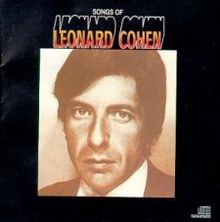
2. The Songs of Leonard Cohen220px-SongsOfLeonardCohen

If Bob Dylan in the mid sixties was on an amphetamine fueled creative voyage into oblivion Leonard Cohen was on a quietly mannered journey back from it. This album emerged in 1968 and gradually became a bedsit legend as many sad young men and women took the songs to heart. Okay, it has been called music to slit your wrists to and Cohen’s voice has probably been even less complimented than Dylan’s but to those in the know this is an album of beautifully crafted songs whose underlying message is surprisingly optimistic completely unlike the eternal whinging of say Morrissey and the Smiths who actually DID create music to slit your wrists to. Cohen’s songs deal with ideas that had seldom been dealt with by popular music before. Despair, spirituality, sexual love and he wrote like a real poet which of course is what he was. He was also a well known novelist before he became a singer and a songwriter. A very different pedigree to most of the pop singers and rock and rollers at the time. He was a remarkable performer though and managed to follow Jimi Hendrix at 4 in the morning at the 1970 Isle of Wight Festival and still get a standing ovation. Producer Bob Johnson was so impressed with him that he gave up producing and joined his band as a keyboardist. This was his first album and contains classics like “Suzanne” and “Hey That’s No Way to Say Goodbye”. My favourite is “The Stranger Song” that manages to evoke feelings of loss, alienation and redemption. ” And then sweeping up the jokers that he left behind you find he did not leave you very much not even laughter. Like any dealer he was watching for the card that is so high and wild he’ll never need to deal another.He was just some Joseph looking for a manger”. It also has his trade mark guitar ripple which is quite difficult to do. The perfect song for existentialists.

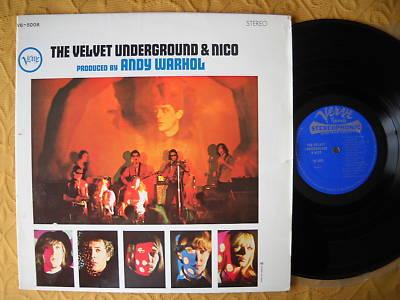
3. The Velvet Underground & Nico

The Warhol Banana cover is more well known but this was the original cover in the UK.

The Warhol Banana cover is more well known but this was the original cover in the UK. The record label is wrong. It should be black.

If Leonard Cohen was the poet laureate of despair and alienation the Velvet Underground were like a sound track to the heroin drenched ravings of William Burroughs in “The Naked Lunch”. Here we have tracks like “Heroin”, “The Black Angel’s Death Song” and “Waiting for the Man” complete with drones and excruciating feed back. This is like the antithesis of pop music, both disturbed and deranged. Not surprisingly it was neither played on the radio nor bought in any quantity by the general public at the time. It has since of course been cited as one of the greatest records of all time and was a massive influence on punk rock. Famously produced by Andy Warhol (or should that be non-produced as he knew nothing about music or record production!) it also contained some sweet ballads dealing with wholesome events like “All Tomorrow’s Parties”, “Femme Fatale” and “Venus in Furs” that reference both mental insecurity and sado-masochistic sex. Not your typical pop song.! This is a truly adorable record that managed to both scare and make me smile. Lou Reed thinks that if it had NOT been produced by Warhol it might have sold a lot more as he was so universally detested at the time (Warhol that is. Lou Reed has only become detested more recently!) and his name on the record put people off. On the other hand it would never have been released as it is without his influence. Some PROPER record producer would have cleaned it up and totally ruined it.

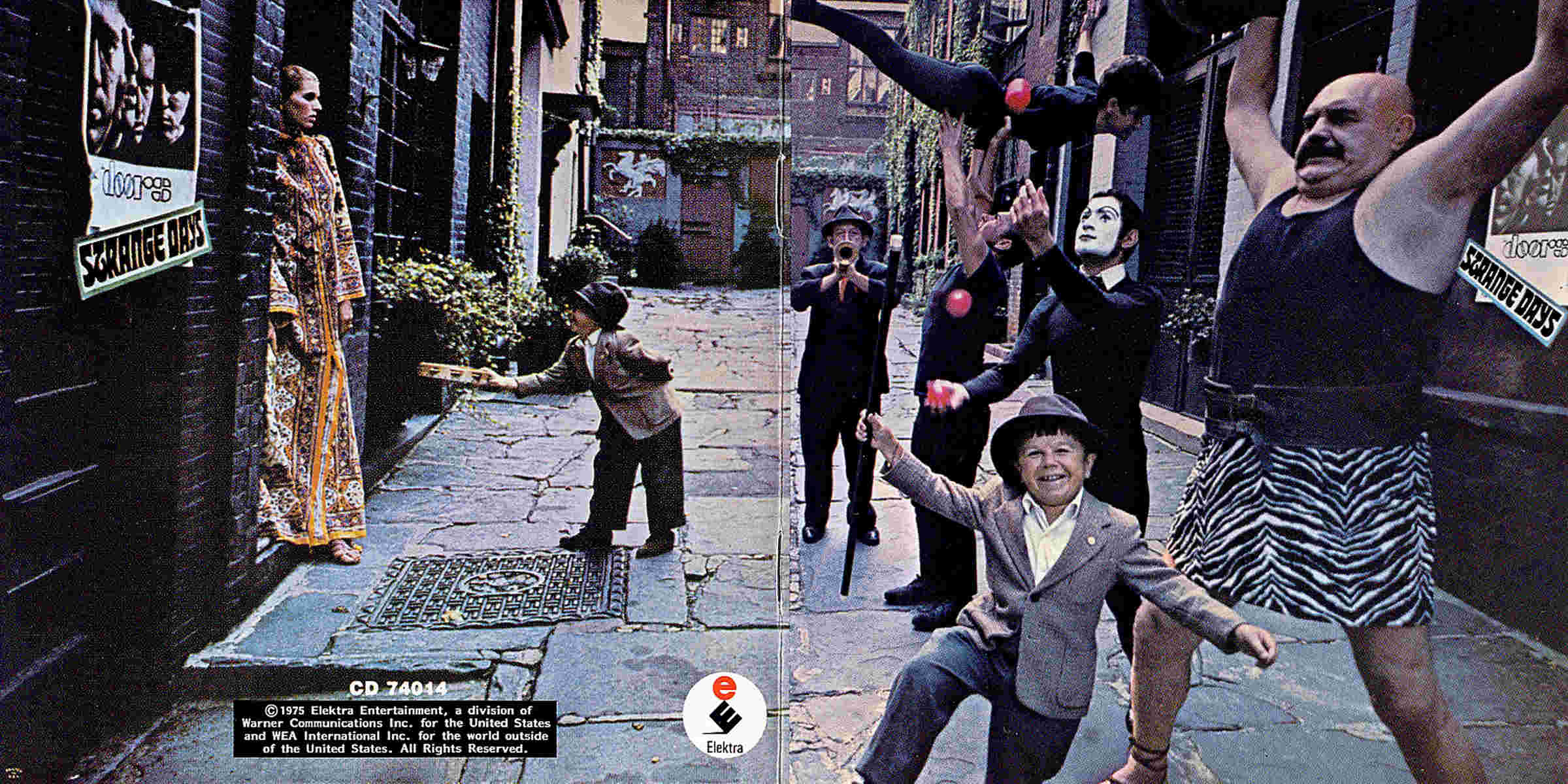
4. Strange Days by The Doorsfreecovers.net

You may wonder why this record by the Doors is so high up the chart and not their dazzling first LP. Well, the answer is simple. Apart from a couple of singles like “Light My Fire” I missed the first one and went straight into “Strange Days” which I think is absolutely brilliant. The sound of the Doors is wonderful and the quality of Jim Morrison’s voice is just perfect. He described it as “sick crooning” as he had based it on the sound of Frank Sinatra. Mind you, he doesn’t sound much like Frank when he bellows out “Cancel my subscription to the Resurrection!!” He was a great lyricist who raided the poems of William Blake and created something new. The final song “When the Music’s Over” is monumental and gives the impression of spontaneity and improvisation. Morrison introduced performance poetry to pop music and created the way for great artists like Patti Smith. I just love the line “Before I sink into the big sleep, I want to hear the scream of the butterfly”. It has been said by some critics that this album is not as good as the first and they used up all their best songs on that one. I disagree, I think this is just as good and,in my mind, perhaps even better. Mind you, I also love “Waiting for the Sun” and even the song “Hello, I Love You” which attracted some derision at the time because it was seen as cynically commercial (and plagiarised The Kinks)! I guess the Doors can do no wrong for me!

5. Revolver by The Beatles220px-Revolver

In a similar way that I missed the first Doors album I also missed “Rubber Soul” by the Beatles. If I hadn’t have done it would probably have been my favourite Beatles record. As it is, I didn’t listen to it in it’s entirety until years later! However, “Revolver” still stands up as the most ambitious Beatles record until that date. “Sgt. Pepper” is probably more ambitious but it is not as interesting, in my opinion, with the exception perhaps of “Day in the Life”. “Revolver” totally knocked my socks off. From the opening count-in of “Taxman” to the wailing drones of “Tomorrow Never Knows” I was captivated. This was music I had never heard before and I loved it! It also had the first real use of Indian music. Sure, George had used the sitar on “Rubber Soul” but here we have a full Indian ensemble including tabla with George crooning mystically over the top of it. Totally brilliant!! There is also the first use of experimentation with the recording of reverse guitar tracks and tape loops. The Beatles are growing up and trying new things! This record probably has the Beatles playing together at their best. George’s lead guitar playing has improved and changed considerably. Ringo’s drumming has never been better. John and Paul’s voices are perfectly matched. It is interesting that in the same year that they gave up playing live they produced their tightest recordings ever. Songs like “And Your Bird Can Sing” and “She Said, She Said” are miniature gems of great writing and playing. Oh, and the sleeve’s pretty cool as well!

‘Yellowism’ Explained!

I found this blog when looking for images of Duchamp and decided to copy and post it here. It links to my ‘Vandalising Rothko’ piece and at the time I had no idea what Yellowism was! I found it very interesting so I reposted it in full. It is clear that Vladimir Umanets was very influenced by Duchamp. I want to make it clear that I do not necessarily agree with what’s written here, I’m not sure I can even understand it! However, I believe that Umanets was motivated by a strong force and the question “What Is Art For?” is still a valid pursuit. He showed courage and commitment to do what he did but I’m not convinced by his philosophy at this stage.

Here’s an interesting post from Interdome about the treatment of Umanets i.e. giving him a two year prison sentence for defacing the Rothko:

As a case study, let’s look at Ai’s Dropping a Han Dynasty Urn.

On the surface level, the photo set appears to mock artistic fetishism: Ai looks like he could not possibly give a fuck as he lets the valuable artifact shatter on the ground. There’s a sublime disregard in the pictures; it’s art against art like Kruger’s sentences are ads against ads. But as an artist, Ai can’t destroy art, he can only make more. From one urn, he gets three pictures. If I went into the Hirshhorn, grabbed one of the photos off the wall, and let it fall to ground like I didn’t give a fuck, I would be arrested and taken to jail. It’s only freedom of expression if you break something you own, otherwise it’s vandalism.

One true vandal learned this lesson (or taught it) very publicly when Vladimir Umanets was sentenced to two years in prison for writing “a potential work of yellowism” on a Mark Rothko painting in London’s Tate Modern. Yellowism is the idea that if anything can become art regardless of its use value, then we could imagine a third category of stuff past art, in light of which the art/non-art distinction dissolves. Both are equally potential works of yellowism, just like a soup can and a urinal are equally art objects. Umanets writing “a potential work of yellowism” on a Rothko is the same as Duchamp Sharpie-ing “a potential work of art” on a toilet while he takes a piss. Except Umanets isn’t an artist. We know he’s not an artist because he’s in jail in England, and England, Ai would remind us, has freedom of expression.

Umanets wasn’t looking for freedom of expression, but freedom from expression, out from under the artistic injunction to replace what you destroy. He wanted to break without buying, but that’s not in liberalism’s deal. And no one cries for a vandal.

Because Umanets is a vandal and not an artist, there won’t be any complaints from the U.S. State Department. Because this is England and not Russia, there won’t be a Human Rights Watch report, as there was for the band Pussy Riot when they were arrested for trespassing. Even anti-capitalist arts writers called for his head on a platter.

Anonymous asked: FUCK OFF PLEASE

x

29 Mar 2013 / 0 notes

►► The Authors of the Death
by Marcin Lodyga

When looking from art perspective, one can say that yellowism is a dead territory where the richness of meanings and interpretations is reduced to one – to yellow. But one needs to remember that yellowists don’t announce the death of art. Art is and will be alive forever. They rather say that yellowism is dead, inert, homogeneous mass without creativity. Authors of the manifesto and definition of yellowism are the authors of the death – yellowists are the authors of a single interpretation. This death is positioned outside of art, like mirror.

Roland Barthes in “The Death of the Author” says: “To give a text an Author” and assign a single, corresponding interpretation to it “is to impose a limit on that text.” Barthes argues against the method of reading that relies on aspects of the author’s identity — their political views, historical context, religion, ethnicity, psychology, or other biographical or personal attributes — to distill meaning from the author’s work. Yellowists want to impose a limit on the text, on art, and on ordinary reality too, but not by giving a “text” an author. Paraphrasing Barthes I say: To give a “text” a YELLOW and assign a single, corresponding interpretation to it is to impose a limit on the text. Barthes demands the death of the author (author disappears) because the author’s identity limits the text, the reading. In yellowism case author also disappears and yellow – the necessary “limitation” appears instead of the author.

Inside yellowism the artistic kingdom of meanings and interpretations is erased together with the author. It doesn’t matter WHO made a piece of yellowism because all pieces were, are and will be about yellow only. Yellowism is permanent, boring, inert, homogeneous flat, ‘dead’ mass. Always was and always will be. Like in the forest where all the trees (meanings) ‘look’ the same – wherever you go you are in the same place anyway. A thousand kilometers left, two meters right or backwards – you are always in the same place. In yellowism the nature of the authors has “the identity of the indistinguishable forest”.

Barthes conclusion: “the birth of the reader must be ransomed by the death of the Author.” Yellowism conclusion: the death of meanings and the death of the author must be ransomed by the birth of single meaning – yellow.

image

image

image

Marcin Lodyga
“Sounds from the chamber”
piece of yellowism
for public audition in yellowistic chambers only
CD / audio recording of a walk through Miroslaw Balka exhibition Gravity made in the gallery space
executed in 2013

Anonymous asked: please can you explain the relevance of all the tits and bums on this site to yellowism. Is yellowism tits and bums? is that the context everything is reduced to?

x

5 Mar 2013 / 1 note

image

Anonymous asked: At least Marinetti was funny..

x

4 Mar 2013 / 1 note

image

►► Luncheon on the grass
(on the grass: Arthur Danto, Roy Turner, Joseph Kosuth, Marcin Lodyga)

What makes the difference between a Brillo box and a work of art consisting of a Brillo box is a certain theory of art. It is the theory that takes it up into the world of art, and keeps it from collapsing into the real object which it is. – Arthur Danto. But to expose the irrelevance of this idea when attributed to the tradition, we have only to ask what “real object”, “Le déjeuner sur l’herbe” by Manet collapses into when the implicit theory which supported it is refuted. – ask another thinker Roy Turner (Philosophy Now magazine)

Marcin Lodyga starts: If “Le déjeuner sur l’herbe” by Manet was placed in the context of yellowism, inside a yellowistic chamber, then it would stop to be a work of art and it would become a piece of yellowism – a pure expression of yellow color in the form of Manet painting. Inside yellowism the painting by Manet is not a work of art. We have only to ask what piece of yellowism “Le déjeuner sur l’herbe” by Manet collapses into when the implicit context of yellowism which supported it is refuted. The answer: it collapses into a work of art, it becomes a work of art again, it gains its previous status.

Painting is a kind of art. If you make paintings you are already accepting (not questioning ) the nature of art. One is then accepting the nature of art to be the European tradition of a painting-sculpture dichotomy. – nervously said Joseph Kosuth (“Art After Philosophy”). Dear Joseph – Marcin replies – in the context of yellowism – which is NOT a kind of total, huge conceptual art work, as you would consider it probably, painting is not a work of art. You said: “Art is the definition of art”, I say: yellowism is the definition of yellowism.

text by Marcin Lodyga
27/02/13

The Flaneur art blog- Should Umanets really be jailed for 2 years for defacing a Rothko? #yellowism –

flaneurphotos:

New Post has been published onhttp://flaneur.me.uk/12/should-umanets-really-be-jailed-for-2-years-for-defacing-a-rothko-yellowism/

Should Umanets really be jailed for 2 years for defacing a Rothko? #yellowism

image

26 Feb 2013 / Reblogged from flaneurphotos with 5 notes / yellowism

Interdome: As a case study, let’s look at Ai’s Dropping a Han Dynasty Urn. On the…

interdome:

As a case study, let’s look at Ai’s Dropping a Han Dynasty Urn.

On the surface level, the photo set appears to mock artistic fetishism: Ai looks like he could not possibly give a fuck as he lets the valuable artifact shatter on the ground. There’s a sublime disregard in the pictures;…

26 Feb 2013 / Reblogged from interdome with 4 notes / yellowism


fixedgearbikesyeah asked: NO ONE CARES

x

9 Feb 2013 / 1 note

justiceismine asked: Yellowism is neither art, nor anti-art but a cause. Some might ask if Yellowism is needed or say it’s pathetic/stupid but I say it deserves it’s place as did Jackson Pollock for example, which he did not get at his time.

x

6 Feb 2013 / 3 notes

spacecowboysparklefingers asked: No one is going to drink your yellow kool-aid. Your totalitarian snake oil ideology has been ineffectual and irrelevant since De Stijl/Neoplasticism tried it. There is no dialogue here, you won’t even respond to this with anything more than an “X”. Please don’t write on anymore Rothko’s (or any other pieces of art for that matter), they are not yours to write on, and some people really enjoy them. No one wants you here yellowism, go home.

x

6 Feb 2013 / 1 note

image

image

Marcin Lodyga
“You can start painting again, in yellowism”
yellowistic draft
signed and dated on the front
poster printed for the occasion of Duchamp season in Barbican, London
150 x 100 cm
executed in 2013

image

►► Rome outside of art
by Marcin Lodyga

Yellowism is not dadaism or neo-dadaism. If you think that yellowism is dadaism then actually you are a dadaist, because you try to devalue yellowism and make it meaningless. Dadaists were nihilists and they “promoted” nonsense. The fact that in yellowism everything means yellow leads to the wrong conclusion that everything means nothing and therefore yellowism is perceived as nihilism /dadaism. This is the big misunderstanding. The real consequence of yellowism existence is the philosophy of ONE and the vision of many different isms (existing outside of art) which can be reduced to (one) yellow-ism anyway. Although yellowism clones exist under different names – they are yellowism. In the future: many one-perspective “worlds”. Not only one “world” full of perspectives (meanings), many various subjective interpretations – like in postmodernism, especially postmodern art, but also many separate “worlds” (greenism, blueism, chairism) with one perspective each, concentrated on one meaning only. Yellowism, divided into many isms, will be positioned away from the forever developing, “organic” realm of art.

The total flattening announced by yellowists is more humanitarian than dadaism because it doesn’t leave people with nothing – inside the desert of meanings where you can watch only the wrecks and corpses of culture. Yellowists save one meaning (yellow) for everything and also they let you live in the “yellowistic totalitarian illusion of many”- you can exist in autonomous groups called greenism, blueism, chairism or skyism etc. but you will be a yellowist anyway. All roads lead to Rome. The universal Rome – the absolute truth will be always outside of art.

Dadaists are nihilists, they do not offer anything, they don’t show a new perspective, new possibilities, they replace everything with nothing. » Dada (…) wants nothing, absolutely nothing, and what it does is to make the public say ” We understand nothing, nothing, nothing “. “The Dadaists are nothing, nothing, nothing and they will surely succeed in nothing, nothing, nothing.” « 391, No. 12, Paris, March 1920 Francis Picabia who knows nothing, nothing, nothing.

Nihilists say that without absolute, universal, and transcendent values, there can be no real values at all. Friedrich Nietzsche, however, argues that the lack of such absolute values does not imply the absence of any values at all. Nietzsche “permits” the values of many different and even mutually exclusive perspectives. This is called “perspectivism” – all ideations take place from particular perspectives. This means that there are many possible conceptual schemes, or perspectives in which judgment of truth or value can be made. This leads (me) to postmodernism. Postmodernism is the consequence of Nietzsche’s perspectivism but is nihilistic. The proliferation of alternative perspectives, beliefs and values makes that postmodern society is foundationless.

This what we see in the galleries is the result of postmodernism or post-post modernism, or postpostpostmodernism, whatever. Many perspectives, many points of view, not one grand and universal but many interpretations closed inside the circle called “art”. In the future artists will resign from art, will abandon this circle. Art full of many perspectives will still exist but will be surrounded by – isms. Some artists will never leave the territory of art but there will be yellowists, greenists, chairists looking at them from outside – located in one perspective circles.

All the other isms are actually yellow-ism because, they have the same architecture, logic. Finally they can be reduced to yellowism, flattened to yellow-ism. However, people will need this totalitarian illusion of many isms, they will construct their own contexts, for example greenism,redism, chairism or godism, and they will be happy inside the isms but all the new one-meaning worlds can be always considered as yellowism.

Yellowism doesn’t replace (like dadaism) all the values with nothing, yellowism gives one sense instead of nonsense. Yellowism presents the vision of many autonomous territories around multiperspective art. Yellowism saves the ONE – whatever it is: blue, green, chair and offers the new grand philosophy of ONE.

Marcin Lodyga
18.01.2013
London

mysar: yellow posterby rasym aka. mysar

mysar:

yellow posterby rasym aka. mysar

19 Jan 2013 / Reblogged from mysar with 3 notes

image

image

Marcin Lodyga, Khadija Davies
Portrait of Members of Art & Language with Caps, in the Style of Jackson Pollock
yellowistic draft
signed and dated 18/01/13 on the front
magazine cover, pink ink
22.4 x 28.6 cm
Executed in 2013

The authors of manifesto and definition of yellowism Marcin Łodyga and Vladimir Umanets at The British Museum in London (January 2012).
© Sylwester Kolton.

►► Discipline and punish.The birth of the black hole

Yellowists see the whole domain of reality and the whole domain of art as gigantic readymades which can be transported into the context of yellowism. Yellowism is a specific prison, a ghetto in which you are free from freedom, in which the freedom of interpretation doesn’t exist. Every content placed in this territory defines yellow color. It requires a noetic discipline. You have to respect the internal yellowism law. Yellowism is a bit like a black hole – most of the information about the matter that went into forming the black hole is lost. In the end yellowism only remembers the total mass, charge, and angular momentum. The physical form of objects and beings transported from art and reality is preserved, but all the forms carry only one, always and forever the same, identical message. You can observe that something is moving inside, you can watch pieces of yellowism free from the past and future; there is a movement but there is actually no time.

Yellowists don’t punish art, they don’t take a revenge on art or reality. Manifesto of yellowism is not a death sentence for art. Yellowists don’t destroy and don’t create. Yellowism is not vandalism and it’s not a form of creation. There is no postmodern, Derrida’s deconstruction, any destruction or creative construction inside yellowism. There is something else: flatstruction. Everything is flattened to yellow, all interpretations are ironed to one flat surface, to one meaning. The total flattening (flatstruction) is a state of permanent homogeneity. Yellowists don’t create and they don’t destroy, they make everything flat therefore, inside yellowism, deconstruction, creativity, vandalism, surrealism or fascism or anything else is flattened to one, to the expression of yellow.

Artists push the boundaries of art and are imprisoned in their seeming freedom. Yellowists are free outside of art. They resigned from art, they overstepped the boundary and the fact that everything can be about yellow gives them the almost cosmic freedom.

text by Marcin Lodyga

►► A dead animal

Today you can overstep the border, you can be a bit like Alice through the looking glass, you don’t have to, together with other artists, push the boundaries of art further anymore, now it’s time to cross it and discover the another, still unknown for many, space called yellowism. Of course, you can stay where you are and run your artistic life in harmony with the motion of postmodernism. Yellowists don’t announce the end of art; they say in manifesto: art is a forever developing whole. They don’t promote a slogan: “art is dead”, they rather say that yellowism is dead and always was dead and always will be dead. Therefore they don’t want to replace art with yellowism. They just introduce a new autonomous territory, specific environment which is parallel to the context of art. They give you a vision of time in culture when the resignation from art will be a trend. Yellowists show you the possibility of alternative existence in which the fact that you abandon art is considered as the most creative decision. It doesn’t matter what the condition of art will be after twenty or hundred years – yellowism will be still the same. Any changes and any progress around yellowism are and will be, metaphorically speaking, like a tank of formaldehyde for a dead animal.

text by Marcin Lodyga

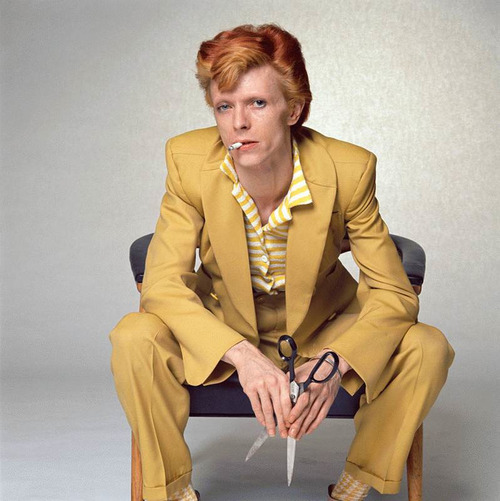
DAVID BOWIE EXHIBITION

David Bowie Exhibition (reprinted from ‘That’s Not My Age‘)

Starman suit.

Bowie Mania has come to town – and I like it. Record advance ticket sales (an astounding 47 thousand) for the V&A’s exhibition and a number one album highlight this 66-year old superstar’s enduring appeal. From the Ziggy Stardust neon flash in the foyer, to the floor-to-ceiling surround-sound Bowie Fest in the penultimate room, this exhibition documents the artist’s life, sound and vision-style. And if there’s one artist who’s life is worth documenting in a world-class museum, here he is. Stereo headphones for the soundtrack – thankfully there’s no Tin Machine – and banks of video screens for the Man Who Fell To Earth visuals, immerse visitors in the World of Bowie.

More than 300 objects from His Majesty’s personal archive – wonky handwritten lyrics, naive sketches, even a crumpled up tissue with Bowie’s lipstick on it (much redder than you’d imagine) – are on show for the first time. I’m not a fan of blockbuster shows, Art Rage is something I can live without, but it was worth being jostled by journalists and clobbered by cameramen at this exclusive preview. I loved seeing the stage costumes, over 60 of them – the teeny tiny waisted, pale blue suit from his Life On Mars video, the Aladdin Sane knitted all-in-one, designer gear from McQueen, Mugler and Slimane – plus photos and videos of the artist’s many guises, are a reminder of Bowie’s radical individualism and his massive influence on fashion, style and popular culture. Not that we ever needed one.

Knitted Love: Aladdin Sane
Remember when everyone wore Bowie pants?
Diamond Dogs suit.
Photo: Terry O’Neil.

Towards the end of the show there’s a ‘David Bowie is all around you’ installation, highlighting his impact on musicians/artists/fashion designers/Tilda Swinton, and The Periodic Table of Bowie by Paul Robertson (poster available in the museum shop).

As the Jon Savage quote goes, ‘David Bowie has lasted. To the public he is beyond a pop star.’

And now I’m off for a lie down. I’ll be dreaming of BBC2’s feature length profile on Bowie scheduled for May.

‘Where Are We Now?’ by David Bowie

I particularly like this song because it references places I know in Berlin and has such an atmosphere of longing and even dread. An example is that Pottsdammer Platz was a bleak ‘no mans land’ in the 70s. This is a very touching song about something more than nostalgia.

Diagram of an Artist: Roy Lichtenstein