Until recently I knew about Marcel Duchamp but not very much. I knew he was an iconoclast who presented a porcelain urinal as a work of art but I had no idea of his profound influence on others like John Cage and Merce Cunningham. Visiting this exhibition at the Barbican changed all that. It is apparent how important Duchamp’s ideas were. In fact, it has filled in quite a few gaps for me.
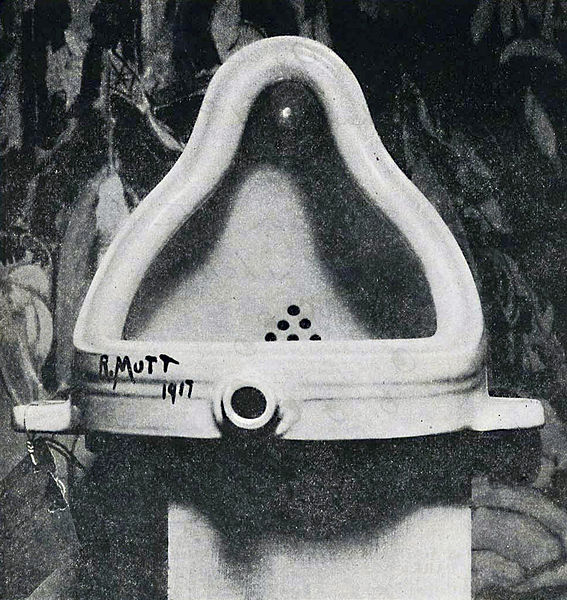
It is perhaps not suprising to have not seen many of his works in the past. It seems that most of them are in Philadelphia and there aren’t really that many of them. Also, many of his art works were conceptual and the original pieces were lost. It was the idea that was important. This was especially true of his readymades. The famous urinal piece Fountain was presented for exhibition to the Society of Independent Artists exhibit in 1917. “Artworks in the Independent Artists shows were not selected by jury, and all pieces submitted were displayed. However, the show committee insisted that Fountain was not art, and rejected it from the show. This caused an uproar amongst the Dadaists, and led Duchamp to resign from the board of the Independent Artists.”(Wikipedia)
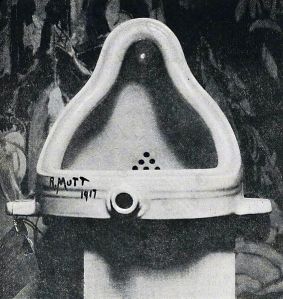
Duchamp Fountain. This is the only known photograph of the original urinal that was lost. Signed by R.Mutt! It was turning it on it’s side and signing it that made it art!
This was the point at which Duchamp rejected retinal (roughly, things you can see) art and developed ideas of “art at the service of the mind.” In fact, he is probably the first conceptual artist. He liked the idea of being an artist but was not so convinced by art.He was a big influence on the Dadaists of the early 20s who rejected mainstream art.
Dada was born out of negative reaction to the horrors of World War I. This international movement was begun by a group of artists and poets associated with the Cabaret Voltaire in Zurich. Dada rejected reason and logic, prizing nonsense, irrationality and intuition. The origin of the name Dada is unclear; some believe that it is a nonsensical word. Others maintain that it originates from the Romanian artistsTristan Tzara and Marcel Janco‘s frequent use of the words da, da, meaning yes, yes in the Romanian language. Another theory says that the name “Dada” came during a meeting of the group when a paper knife stuck into a French-German dictionary happened to point to ‘dada’, a French word for ‘hobbyhorse’.(Dona Budd “The Language of Art Knowledge”)

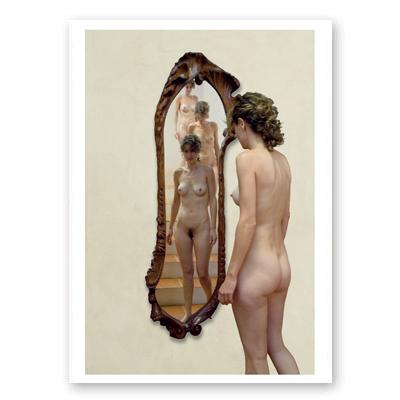
This exhibition deals with Duchamp’s ideas but also looks at his influence on other artists particularly John Cage, Merce Cunningham, Robert Rauschenberg and Jasper Johns. As I found earlier on this year he was also a big influence on Richard Hamilton who created his own picture of Nude Descending a Staircase which you can see in a previous post. The Nude by Duchamp was painted at a time when he was influenced by both Cubism and Futurism and he tries to convey movement in the picture which I think he succeeds in. The Hamilton picture on the other hand seems very static. Was that intentional?
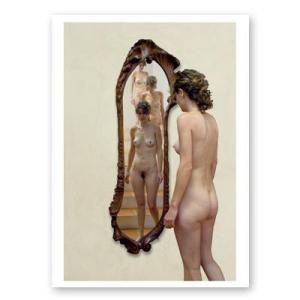
Hamilton’s version of Duchamp
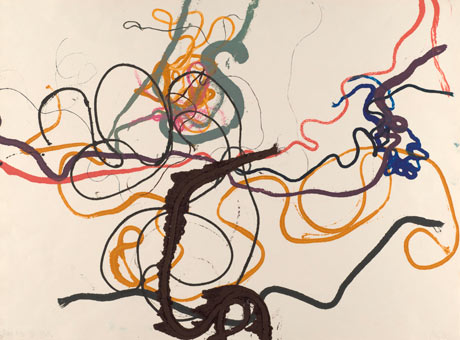
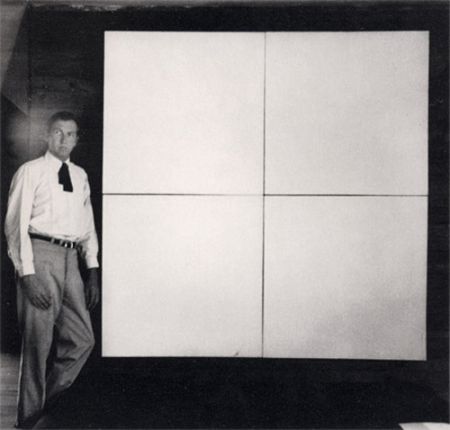
John Cage is someone I know a lot more about. Like Duchamp and other members of the American avant garde in the 1940s and 50s he was often seen as a dilettante, a kind of fool but after the publication of his book Silence in the early 1960s opinion of him radically changed and he is now seen as one of the most important composers of the 20th Century. Yes, he is the composer of the infamous 4’33” that so many have heard of but so few have actually heard. It consists of silence in three parts. Of course, he used it to prove there was no such thing as silence. He was influenced by Duchamp but his readymades were found sounds. He put forward the theory that all sound is and can be music. He also introduced chance into his compositions by using the I Ching (a Chinese divination book of wisdom) and other methods. Artist Robert Rauschenberg created paintings that were pure white to show that visual events still happened with shadows, blemishes etc. Choreographer Merce Cunningham created dances in collaboration with Cage and Rauschenberg that used similar chance methods. All of this happened because of the ideas and influence of Duchamp. His position in history is assured.
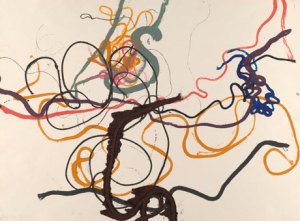
John Cage score for Strings 20 created by dropping ink stained pieces of string on to a page.

White Painting by Robert Rauschenberg
The exhibition was fascinating and definitely worth visiting. There is music playing and the recorded sounds of dancers (and sometimes real dancers). There is a strange kind of peacefulness in the air, probably helped by the fact the gallery wasn’t that full when I was there! It raises and in some ways answers the question “what is art for?”. On the other hand the pieces are still displayed in a pristine white gallery and they are still worth millions of dollars to collectors. It’s ironic that 50 years after Duchamp questioned Art and announced the readymade that Andy Warhol could take a Brillo box or a soup can and call it art and it now sells for tens of thousands of dollars. Either someone didn’t get the joke or they never really understood what was being said in the first place. And in the post modern world of Damian Hirst and Tracey Emin there is no longer even any irony in it.

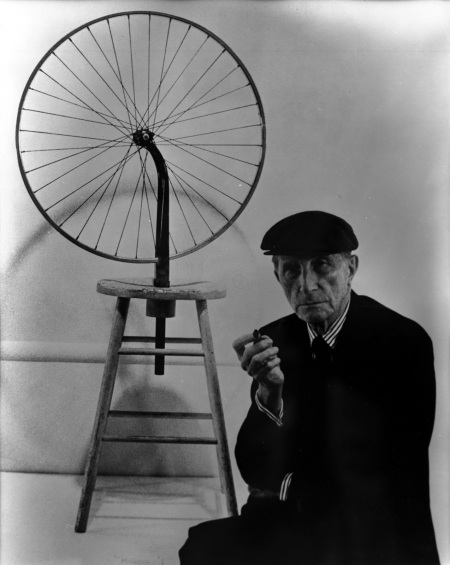
Duchamp with his bicycle wheel mounted on a stool. Apparently this was never exhibited. He liked having it in his studio and spin the wheel round!
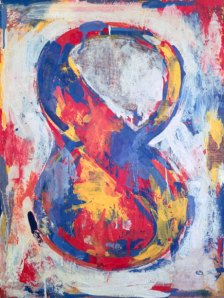
Jasper Johns Figure 8. Creating art from the mundane!
52.636878
-1.139759












 Kenny Wilson's Blog