My Favourite Albums of All Time (Part One)

This is a tricky one. I’ve never been that impressed with ‘best of’ lists but I found myself sitting in a hotel room listening to music on my phone and I began thinking about what my favourite (and most influential) albums of all-time were. I say influential because, as some of you know, I am a musician and song-writer who has followed in the footsteps of numerous greats. It’s a hard choice but here’s my favourite 10. I’ve limited myself to two albums by the same artist or else they would probably be all by Bob Dylan ! I also realise, having completed the list, that, with the exception of the first 5, the rest are in no particular order. I’m also aware that there are countless others that could, and probably should, be included. Alright, it’s a stupid idea but here it is!

1. Highway 61 Revisited by Bob Dylan.

Highway+61+Revisited+Bob+Dylan++Highway+61+Revisite

Okay, what can I say about this album apart from the fact that it is probably the most inspired piece of work I have EVER heard (notice the Dylanesque emphasis) and I’m not just talking about music! I have read reports about the session and all participants agree that something very special happened here. It contains, in my opinion, the greatest rock song of all time “Like a Rolling Stone” but this is not really the essence of the album. It stands apart and, indeed, was produced by a different person from the rest of the record. The remainder contains Dylan at his most aggressive and elusive best. The most interesting song, again in my opinion, is Desolation Row, a surreal trawl through 20th Century culture and ideas. “Ezra Pound and T.S. Eliot fighting in the captain’s tower, while calypso singers laugh at them and fishermen hold flowers”. This isn’t just poetry and music it is an assault on the senses and intellect! “The Agents” and “The Superhuman Crew” check to see that no one is escaping to Desolation Row. The famous voice that people either love or hate is at it’s expressive best. Like many albums on my list this one is unique. There was nothing like it before and there’s been nothing like it since. Even the titles of the songs were a new departure with weird names like “Queen Jane Approximately”, “Just Like Tom Thumb’s Blues” and “Ballad of a Thin Man” that seemed to have nothing to do with the lyrics of the songs but probably did have. Pop music had found Symbolist poetry and the kids loved it!! (Well, this one did). It stands alone and sounds forever modern and archaic at the same time. Dylan himself has said that he had no idea how he wrote the songs and wouldn’t be able to do them now. The musicianship is impeccable especially the electric guitar playing of Mike Bloomfield and the acoustic lead of Charlie McCoy imported especially from Nashville for just one track!

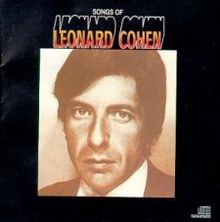
2. The Songs of Leonard Cohen220px-SongsOfLeonardCohen

If Bob Dylan in the mid sixties was on an amphetamine fueled creative voyage into oblivion Leonard Cohen was on a quietly mannered journey back from it. This album emerged in 1968 and gradually became a bedsit legend as many sad young men and women took the songs to heart. Okay, it has been called music to slit your wrists to and Cohen’s voice has probably been even less complimented than Dylan’s but to those in the know this is an album of beautifully crafted songs whose underlying message is surprisingly optimistic completely unlike the eternal whinging of say Morrissey and the Smiths who actually DID create music to slit your wrists to. Cohen’s songs deal with ideas that had seldom been dealt with by popular music before. Despair, spirituality, sexual love and he wrote like a real poet which of course is what he was. He was also a well known novelist before he became a singer and a songwriter. A very different pedigree to most of the pop singers and rock and rollers at the time. He was a remarkable performer though and managed to follow Jimi Hendrix at 4 in the morning at the 1970 Isle of Wight Festival and still get a standing ovation. Producer Bob Johnson was so impressed with him that he gave up producing and joined his band as a keyboardist. This was his first album and contains classics like “Suzanne” and “Hey That’s No Way to Say Goodbye”. My favourite is “The Stranger Song” that manages to evoke feelings of loss, alienation and redemption. ” And then sweeping up the jokers that he left behind you find he did not leave you very much not even laughter. Like any dealer he was watching for the card that is so high and wild he’ll never need to deal another.He was just some Joseph looking for a manger”. It also has his trade mark guitar ripple which is quite difficult to do. The perfect song for existentialists.

3. The Velvet Underground & Nico
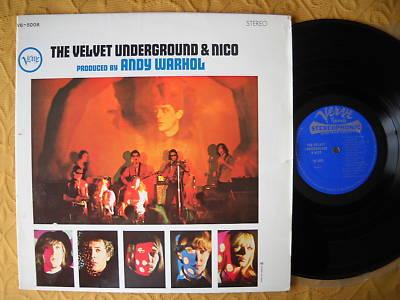
The Warhol Banana cover is more well known but this was the original cover in the UK.

The Warhol Banana cover is more well known but this was the original cover in the UK. The record label is wrong. It should be black.

If Leonard Cohen was the poet laureate of despair and alienation the Velvet Underground were like a sound track to the heroin drenched ravings of William Burroughs in “The Naked Lunch”. Here we have tracks like “Heroin”, “The Black Angel’s Death Song” and “Waiting for the Man” complete with drones and excruciating feed back. This is like the antithesis of pop music, both disturbed and deranged. Not surprisingly it was neither played on the radio nor bought in any quantity by the general public at the time. It has since of course been cited as one of the greatest records of all time and was a massive influence on punk rock. Famously produced by Andy Warhol (or should that be non-produced as he knew nothing about music or record production!) it also contained some sweet ballads dealing with wholesome events like “All Tomorrow’s Parties”, “Femme Fatale” and “Venus in Furs” that reference both mental insecurity and sado-masochistic sex. Not your typical pop song.! This is a truly adorable record that managed to both scare and make me smile. Lou Reed thinks that if it had NOT been produced by Warhol it might have sold a lot more as he was so universally detested at the time (Warhol that is. Lou Reed has only become detested more recently!) and his name on the record put people off. On the other hand it would never have been released as it is without his influence. Some PROPER record producer would have cleaned it up and totally ruined it.

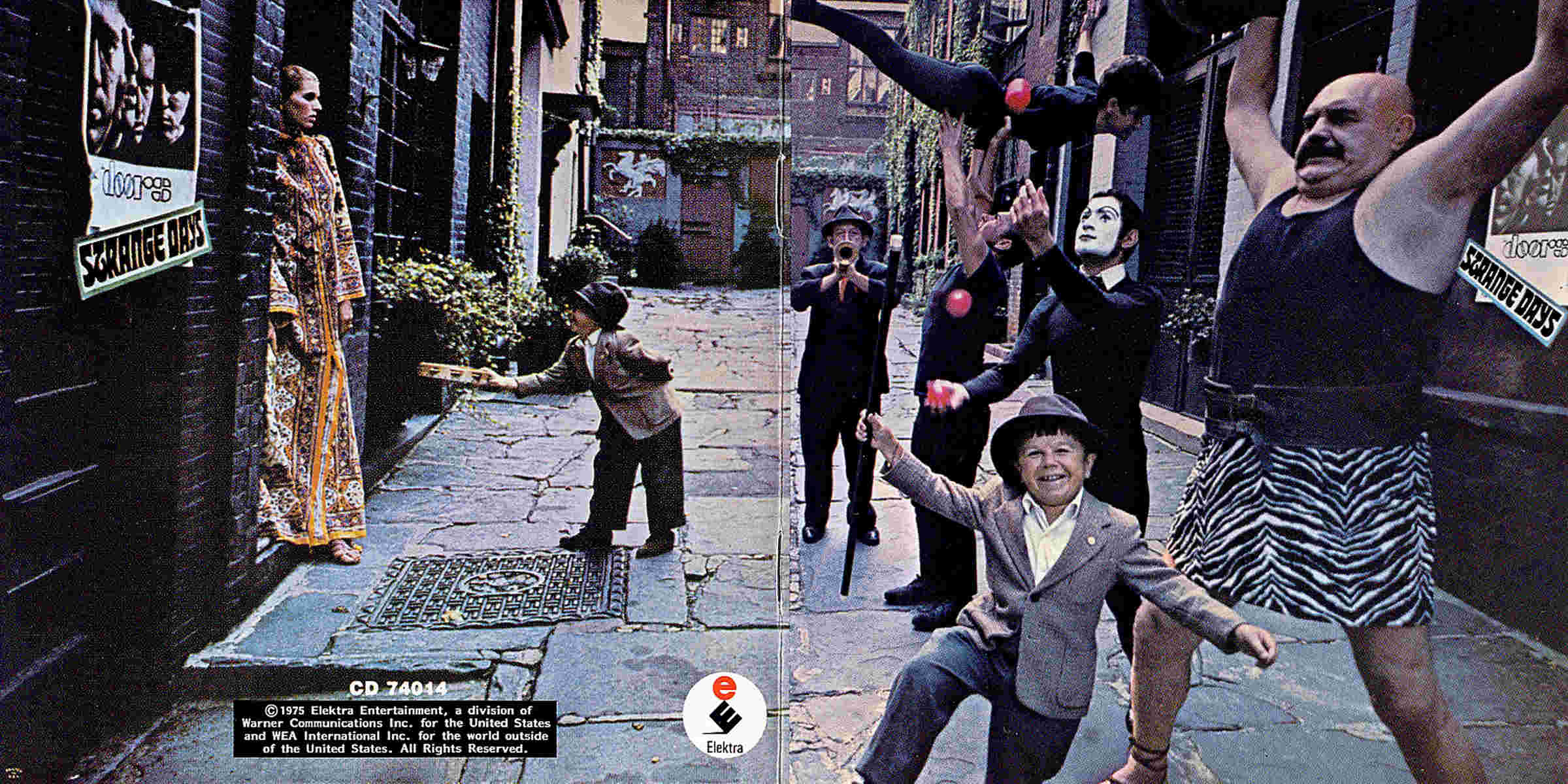
4. Strange Days by The Doorsfreecovers.net
You may wonder why this record by the Doors is so high up the chart and not their dazzling first LP. Well, the answer is simple. Apart from a couple of singles like “Light My Fire” I missed the first one and went straight into “Strange Days” which I think is absolutely brilliant. The sound of the Doors is wonderful and the quality of Jim Morrison’s voice is just perfect. He described it as “sick crooning” as he had based it on the sound of Frank Sinatra. Mind you, he doesn’t sound much like Frank when he bellows out “Cancel my subscription to the Resurrection!!” He was a great lyricist who raided the poems of William Blake and created something new. The final song “When the Music’s Over” is monumental and gives the impression of spontaneity and improvisation. Morrison introduced performance poetry to pop music and created the way for great artists like Patti Smith. I just love the line “Before I sink into the big sleep, I want to hear the scream of the butterfly”. It has been said by some critics that this album is not as good as the first and they used up all their best songs on that one. I disagree, I think this is just as good and,in my mind, perhaps even better. Mind you, I also love “Waiting for the Sun” and even the song “Hello, I Love You” which attracted some derision at the time because it was seen as cynically commercial (and plagiarised The Kinks)! I guess the Doors can do no wrong for me!

5. Revolver by The Beatles220px-Revolver
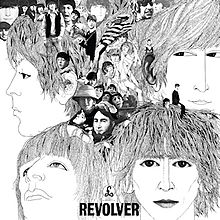
In a similar way that I missed the first Doors album I also missed “Rubber Soul” by the Beatles. If I hadn’t have done it would probably have been my favourite Beatles record. As it is, I didn’t listen to it in it’s entirety until years later! However, “Revolver” still stands up as the most ambitious Beatles record until that date. “Sgt. Pepper” is probably more ambitious but it is not as interesting, in my opinion, with the exception perhaps of “Day in the Life”. “Revolver” totally knocked my socks off. From the opening count-in of “Taxman” to the wailing drones of “Tomorrow Never Knows” I was captivated. This was music I had never heard before and I loved it! It also had the first real use of Indian music. Sure, George had used the sitar on “Rubber Soul” but here we have a full Indian ensemble including tabla with George crooning mystically over the top of it. Totally brilliant!! There is also the first use of experimentation with the recording of reverse guitar tracks and tape loops. The Beatles are growing up and trying new things! This record probably has the Beatles playing together at their best. George’s lead guitar playing has improved and changed considerably. Ringo’s drumming has never been better. John and Paul’s voices are perfectly matched. It is interesting that in the same year that they gave up playing live they produced their tightest recordings ever. Songs like “And Your Bird Can Sing” and “She Said, She Said” are miniature gems of great writing and playing. Oh, and the sleeve’s pretty cool as well!
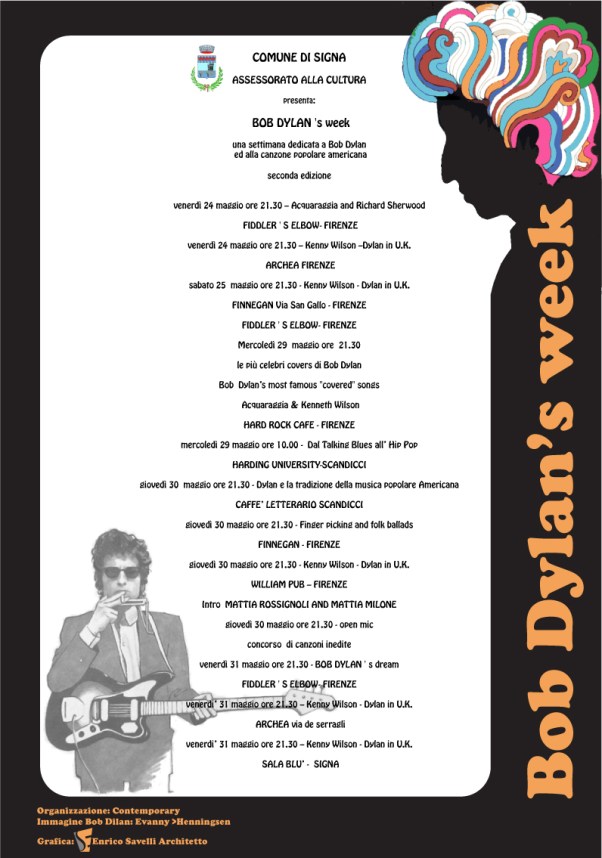
Gigs in Florence, Italy

Gigs in Florence, Italy

Gigs I’m doing in Florence, Italy at the end of May.

The Decline of the 1960s Counterculture and the Rise of Thatcherism | Kenny Wilson

In the past few weeks I have been reading widely about the 1960s Counterculture both here and in America. This interest was inspired by two things. Writing an account of My Life in Music, which included my experience of the Counterculture in Leicester, and visiting an exhibition of sculptures by Francis Upritchard at Nottingham Contemporary and seeing James Riley’s talk about the perceived end of the Counterculture into “bad craziness” in the early 1970s.

My original piece was just based on memory with no reference to any other sources but I was struck by how close my experience was to the sequence of events described by James Riley. I was also intrigued by Francis Upritchard’s description of hippies in New Zealand when she says that “all the things that hippies hoped would happen, or felt might happen, didn’t.” In one sense her exhibition is about the failure of the 1960s and 70s counter-culture that is still celebrated at festivals – and its gaudy, individualistic “alternative” aftermath.

At this point it might be worthwhile to describe what I think the Counterculture is (or was). The Counterculture appeared in the 1960s both in the UK and America and became influential throughout the Western World and also in Eastern Europe. It’s protaganists were mainly young but there were significant influences from older artists and intellectuals. It’s not really clear why or how it came about but it epitomised what became known as the Generation Gap. This could be described as the difference between people who became adults before World War 2 and those who were adults after it.

Jeff Nuttall in his seminal book Bomb Culture(1968)  thinks that alternative attitudes in the UK grew out of the shadow and fear of the H Bomb. As the Cold War developed there was a constant reminder with the proliferation of nuclear weapons that the World could end any minute. This lead to massive demonstrations in the UK organised by CND (The Aldermaston Marches). Although these were attended by many thousands of people it became clear by the early sixties that the government had no intention of disarming or stopping the arms race. This lead to disillusionment and a feeling of alienation. Many young people began to reject the growing Affluent Society and started creating their own culture much to the bewilderment of the older generation who, as Prime Minister Harold Macmillan said at the time, had “never had it so good”. A youth subculture emerged called The Beatniks by the press. They grew their hair, played trad jazz and folk music, frequented coffee bars and hitchhiked around the country, influenced by American beat writers like Jack Kerouac. In the UK this is where the Counterculture had it’s roots. Here is an unintentionally hilarious TV report about Beatniks in Cornwall in 1960:

Of note in this film is the playing and singing of Whiz Jones. You may think he is influenced by Bob Dylan but you’d be wrong. It was two years before Dylan’s first album was released, he hadn’t even arrived in New York by then. The guitar and singing style was undoubtedly learnt from American folk singer Ramblin’ Jack Elliot who was in England at the time and influenced a whole generation of British guitarists including Donovan (he was also a big influence on Bob Dylan!).

The roots of the American Counterculture are slightly different. Although there was the same fear of nuclear annihilation especially with the Cuban Missile Crisis of 1962 when the Soviet Union based nuclear missiles in Cuba within easy reach of the USA. Another factor was the Civil Rights Movement that was working to end racial segregation in the South and also the Vietnam War especially when conscription was accelerated from 1964. Out of this milieu a counterculture was created that eventually became what are known as Hippies. This movement had a profound effect both in America and the rest of the World during the 1960s and it’s legacy has continued until now as I hope to demonstrate.

The UK and American countercultures influenced each other. Initially, the British counterculture imitated the Americans especially in the areas of poetry and the creation of Underground newspapers and magazines. As time progressed the British started influencing the Americans especially in the areas of art, fashion  and music. The Beatles became the most popular and influential group in the World and embraced many countercultural ideas like drugs, mysticism and experimentalism. Paul McCartney was closely linked to the English Underground and was a main financier of the International Times, an important countercultural paper that had a wide distribution. Pink Floyd emerged out of the British Underground with their take on psychedelic rock and, again, eventually became one of the most popular groups in the World.

The name Underground started to be increasingly used for the Counterculture although, really, this was a misnomer. The main players and self styled leaders were media savvy and natural experts in self promotion.  (This was especially true of American Yippies Abbie Hoffman and Jerry Rubin. They achieved international fame at the Chicago Conspiracy Trial where the American justice system managed to appear both brutal and ridiculous.  In a rare display of humour a member of the conventional left described their antics as Groucho Marxism!) It never really became underground until the 1970s when the mainstream media and press began to lose interest in it.

The Underground did not have a coherent political agenda. Although there was much talk of Revolution it was not clear what this really meant. This was true both in Britain and America. It definitely did not mean the same thing as what the old left referred to . The Communist states were seen as no better than the Capitalist ones and probably worse. Even Cuba, apart from the love for Che Guevara (who in the spirit of rock n roll died young and left a good looking corpse. He became the poster boy of the Revolution with his long hair and revolutionary beret!) was treated with suspicion. There was no strict ideology but general beliefs in the use of drugs (particularly marijuana and LSD), rejection of alcohol, free love, anti-war, anti-materialism, anti-consumerism, individualism, creativity, opposition to alienating work, rejection of television and advertising, caring for and living with the natural environment etc. The list could get very long and forms a general philosophy which is hard to formally categorise. The Revolution consisted of all these things. Slogans appeared that would have done justice to the best copywriters of Madison Avenue like “make love not war”, “turn on, tune in, drop out” and “do your own thing”.

So, why did the Revolution fail and where did it go wrong? Conventional wisdom would say that three events in 1969 caused a massive shift in attitudes. The infamous Charles Manson murders, The Woodstock Festival and the killing of a member of the audience by Hell’s Angels at Altamont Free Festival. The death of 60s idealism and the lost innocence of rock n roll is the theme of Don McLean’s song American Pie.

Charles Manson and his Family inverted the ideas of a hippy commune and went on a killing spree based on a psychotic interpretation of the Beatles White Album.

Woodstock is widely seen as the epitome and apotheosis of the Love Generation but can also be seen as the start of a megalithic, bloated and commercial music industry involving large scale festivals and stadium gigs. In order to attract popular acts large amounts of money were paid. Jimi Hendrix is reputed to have received $50,000, an incredible amount at the time equivalent to more than half a million now. Joan Baez virtually destroyed her credibility by accepting $10,000 even though she was using much of her own money to support radical causes. The festival made a colossal loss although that was recouped by subsequent sales of the film rights and DVD. A very interesting book about the making of this festival is Barefoot in Babylon by Robert Stephen Fitz. Rather than the music being an expression of the Counterculture a new commercial aristocracy was formed. The divorce between the music and the Counterculture was perhaps most symbolically shown when Pete Townshend of the Who knocked Abbie Hoffman off the stage with his guitar when Hoffman invaded the stage and tried to make an impromptu speech. It affected both people for years afterwards and effectively ended Hoffman’s political career. The clown prince of politics had been made to appear ridiculous and ineffective! Pete Townshend showed he wasn’t too enamoured with peace and love as this audio clip shows.

To deflect criticism of the cost of tickets on their 1969 tour of America the Rolling Stones gave a free concert at Altamont Speedway in California. This remarkably badly organised festival has become immortalised in the film Gimme Shelter (No, the Revolution wasn’t televised but it was often caught on film, which provided a good source of income from “Free” Festivals. The Stones had already done this with the Hyde Park Free Festival). The general air of chaos and violence is palpable with at least three deaths and a murder.

However, I don’t subscribe to conventional wisdom. Nor do I think that the Counterculture ended in 1969. As James Riley has said these events could just be coincidence and don’t signify anything. Personally, I think that after 1972 the Counterculture actually did go Underground. It was no longer really visible and it also became separated from the Music Industry which had become a large and profitable globalised industry. The press and media also lost interest  until it gained notoriety again in the 1980s as the Peace Convoy and the New Age Travellers. This culminated in the savagery and brutality of mainstream culture under Thatcherism at the Battle of the Beanfield. This is an Observer article about this event twenty years later:

* Tony Thompson, crime correspondent
* The Observer, Sunday 12 June 2005

It looked just like a carnival – at first. The weather was sunny and music played as the 140 vehicles set off towards Stonehenge. The 600 or so Travellers were on their way to attend the annual free festival on squatted land beside the ancient stones.

A few hours later the convoy had been ambushed by more than 1,300 police officers; dozens of Travellers were injured, all but a handful were arrested, and every one of their vehicles was destroyed.

This month marks the 20th anniversary of what has become known as the Battle of the Beanfield. Despite four months’ planning, the police operation to stop the convoy was a shambles. Faulty police intelligence suggested the Travellers were armed with chainsaws, hammers, petrol bombs and even firearms. All this information was false.

Plans to stop the convoy near the A303 collapsed when a convoy outrider spotted the roadblock and directed the travellers down a side road, where they encountered a second roadblock. After a first wave of violent assaults by the police, in which windscreens were smashed and the occupants dragged out screaming, most of the vehicles broke into a neighbouring field, derailing the police plan further.

For the next four hours there was a standoff, while Assistant Chief Constable Lionel Grundy, the officer in charge, insisted all Travellers had to be arrested.

The final assault began at 7pm, by which time all the officers had changed into riot gear. Pregnant women were clubbed with truncheons, as were those holding babies. The journalist Nick Davies, then working for The Observer, saw the violence. ‘They were like flies around rotten meat,’ he wrote, ‘and there was no question of trying to make a lawful arrest. They crawled all over, truncheons flailing, hitting anybody they could reach. It was extremely violent and very sickening.’

When some of those remaining tried to get away, driving their vehicles through the beanfield, the police threw anything they could lay their hands on – fire extinguishers, stones, shields and truncheons – at them in order to bring them to a halt. The empty vehicles were then systematically smashed to pieces and several were set on fire. Seven healthy dogs belonging to the Travellers were put down by officers from the RSPCA. In total, 537 people were arrested – the most arrests to take place on any single day since the Second World War.

All those arrested were charged with obstruction of the police and the highway, but most of the charges were dismissed in the courts. The Travellers’ unexpected saviour was the Earl of Cardigan, whose family owned the forest where the convoy had stayed the night before. Cardigan had tagged along out of interest, and his descriptions of the violence prevented what might otherwise have become a major miscarriage of justice.

Cardigan recalled that in many cases ‘the smashing up of the vehicles and the instructions to ‘Get Out! Get Out! Get Out!’ and hand over your keys were given simultaneously and therefore there was no chance to understand what was being shouted at you, and to comply before your vehicle started disintegrating around you with your windscreen broken in and your side panels beaten by truncheons and so on.’

It remains a mystery why the police felt compelled to use such violence. With evidence that radio logs of conversations between officers on the day have been altered, the full story may never be known.

‘The Battle of the Beanfield remains a black day for British justice and civil liberties,’ says Andy Worthington, whose book on the event is published this week. ‘From the anti-Traveller legislation of the 1986 Public Order Act and the 1994 Criminal Justice Act to the current hysteria surrounding Gypsy and traveller settlements, the repercussions are still being felt.‘”

The 1986 Public Order Act caused many New Age Travellers to leave England to more tolerant places like Spain and New Zealand. Interestingly, the hippies that Francis Upritchard came across may have been refugees from this time.

Margaret Thatcher was an enigma. Behind the authoritarian Iron Lady facade she wasn’t even really a Tory. She is considered to be the first of what are called conviction politicians. She appeared motivated by a mission and set of beliefs. Tony Blair and David Cameron have also used this approach and in some ways are seen as her successors. Thatcher’s beliefs had more to do with 19th Century Economic Liberalism than traditional Tory concerns. Her mission was to restore the British nation to it’s former glory and roll back the tide of National Debt, Trade Unions holding the country to ransom and encourage Free Trade and Private Enterprise. She famously hated the sixties and virtually saw that period as the main cause of the country’s woes with it’s strong Trade Unions, Nationalised industries and Social Liberal values.

Margaret Thatcher was ruthlessly effective and she chose her battles well. By defeating the Miner’s Strike and legislating against the Closed Shop she seriously reduced the power of the Trade Unions. At the same time she closed down most of the old heavy industries like steel, ship building and coal mines. By deregulating the banks, Privatising Nationalised businesses like energy and telecommunications and giving council house tenants the Right to Buy she effectively created a new capitalist society which boomed on the back of investments, services and rising house prices. It seemed to work so well that with the fall of the Berlin Wall in 1989 and the end of the Cold War political economist Francis Fukuyama declared “What we may be witnessing is not just the end of the Cold War, or the passing of a particular period of postwar history, but the end of history as such…. That is, the end point of mankind’s ideological evolution and the universalization of Western liberal democracy as the final form of human government.”  Mind you, considering events that happened in 2008, this was probably a bit premature!

But, I would still contend that the ideas of the 60s Counterculture permeated this period. As I have already said, Hippie ideals were resurrected with the Peace Convoy which was attracting many people to it, especially the legion of unemployed created by Thatcher’s early policies. But the ideas had also influenced the mainstream. The new bankers and brokers of the “Greed is Good” years were not the conservative bowler hatted bores of yesteryear but cocaine sniffing, champagne swilling hedonists who roared round London in new Porsches. They were into conspicuous consumption and, dare I say, a rock n roll life style. Also, the type of entrepreneurs that Thatcher was trying to encourage already existed in businesses started in the 60s. Although not British, clothing store chain The Gap, started as a “head shop” in San Francisco. Global business Time Out started when Tony Elliot took over the listings page from International Times because no one else could be bothered to do it! It became an immensely profitable business. Perhaps the most well known business with counterculture roots was Richard Branson with his Virgin brand. This started off as a mail order record company in the late 60s. All of these businesses brought a more relaxed, casual style and in the case of Branson a kind of celebrity status that would never have happened in the past. Basically, countercultural ideas had been assimilated by the mainstream.

However, the real Underground continued both in the Peace Convoy, the Greenham Common Women’s Peace Camp and more recently with the Occupy Movement which has become a global phenomenon. I will say more about this later!


Music Review: Bob Dylan’s “Tempest”

Bob_Dylan_Tempest_CNNCTD_sound_graffiti_4_detail_em

Graffiti ad for Bob Dylan’s Tempest. Is this the first time this has been done?

The other day I came across a review of this album on the Guardian web site. Written by Alex Macpherson it is almost totally negative. There is a link to it here:

Bob Dylan’s song about the Titanic makes you wish you’d been on board

The article shows an almost appalling lack of knowledge of one of the most important artists of the 20th Century, but compounds that with a total lack of understanding of what Dylan is saying and how he is saying it. Possibly Macpherson is deliberately being provocative but it is hardly an excuse for such ignorance and stupidity.

No, in my opinion having only heard it a few times, I think it is one of the best albums Dylan has ever made. Sure, his voice is a rasp but it is a supremely expressive and musical rasp. Macpherson implies that the lyrics look better on paper than when they’re sung. I think he can’t be listening to the same album as me because I would say the reverse. In fact, I think the lyrics are amongst the best he’s ever written but they still work best as songs.

At the moment I wouldn’t like to say exactly what many of the songs do mean but they are supremely evocative and conjure up a doom laden scenario with elements of self doubt and black humour. Like the best of Dylan the meanings change and shift with each hearing. At least two of the songs Scarlet Town and Tin Angel draw on traditional folk songs for their inspiration. I absolutely love Scarlet Town which takes the song Barbara Allen and turns it into an almost apocalyptic film scenario but still uses some lyrics from the original song. In some ways it is like an update of Desolation Row. The music and accompaniment to this are superbly atmospheric. Tin Angel uses the song Black Jack Davey and creates a twisted tale of jealousy and deceit that is almost cinematic in quality, again with a brilliant repetitive accompaniment.

I think it’s time the Dylan Can’t Sing Brigade pulled there head out of the sand and stopped complaining. Dylan is possible the most unique performer of the past sixty years who single-handedly changed what a pop song can be about! His position is unassailable and his new album is a towering achievement.

Reflections and Recollections

Have been back a week now and have decided to write about my feelings about visiting New York.

The reason I went was to fulfil a long ambition to visit a place that figured large in my imagination and was a place where many things happened that were an influence on me. In my mind at times it was a place I should have been. But I never went and, in fact, never visited America until now. Why was that? Well, chiefly it was financial. I simply couldn’t afford it. But I am sure I could have found a way if I had really wanted to. Money never stopped me from doing other things I wanted to do. I think the main reason was fear of disillusionment. That it would not live up to my idea of what it was. That all the things that I found attractive were not there any more or that I would not find it or fit in to it. And also fear of leaving my comfort zone and what I was familiar with. In many ways all these fears applied to me on my recent trip, it was just money that was no longer a problem!

I spoke to a friend last week who was enthusiatic, perhaps too enthusiastic, about my recent trip. He said I was living the dream. He’s the second person who has said that. He was raving about how I had done what Bob Dylan did and how I was an inspiration to him. I know this is quite a compliment but it is not really true. When Bob Dylan went to New York he was young, poor and ambitious. I was old and relatively well off and not ambitious in the same way. I wasn’t seeking fame and fortune, it was more an act of redemption! At the same time I think I probably felt some of the things that Bob felt. It is a scary thing to go to a big city where you don’t know anyone and you have no idea what is going to happen.  On the other hand, we were both driven, in our own way, to do this. I’m very glad I did. The experience has been better than my most optimistic scenario. I met lots of nice, interesting people and felt I achieved something special doing the rounds of open mics and jam sessions. In fact, I felt accepted in a way I never expected to.

Another more recent influence was reading Patti Smith’s book “Just Kids”. I thoroughly recommend this book. In it she chronicles how she went to New York in a similar spirit to Bob Dylan. She slept rough and on subway trains and eventually had great success as a poet and singer. Inspirational. I can particularly relate to her description of visiting Jim Morrison’s grave in Paris. I’ve done the same thing. You’ve got to step out of yourself to find yourself.

The New York scene is not the same as it was in the 60s or 70s. The same focus is not there. But, I think, that is the same everywhere (as far as I know). Music has become far more diverse and there is not the same audience for live music as there was. On the other hand, interest and desire to play and write music is possibly even higher than it was. New York is full of great musicians and song writers and other acts. There is a vibrant poetry and spoken word community. In fact, you can find more than one place to perform any day of the week. On top of that busking is accepted in parks and subway stations. The general standard is pretty high! There is also a strong community feel amongst performers, they are supportive and interested in each other. From my first open mic spot onwards I was invited to many events and was even offered a job in a band as a lead guitarist! I couldn’t have asked for anything more.

There are many places to play. Bars and cafes offer one hour slots through the night. There tends to be no official pay but a bucket is passed round at the end of the set. Where there’s a decent crowd people tend to be generous and it is possible to make a reasonable amount of money. People are also more inclined to buy CDs than here. I took thirty and came back with none. Should have taken more!

My favourite place was Penny’s Open Mic on St. Mark’s Place. There was an amazing variety of acts and they were all incredibly good (well, nearly all). I’d go back to New York just to go there! But there are lots of others. Path Cafe is good and that is where I made most of my contacts. It was also, conveniently, just round the corner from where I was staying. The spoken word event on 116 MacDougal Street is worth going to. I was the only musician but they liked my song so much they videoed me and put it on their web site. They were very encouraging and the poetry was brilliant. Paddy Reilly’s and National Underground were good for jam sessions and I also made lots of contacts there. By the end of my time in New York I felt like a part of the local scene which like everywhere, considering the size of the city, is really quite small.

One of the good things about New York is the public transport. For $29 you can buy an unlimited ticket that you can use on any bus or subway train. This can take you to any part of the city including Brooklyn, Queens and The Bronx, and they run all night. The Staten Island ferry is free! No excuses not to go anywhere. There are many places and things I didn’t see but I had such a good time I’m sure I’ll be back.