Film Review: About Elly

About Elly

I went to see this film this week at the Phoenix Square Cinema, Leicester. It is a very impressive picture. The cast are very natural and believable. It is directed by Iranian director Asghar Farhadi who creates a mystery tale that deals with well intentioned deceit and lies. This is the plot outline:

A group of middle-class Iranian friends travel to the shores of the Caspian Sea on a three-day vacation. They are former classmates at the Law faculty in the university. Three couples include Sepideh and her husband Amir who have a little daughter. Shohreh and her husband Peiman who have two children including their little son Arash. Nazy and her husband Manoochehr are the third family. The trip is planned by Sepideh, who brings along her daughter’s kindergarten teacher Elly in order to introduce her to Ahmad, a friend who has come back from Germany to get married.

They all go to the villa that Sepideh has booked from Tehran, but the rural woman in charge tells them that the owners of the place were going to come back the next day, so they wouldn’t be able stay there. The old woman suggests that they stay in a deserted villa that needs a lot of repairs. There would be no cellphone reception there and they would have to go to the old woman’s house in order to make calls. Sepideh lies to the old woman about the relationship between Elly and Ahmad: she says they’re married and are there for their honeymoon.

Elly is a bit shy, but she begins to feel attracted to Ahmad, who seems to feel the same. She calls her mother and lies to her saying that she’s with her co-workers at the sea-side. She wishes to go back to Tehran the following day, as planned. Sepideh does not want her to leave and hides her luggage. In a twist of events, Elly goes missing after one of the mothers asks her to watch the children playing in the water. The group does not know whether Elly drowned or left for Tehran on her own.

It is interesting, considering media representations of Iran, how ordinary the participants are. They could be a group of people from America or Europe visiting the seaside. It shows the importance of World Cinema in breaking down stereotypes. Many people’s views of Iranian society are probably of mad jihadists and women in burqas. This is far from the truth. The film does deal with things like honour but in a totally comprehensible way. It is both a riveting mystery tale and an exploration of guilt and lies. Highly recommended!

August Sander at Leicester Museum and Art Gallery

Bricklayer by August Sander

If you haven’t been recently you really should go to Leicester museum and Art Gallery on New Walk. It has recently been refurbished (not quite finished yet) and looks great. Currently there is an exhibition of photographs by August Sander that is really worth a look. I realise that in my wanderings I have come across exhibitions with the subtitle Artist Rooms. I have discovered that this refers to art dealer Anthony D’Offay who donated most of his art collection to the nation in 2008.

” In 2008 Anthony donated hundreds of his own works, including many Warhols, to the nation. This collection is known as ARTIST ROOMS and is managed by Tate and the National Galleries of Scotland. Artworks from it are lent to national and regional museums and galleries with the opportunity of receiving funding to attract young audiences. This was an incredibly generous thing to do and really makes d’Offay one of the ‘good guys’.” (From the Sheffield Art Gallery web site).

Both the Warhol exhibitions in Sheffield and Hull are part of this and so is the exhibition in Leicester of August Sander.

Soldier by August Sander

This is what the programme says of his work:

“The exhibition of German photographer August Sander (1876-1964) draws together 175 photographs and a wide range of archival material from the collections of Tate, National Galleries of Scotland, Anthony d’Offay and Gerd Sander.

This presentation creates a unique opportunity to see the different facets of August Sander’s photographic practice, including his celebrated portraits alongside less well known aspects of his work.

August Sander’s most significant project was ‘The People of the Twentieth Century’. Sander wanted to create an encyclopaedic survey of different types of people from the first half of the twentieth century. His working life in Germany spanned the First World War, the interwar years, the rise of the Nazi party, the Second World War and its aftermath.

The Artist

His photographs are unflinching documents of a society going through huge change. The work reflects both the catastrophic political convulsions that Germany was enduring and a society slowly coming to terms with the impact of industrialisation. The clarity and breadth of his vision remains powerful and his vocational portraits still resonate today.”

It is a fascinating exhibition with incredibly sharp black and white pictures. He attempts to photograph all types of people in his native Germany but it inevitably becomes much darker as the Nazis take power and the build up to World War 2. By this time the sections include The Soldier, The Victims and The National Socialist!

Victim Of Persecution

Here is a short biography of him:

August Sander (17 November 1876 – 20 April 1964) was a German portrait and documentary photographer. Sander’s first book Face of our Time (German title: Antlitz der Zeit) was published in 1929. Sander has been described as “the most important German portrait photographer of the early twentieth century.”
Sander was born in Herdorf, the son of a carpenter working in the mining industry. While working at a local mine, Sander first learned about photography by assisting a photographer who was working for a mining company. With financial support from his uncle, he bought photographic equipment and set up his own darkroom.
He spent his military service (1897–99) as a photographer’s assistant and the next years wandering across Germany. In 1901, he started working for a photo studio in Linz, Austria, eventually becoming a partner (1902), and then its sole proprietor (1904). He left Linz at the end of 1909 and set up a new studio in Cologne.
In the early 1920s, Sander joined the “Group of Progressive Artists” in Cologne and began plans to document contemporary society in a portrait series. In 1927, Sander and writer de:Ludwig Mathar travelled through Sardinia for three months, where he took around 500 photographs. However, a planned book detailing his travels was not completed.
Sander’s Face of our Time was published in 1929. It contains a selection of 60 portraits from his series People of the 20th Century. Under the Nazi regime, his work and personal life were greatly constrained. His son Erich, who was a member of the left wing Socialist Workers’ Party (SAP), was arrested in 1934 and sentenced to 10 years in prison, where he died in 1944, shortly before the end of his sentence. Sander’s book Face of our Time was seized in 1936 and the photographic plates destroyed. Around 1942, during World War II, he left Cologne and moved to a rural area, allowing him to save most of his negatives. His studio was destroyed in a 1944 bombing raid.
Sander died in Cologne. His work includes landscape, nature, architecture, and street photography, but he is best known for his portraits, as exemplified by his series People of the 20th Century. In this series, he aims to show a cross-section of society during the Weimar Republic. The series is divided into seven sections: The Farmer, The Skilled Tradesman, Woman, Classes and Professions, The Artists, The City, and The Last People (homeless persons, veterans, etc.). By 1945, Sander’s archive included over 40,000 images.
In 2002, the August Sander Archiv and scholar Susanne Lange published a seven-volume collection comprising some 650 of Sander’s photographs (August Sander: People of the 20th Century, Harry N. Abrams).”

Circus Workers

SS Captain


Nottingham Contemporary

A strange thing happened to me on Thursday. On a complete whim I decided to take a train to Nottingham. I had a bit of a walk round and then went to Caffe Nero for a cappuccino. So far so boring. Then I decided to visit a gallery. I’ve never been to Nottingham Contemporary before so I decided to give it a try.

There were two exhibitions on. One was an exhibition of drawings by Alfred Kubin, an Austrian artist and writer who I have never heard of before. He is described as a late Symbolist and all the drawings were made as a young man in the late 19th/early 20th centuries. They are incredibly powerful and predate but are similar to later Surrealist works. This is what the programme notes say:

“Haunting drawings of death, trauma and fantastical creatures inhabiting imaginary worlds sprung from Alfred Kubin’s pen at the beginning of the 20th century. His work, executed in a delicate, atmospheric ink wash technique, anticipated some of the horrors of the First World War, and the following decades, at a time when Europe’s empires were toppling. His exquisite, yet nightmarish black and white drawings came from his own imagination, or from illustrating works by writers like Fyodor Dostoyevsky and Edgar Allan Poe.” I would definitely recommend visiting this exhibition.
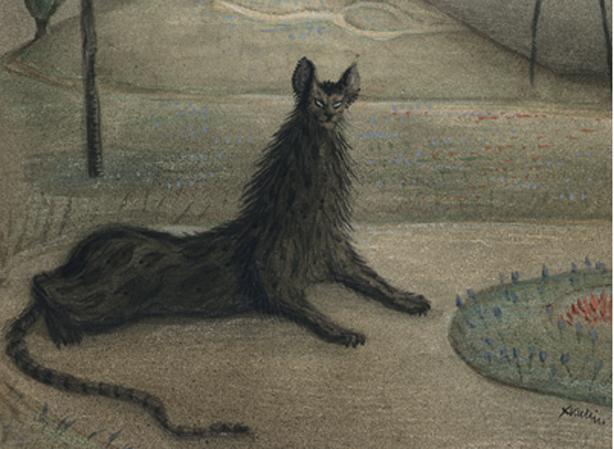
The other exhibition was of Francis Upritchard who is a New Zealand artist. At first I couldn’t quite see what her sculptures were aiming at. The more I looked at them though the more it became apparent, helped by the exhibition notes! Again, they are very impressive and quite haunting. I was most impressed by the “Hippies and Holy Fools” section. There seems to be a weariness and almost hopeless feel to them as though it is the last clinging to  a lost ideal. This is what the notes say about it:
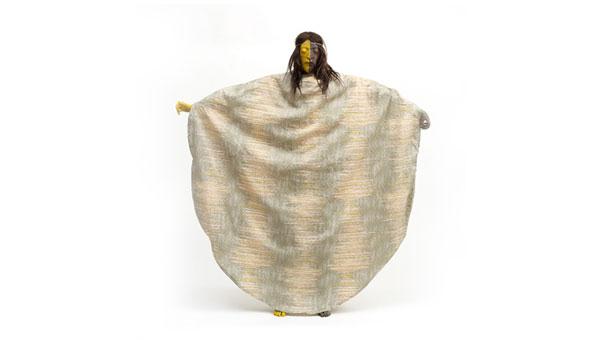
“Francis Upritchard’s psychedelically coloured human figures “live” on islands of ornate furniture. There is a festival feeling to their gatherings, emphasised by Upritchard’s acid-bright colours, hand-woven blankets and tie-dyed silks. Upritchard has said “all the things that hippies hoped would happen, or felt might happen, didn’t.” In one sense her exhibition is about the failure of the 1960s and 70s counter-culture that is still celebrated at festivals – and its gaudy, individualistic “alternative” aftermath.”

What really struck me about this exhibition is how close it was to what I’ve been thinking about my own past as I write about it in “My Life In Music” and also what a coincidence it was that I had discovered the exhibition by chance. I’d only just finished writing about how the year of the Woodstock festival had seemed like the end of an era to me. I haven’t referred to any other sources other than my own memories and here I was confronted by my own feelings. Even more astonishing was a talk by James Riley that I saw in the study area of the gallery. In this he speaks about ” the symbolic status of 1969 as a terminal point at which the decade’s earlier optimism gives way to death, violence and ‘bad craziness’.” Almost exactly what I’d been thinking and writing. I came away feeling quite strange and determined to follow up some of the leads he discusses and to continue my own work. It’s taking on an importance I never really intended!