

According to the poet Philip Larkin
“Sexual intercourse began
In nineteen sixty-three
(which was rather late for me) –
Between the end of the Chatterley ban
And the Beatles’ first LP.” (Philip Larkin)
It may have been a bit late for Larkin but it was rather early for me. In 1963 I was 12 years old which meant I was very aware of what was going on out in the World but I was still basically a child. I had a lot of freedom (and a bike) and I was just finishing my first year at secondary school. The obscenity trial of Lady Chatterley’s Lover was all over the news and, as has been often said, was a nail in the coffin of the old established order, who appeared so out of touch with the modern age. The Beatles were obviously a totally new phenomenon that epitomised modern times and I, like most of my contemporaries, were totally won over by both their sound and their energy.
At the age of twelve I was not a rebellious child, in fact I was quite the opposite. I enjoyed going to school and I volunteered for virtually all the activities offered. I joined the school band, I was a member of the Rugby and Cricket teams, on sports days I volunteered for nearly all the events (it took me about a week to recover) and I swam several events in the swimming galas. On top of that I acted in the school play (oh, and recited a poem by heart at an external competition. The teacher said I sounded like I was reading a laundry list! It was Robert Browning’s The Pied Piper of Hamelin, which is a lot to remember!). I was also a keen member of the scouts and loved hiking and camping. Like Syd Barrett of Pink Floyd, I also eventually became a patrol leader.
So what could possibly go wrong?
Well, not a lot actually. I carried on doing all of those things but there is something that changed, and that was that I became a TEENAGER. It seems strange now that such a small thing could create such a change in attitude and outlook, but this was the 1960s and Teenagers were all the rage. A whole industry had arisen to cater for their needs and, of course, as usual, the media had created a monster. For me 1964 was the beginning of a New Age and I discovered it’s dark side. The Rolling Stones and The Who became my favourite groups and 1965 became the year I experimented with Crime and Delinquency. 1965 was also the year that Like a Rolling Stone was released by Bob Dylan, a song that still resounds like liquid mercury in my brain!
Like many before I was drawn to what the bad kids were doing and thought there was a world of immense joy and pleasure out there. The first real youth subculture in Britain were the Teddy Boys and they provoked fear, or at least tried to, in all they came across. There were a terrifying group that met up on a street corner near where I lived. I walked an extra mile just to avoid them on my way back from the scouts. But 1964 saw a media storm involving a new subculture: The Mods. The first that most people knew about the Mods was when the press and TV sensationally reported battles between them and the Rockers (another new subculture based around motorcycles) at British seaside resorts mainly in the south. Well, of course, this was enough to create the self-fulfilling prophecy of violent gangs stalking the streets of England. It has been described in a study by Stanley Cohen in 1972 called Folk Devils and Moral Panics.
Before 1965 I had never considered the possibility of entering a life of crime and violence but it seemed to occur by it’s own volition. My best friend at school was very impressed with the Mods and, indeed, he was quite knowledgeable about them. His mother’s hair-dressing shop had an apprentice who was a fully fledged Mod who had a scooter and was old enough to travel to some of the clubs that were opening up. He was a source of information for both of us. Mod was about fashion and had a real self-confidence about it. When pop group The Who released My Generation it’s sheer arrogance was quite shocking. By contrast The Rockers were fairly conservative, trying to look like Marlon Brando in The Wild One and listening to 1950s Rock and Roll. At the time I was open to anything that looked good. For example, the Rockers decorated their belts and leather jackets with studs in quite intricate designs, and this appealed to me, but the Mods choice of music was far more interesting and innovative. The Rockers dress sense was very macho and they could look pretty good, especially when the trend for skintight, ice blue jeans came into style. They also had a reputation for being far more violent than the Mods, arming themselves with bicycle chains and studied belts. Many of the ‘battles’ between the Mods and Rockers through the streets of Leicester involved Mods haranguing Rockers and then running off with the Rockers giving chase. As far as I can remember, there was a lot of running and squaring up to each other, and not a lot of fighting. There was a sickening atmosphere of violence over the whole affair though. It accompanied the growth of fighting and hooliganism at football matches, which had it’s roots during this period, although there is evidence that this probably started much earlier. I can remember being a part of ‘battles’ in town where we sang the Dave Clark Five song Catch Us if you Can (1965) as we ran:
“Here they come again, mmmm-mm-mm
Catch us if you can, mmmm-mm-mm
Time to get a move on, mmmm-mm-mm
We will yell with all of our might! [drums kick in]
Catch us if you can …” (Dave Clark Five 1965)
My third year at school lasted from September 1964 to August 1965. During this time I befriended perhaps one of the most unusual people I have ever met. He wasn’t in the same class as me but we became inseparable for nearly a year. That was until we got arrested for stealing two footballs (in case you are wondering, they were deflated!) from Lewis’s Department Store in Leicester. We ended up before the Juvenile Court and I was given a £3 fine and he was sent away to what the Americans call Juvie (Approved School in England, although there were other types of juvenile detention). He actually had quite a few previous offences so the court considered I had been led astray and that is why his punishment was more severe. To the chagrin of my parents I had become a fully fledged Juvenile Delinquent, a phrase that was banded about quite a lot in those days.
However, my friend wasn’t really a delinquent at all. He didn’t really tick any of the boxes, except that he was a truly obsessive kleptomaniac. He took massive risks and actually got away with it most of the time. He was addicted to the adrenaline rush and I really picked up on that and became an adrenaline junkie myself. He wasn’t really a criminal even. He wasn’t trying to profit from it, he really was just living for kicks, a phrase that was used a lot in those days. Apart from that, he was a nice, kind person from a quite respectable background. After 1965, to my regret, I never saw him again until I was doing a gig at The Crows Nest, Leicester in the late 1970s. Unfortunately, by then, apart from our shared school experience, we no longer had much in common.
During my fourth year at school from 1965 to 1966 I decided to give up my criminal ways and pursue more artistic and cultural interests. I started going to the Phoenix Theatre that had recently opened, and I also attended all sorts of concerts at the De Montfort Hall some of which I paid for and others I just hung about outside, this included Bob Dylan’s famous electric gig and also the American Folk Blues tours where I actually got to meet Son House and Willie Dixon.

It was during this time that I first got involved with the local Leicester live music scene. With my new best friend I started going to the Green Bowler Cafe on Churchgate. This was quite a small place that became a major meeting place for the Mods. There were always rows of scooters outside and there were often encounters from the Rockers who were based at the Roman Cafe. This worked both ways and in the end there was a ‘summit’ between the owners of the respective cafes to create a ‘Pax Romana/Bowler’ which actually worked.
You could own and ride a scooter or small motorbike at the age of 15 and I would have joined the ranks of scooter owners if it wasn’t for the fact that I had another run-in with the law for riding a moped without a licence, insurance or tax. To make matters worse I foolishly gave a wrong address and when the police finally caught up with me I was given another fine and banned from driving for two years. Even with my decision to ‘go straight’ I now had two criminal offences to my name and I hadn’t even reached the age of 16. My future was not looking good!
The Green Bowler had a few tables at the front and side and at the back was the bar selling ‘frothy coffee’, two American pinball machines and a superb jukebox containing all the latest hits. For me, the pinball machines were the big draw. After a certain amount of points you’d get a replay, and you could get even more replays as the game continued. The essence of the game was to stay on as long as possible and there were many people keen to displace you. It is a real game of skill and quick reactions and I became a bit of a ‘Pinball Wizard’ (not like the Who’s ‘Tommy’ though. I couldn’t do it with my eyes closed!)
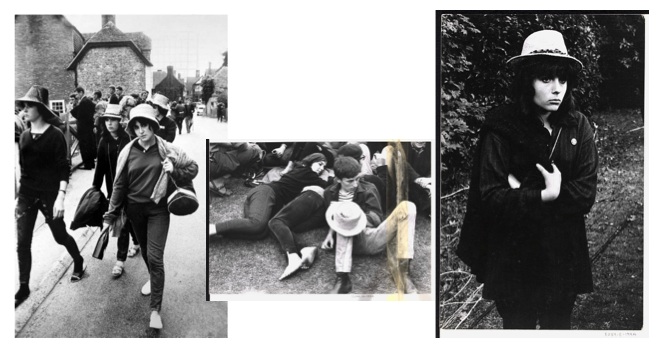
There were girls at the Green Bowler and it was a great social scene. I met my first proper girlfriend there. The girls had their own style that was quite androgynous. When Andy Warhol encountered British Mod Fashion in New York at the time of the British Invasion he was impressed by how the boys looked like girls and the girls looked like boys. The rest of America weren’t quite as sure though, especially in the Deep South! Warhol Superstar Edie Sedgwick became the first American Mod Girl and the style went International!

Mod American style with Warhol Superstar Edie Sedgwick
As time went on the owners opened up a club upstairs called The Antiquity Club. This was tiny but there was a small stage where local groups played and there were alcoves, and a jukebox that was even louder than the one downstairs. Without a doubt, you have never really heard classic 60s hits like the Stones, Who or the Beatles until you hear them on a loud classic jukebox (45 rpm singles, not digital rubbish!).
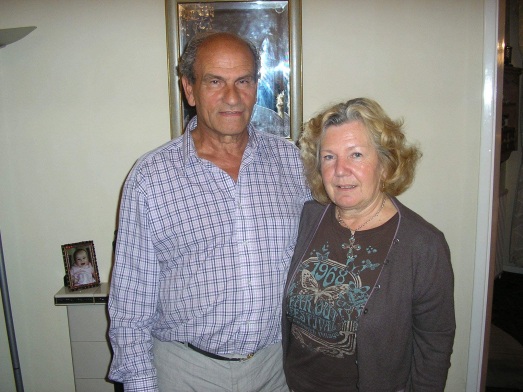
Fairly recent picture of the original owners of the Green Bowler. Lovely people!
A friend of mine has said that there was the intention of opening another club in the basement of the Green Bowler but I never experienced this. There is a large interesting building next door that became the Freewheeler Club in the 1970s. This was quite a happening place for a few years.
By 1967 the Mod scene was splitting. Many of the Faces (trend setting figures) were moving towards the Hippie Counterculture, which was far more fashion-conscious than the American equivalent, whilst others stuck to the somewhat grim, violent, right-wing morality of what eventually became the Skinheads. The Green Bowler lasted for a few more years and became meeting spot for people and musicians but the real scene for me moved to other places like the Chameleon, the Art Centre Cafe, The Fuddyduddy (Kenco Coffee House on Granby Street) and the Art College Chaplaincy Centre (on Newarke Street).



 Kenny Wilson's Blog