Okay, this isn’t true anymore because the bar has changed hands. I really miss it. It was one of the best residencies I have ever done, along with The Pump and Tap in the early 90s!

Okay, this isn’t true anymore because the bar has changed hands. I really miss it. It was one of the best residencies I have ever done, along with The Pump and Tap in the early 90s!

According to the poet Philip Larkin
“Sexual intercourse began
In nineteen sixty-three
(which was rather late for me) –
Between the end of the Chatterley ban
And the Beatles’ first LP.” (Philip Larkin)
It may have been a bit late for Larkin but it was rather early for me. In 1963 I was 12 years old which meant I was very aware of what was going on out in the World but I was still basically a child. I had a lot of freedom (and a bike) and I was just finishing my first year at secondary school. The obscenity trial of Lady Chatterley’s Lover was all over the news and, as has been often said, was a nail in the coffin of the old established order, who appeared so out of touch with the modern age. The Beatles were obviously a totally new phenomenon that epitomised modern times and I, like most of my contemporaries, were totally won over by both their sound and their energy.
At the age of twelve I was not a rebellious child, in fact I was quite the opposite. I enjoyed going to school and I volunteered for virtually all the activities offered. I joined the school band, I was a member of the Rugby and Cricket teams, on sports days I volunteered for nearly all the events (it took me about a week to recover) and I swam several events in the swimming galas. On top of that I acted in the school play (oh, and recited a poem by heart at an external competition. The teacher said I sounded like I was reading a laundry list! It was Robert Browning’s The Pied Piper of Hamelin, which is a lot to remember!). I was also a keen member of the scouts and loved hiking and camping. Like Syd Barrett of Pink Floyd, I also eventually became a patrol leader.
So what could possibly go wrong?
Well, not a lot actually. I carried on doing all of those things but there is something that changed, and that was that I became a TEENAGER. It seems strange now that such a small thing could create such a change in attitude and outlook, but this was the 1960s and Teenagers were all the rage. A whole industry had arisen to cater for their needs and, of course, as usual, the media had created a monster. For me 1964 was the beginning of a New Age and I discovered it’s dark side. The Rolling Stones and The Who became my favourite groups and 1965 became the year I experimented with Crime and Delinquency. 1965 was also the year that Like a Rolling Stone was released by Bob Dylan, a song that still resounds like liquid mercury in my brain!
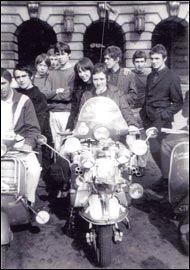
Like many before I was drawn to what the bad kids were doing and thought there was a world of immense joy and pleasure out there. The first real youth subculture in Britain were the Teddy Boys and they provoked fear, or at least tried to, in all they came across. There were a terrifying group that met up on a street corner near where I lived. I walked an extra mile just to avoid them on my way back from the scouts. But 1964 saw a media storm involving a new subculture: The Mods. The first that most people knew about the Mods was when the press and TV sensationally reported battles between them and the Rockers (another new subculture based around motorcycles) at British seaside resorts mainly in the south. Well, of course, this was enough to create the self-fulfilling prophecy of violent gangs stalking the streets of England. It has been described in a study by Stanley Cohen in 1972 called Folk Devils and Moral Panics.
Before 1965 I had never considered the possibility of entering a life of crime and violence but it seemed to occur by it’s own volition. My best friend at school was very impressed with the Mods and, indeed, he was quite knowledgeable about them. His mother’s hair-dressing shop had an apprentice who was a fully fledged Mod who had a scooter and was old enough to travel to some of the clubs that were opening up. He was a source of information for both of us. Mod was about fashion and had a real self-confidence about it. When pop group The Who released My Generation it’s sheer arrogance was quite shocking. By contrast The Rockers were fairly conservative, trying to look like Marlon Brando in The Wild One and listening to 1950s Rock and Roll. At the time I was open to anything that looked good. For example, the Rockers decorated their belts and leather jackets with studs in quite intricate designs, and this appealed to me, but the Mods choice of music was far more interesting and innovative. The Rockers dress sense was very macho and they could look pretty good, especially when the trend for skintight, ice blue jeans came into style. They also had a reputation for being far more violent than the Mods, arming themselves with bicycle chains and studied belts. Many of the ‘battles’ between the Mods and Rockers through the streets of Leicester involved Mods haranguing Rockers and then running off with the Rockers giving chase. As far as I can remember, there was a lot of running and squaring up to each other, and not a lot of fighting. There was a sickening atmosphere of violence over the whole affair though. It accompanied the growth of fighting and hooliganism at football matches, which had it’s roots during this period, although there is evidence that this probably started much earlier. I can remember being a part of ‘battles’ in town where we sang the Dave Clark Five song Catch Us if you Can (1965) as we ran:
“Here they come again, mmmm-mm-mm
Catch us if you can, mmmm-mm-mm
Time to get a move on, mmmm-mm-mm
We will yell with all of our might! [drums kick in]
Catch us if you can …” (Dave Clark Five 1965)
My third year at school lasted from September 1964 to August 1965. During this time I befriended perhaps one of the most unusual people I have ever met. He wasn’t in the same class as me but we became inseparable for nearly a year. That was until we got arrested for stealing two footballs (in case you are wondering, they were deflated!) from Lewis’s Department Store in Leicester. We ended up before the Juvenile Court and I was given a £3 fine and he was sent away to what the Americans call Juvie (Approved School in England, although there were other types of juvenile detention). He actually had quite a few previous offences so the court considered I had been led astray and that is why his punishment was more severe. To the chagrin of my parents I had become a fully fledged Juvenile Delinquent, a phrase that was banded about quite a lot in those days.
However, my friend wasn’t really a delinquent at all. He didn’t really tick any of the boxes, except that he was a truly obsessive kleptomaniac. He took massive risks and actually got away with it most of the time. He was addicted to the adrenaline rush and I really picked up on that and became an adrenaline junkie myself. He wasn’t really a criminal even. He wasn’t trying to profit from it, he really was just living for kicks, a phrase that was used a lot in those days. Apart from that, he was a nice, kind person from a quite respectable background. After 1965, to my regret, I never saw him again until I was doing a gig at The Crows Nest, Leicester in the late 1970s. Unfortunately, by then, apart from our shared school experience, we no longer had much in common.
During my fourth year at school from 1965 to 1966 I decided to give up my criminal ways and pursue more artistic and cultural interests. I started going to the Phoenix Theatre that had recently opened, and I also attended all sorts of concerts at the De Montfort Hall some of which I paid for and others I just hung about outside, this included Bob Dylan’s famous electric gig and also the American Folk Blues tours where I actually got to meet Son House and Willie Dixon.

It was during this time that I first got involved with the local Leicester live music scene. With my new best friend I started going to the Green Bowler Cafe on Churchgate. This was quite a small place that became a major meeting place for the Mods. There were always rows of scooters outside and there were often encounters from the Rockers who were based at the Roman Cafe. This worked both ways and in the end there was a ‘summit’ between the owners of the respective cafes to create a ‘Pax Romana/Bowler’ which actually worked.
You could own and ride a scooter or small motorbike at the age of 15 and I would have joined the ranks of scooter owners if it wasn’t for the fact that I had another run-in with the law for riding a moped without a licence, insurance or tax. To make matters worse I foolishly gave a wrong address and when the police finally caught up with me I was given another fine and banned from driving for two years. Even with my decision to ‘go straight’ I now had two criminal offences to my name and I hadn’t even reached the age of 16. My future was not looking good!
The Green Bowler had a few tables at the front and side and at the back was the bar selling ‘frothy coffee’, two American pinball machines and a superb jukebox containing all the latest hits. For me, the pinball machines were the big draw. After a certain amount of points you’d get a replay, and you could get even more replays as the game continued. The essence of the game was to stay on as long as possible and there were many people keen to displace you. It is a real game of skill and quick reactions and I became a bit of a ‘Pinball Wizard’ (not like the Who’s ‘Tommy’ though. I couldn’t do it with my eyes closed!)
There were girls at the Green Bowler and it was a great social scene. I met my first proper girlfriend there. The girls had their own style that was quite androgynous. When Andy Warhol encountered British Mod Fashion in New York at the time of the British Invasion he was impressed by how the boys looked like girls and the girls looked like boys. The rest of America weren’t quite as sure though, especially in the Deep South! Warhol Superstar Edie Sedgwick became the first American Mod Girl and the style went International!

As time went on the owners opened up a club upstairs called The Antiquity Club. This was tiny but there was a small stage where local groups played and there were alcoves, and a jukebox that was even louder than the one downstairs. Without a doubt, you have never really heard classic 60s hits like the Stones, Who or the Beatles until you hear them on a loud classic jukebox (45 rpm singles, not digital rubbish!).

A friend of mine has said that there was the intention of opening another club in the basement of the Green Bowler but I never experienced this. There is a large interesting building next door that became the Freewheeler Club in the 1970s. This was quite a happening place for a few years.
By 1967 the Mod scene was splitting. Many of the Faces (trend setting figures) were moving towards the Hippie Counterculture, which was far more fashion-conscious than the American equivalent, whilst others stuck to the somewhat grim, violent, right-wing morality of what eventually became the Skinheads. The Green Bowler lasted for a few more years and became meeting spot for people and musicians but the real scene for me moved to other places like the Chameleon, the Art Centre Cafe, The Fuddyduddy (Kenco Coffee House on Granby Street) and the Art College Chaplaincy Centre (on Newarke Street).
Friday 3rd and Saturday 4th of March 2017 I attended a conference at DMU, Leicester about film maker Peter Whitehead, and celebrating the donation of his archive to the University.
I found out about it late but am really glad I went. There were some excellent talks that brought new light to the meaning and relevance of the 1960s Counterculture, and other aspects of the Swinging 60s, and also a sublime showing of Whitehead’s Tonite Let’s All Make Love in London on the big screen at Phoenix Square Cinema, Leicester. It was almost like watching a different film to the one I have only previously seen on YouTube.
This is a fascinating view of what was happening at the height of what is now seen as the first great flowering of the Counterculture. It is not uncritical though and the seeds of it’s decline can be seen in the interviews of contemporary stars like Julie Christie, Michael Caine and David Hockney. There is almost a sense of impending loss, and also a critique of it’s superficiality and materialism.
The film is really a response to Time Magazine’s famous article about Swinging London that shifted American’s ‘must visit’ tourist location from Paris to London. After a brilliant start with footage from the UFO Club accompanied by a great version of Interstellar Overdrive by Pink Floyd, Michael Caine bizarrely announces that “…it all started with the loss of the British Empire….”
There is no narrative as such but a series of Chapters that are linked by the time and place, and a general sense of bewilderment by the participants. Following some amazing footage of the Rolling Stones live in Ireland Mick Jagger comes across as a slightly lost , petulant school boy trying to make sense of it all “… they don’t like violence but they themselves are violent which doesn’t seem to make sense…”. Yes okay Mick, thanks for that, you sound just like my mother. Julie Christie, who looks absolutely stunning, bemoans the fact that she is totally superficial and has nothing to say “… everything’s happening to me and I’m not happening to anything…am I allowed to talk?…”. David Hockney is not impressed by ‘Swinging London’ at all and prefers New York and California. The bars stay open til 2 a.m. and the drinks are cheaper and he can meet ordinary people in the clubs, unlike London which is overpriced and exclusive. To be fair though, David Hockney has been moaning about something for most of his life, quite often about not being allowed to smoke cigarettes wherever he wants! He is very amusing though. When Julie Christie smokes a cigarette in the film she doesn’t look like she quite knows what to do with it. Vanessa Redgrave, on the other hand, exudes confidence and political commitment and sings a capella and lectures the audience, a bit like an over-confident trainee teacher.
Andrew Loog Oldham is the stereotype of a cynical, Svengali-like pop manager who talks about how he ‘invented’ the Rolling Stones image as the ‘bad boys’ of pop, which, in fact, they quite obviously are not. He revels in his lack of knowledge but obviously believes he can do anything he wants “… I might get into politics someday..or films” he says. In some ways, this is quite a refreshing and confident attitude. Nevertheless, he never did get into either politics or films which is probably just as well as I am sure he would have joined the ranks of the Thatcherites and done something really terrible like close down the NHS or sell the whole of England to Disneyworld. The film ends where it began with some amazing footage of dancers at the UFO Club and the music of Pink Floyd. A truly remarkable film! There is a real sense of dynamism and change. The way the music accompanies the live performances of the Stones is inspired especially with the song Lady Jane. Whitehead doesn’t bother about synchronicity and blends unrelated recordings with live footage. Have You Seen Your Mother Baby (Standing in the Shadows), a surprisingly dark and seemingly uncommercial recording (even though it was a top ten hit), it’s not unlike the Velvet Underground, plays while the band and audience go wild and Lady Jane introduces a strange and eerie sense of calm.
The rest of the conference passed quickly. It took place over two days but the papers delivered were so fascinating that I never lost interest the whole time I was there. This has got to be a first for me, my attention can easily wander! I usually have alternative activities at hand in case I get bored! Didn’t need them this time! There were a wide range of themes that dealt with the 60s with some, but not all, relating to the work of Peter Whitehead
Adrian Smith discussed the interesting sub genre The Love Business: European Prostitution Drama as British Popular Entertainment. This dealt with the film distributors who were showing European films, many of which had a serious sub-text, as soft porn films to a British audience. There are some echoes of this theme in a recent Channel 4 series Magnifica 70 that deals with film and censorship in Brazil in 1970. Worryingly, this is about a right wing dictatorship in Brazil but could just as easily be about censorship and social control in Britain in the 1960s. Definitely worth a look.

Richard Farmar looked at the bizarre film The Touchables and Melanie Williams gave an interesting account of the film maker David Hart. She talked about the “Right-wing Counterculture” which to some would be a contradiction in terms. The majority of countercultural participants were either “left wing” or perhaps “apolitical” but she made a very good argument about how many issues, like women’s lib or gay rights, could belong to either the left or right. She pointed out how politician and journalist Jonathon Aitken started as a countercultural figure in the 1960s but ended up as a cabinet minister in the Conservative Government of the 1980s (before he ended up in jail, that is!). I have investigated elements of right wing attitudes in my essay The Decline of the 1960s Counterculture and the Rise of Thatcherism in which I look at libertarianism and other aspects of the counterculture in the 1980s such as sexual freedom, drug taking and “alternative” businesses such as Virgin and Gap.

Caroline Langhorst gave an interesting talk on three lesser known films of the 1960s all of which are critical of the optimism and the joie de vivre of the period. These are Tonite Let’s All Make Love in London, Privilege (starring Manfred Mann singer Paul Jones) and Herostratus (featuring a young Helen Mirren).

Both Privilege and, especially, Herostratus are relatively unknown films. Privilege had a cinema release in the 1960s (I actually saw it) but I believe Herostratus was virtually lost, although there is a copy now on Blu-ray (which I have yet to see). There are some clips of it on YouTube which are quite intriguing. Personally, I feel that the films that really define and critique the era, especially in terms of pop music and the counterculture, are Easy Rider, Performance (featuring Mick Jagger) and, of course, Tonite Let’s All Make Love in London. What becomes generally apparent is the mainstream media’s inability to really understand what is going on during this period. Their attempt to commercialise the movement in films of the time often produced a cliched view of pop culture and society that, for some, defines what the 1960s are about but is actually a ridiculous fiction.

There were some interesting talks about feminism in the 1960s. Alissa Clark investigated Peter Whitehead and Niki de Saint-Phalle’s collaberation Daddy. In 1972, Saint Phalle shot footage for this surreal horror film about a deeply troubled father-daughter, love-hate relationship. She was an artist, sculptor and film maker who made quite an impact on the avant garde scene from the 1940s onwards.

There was also a passionate and forceful account of radical filmmaker and theatremaker Jane Arden who I had actually not heard of before. In 1970, Arden formed the radical feminist theatre group Holocaust and then wrote the play A New Communion for Freaks, Prophets and Witches. The play would later be adapted for the screen as The Other Side of the Underneath (1972). Arden directed the film and appeared in it uncredited; screenings at film festivals, including the 1972 London Film Festival, caused a considerable stir. The film depicts a woman’s mental breakdown and rebirth in scenes at times violent and highly shocking; the writer and critic George Melly described it as “a most illuminating season in Hell”, while the BBC Radio journalist David Will declared the film to be “a major breakthrough for the British cinema”. Interesting stuff!
Stephen Glynn gave an entertaining look at Whitehead’s films of the Rolling Stones including the iconic promotional film for the song We Love You and Steve Chibnall showed us what the 1960s Counterculture was like in a provincial city, namely Leicester! Well, I should know because I was there, but he managed to come out with facts that I knew nothing about. For example, how the local paper The Leicester Mercury led a campaign to close down the late night clubs and coffee bars that proliferated at the time. Do You Know What Your Children Are Up To While You Sleep? screamed the headlines. My favourite band Legay complained that they had hardly anywhere left to play and were moving to London! I am shocked and stunned by these revelations!

Richard Dacre gave an entertaining account of the Counterculture and Peter Whitehead at the Royal Albert Hall. Apparently, after Wholly Communion, poetry performances were banned at the hall for more than 20 years! Hilarious. I am looking forward to the Whitehead inspired festival at the RAH later on this year!

Here is a different version of Frederick Tipping in 4/4 time, with different words. Sung by Steve Cartwright and produced by Kenny Wilson.

Next Sunday (27th September 2015) I am organising a night commemorating the 50th anniversary of the song “Like a Rolling Stone” and the album it is from “Highway 61 Revisited”, at the Musician Pub in Leicester. I’ve got a few days to go and I’m beginning to get a bit nervous now. Some of Leicester’s best are coming to perform their favourite tracks from the album and other songs from the other great mid 60s records, when Dylan decided to “plug in” (“Bringing It All Back Home” and “Blonde on Blonde”). 50 years is a long time but the songs and music have not lost their power. In fact, to my ears, they seem even more startling and profoundly modern. Not only have they stood the test of time but they are in the pantheon of great 20th Century Art along with T.S. Eliot’s “The Waste Land”, Jackson Pollock’s evocative splatterings and Charlie Parker’s mindbending improvisations. It had never been done before and it will never be done again. It stands alone!
Of the three great “electric” records “Highway 61 Revisited” is the pinnacle. It is the first Dylan album that he was part of a real band rather than a soloist with backing musicians. “Bringing It All Back Home” paved the way with some really exciting performances, especially “Subterranean Homesick Blues” and “Bob Dylan’s 115th Dream” but half of it was acoustic although the songs were like nothing heard before. Dylan had rejected political protest and replaced it with a kind of explosive, image laden, nihilistic stream of consciousness. Popular music had never experienced anything like it. “It’s Alright Ma (I’m Only Bleeding)” takes an Everly Brothers lick and creates a blast of vitriolic energy which is mindblowing: ” Old lady judges watch people in pairs, limited in sex they dare, to push fake morals insult and stare, while money doesn’t talk, it swears, obscenity who really cares, propaganda all is phony”. But, in this record he is still making sense. “Highway 61″ moves the song writing into a different realm. This is a world in which the songs seem to mean something but you can’t quite place what it is. ” Ballad of a Thin Man” epitomises this: “Something is happening but you don’t know what it is, do you Mr. Jones?”. A series of bizarre incidents follow involving sword swallowers, professors and geeks and how your imagination is being attacked! This is the ultimate statement of the Hip/Straight divide that was emerging in the growing counterculture of the 1960s. Most of the songs on “Highway 61” defy logic. They are absurdist and mysterious and yet seem to pertain to a deeper meaning that washes over us and draws us in. “They’re selling post cards of the hanging, they’re painting the passports brown, the beauty parlour is full of sailors, the circus is in town” and all through the song we learn that “Desolation Row” is either the place to be or the place you are prevented from going. “Right now I can’t read too good, don’t send me no more letters no, not unless you mail them from Desolation Row”.
Perhaps the ultimate Dylan song is “Like a Rolling Stone”. Bruce Springsteen described the beginning of this, the opening song on “Highway 61 Revisited”, as the “snare shot that sounded like somebody’d kicked open the door to your mind.” Folk singer Phil Ochs was even more rhapsodic about the LP: “It’s impossibly good… How can a human mind do this?” When I first heard this song I moved from being a fan of Pop Music to someone who wanted to play and write songs and that desire has never left me. That’s why I’m looking forward to the gig next Sunday and am also quite nervous about it. It is commemorating something that changed my life!!
Here are some videos of Steve Cartwright and my involvement with the N.U.T. strike in Leicester. The p.a. system stopped working but we managed to get by!
