I have discovered the digital archives of several publications and they contain fascinating contemporary reports of events and happenings in the past. More importantly, I can also access them.This is one about the Mods in 1964 and the leaders known as Faces. Incredible! I’ve found lots more like this and I feel quite excited by it all. Will post more as I collect them.
Observer journalist Peter Dunn hangs out at the Scene for a Mods’ eye view of the tribal war that led to the vicious battle of Margate in 1964.
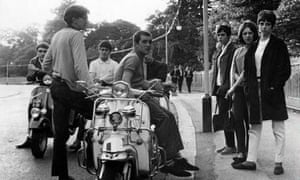
Teenage mods keeping up with the fashion.
The Mod and Rocker season will probably last in its present form until August Bank Holiday. It will feature renewed forays to the south coast and possibly to Southend. Last Monday’s fighting at Brighton and Margate, followed by skirmishes throughout the week in London, is then expected to enter its final phase. That, in any event, was the opinion of a Mod who stood outside the Scene, the rhythm and blues club off Great Windmill Street, early yesterday. It was raining and dark and he wore sunglasses.
He was a smallish boy who came from Liverpool to find work and had got a job loading crates in a London milk depot. The languid Merseyside tone underplayed the alternating exhilaration and disappointments of his life – the T-shirt he got by “chatting up a Yank”; the purple heart pills he could buy at 18s 6d for 20; the singlehanded fight he almost had in Paddington with three Rockers; and the battle of Margate. “We just charged up the beach. There were 800 of us and 100 Rockers. I didn’t see what was going on because I was at the back with my tart.”
Last week’s fighting in London isolated both factions even further from the public, which welcomed the hearty talk about “hooligans… rats… and miserable specimens” from the seaside magistrates’ bench. The heavy sentences handed down last week have led to some ominous threats of retaliation. “If anyone fined me £75,” a Mod said, “I’d go back and do some real damage; put a few windows through with a hammer.”
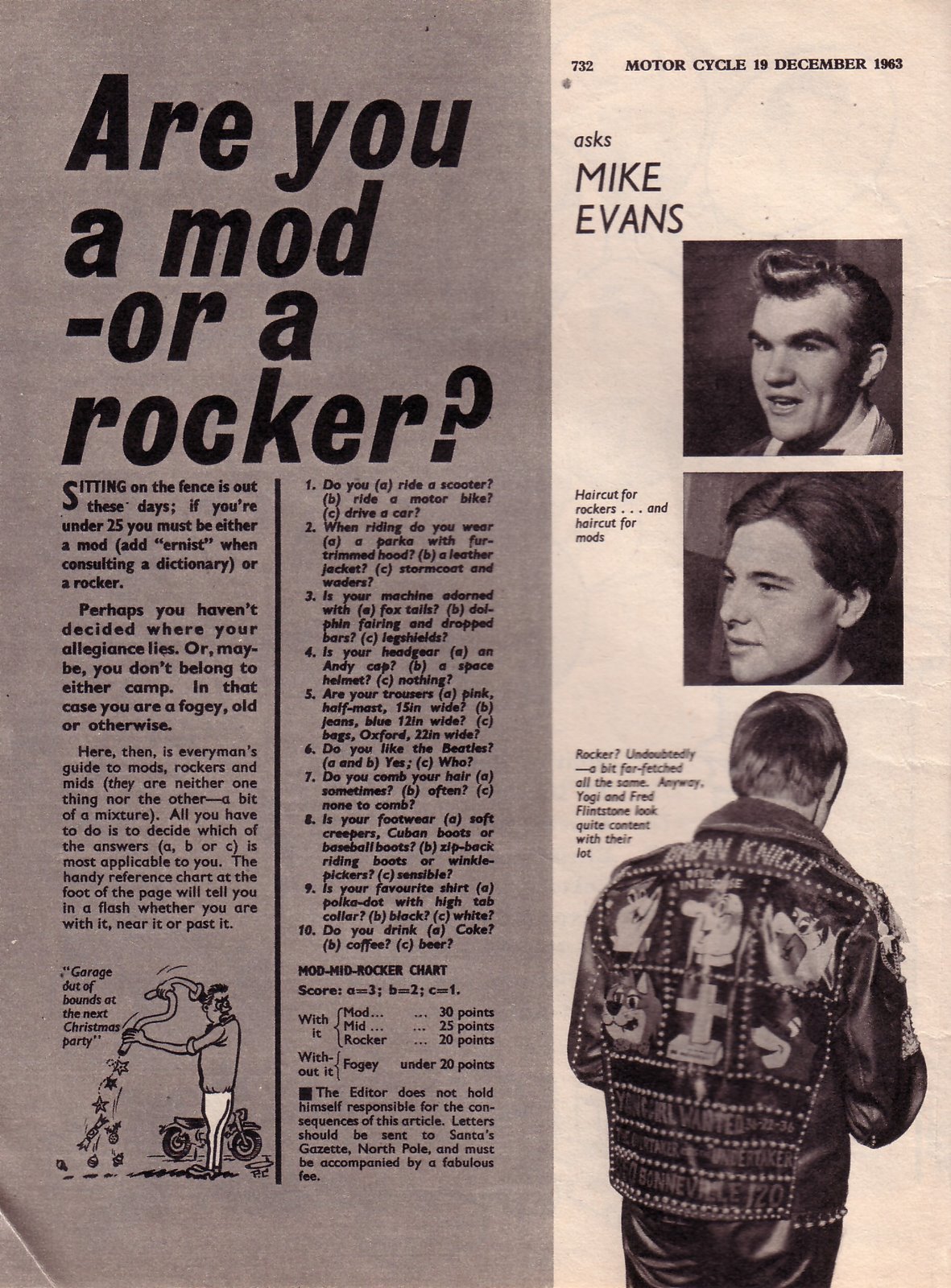
Mods and Rockers have co-existed comparatively well for a year or so – the Mods, neatly dressed and on scooters, the Rockers in studded leather jackets and on motorbikes. The Rockers may have jeered at the Mods’ fancier ways (sublimating sex, as one Mod’s father put it, to the problems of motorbike clutchplates) but they had been slowly copying the Mods’ form of dress. When, for example, the Mods’ high-heel boots went out of fashion, the Rockers started wearing them.
Mods are losing interest in their scooters but they do care about changing fashions and spend £4 or £5 a week to keep up to date. The latest trend is towards American crew-cuts, T-shirts with big letters, Y for Yale, H for Harvard.
Seventy-five per cent of the Scene’s members are reckoned to be middle class and can usually afford to follow the trends; the rest tend to say that fashion is no longer so important.
Four of the Mods outside the Scene at 2am yesterday – two still carrying their Margate war wounds – said they stayed out all night because they wanted to enjoy themselves while they still had time. One said: “My old lady raised hell the first few times. I’m not going home tonight. I might go in for a wash-up tomorrow but I’ll be out again all tomorrow night.”(Observer 24th May 1964)
This is copied from an article about Mods in Leicester in the mid 1960s printed in the Leicester Mercury in2010. It is the only thing that comes up if you Google some of the Coffee Bars and Clubs in Leicester around at that time. The internet Information Revolution seems to start in the 1990s and knowledge about earlier times appears to be getting lost, or just isn’t there!! The article actually presents a pretty accurate picture of some of the things that happened then and the places that people went to. It complements my post about My Life in Music. The Irish was one of the main fashion shops but it was actually in Silver Arcade which was off Silver Street. It subsequently moved to the corner of Silver Street and High Street and is still there now, I believe, but it’s not the fashionable place it once was. The article also talks about the Antelope pub. I must have missed this totally because, although I remember the pub, I never went into it. I thought it was an “old man’s pub”. The main pubs we went to were the Fish and Quart on Churchgate and the Churchill on Silver Street which is now The Lamplighters. The Churchill became the trendy place to be from 1968 onwards.
Marlon Brando in “The Wild One”
The interesting thing about the rivalry of the Mods and the Rockers was that it was invented by the media. If you look at the headlines they scream out about the Wild Ones! Actually, this is a reference to the Marlon Brando film “The Wild One” which was banned in Britain and not many people had seen it. Brando was the role model for the Rockers though, with his leather gear, macho swagger and surly attitude, to say nothing of the slurred drawl. “Hey, Johnny whadaya rebelling against?”“Whadaya got?” Elvis Presley copied him too in his earliest and greatest incarnation, circa 1956. Originally, however, there was no conflict. In fact, Mods became Rockers and vice versa. It all changed in the reporting of events at Brighton in 1964 and the rest is history! I do remember an occasion at Avenue Road Youth Club which was a Rocker stronghold. I’d been told to give a message by a group of Mods to Dave Buswell, leader of the local Rockers and as mean a looking guy as you could wish to meet. He was terrifying! The Mods were on Victoria Park ready for a battle. At that point all hell broke loose as they rushed out for the affray. Personally, I decided to go home and have a night in, watching telly! It was one battle I had no desire to fight and I didn’t even really know if I was a Mod or Rocker supporter then! I kind of liked them both!
I did eventually side with the Mods because, actually, the music was a lot better and the coffee bars and clubs were much more exciting! And although the girls weren’t any better looking, they were far less ferocious!
Sensational coverage of what was essentially a non-event of bored teenagers with nowhere to go! This is what created the Mods and Rockers clash!!
Juke Boxes were a massively important way of listening to new music.
“Turn left at the Clock Tower, head towards High Street, pass Cheapside, veer off by the amusement arcade and you’re there – right in the heart of Leicester’s pill-popping, sharp-dressing, scooter-revving, hedonistic counterculture”, writes Mark Charlton.
Or at least you would be if this was still the swinging 60s. If London had Carnaby Street at the heart of its Mod scene, Leicester had Silver Street. With their tailor-made suits, parkas and scooters, the Mods had a huge impact on the streets of mid-60s Leicester. They’d ride into town on their Vespas and Lambrettas to hit the coffee bars and hear the latest jukebox sounds from bands such as The Who, The Kinks and The Small Faces.
Rows and rows of scooters would be parked up in city centre streets, particularly outside bars such as Cadena, in Belvoir Street, and Kenco Coffee House, in Granby Street. But Silver Street was the real magnet for the Mods. That’s where Irish Clothing store was. That’s where Il Rondo was. That’s where you went to be seen. That’s where their real-life version of Quadrophenia played out.
John Barratt, 60, who grew up in Humberstone, was one of Leicester’s original Mods.
“Silver Street was our Carnaby Street,” he remembers. “I don’t know why but it was just a big happening for us there. I guess it had a lot to do with Irish Clothing and the Il Rondo, and there was also a pub called the Antelope. I think it just drew us to the area as there were places we could meet.”
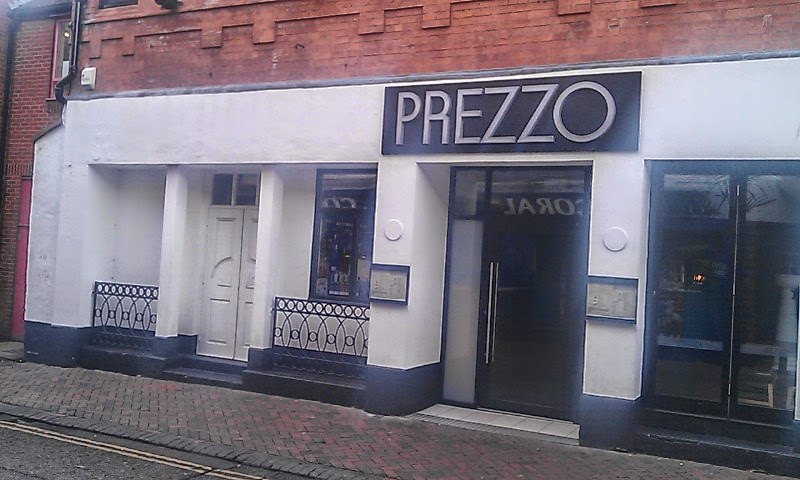
The site of the Il Rondo on Silver Street. Now a restaurant. The original entrance was where the white doors are now.
Leicester was buzzing with these hip, rebellious kids who wanted to make their mark on the world by dressing smartly and listening to the hottest new sounds. It was their way of getting noticed and making a point to their elders. John says: “In the 50s and early 60s, young people were almost penned in, everything was dictated to them. When Mod came along, it was our way of saying ‘we are human beings’. We were trying to put over our feelings that we weren’t going to put up with being told what to do.”
The Mod scene, with its slick fashion and fascination with black American soul music, had spread north from London, fed by newspapers reporting on violent clashes between Mods and Rockers in Brighton and Margate in 1964, and by broadcasts on Radio Caroline. Young people in Leicester were quick to pick up on the idea.
John says: “The first Mods were in Leicester by 1964. It was sweeping the country at that time. I was still at school and started getting into the music and the fashions. I knew I wanted to be a Mod. When I turned 16 I bought my scooter. At that time, I had a good job in engineering. I needed it. Being a Mod was expensive. You had to keep up with all the latest fashions, for a start. Then you had to run your scooter, keeping it taxed and on the road before buying all the accessories to make it look as good as possible. Then there was the music. You had to keep up with all the new music coming out, plus the wild life that went with it and on top of all that you had to try to keep a girl on your arm. I earned good money in engineering, but I didn’t save a penny.”
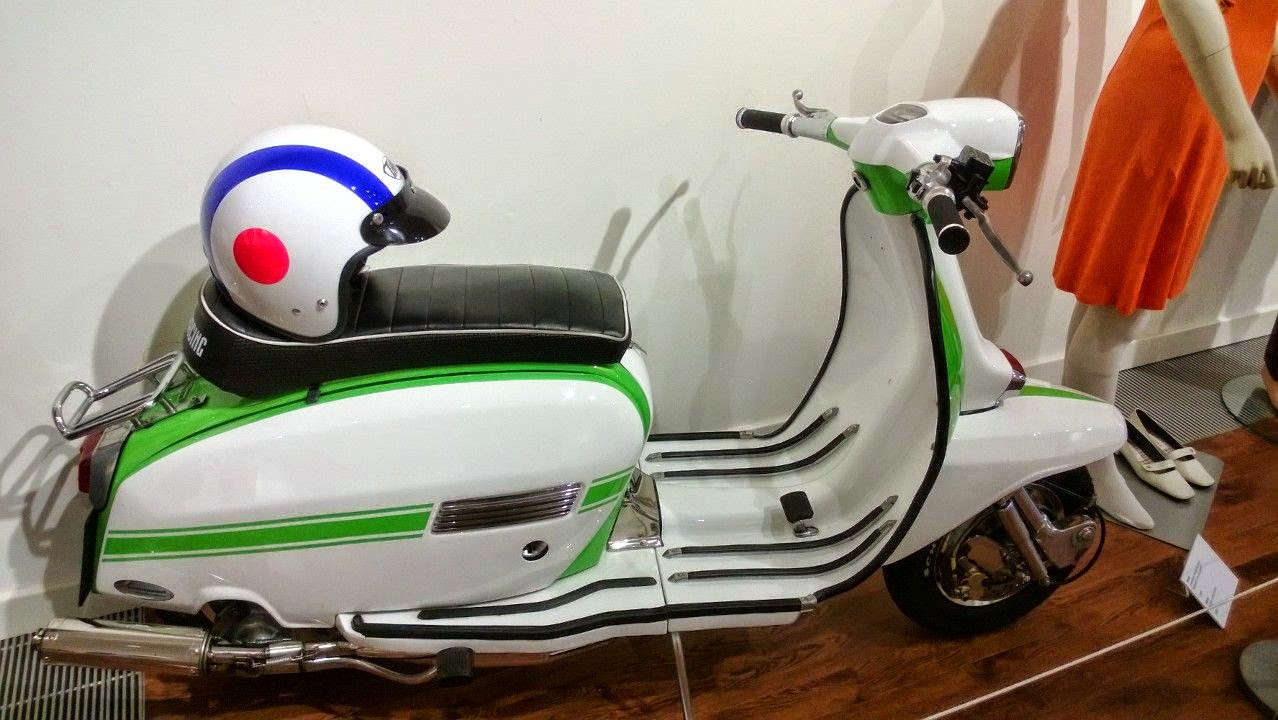
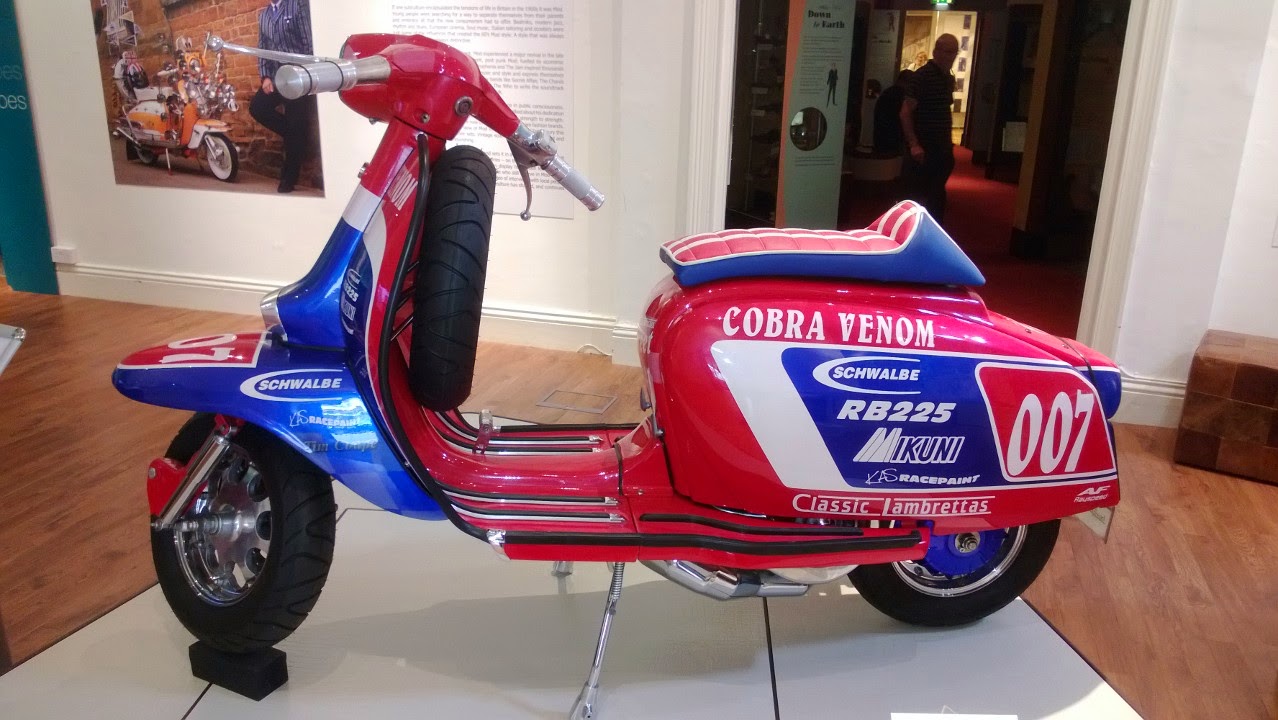
A Mod Lambretta scooter not yet customised! This is a picture I took recently at a Mod exhibition in Northampton.
Another young Mod was Chris Busby, from the West End of Leicester. He recalls choosing to be a Mod when he was still at school.
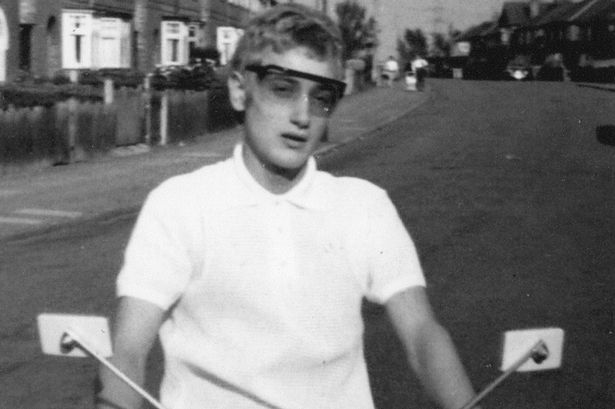
Chris Busby in the 1960s
“I was 14 in 1964 and we thought ‘should we be Mods or rockers?’. I looked at the rockers, they were greasers and horrible. I looked at the Mods, they were so clean looking and smart with their scooters. I wanted to be like that.”
Chris remembers Leicester was a great place to be at that time.
“There was so much going on,” he says. “The music was fantastic, there were some great places to go and lots of house parties.”
Chris was part of a Leicester Mod band called CERT X. Other notable Mod acts from the city’s scene were The Cissy and Legay.
John saw them perform at several gigs in the 60s. He says: “CERT X was a really good local band, really good. The highlight of the band’s career was supporting Cream at Nottingham University.
The music scene was vibrant at that time. Chris remembers: “A place called the Night Owl opened, in Newarke Street, in 1966, which put on all-nighters. I think (soul singer) Geno Washington recorded an album there. Bands like Amen Corner also appeared there. There were a lot of people taking drugs like blues and dexys, and I think that is why it got shut down quite quickly. The Green Bowler, in Churchgate, was popular too.”
Leicester in the mid 60s was already something of a cultural melting pot. Lots of young black kids were mixing with white lads at nightclubs and gigs.
Chris says: “It was a good time. We were friends with a lot of the black lads, there was never any trouble between us – we all respected one another. The only time we ever had aggro was with the rockers.”
The Mods’ cats-v-dogs relationship with the rockers is well documented. Seaside skirmishes at Brighton and Margate and made national news but there was plenty of trouble in Leicester, too.
John says: “The rockers used to hang out down at the Roman Cafe, in Humberstone Road. It was part of the life of a Mod to have problems with the rockers, or Hell’s Angels. They were so different from us. We would roll up at the Roman Cafe on our scooters just so we could have a scrap. They would come looking for us, too.”
Rockers! Mind you, these look a bit too old to be genuine Rockers.
Chris remembers one incident: “We were at the Casino Ballroom at the top of London Road. A popular boxer, Alex Barrow, was there, a black guy, with two of his friends. Two rockers walked in, and one of the lads with Alex said ‘you hit my mate’ and knocked one of them flying. Within 30 minutes, hundreds of rockers were flying down London Road on their motorbikes heading for the club.”
There was an unwritten hierarchy within the Mods. If you were particularly cool, you were a ‘face’. If you could not keep up with the pace of the scene, you were seen as a ‘ticket’.
Chris says: “The older lads, who were about two or three years older, were working and could afford better clothing. We looked up to them, they were the faces to us. There wasn’t a rank as such, but we were subconsciously aware the differences were there. We knew the older ones to nod at, there was never any problem between us.”
John says: “There was a lad called Tony Weston. He was king of the Mods to us. He was the organiser, our leader, always coming up with ideas and things todo. We all looked up to him because of the way he dressed and his scooter.” John had a Vespa 125cc GL scooter. “Registration 461 BBC,” he says.
“I’ll never forget it. It had all the gear – spotlamps, a big aerial at the back, a slimline windscreen and so many mirrors it was a wonder it moved, it was so weighed down. I had so many spotlamps that if I turned on the lights without the engine running it would flatten the battery.” But keeping your scooter up to scratch was a big part of it. It cost a bloody fortune. The main place for buying scooters at that time was a place called Readers,in Aylestone. We all went there. Scooters were appealing at the time because you could do hundreds of miles on a tank of petrol. A group of us went to Yarmouth. It took us the best part of six hours to get there. It was a steady run and we only used a tank-and-a-half of petrol there and back.”
Chris had a Lambretta li 150 with green and white stripped side panels and fur on the seats. “It cost me £30 in 1966 and wasn’t anything special compared to some of the scooters around but it was special to me,” he says. “It would be worth about £2,000 if I still had it.”
Another Lambretta. Poster of a Vespa in the background!
Chris also did his fair share of going to Mod events at coastal resorts, even taking a job in Skegness. But there was plenty going on in Leicester. Wednesday at Il Rondo, in Silver Street, was Mod night, on Sunday, Mod music was played at The Palais de Danse, in Humberstone Gate, and the Casino Ballroom, in London Road, held regular live events. Music was the lifeblood of the scene. All-night dances, or parties were often fuelled by the use of amphetamine-based drugs. Some were known as blues, or purple hearts.
John says: “People were taking them because, if you didn’t there was no way you would last the amount of time you were awake for.”
“The main thing was the music,” says Chris. “It was so new and fresh.”
John says: “There were certain songs that were important to us, for example the Sir Douglas Quintet’s She’s About a Mover and Louie Louie, by the Kingsmen.”
The fashion and hair styles still have a huge influence today. Chris has been a barber for 36 years and now has a shop, in Northampton Street. But when he needed a Mod cut back in the 60s, there was only one place to go.
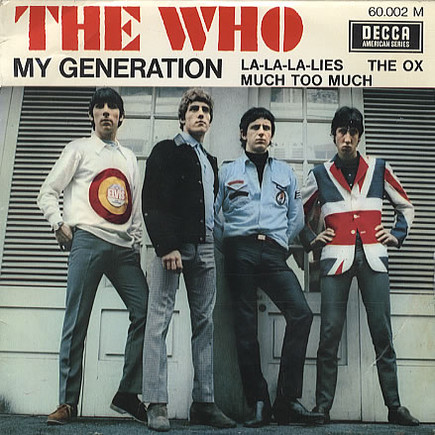
The Who in the mid 60s. My Generation, one of the best records of all time!!
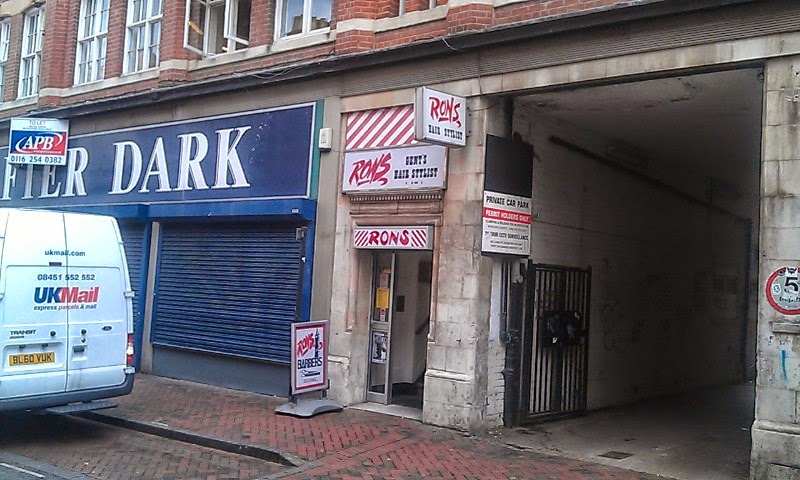
“Everybody went to Ron’s, in Church Gate. It is still there. At the time, there was a look that was something close to how Paul Weller wears his hair now. Another was how Roger Daltry (singer in The Who) wore his, with a parting, although some people just wanted a close-cut, clean look. Mods felt the way they looked set them apart from the rest. Attention to detail was vital. Clothes would be made-to-measure and tight fitting. Shirts and suits would be sent to the tailor for more buttons to be added or taken away, depending on the mood. We’d have bigger vents put in or more buttons put on our shirts, just to make them different. We were always trying to stay one step ahead,” says Chris.
Ron’s Hair Stylists on Churchgate, still going today!!
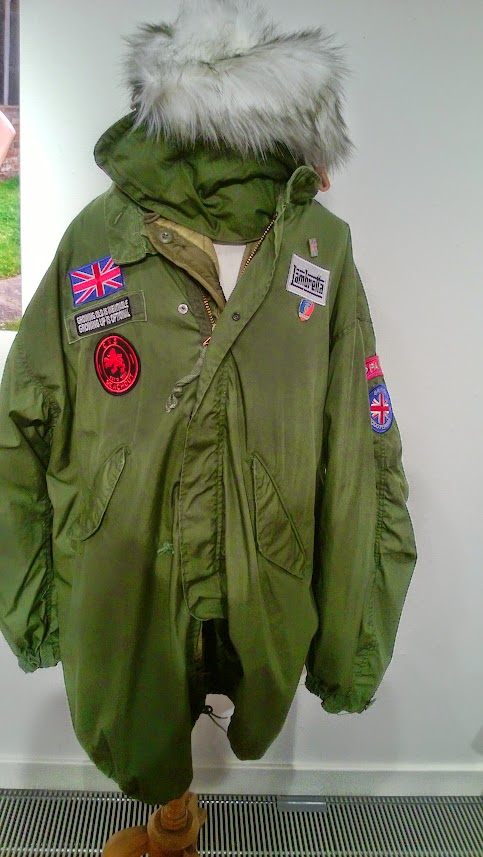
Having such smart clothes proved a problem motoring around town on a scooter. A US Army fishtail parka was ideal for keeping clean on the move.
John says: “I had a parka and a mohair suit – well, several. We were always buying clothes, trying to have something new and to stay ahead of everyone else.”
Mod parka. A photo I took at the same exhibition in Northampton.
Chris says: “I never really got into the suit thing. Lots of people did though. On a Saturday, there was Jackson’s the Tailors, in Gallowtree Gate, and Burton’s, in Church Gate, which would have queues outside all day from the moment they opened, with people collecting clothes they had ordered, or being measured up for something. Jackson’s was seen as a cut above the others because the staff would offer advice to the customers. Personally, I preferred wearing Levi Jeans, desert boots and a Ben Sherman shirt rather than a suit. I wanted to feel comfortable. Also jumpers with targets on, or shirts similar to those Roger Daltry was wearing at the time. I bought an overcoat from Irish for £22. That was four weeks wages to me. I have still got it.”
By 1967, the Mod scene was changing. Some were moving away from the slick looks and sounds and moving into psychedelic music.
“They were what we called the ‘flower children’, says John. “They were getting in to what became the hippy thing. I guess bands like The Who and Small Faces had become more psychedelic, particularly the Small Faces with their album Ogden’s Nut Gone Flake. I moved on to other things but I have never stopped feeling that I am a Mod. Even now, I’m still a Mod. I love the Mods.”
Some stuck to their cause of being a Mod and others became interested in the skinhead scene, which was emerging in the late 60s.
Chris, a married dad of three, remembers: “I was working in Skegness in 1969 and I could still see running battles between Mods and rockers. I went on to become interested in other things, but years later I was thinking about the look and how much I enjoyed wearing the clothes, so I went back to it.
“So now I wear a Ben Sherman, Levi jeans and desert boots. I love it, and the music, of course.”
In 1979, The Who brought out the movie Quadrophenia. It told the story of the Mods, their clashes with rockers, the girls, the drugs, the parties. The film was to coincide with and widen the impact of a Mod revival, which had started in London a few months earlier.
Chris said it was very true to life.
“It’s pretty close,” he says. “Particularly a scene in Brighton as Jimmy (Phil Daniels) walks along the seafront with all the other Mods. Somebody asks him what the best thing about being a Mod is. He says something like ‘being here, amongst all this’. And it was spot on. That buzz, the buzz of being part of it at that time, that is exactly how being a Mod felt.”(Mark Charlton Leicester Mercury 2010)
The press invented the clash between Mods and Rockers and then everyone believed it! It was propaganda on the scale of Goebbels!




 Kenny Wilson's Blog